
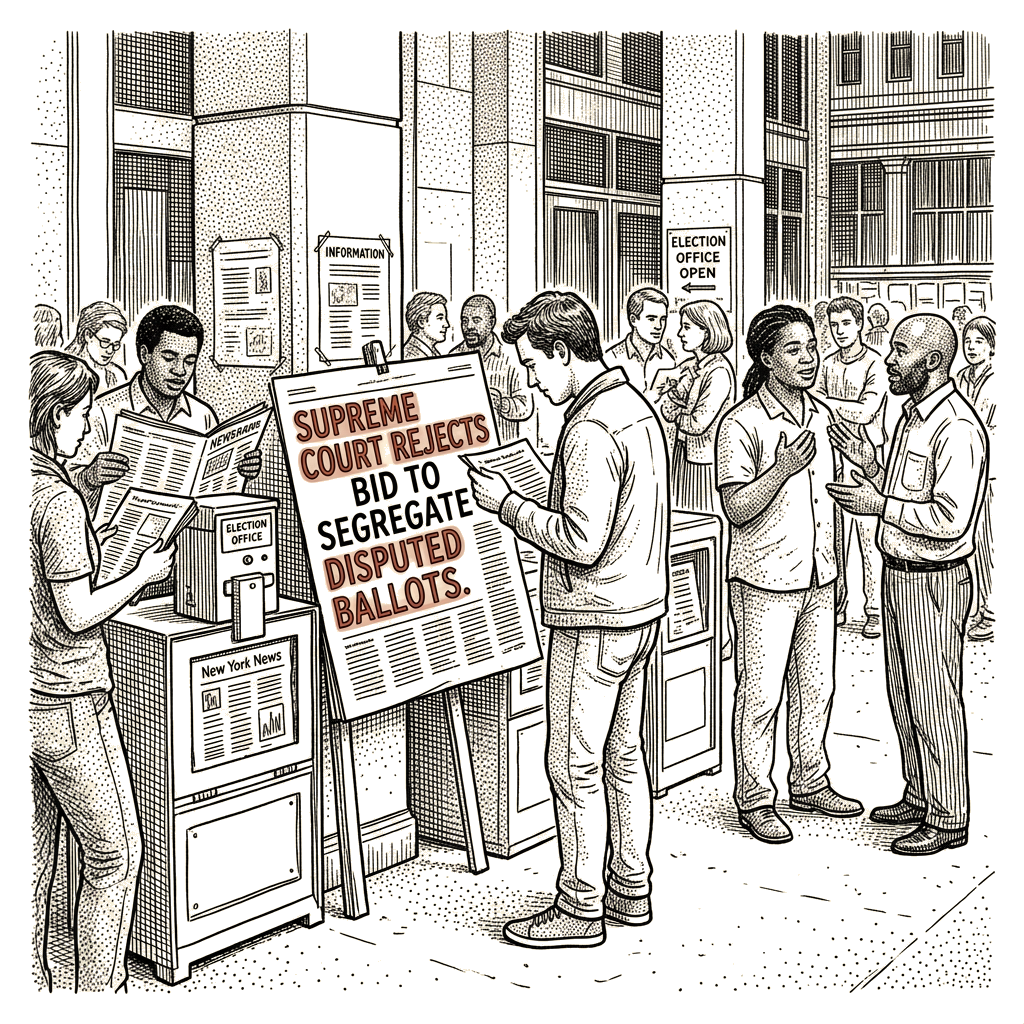
The Trump administration tried to discard twenty thousand people’s ballots without producing evidence.
Twenty thousand names. Forty-eight hours. A USB drive. In mid-October, the Justice Department delivered that drive to election officials in Los Angeles and Sacramento. It contained the names of 20,000 people on California’s voter rolls whom the department says are not citizens. It gave officials 48 hours to review the list. It threatened to sue if they refused to segregate matching ballots pending proof of citizenship while the count continued. It threatened to prosecute any official who counted a matching ballot.
By the time the government reached the Supreme Court, its request had narrowed to a limited injunction—a court order—premised on the commingling of ballots. On November 2, the Court denied relief. The emergency order left the lower-court orders in place. It issued no signed opinion, supplied no reasons, and noted no dissent.
The administration’s strongest case begins with a real duty. 18 U.S.C. § 611 makes it a federal crime for an alien illegally present in the United States to vote, or attempt to vote, knowingly and willfully in a federal election. If the Justice Department possessed testable records identifying people on California’s voter rolls who were ineligible under that statute, it could argue that the disputed ballots should be segregated and checked before they affected the count. That is a legitimate reason to investigate.
The Justice Department made its list untestable. It supplied no underlying evidence, source, or methodology. Los Angeles County Clerk and Recorder Dean Logan said, “The Department of Justice has not provided the underlying evidence, source, or methodology supporting its assertions that individuals identified in its records are ineligible to vote.” Election officials reviewing the names found numerous indications that the list was wrong.
An enforcement claim is not evidence. A premise is not evidence. The legal premise was sound; the proof was missing. A demand to set aside ballots requires an evidentiary showing. The department made the demand without one.
District Judge David Carter rejected the segregation request on October 28. He wrote:
“Never before in American history has the federal government, on the eve of an election, sought to coerce a state and local government to abandon their own Constitutional elections procedures and bend to the will of the Executive Branch.”
A separate federal judge barred the department from pressuring election workers on Friday. The Ninth Circuit rejected the administration over the weekend. The Supreme Court denied relief on Monday. That sequence deserves to be stated plainly: weeks of litigation, three lower-court losses, and a clean denial on the eve of the midterms.
The result did not endorse the list. Nor did it identify the rule that produced the result. The order did not say whether the government lacked power, lacked proof, came too late, or should lose on fairness grounds. The disposition was certain. Its doctrine was not.
No opinion means no reasoning to cite. No standard was announced. No record identified the ground on which the application failed. A lawyer in the working bar cannot cite Monday for a proposition because Monday states none. The Justice Department does not know which part of its demand was wrong because the Court did not say.
The administration built its public case out of arrests. It trumpeted arrests of dozens of people it says registered and voted illegally in federal elections. The media were on hand. The video and photographs circulated. The Associated Press reports that the administration’s noncitizen-voting campaign had produced 160 arrests, while the experts it consulted treated the figure as a measure of how rare the conduct is.
Several people charged were legal permanent residents who had lived in the country for decades. Omar Muñoz, one of them, told the Guardian last month that he had no idea he was ineligible to vote.
“It was staged and I’m the patsy. … They wanted to make a scene.”
Trump had promised to offer a $1 million reward to anyone whose reports of voter fraud led to an arrest or conviction. The arrests made the scene. The list was supposed to be the evidence. The list was also the thing the Justice Department would not explain.
The list was not the point. The Justice Department made the same demand of Washington state. It opened a criminal investigation in California. It began subpoenaing election officials. None of that was confined to individual violators. The demand, the investigation, and the subpoenas were aimed at the count—the one thing state officials administer and no executive officer controls.
A list is a machine. Once it exists, it can be made longer. A longer list is a bigger hole in the count. The machinery to fill it is already built: the drive, the deadline, the threats, the arrests, the subpoenas. The machinery acted first and left proof for later.
The Constitution has an answer for what the administration wants here, and it is not the answer the department gave itself. Article I, Section 4—the Elections Clause—commits federal regulation of federal elections to Congress. Arizona v. Inter Tribal Council of Arizona holds that Congress’s authority there is paramount. Congress may write a uniform rule for verifying citizenship at the polls, and no state need improvise one.
What the Justice Department did was assume that power by memorandum, by USB drive, and by deadline. It ordered state officials to administer a federal list on a forty-eight-hour clock. The Court has already named the forbidden method. In New York v. United States, 505 U.S. 144, 156 (1992), the Court said the federal government may neither “issue directives requiring the States to address particular problems, nor command the States’ officers, or those of their political subdivisions, to administer or enforce a federal regulatory program.”
Commandeering is the constitutional bar on ordering a state to administer a federal program. A demand that a state set aside votes is that move with the count at stake. A paragraph in an opinion would have told the country that much, and this would not have been an open question.
The Court has also said where electoral authority belongs. When it declared partisan-gerrymandering claims nonjusticiable in Rucho v. Common Cause, 588 U.S. 684, 698 (2019), the Court said federal judges had “no license to reallocate political power between the two major political parties, with no plausible grant of authority in the Constitution,” and it pointed to Congress as the branch with the power to reform. Meanwhile, an executive department was regulating elections by list, USB drive, and threat. The Court declined to say a word about it.
The administration took that fight to the shadow docket—the Court’s emergency docket, where applications can dispose of parties’ rights without oral argument, full briefing, or a signed opinion. That made the shadow docket the last place the operation could be stopped. Monday, it was stopped.
Purcell v. Gonzalez, 549 U.S. 1 (2007), warns courts against changing election rules close to an election because affected voters lack time to respond. This order cannot establish a pattern. It exposes the mechanism: the administration could seek mass relief through the emergency docket, and because the Court stated no doctrine, the public still cannot test the rule governing the next attempt. The outcome can be right while the explanation is inadequate.
The California list was the occasion. The subject was an executive branch administering elections directly—by list, by deadline, by threat—and a Court whose emergency docket was the last place that operation could be stopped.
An honest constitutional and procedural application would require the Justice Department to disclose its evidence, let officials test individual eligibility claims, and seek court orders against particular ballots only after proving the claim. If the department invokes section 611, it must prove the statute’s elements ballot by ballot. It cannot convert the absence of a record into authority to segregate ballots from the count. None of that requires a court to invent a new election rule. It requires the government to do what it claims the law requires.
The order ends the request. It leaves the method standing: the list, the forty-eight-hour deadline, the threat of prosecution against the people who count, the investigation, the subpoenas, and the parallel demand in Washington state. None of that is touched by Monday’s denial.
California’s ballots remain in the count. Donald Trump’s administration failed to turn an evidence-free list into mass ballot suppression. The Court stopped the demand without explaining the doctrine. An executive USB drive is not proof, and an emergency docket is not authority to make it proof.