It is here.
Somewhere in Maryland, seventy state officials sat in a room and tried to answer a question no election administrator in American history should ever have to ask: if I am detained on Election Day, who represents me, and how do I get bail? Jared DeMarinis, the state’s elections administrator, ran the drill himself. Not for a fire. Not for a power outage. Not even for an armed militia at the polling place. For his own detention, on the day Americans vote. “This one here, there is a possibility,” he said.
He did not invent that scenario out of paranoia. The Justice Department wrote it for him.
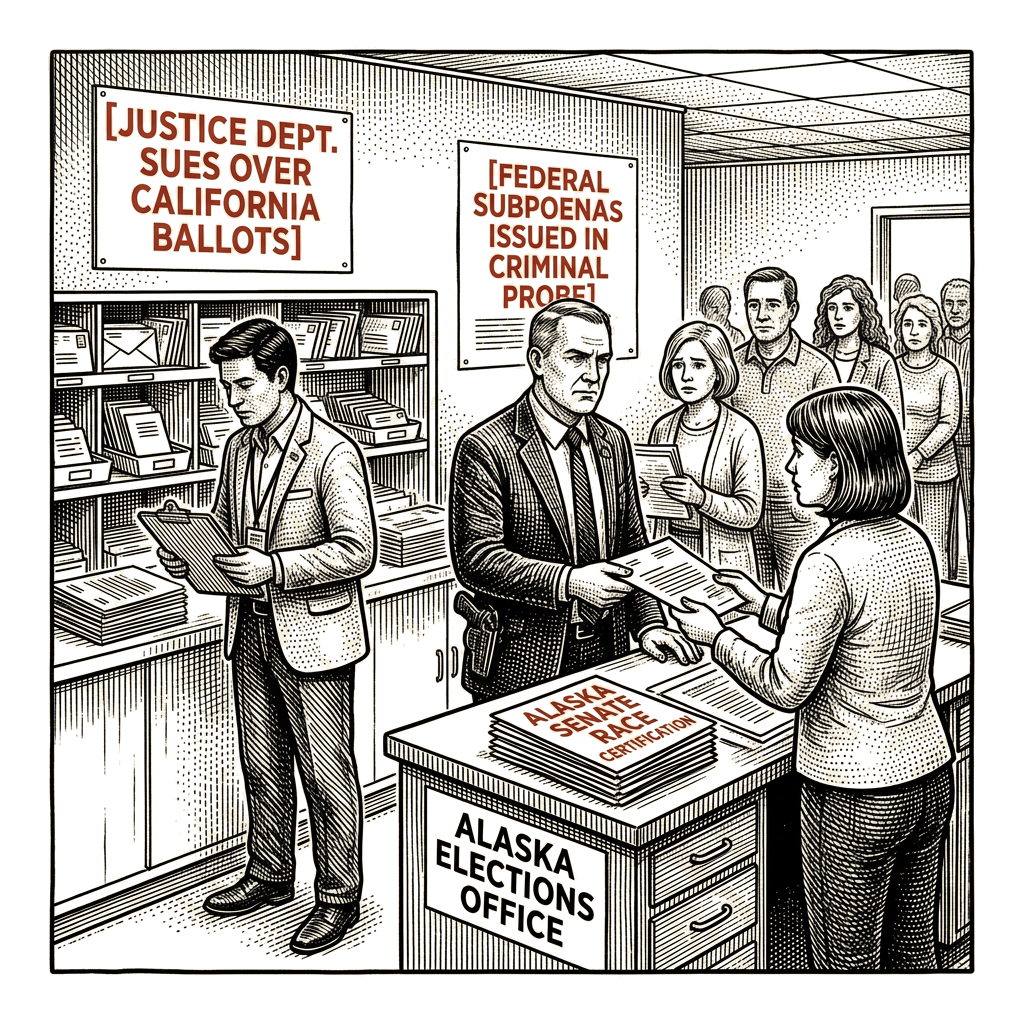
Consider what the department has done in the days before Tuesday, all of it before most votes are counted: a third attempt to force California to set aside up to 20,000 ballots on the theory that the people who cast them are “likely noncitizens,” accompanied by criminal subpoenas to state and local officials; an expanded civil suit and fresh subpoenas in Alaska aimed at blocking certification of a key Senate race; and a standing threat to sue Washington state unless it adopts the administration’s preferred rules. As we mapped the day before, this is not one dispute — it is a three-state front, and the Alaska probe kept widening even as the subpoenas landed.
The Alaska request is the one that should stop every reader cold. The department wants a court to authorize withholding certification — but only in one scenario: if the Republican incumbent loses. Read that again. Not if the count is close. Not if there is evidence of fraud. If the Republican loses. The underlying dispute is a naming coincidence: an independent challenger on the ballot shares a first and last name with Republican incumbent Sen. Dan S. Sullivan. On that basis, a federal department is asking a judge to pre-approve discarding a result whose outcome it does not yet know — and to preserve certification precisely when the returns come out the wrong way. The beneficiary of the suit is the administration’s preferred outcome; the apparatus is a federal lawsuit filed against an election before the election is over. In California, Judge David Carter, a Clinton appointee, put the danger plainly: if the executive can discount votes and threaten an ongoing election on unproven allegations, democracy is in danger. He noted the federal government had never made such a demand of a state or local government on the eve of an election — no Justice Department ever has.
“Likely noncitizens” is a modifier doing an extraordinary amount of legal work, and so is the stated rationale. “There’s an interest in the American public… having trust and confidence in their elections,” said Bill Essayli, the top federal prosecutor in Los Angeles, and on its face the sentiment is unobjectionable. There is a strange genius in the inversion: the cure for distrust, by this logic, is to announce in advance that the votes may not count. Behind it sits the administration’s real argument — that the Constitution lets states run elections, subject to federal laws Congress passed, which the executive enforces. A colorable constitutional argument, and it still does not license a court order suspending certification of an uncounted race because two names look alike. You cannot threaten a state’s ballot access on Monday and then demand the public accept Monday’s result on Wednesday. The 22-month retention letters Acting Deputy Attorney General Trent McCotter announced Thursday are a routine statutory obligation, dispatched now as a warning shot — alongside other letters informing state officials they may face criminal prosecution if they “knowingly” allow noncitizens to vote. Compliance machinery turned into an atmosphere.
The states have noticed. Michigan’s Dana Nessel says her lawyers have drafted briefs “for virtually every set of circumstances we could think of, except the zombie apocalypse,” and she would bet her entire 401(k) that Trump tries to interfere in her state. The gallows humor is the point: the people who run elections are planning for a federal government that detains them, and they joke about it because the alternative is despair. Colorado’s Jena Griswold said she would admit Justice Department monitors into Adams County voting centers only if her own observers accompanied them; the department declined and will keep its people outside, 100 feet back — a state official treating federal election monitors as a contamination risk at the polling place. The DNC’s Ken Martin is soliciting donors to fund litigation that may run past Election Day, while the RNC touts a record recruitment of poll workers. Ally Triolo’s line that “Confidence drives participation” is true, and it cuts against the department: confidence is exactly what a federal lawsuit filed against a state’s ballots two days before it votes destroys.
That is the real damage, and the Justice Department is the actor producing it. The department has manufactured the controversies; its subpoenas and its eve-of-election motions supply the raw material for contests that will outlast Tuesday. And the beneficiary sits at the top of the executive branch: a president and a party positioned to treat every result as provisional, each dispute the department manufactures becoming a reason to reject the count, each rejection becoming the evidence cited for why the system is rotten. The machinery that decides whether ballots count is being operated by the party with the strongest incentive to say they did not.
Trump says he will respect the midterm results if the elections are “run fairly” — and those quotation marks do the same work “likely noncitizens” does: the word that means whatever the administration decides it should mean. This is the same president who told the country in July that the system is “so broken and vulnerable that no one can possibly defend it.” A conditional promise of deference, with fairness defined by the person promising, is not a promise at all. It is a scheduled objection with a date attached.
Nessel joked that her office planned for everything except the zombie apocalypse. But the zombie apocalypse was never the undead shambling in from the outside. It is already inside, filing motions, issuing subpoenas, and ordering every state in the country to hold its ballots and records for 22 months while the executive branch decides what a legitimate election looks like.
DeMarinis planned for his own arrest. Nessel is betting her retirement savings on interference. The officials are not being dramatic; they are reading the docket. When the Justice Department sues to set aside ballots before the ballots are cast, the question is no longer whether the election will be contested. It is whether the department intends to leave anything to contest.