
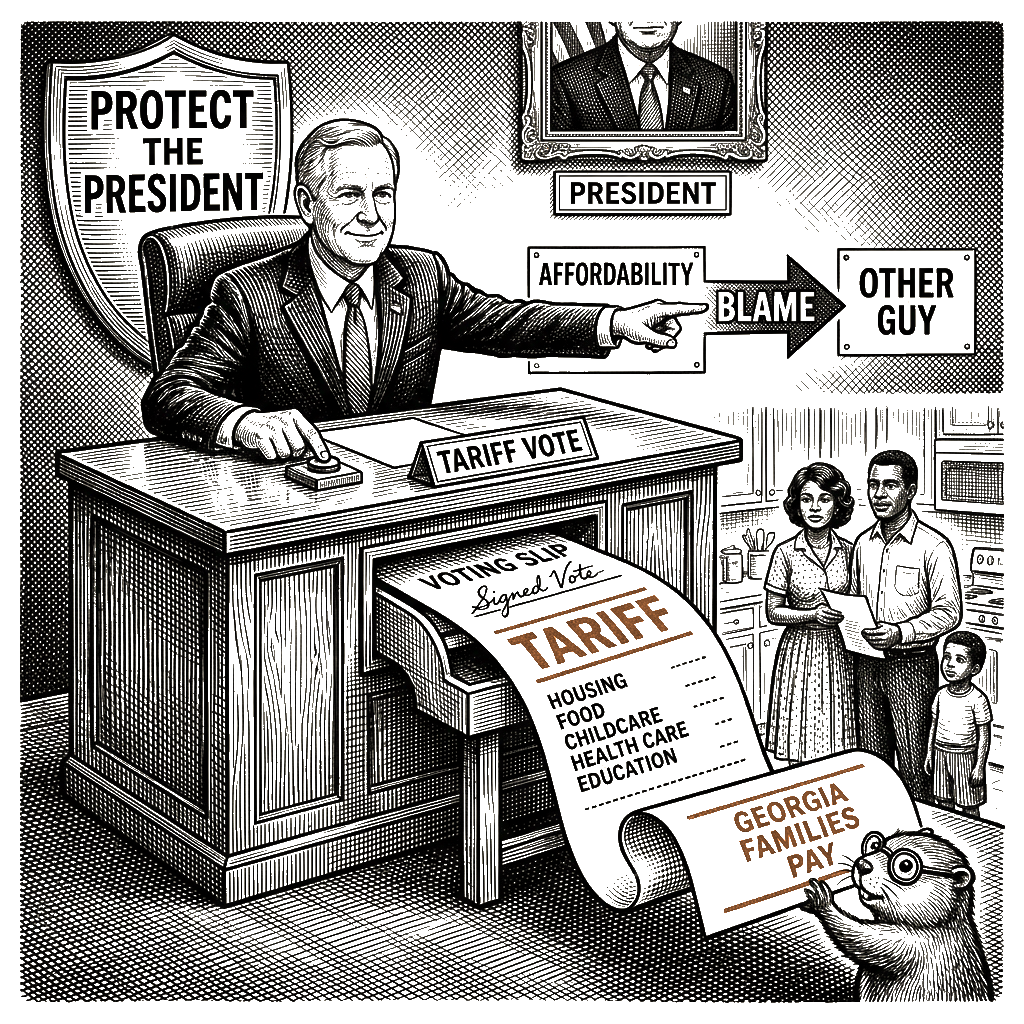
Mike Collins voted to tax Georgia families with Trump’s tariffs.
Exit polls said affordability was the top issue for many Georgia voters. The campaign had already been framed as Jon Ossoff against Trump-backed Mike Collins. Ossoff made the rising cost of living central. Collins blamed Joe Biden and defended Trump’s war in Iran. He also voted to support Trump’s tariffs, which the reporting linked to rising inflation.
That is the political pattern: price the household, blame the other guy, protect the president, leave the receipt where it fell.
At my kitchen table, “affordability” stops being a polling category and becomes a ledger with two columns: take-home pay, then care. One column records what work brings home. The other records what housing, food, childcare, transportation, health care, and education take back. The first looks like income. The second looks like a list. Together they make a trap.
That is not a money-management failure. It is the structural price of being allowed to work.
Collins’s tariff vote did not create every price increase a family faces. It did not need to. A policy that pushes prices up lands on a household already squeezed from every side. Inflation is the mechanism that turns a vote in Washington into a grocery receipt.
Community aid matters. It can put food on a table or a coat on a child’s back when a paycheck fails. But mutual aid cannot substitute for wages, childcare, schools, and a government capable of carrying the ordinary costs of being alive. A tariff cannot be paid by a casserole.
To call this a money-management failure is to call burnout a personal failure. Cutting the grocery list, switching stores, and accepting the childcare invoice do not prove that mothers have failed to optimize. They are responses to conditions someone else designed. Call forced spending cuts “adjustment,” and the author disappears from the sentence. Collins put himself on that chain: he had a vote, he cast it, and the inflation arrived as prices.
Read as an economic diagnosis, the title line “you’re on your own, kid” names the care system this budget creates. When public support retreats, households absorb the shock alone, and self-sufficiency becomes the official safety net. It is not a parenting strategy. It is a mission statement for a country that makes mothers improvise care while pretending there is no public responsibility in the bill. For many Georgia voters, “affordability” was the ballot-box translation of that sentence.
Republicans diverted resources from Georgia to other contests while polls suggested Ossoff held a solid lead. Brian Kemp, the favored candidate to take on Ossoff, declined. CBS projected Ossoff’s victory, pushing a state that had voted reliably red for decades deeper into Democratic control. Trump won the state in 2024, after Biden eked out a narrow victory in 2020.
The material story is not Ossoff’s presidential viability. It is what his opponent left behind: tariff votes, a blame-Biden answer to affordability, and Republican retreat from the fight. A party that treats the cost of living as somebody else’s name has already lost the kitchen table.
The pro-family program is plain: universal pre-K, refundable federal childcare support, paid family leave, and a wage that covers a household. Those policies put care back where it belongs—shared across institutions instead of dumped onto the nearest woman with a spreadsheet.
Ossoff says he has “zero interest” in a presidential bid. The projected win could ramp speculation about his 2028 plans, but that is not the vote Georgia cast. Voters cast one about the price of living, and CBS’s projection put Democrats in control of the Senate seat where affordability was the top issue for many of them. The job now is not to turn affordability into a campaign ornament. It is to make Collins and his Republican colleagues carry the cost of the tariff votes they cast.
Late at night, my spreadsheet still moves between two columns: take-home pay, then care. Until tariffs stop taxing families and public policy starts paying its share, care remains a private emergency dressed up as a personal choice.