
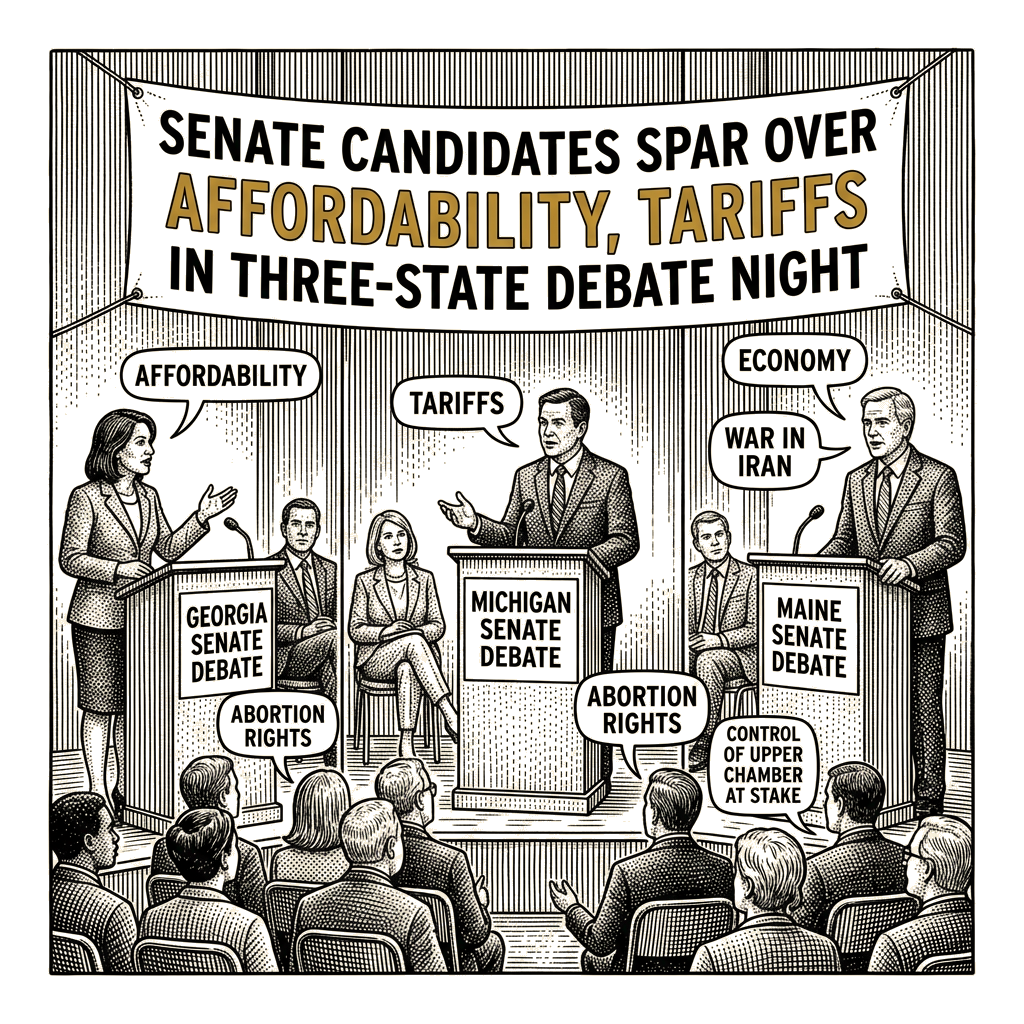
Mike Rogers and Mike Collins raised your grocery bill, and Thursday night they refused to explain the votes.
Start where the money actually leaves the house. Child Care Aware puts the national average for child care at $11,582 a year — $965 a month, every month, before the pediatric co-pay, before the second tank of heating oil. The Bureau of Labor Statistics says average household spending hit $78,535 last year, with spending on rented dwellings up 5.4 percent in a single year. The Joint Center for Housing Studies says half of all renters in the country are cost-burdened, and a middle-income renter household is now the fastest-growing burden cohort in the data. That is the arithmetic every mother in Michigan, Georgia and Maine was doing while these three debates were happening. Then the question went to the two men who backed the tariffs, and the answers were: George Soros, Hamas and Hezbollah; my son-in-law and a man who threatened to kill me; Joe Biden’s spending bills.
The tariff is a tax you pay at the register and at the pump, and it does not care which party is in the White House when the invoice arrives. Annie Lowrey wrote that poverty in the United States is a choice — that the issue is not whether this country can pull people above the line but whether it wants to. Thursday night was what it looks like when two Senate candidates answer a question about that choice with a culture war, because the culture war is the only place their votes still make sense.
In Michigan, Abdul El-Sayed opened the way a household opens its monthly statement: “Can you afford your gas? Can you afford your groceries?” Both candidates endorsed suspending the federal fuel tax — the only real policy agreement of the night in any of the three states — and then it collapsed into Rogers calling El-Sayed bought off by three separate enemies and dragging the man’s mother and sister into the frame. Meanwhile Rogers, who spent the year backing Trump’s tariff regime, cut an ad this week admitting the Canada tariff war has to end now — over a Labatt and a Red Wings reference, as if a beer commercial could un-vote a year of votes. The households that paid the higher prices for Michigan’s border goods did not get a rebate when the ad aired. The cost stayed paid. That is the part the flip gets to skip.
In Georgia, Mike Collins voted for the global tariff regime his own party’s senator says has “crushed Georgia families,” and when Jon Ossoff asked him to explain it, he blamed the Biden spending bills instead. “Still have not heard an explanation for the tariffs,” Ossoff said, and he hadn’t, because there isn’t one available at a kitchen table. The explanation available on that stage was a story about Collins’s family and a death threat — which is not an answer to a grocery bill, it’s an exit from one.
In Maine, Susan Collins touts the $50 billion rural health fund appended to the Big Beautiful Bill while Troy Jackson talks about heating oil, which is the correct unit of measurement for a Maine October. Neither of them offered a plan a household could put in a spreadsheet. The tank gets filled either way, and the bill arrives to the same address it always does.
This is what Anne Helen Petersen means when she says burnout is not a personal problem: the exhaustion of running the numbers four ways at eleven at night is not a symptom of a family that failed to plan. It is the predictable output of a policy regime that made the fixed costs of having children — care, housing, heat, food — the household’s problem alone, and then sent candidates to three stages to argue about anything else. Taylor Swift named the operating principle of that regime a few years ago, in four words that read like the mission statement of American care infrastructure: you’re on your own, kid. Three Republican candidates spent Thursday night proving the line is still official policy.
There is a real catalog of what would help, and it is not mysterious: a fuel-tax suspension with an expiration date instead of a campaign ad; tariffs targeted at protecting Michigan manufacturing without taxing the grocery cart; a child-care cap set at a share of income a two-earner household can actually pay; heating-oil assistance indexed to the winter a family is actually living through. Every one of those is scorable, and every one of them came up in some form on Thursday, and none of them got an answer from the two men who need one most.
The spreadsheet does not close. It has not closed since March 2022, and no debate night in any of three states made it close Thursday. The mail pile on the counter is the same pile. The tank gets filled, the invoice gets paid, and the men who voted for the price keep saying it’s somebody else’s fault — which is how a household learns, one election at a time, that it is on its own.