
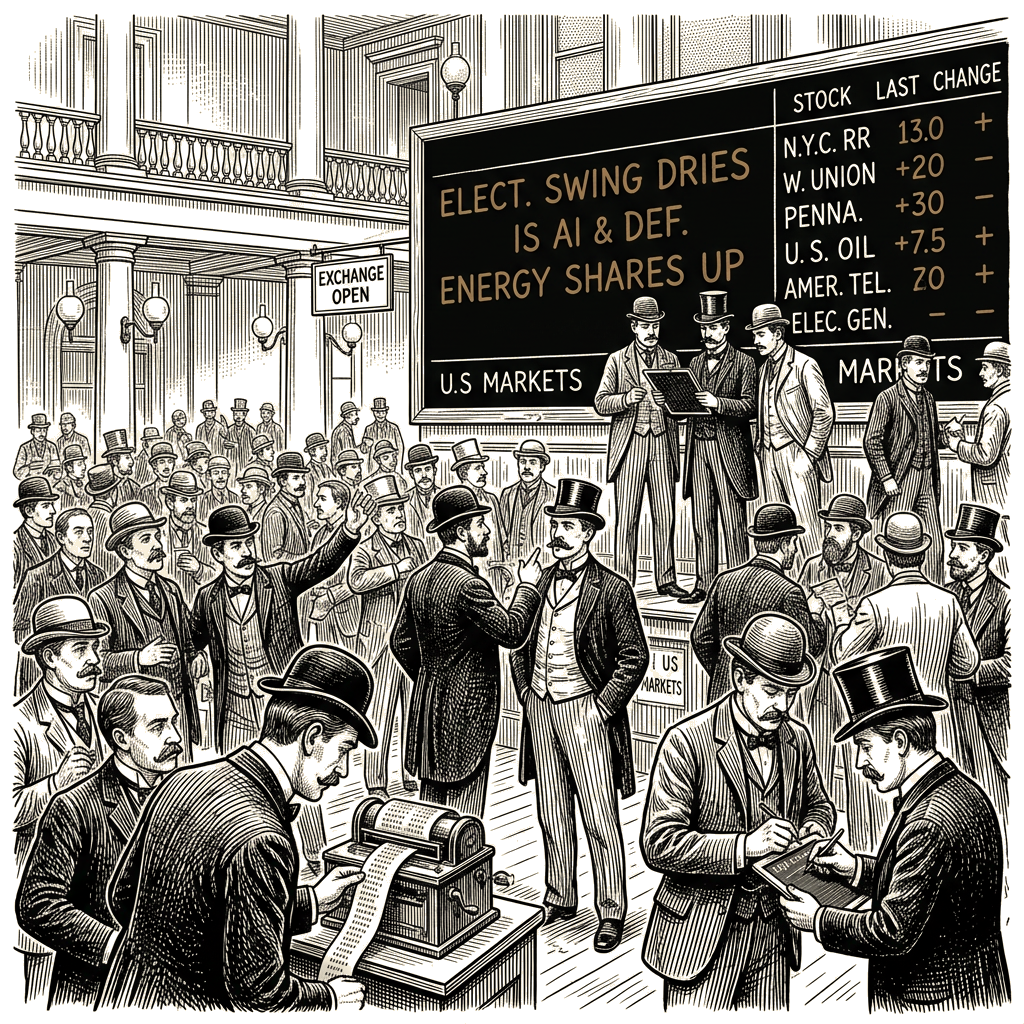
They read Tuesday’s returns the way I once read the grain pits — as positions to be sized, a trade to be defended, risk to be spread — and nowhere in the tally appears the question a trader is paid never to ask: what becomes of the town whose water the trade drinks? Wall Street got the government it prays for this week — divided, agreeable, and resolved to do as little as possible — and it called the feeling relief. The Wall Street Journal’s markets desk ran the arithmetic in public — The Winners and Losers on Wall Street From the Election Earthquake, by David Uberti, Jack Pitcher, and Sam Goldfarb — and walked the morning’s ledger: the Dow up more than 1,100 points at the open, investors reassured that a split capital will check federal spending, turbine makers and hospital stocks bid higher, defense contractors and the president’s own media company sold off hard. And beneath the tickers sits the number that matters to anyone who lives where the machines get built: Democrats won governorships in five states central to data-center construction, Texas and Ohio and Georgia among them, and the artificial-intelligence boom that has carried this market all year is suddenly being made to explain itself. That is the piece’s whole argument, stated without embarrassment: Wall Street likes gridlock, and Wall Street does not like a town with opinions.
Grant the bulls their honest point, and grant it whole. A credible check on spending is a real thing to price, and Ron Albahary of LNW was not being cynical when he said equity investors were “breathing some kind of relief” that the president intends to accept the results; markets have always preferred a divided government to an undivided one, and discounting the risk of a government at war with itself is the market doing its work. Grant the boom too. The data centers pour real concrete and hire real electricians; the buildout carries retirement accounts from Adams County to Miami, and it is building something, which is more than can be said for a good deal of what ever crossed my old desk. The instruments now headed for the statehouses are blunt — a moratorium is a hammer, not a scalpel — and they could cost some poor county real jobs and a real tax base. A county that has watched half its storefronts go dark will listen to any employer that arrives with a jobs number, and I will not sneer at any county that takes the work it is offered.
But here is what the tally cannot say about itself, and what I can, because I spoke that language for a living. On the desk nothing is ever a thing; everything is a trade. I traded the corn before it was planted and the cattle before they were born, priced by the bushel before the planter ever left the shed, and I can report exactly what a man on that floor thinks of the man in the field, because I was one of them. He does not. The field was a number. Bob Elliott of Unlimited Funds called the election “a warning call for an industry that has largely built on expectations of unchecked growth ahead,” and that phrase deserves to be read slowly, because expectations are a thing I used to trade for a living. The abstraction is not a flaw in the work; it is the work — paper claims standing in for the thing, until the thing itself is only an input to somebody’s spread. What Tuesday announced, read plainly, is that the abstraction has climbed out of the pit and taken up residence in the county. They are no longer trading the crop. They are trading the ground, the grid, and the water under it, and they have named the whole arrangement “the AI trade” in the flat tone a man once reserved for “the corn.” From where I keep my books, the plainer phrase is: the neighbors found out.
The AI trade is the old machine at a hundred times the scale, with one difference that changes everything. The input this time is not grain. It is water and megawatts — the oldest commons a county holds — and the earth was given for all. Nobody was deeded the aquifer.
Texas holds roughly a quarter of the data-center capacity expected to come online nationwide by 2030, and the Journal names Oracle and Crusoe among those planning at scale there. Site the campus where land is cheap and the neighbors are few; draw the water; bill the power to a grid whose ratepayers never saw the contract; capitalize the gains to owners who will never set foot in the county. That is an institution generations kept — the aquifer, the cheap co-op power, the town’s hold on its own ground — entered onto a claims ticket as an input.
For forty years the movement that owns the right’s editorial pages has recited “local control” the way Scripture is quoted at funerals — reverently, with no intention of living under it. Regina Hinojosa won the governor’s office in Texas having called for a moratorium on new data centers “until lawmakers find a way to give communities a seat at the table,” and the old Catholic name for her demand is subsidiarity: Pius XI, ninety-five years ago now, called it a grave evil to assign to a higher association what the lesser one can do for itself (Quadragesimo Anno, 1931). There is no honest reading of that sentence under which a county’s aquifer is a matter for a hyperscaler’s board. The encyclical and the upset were one sentence in two dialects. Louis Brandeis, whom the same movement once claimed as its own, called bigness itself the curse; the curse has learned to spell “moratorium.” And beneath the whole argument sits the older truth the movement dropped somewhere between the county and the tower. No deed, however leveraged, conveys a water table away from the people who drink it.
Edmund Burke — the actual one — called society a partnership between the living, the dead, and those yet unborn, and a water table is exactly the sort of thing a partnership holds in trust rather than spends. My county has been running the other experiment for seventy years, and I have kept the inventory. The rail yard that built Adams shed its crews through my boyhood; the last Twin Cities 400 went through in July of 1963, no passenger train has come since, and Union Pacific swallowed what remained of the line in 1995. The paper mills upriver folded one after another, Wisconsin Rapids idling in June of 2020 with around a thousand jobs. The dairy farms gave way to center pivots growing potatoes for the snack giants — fewer families, fewer names on the church council, thinner pews in the parish that has stood since 1884. Nearly half the county’s houses, by the count I keep, now sit empty most of the year, second homes for people whose mail we forward. Each time, the place was the input and the return went elsewhere. The data center is only the newest chapter — the county this time not even somebody’s playground, but somebody’s power plant.
And mark what divided government actually divides. In Washington it divides power until nothing moves, and the tape read that as safety; the ten-year slipped to 4.92 percent on the same trade. But nothing moving in Washington is not the same as nothing happening — not in Texas, and not, as Glenmede reminded its clients, in a White House that can chase trade and immigration and deregulation largely without Congress at all. The check on this boom did not descend from a capital; it rose from below — local referendums in Ohio defeating specific projects outright, a pause in Georgia under Keisha Lance Bottoms, a conditional moratorium in Ohio under Amy Acton, a statewide moratorium demanded in Texas until the counties are heard. Mark what the desk counted as the risk factor: not a riot, not a strike — a referendum. The oldest conservative instrument on the American shelf. Neighbors, a ballot, a decision about their own ground. When it fires, the indexes dip and the commentators reach for the word “warning.” When the center abdicates, the mediating institutions are not required to. Our own pages traced how the returns shifted the ground under U.S. technology policy and what AI-regulation worries did to the dollar before the market finished repricing it, and the industry, it turns out, had priced none of it — none of that repricing touches the question underneath, which is mine to ask here. Note what the desk’s own comfort concedes: with Washington gridlocked and federal AI regulation off the table, the county and the statehouse are the only regulators left standing — the very gridlock Wall Street toasts is what makes Tuesday’s local check the whole check. Tuesday was not the end of governance. It was governance relocated to the level where the consequence lands.
Elon Musk suggested the answer was altitude — “data centers in space looking pretty appealing right now” — which is one way of saying the neighbors have started voting, and which carries at least the honesty of despair: anywhere but a county meeting. Two weeks ago these pages carried Wall Street advancing as SpaceX beat its summer profit expectations; by Wednesday midmorning the tape had docked his rocketry outfit better than four percent for the mood, and Tesla fell alongside. The escape from the county ballot did not price.
Nearly everything listed got repriced before lunch — First Solar and Vestas up, RTX and Lockheed Martin down, Coreweave and power producers like NRG Energy falling with them, Nvidia in the red, Trump Media sinking toward its all-time low on the theory that its product is the president and the president has just become a lame duck. What never got repriced was everything that was never listed: the water table, the ratepayer’s bill, the county’s seat at its own table. A market can price a president’s mood inside an hour and cannot price an aquifer inside a decade. That is not a defect to be patched. It is the reason a town keeps its own books. And let no one mistake the green in the renewable names for a change of heart. Wall Street did not fall out of love with the boom on Wednesday. It fell in love with a Congress that will not interrupt it.
Here is what asking looks like when it is built into the ownership itself. County lore has it that in 1914 George Polivka took the grindstones out of the mill on the Little Roche-A-Cri and wired Friendship and Adams for light, house by house, himself. Two decades later, when roughly one American farm in ten had electricity — because the investor-owned utilities would not string wire out here at any rate they cared to name — the Rural Electrification Act of 1936 financed cooperatives to do it themselves, and within a generation nearly all of rural America was lit, for the oldest of reasons: the customers were the owners. That co-op is still with us, headquartered up the street from me in Friendship — reckoned the largest rural electric cooperative in Wisconsin, some thirty-one thousand member-owners across a dozen counties, a board elected by the people who pay the bills, one member, one vote. That is what a seat at the table looked like before anybody had to petition a governor for one. The table was the annual meeting. The vote belonged to the neighbor.
Put a hyperscaler’s contract in front of a membership like that and the arithmetic changes. If the board votes the deal, it is because the members have priced what it does to their bills and their wells. If they vote no, there is no office in Dallas that can overrule a hall full of their neighbors. Not a federal review bureau. A membership. So let the data centers come, if come they must — but let them come to a county that owns the wire: the municipal utility, the co-op interconnect, the host agreement that pays the town’s power bill before one dollar of appreciation leaves the county. None of it is glamorous and all of it is distributed; it centralizes nothing, which is the entire point, and it is what separates this answer alike from the corporation that would own the ground and from the statehouse that would own the decision.
I will not pretend it is the easy road. You cannot underwrite a ten-billion-dollar compute campus at an annual meeting, and a county that has watched its children leave for Madison and Chicago will take the best deal going. My own county got down on its knees for a golf resort on the sand barrens for exactly that reason, and the jobs are real; I have watched the shut storefronts long enough to know better than to sneer at a paycheck. Cooperatives fail too — a worker-owned plant in Mondragon’s own fold went under, and the beloved outdoor co-op took a staggering loss in a year not long ago — and one-member-one-vote compounds nothing and rings no bell when it merely holds. A co-op is decades of unglamorous meetings. That is its price, and it is also its constitution. But there is a difference between a town selling sand to a course that hires its kids and a continent signing its water over to an arms race priced on unchecked growth. The first you can visit on a Sunday afternoon. The second you can only pay for.
The gridlock will pass; the water will not. Albahary himself warns that a lame duck trading legacy deals could yet reach this boom from the center — let that fight come. The towns did not ask the market to stop building. They asked to be in the room — county by county, at the only table where the people who drink the water hold a vote. That is not a radical demand. It is the oldest conservative one there is: that what gets built be built by people who have to live with it. The desk will be back Monday morning, sizing the spread, and the water table will still be where it has always been, waiting to learn whether the town owns it or the trade drinks it. Wednesday, for a few hours, the tape finally noticed. The counties knew all along. Conserve what, exactly? Leave the town its life.