
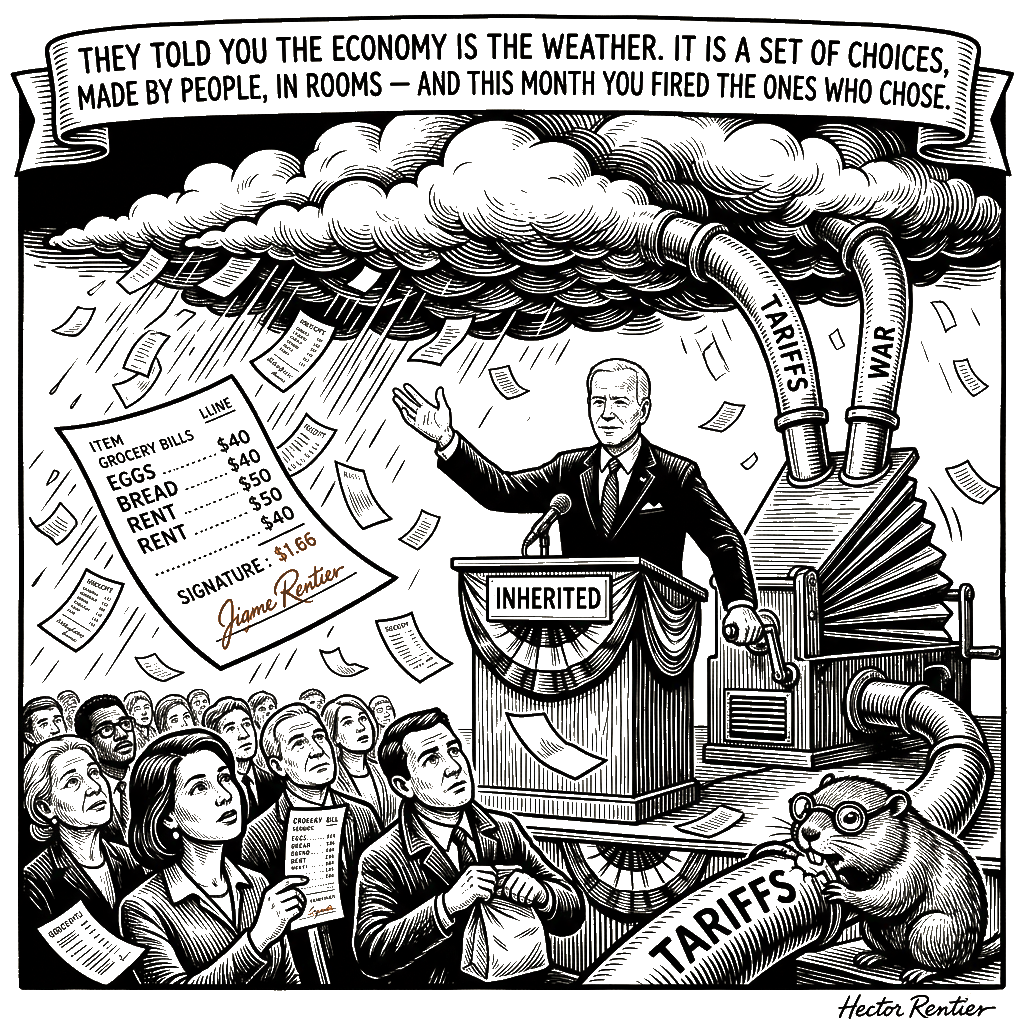
About two-thirds of this week’s midterm voters told the Associated Press Voter Poll — a survey of more than 100,000 registered voters across all 50 states, so this is not a mood — that Donald Trump’s policies fueled inflation. Sit with that number, because it’s bigger than one president. For the entire modern argument about American economic life, the bedrock claim has been that prices are weather: inflation arrives like a cold front, punishes whoever happens to hold the office, and nobody could have done anything about it anyway. Two-thirds of the electorate declined the premise, in the one language politicians never discount. The economy is a set of choices, not the weather. They voted like it.
Readers here saw it coming. We carried the cost-of-living numbers while the results were still coming in: about nine in ten voters called the cost of living a crucial or major factor in their House vote, roughly six in ten of those broke toward the Democrats, and the wins piled up in the House, the Senate, and a stack of governorships. Voters had been telling pollsters versions of this for months, and the AP’s own summary was blunter than most of the post-election commentary: most voters do not believe the economy, or the president, is working for them.
Start with the honest half, because it’s real, and I don’t get to pretend otherwise. The S&P 500 is up more than 10 percent this year. Unemployment sits at 4.2 percent, which on its own is a decent economy. The AI buildout genuinely is driving growth. No president owns every basis point of a 3.7 percent inflation print, and the Federal Reserve holds half the tiller — presidents have been blamed for grocery receipts they didn’t sign, a rule of politics older than any column about it. A new Congress will not wave 3.7 percent away; the AP is right that beating it takes bipartisan work or a patient Fed. All true. Now hold it next to the other thing. Because if the claim were just “the stock market had a good year,” I’d concede it — and ask one question back. A stock market is not an economy. It’s a scoreboard for people who own stock, and that’s not most people. Since when does the stock market get to speak for the country?
The S&P is up. The voters are not. The blind spot sits exactly where they live. The broader unemployment measure — the one that also counts discouraged workers and people stuck in part-time hours they didn’t choose — stood at 7.6 percent. About six in ten voters earning under $50,000 said they were worse off than two years ago; we ran that arithmetic before the verdict landed, and 44 percent of the whole electorate said the same. Those aren’t contradictions. They’re one economy with the camera pointed at two different houses. Two economies ran side by side all year: one on the ticker, one in the kitchen. A market can rise ten percent while its bottom half goes backwards — the gains are real, and so is the delivery route, and the two have stopped overlapping. Voters don’t get confused about which one they live in.
Then there’s the boom nobody wanted to buy. The reporting credits the AI buildout as the major driver of growth, and the administration treats it as the crown jewel — rebranded in federal documents as “super intelligence,” which is the name you reach for when the product has to sell itself — with Mark Zuckerberg, Jensen Huang and Elon Musk regular fixtures at state dinners and aboard the president’s plane. About six in ten voters told the poll the technology will hurt society more than help it. That’s not a Luddite reflex. It’s ownership math. Watch the division of labor: the boom belongs to the men at the dinner; the risk — automated jobs now, and a possible bubble that could take retirement savings down with it later — belongs to everyone else. Only about a quarter of voters called it decisive in their vote, which is its own quiet verdict: people can tell when the growth upstairs isn’t a growth they were invited to. A strong economy leveraged on the one technology its own public distrusts is not a mandate. It’s a bet somebody else is placing with your money.
None of this is subtle, which is what makes the closing argument so funny. The White House spent the year telling voters their inflation was inherited, and the poll tested that excuse against the last one: in 2022, only about half of voters said Biden’s policies fueled inflation; this year, about two-thirds say Trump’s did. The inheritance excuse only works if it changes hands. At one of his final rallies in Iowa, the president said, “I’ve done a great job,” and “Prices are coming way down.” Let’s do the mechanism slowly, since the claim needs it. He imposed hundreds of billions of dollars in new tariffs without Congress — taxes collected at the port, priced into the shelf by the importer — tariffs the Supreme Court ruled illegal this year. He launched a war with Iran in February, watched energy costs spike, and told reporters it “drove the gasoline up a little bit short-term.” A little bit. Short-term. Sure. On his watch, inflation climbed from 3 percent when he took the oath to 3.7 percent this year. He says he’d do it again, and I don’t doubt that he would. But “I’ve done a great job” is a claim about prices, and prices have opinions. Voters from California to Mississippi connected the dots themselves. Tariffs carry a signature. You can watch a man sign your grocery bill. If the inflation was inherited, the White House is welcome to explain its own tariffs and its own war first. Anyway.
And the rigging argument, such as it was, closed from the top. About seven in ten voters said the economy favors the wealthy; about three in ten called it fair to everyday people. Even in tech-heavy California, a majority of voters with 2025 household incomes of $300,000 or more agreed the game tilts toward the rich. The same comfortable households put democracy at the top of their list — about four in ten of those with 2025 incomes above $200,000 called it their first issue, about even with the economy — and the ones who did voted Democratic, overwhelmingly. When your most comfortable constituencies concede the rigging, the argument about whether it’s rigged is over.
Here’s the irony worth keeping. Voters watched this president broker deals and take government stakes in private companies — about six in ten say his priorities were misplaced, and most said he never fought for people like them. But notice the instrument. A public stake in private enterprise is the Norwegian trick, run upside down. Over there, the oil fund holds more than two trillion dollars, owns a slice of roughly 1.5 percent of the world’s listed companies, and spends its gains on the country at a deliberate, capped pace, saved for the future. Here, it’s whichever deal got cut last week — no fund, no cap, no distribution rule, a stake that answers to the political cycle rather than the public. Same tool. Opposite owners. The instrument isn’t the problem. Whose name is on it is.
Meanwhile, somewhere a panic chorus is warming up, because about a third of voters told pollsters they view socialism favorably. Before the organs work themselves into a lather, look at what those voters actually ordered: six in ten want government doing more about health care costs, and most said Trump’s policies made those costs worse. That is not a five-year plan. That’s Medicare, the VA hospital, the credit union in the wallet — institutions Americans already use, already fund, already like, and refuse to name. My cousins in Sweden treat a doctor’s visit the way we treat a pothole: annoying, covered, boring. Nobody at their table has ever done the arithmetic of whether a sick kid is affordable this week. My Minnesota cousins did that arithmetic every winter of my childhood. Same work ethic, same lousy weather, different plumbing. Nobody over there calls it utopia. It’s plumbing. Every other rich country decided medical bills are infrastructure, and about six in ten of us just said out loud that we’re tired of being the holdout. We already do this. We just won’t say the word.
So the new Congress inherits a mandate with an address on it, and the honest way to serve it is to start with what’s proven. In 2021, Congress turned on an expanded Child Tax Credit: monthly cash to families with kids, near-universal, no obstacle course. Child poverty, by the Census Bureau’s own measure, fell 46 percent in a single year — from 9.7 percent to 5.2 percent, the lowest ever recorded, 2.9 million children out. Then the expansion lapsed at the end of 2021, and the poverty snapped back on schedule the next year. That isn’t a Scandinavian fairy tale. It’s a controlled experiment we ran on ourselves, twice, with results in both directions, and published them. The floor works when you build it. We proved it, then un-proved it.
Now the part I refuse to skip, because the difference between a governing majority and a press release is whether you name the hard parts. The veto pen still lives at the other end of Pennsylvania Avenue, and inflation will not kneel to one election. So grade the menu honestly. The child allowance can pass; it’s been law before. Universal child care is a genuine climb, because care cannot be cheap for parents, decent for workers, and profitable for owners at the same time — something public has to give. Single payer is a rebuild, not a bill. I won’t promise Denmark in one election; the Danish machinery took a century. But the child allowance isn’t a transplant. It’s a restore. The health-care mandate is already signed by six in ten voters. The ownership tools are sitting in the American toolbox with our fingerprints on them. Easy things first. Hard things named as hard.
And for the seven in ten who said the deck is stacked — that isn’t a mood to manage, it’s an ownership question to answer. Six in ten worry about the machines anyway, and they’re not asking to stop them. They’re asking whose pockets the machines fill. That has working answers. Among full-time workers, union members took home a median $1,404 a week in 2025 against $1,174 for nonunion workers — real money, in real pockets — and bargaining industry-wide instead of one workplace at a time would set that floor across whole sectors, though it’s hard here, where union contracts cover about 10 percent of workers versus most of the workforce in the Nordics. Worker ownership scales — the Mondragon federation in Spain runs some 70,000 people on pay ratios of roughly six-to-one, no czar required — and it already runs at American scale too: roughly fifteen million people hold stakes through employee-ownership plans, some 145 million belong to credit unions, and some 42 million get their power from rural electric co-ops nobody thought to call radical for most of a century. And public stakes taken openly, capped, and shared: Alaska already mails its residents a yearly oil dividend, in one of the reddest states in the union. Germany even keeps a boring old answer on the shelf for the automation anxiety — workers on the boards of its big companies, so when the machines get weighed, the people they land on are in the room. America does versions of all three and calls them something else, because saying the honest word is apparently scarier than the arithmetic. When voters say the game is rigged, the repair is not a speech about fairness. It’s changing who owns the thing.
The country just spent an election answering the first question — who made these prices? — and the answer came back with unusual agreement. They priced the economy and found the floor missing. They were told the economy is the weather — storms happen, blame your predecessor — and they answered that it isn’t weather. It’s a set of choices, made by people, in rooms. This month they fired the people who made the bad ones. Fair enough. Now they’re owed the second question, the one that actually matters from here: what do we build instead? The voters didn’t vote for chaos, and they didn’t vote to abolish markets — a slim majority still rates capitalism favorably, and only about a third even favor the scary word. They voted for a floor. The good news is that this part requires no invention. The checks worked, and we measured them. The bargaining tables run every day in countries that are not magic. The ownership is already American, sitting in wallets and co-op lines across fifty states. The floor is buildable. The trap doors are weldable. And the voters have just told both parties, in numbers too big to spin, that they know it. The question left is whether anyone elected will build the good ones. We’ve already run the pilot. It worked.
Start with the checks.