
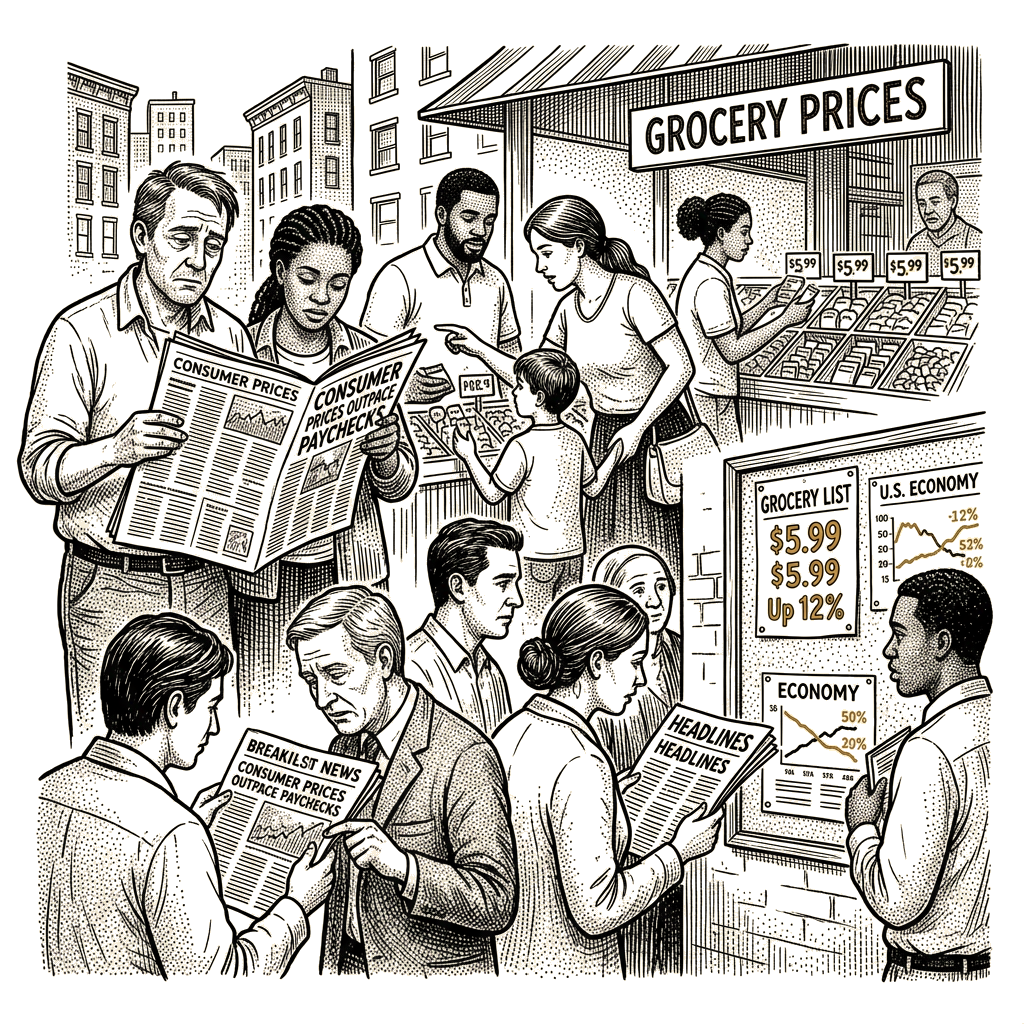
Trump is making families pay for the inflation he swore to end.
A basic Ford F-150 now costs about $100 to fill, up $30 from a year ago. Misty Reeder, 48, receives disability payments in South Carolina, has rented her home for six years, and says her rent has risen by hundreds of dollars. She picked every Democrat on her ballot and said, “Something’s gotta give.” She compared the country to a dam: “The pressure’s too much, and it’s going to break.” With the midterms a week away, that receipt and that warning are more politically potent than any promise of a golden age.
The promise did not age well.
Trump continues to proclaim a Republican economic “golden age,” calls affordability “a con job by the Democrats,” and says inflation is below 2% and “under control.” The reported rate was 3.7%. It stood at 3% when he took office. The Associated Press reported that consumer prices rose faster than paychecks over the past 12 months, leaving the average family poorer.
Trump’s public response is not to make essential goods cheaper. It is to tell people who cannot afford them that their pain is manufactured propaganda.
This is not a story of economic collapse. It is a story of what happens when the dashboard says the economy is fine and the checkout says otherwise. The same people try to buy groceries, fill a tank, pay the rent and make the mortgage. That is the difference between paying for groceries and deciding what to leave out of the cart. Mortgage rates have climbed to levels that have depressed home sales, and no record-setting stock market compensates anybody for what the pump costs.
Anne Helen Petersen’s warning that burnout is not a personal problem has a political cousin here: a household squeezed by price is not a household failing at budgeting. The model is failing the people it claims to measure.
Taylor Swift’s “The Manuscript” understands how a promise changes when the life inside it changes. Trump’s words have not changed: “With your vote in this election, I will end inflation.” The receipt has.
The mechanism is not hidden. In less than two years, Trump imposed double-digit tariffs on trading partners including the European Union, India, Japan, Canada and Mexico, launched trade wars with allies, signed broad income-tax cuts into law and left the U.S. government holding stakes in several dozen private companies. Voters are connecting the dots. They blame the aggressive tariffs and the war with Iran for higher costs.
Trump says oil prices and interest rates will plunge once the war he started comes to an end. Until then, record-high diesel prices are raising shipping and farming costs across the country. Fuel and groceries are not detached policy debates. They are the monthly operating system of work, transportation and shelter.
That is particularly dangerous for Republicans in Iowa, Kansas, Ohio and Texas, places where Democrats have become uniquely competitive and where fuel costs now threaten conservative candidates. These states did not become political prizes because Democrats suddenly discovered better messaging. They became prizes because Republicans’ policies are showing up in farm invoices and checkout lines.
A Harris poll found that 78% of Americans, including 57% of Republicans, blamed Trump for inflation. Republicans may still possess the advantage of incumbency, but they no longer possess the advantage of being trusted on the economy. Republican candidates are already recalibrating on affordability. Changing the subject is not the same as answering the complaint.
Stephen Moore, an adviser to Trump, wants Republicans to spend more time discussing rising median incomes and a record-setting stock market. He also understands what voters are saying: “People hate paying more money for gas, and the prices have gone up a lot.” His prescription points upward—at the stock market and the statistics that flatter the average—while the political problem presses down on every household.
A record market is not a grocery receipt.
Moore also acknowledged that the Iran situation has had a major effect on the economy and warned that Republicans may pay a high price for it. That warning is not hypothetical. It is arriving at the pump. His blunt diagnosis was: “What matters is how people feel, and clearly people are feeling stressed out financially.”
A concession is not yet a strategy.
These are not partisan caricatures. They are the electorate moving in real time, across ideological lines and inside families.
Sandra Capell, 69, lives in the same conservative Upstate region and remains a Republican. She says “everybody is kind of suffering when it comes to groceries, gas, everything really.” Her message to her party: “jump on the wagon, get in the saddle and let’s bring it back.”
Beti Rosales, 47, whose family owns a Mexican restaurant in Allentown, Pennsylvania, sees the costs in limes, avocados and the plumber she occasionally needs. She gave Trump and Republicans a chance two years ago, hoping for relief. “The reality now is that it actually didn’t get better. It actually got worse,” she said. Now she is considering voting Democratic.
In Round Rock, Texas, Amy Richards, 56, was once a Republican but has voted Democratic since Trump became his party’s 2016 nominee. She said the president believed the economy was doing well because he and his family had enriched themselves by several billion dollars. “He has zero idea what it is like to receive a paycheck and have to feed yourself and your family,” she said.
Renee Blood, 57, also from Round Rock, sees the economy as improved and affordable despite fluctuating gas prices. She plans to vote Republican because she fears conditions will worsen if Democrats return to power. Trump’s golden age may not have arrived, she said, but “we are still working on it.” Her confidence is an argument Republicans have to win on its merits, not merely restate.
Reeder, Capell and Rosales are asking for something much less romantic than a revolution: a lower bill.
Democrats understand the opening. Sen. Jon Ossoff says the country now costs more than ever to fill a truck, stock a refrigerator, visit a doctor or power a home. The treadmill gets faster while the bills get higher. New York Democratic candidate Cait Conley is using Republican Rep. Mike Lawler’s own advice against him: fill the tank, go grocery shopping, then decide whether the system is working. North Carolina Senate candidate Roy Cooper is accusing Washington politicians of enriching themselves while the public gets hurt. Michigan Senate candidate Abdul El-Sayed is attacking the Iran war as a costly blank check that drives up gas prices.
Republicans answer by casting their opponents as extreme and pointing to an ascendant populist wing of the Democratic Party that includes a number of Democratic socialists. The response may energize the Republican base. It does not answer the person standing at a pump.
Democrats have the sharper immediate issue, but they have a vulnerability of their own: voters have already heard enough grand promises to recognize the genre. Their affordability argument will survive only if it puts checkable commitments on food, fuel and housing costs rather than asking voters to accept blame as a platform. Republicans, meanwhile, must decide whether their case will be that the economy is fine or that the president understands why families believe it is not.
An honest pro-family agenda is measurable: lower food, fuel and housing bills, trade policy that stops taxing groceries after wages are spent, and tax relief households can actually use. Republicans can point to the income-tax cuts they passed, but they still have to answer the pump. Democrats can point to the pump, but they still have to put checkable commitments on the page.
As of Oct. 26, FRED data put the official unemployment rate at 4.2%, the broader U-6 rate at 7.6% and the Atlanta Fed’s median-wage growth tracker at 3.9%. Those measures do not resolve whether household prices kept pace with paychecks; AP’s reporting on what families experience does. Continued economic growth and low unemployment remain genuine positives. But they do not erase the squeeze consumers report when the same people try to buy groceries, fill a tank and pay the rent.
Republicans can point to those numbers. None of them reverses what families say they can no longer afford. Voters are not refusing to discuss the economy. They are doing nothing but discussing the economy. They are doing it while paying more for diesel, food, rent and mortgage costs. They are doing it after Trump promised to lower their costs and then said inflation was under control at 3.7%.
Trump made affordability central to his 2024 comeback. By 2026, affordability has become his indictment. The mechanics are visible: a Republican wants change from her party, a two-year trial of Trump is ending in a possible Democratic vote, and a former Republican has already crossed over. Affordability has become a Republican defection problem, not merely a source of general dissatisfaction.
The affordability vote is already underway.
Reeder’s dam is already under pressure. So is the Republican coalition. The midterms will determine whether voters believe the man in the White House—or whether they make him pay for the inflation he promised to end.
The party can call affordability a con job. It still has to pay the bill.