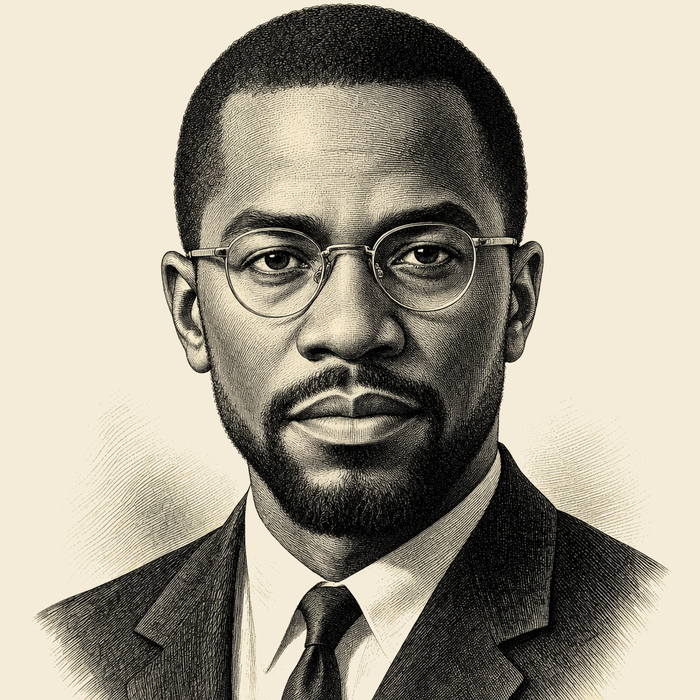
Republican lawmakers in Alabama drew Shomari Figures’s new congressional district to cut its voting-age Black population from 48 percent to 40 percent and make his reelection harder.
There is no metaphor in that sentence and no accident in that arithmetic. A voting-age population is a count, and a map either holds the count or it reduces it. Alabama’s legislative majority reduced it by eight points, with a pen, in the district of a Black congressman whose seat it wanted, after the Supreme Court’s decision this year gutted the Voting Rights Act and reopened the door the statute had held closed for sixty-one years. This is what power does when it cannot win an argument: it changes the audience.
Sheyann Webb-Christburg was eight years old on the Edmund Pettus Bridge at Selma on March 7, 1965 — Bloody Sunday — in the crowd that state troopers met with billy clubs and tear gas, in the months before Lyndon Johnson signed the act into law. Sixty-one years later she stood Tuesday night in Montgomery, the city where the Confederacy convened its first capital and where the Selma march finally concluded, among people celebrating an election this year’s jurisprudence had been built to make impossible. “I think a new movement has started,” she said. She has earned the right to name a movement. She was there when the last one was paid for in blood.
Before a single ballot was cast, the design of this election was already written, and it was written in district lines. In Tennessee, Republican lawmakers split the congressional district representing Memphis, a majority-Black city, into three. In North Carolina, they redrew Representative Don Davis’s seat to be favorable to the GOP. The Associated Press describes this year’s Supreme Court decision as weakening the act and allowing Republican-led states to redraw districts in exactly this way — in a manner that weakens Black congressional representation. That is not cartography. That is arithmetic, and the arithmetic had a purpose: fewer Black voters per district, fewer Black representatives, a Congress shaped accordingly.
Follow the map to the people who profit from it. Its authors are the Republican state legislative majorities, working in the window the Court opened. Its beneficiaries are the politicians who inherit safer seats without persuading a single additional voter — representation gained by subtraction rather than by argument. Its cost bearers are Black voters in Alabama, in Memphis, and in North Carolina. Its public framing is the word “redistricting,” a word that names a neutral clerical act and launders a targeted one. Nobody who drew those lines believed they could win those voters. That is the tell. It is also the fear.
Figures, forty-one, ran anyway. He did not run from the map and he did not campaign on it; he ran on the economy, and on what his voters were living — the plain exhaustion of the moment. “People are just tired, man,” he told the Associated Press. “They’re tired of the lack of decency. They’re tired of the lack of integrity. They’re tired of the lack of honesty.” That is a platform. Donald Trump carried that district by double digits two years ago. On Tuesday, Figures won it, carried by Montgomery, a predominantly Black city where some polling places saw lines stretching around the block for much of Election Day. A line that gathers and a line that intends are different instruments, and Montgomery has stood inside both — on the bridge in 1965, and at the polls on Tuesday. The map assumed his voters were a fixed quantity, subtractable on paper. They were not fixed, and they could not be subtracted.
Now the receipts, because they are unusually clean. The AP Voter Poll found about nine in ten Black voters supported the Democratic candidate in their local U.S. House race, up from about eight in ten who backed Kamala Harris in 2024. In Georgia, about nine in ten Black men voted for Keisha Lance Bottoms, against roughly three-quarters who supported Harris two years ago — a shift large enough to move Black support as a whole. In Clayton County, in metro Atlanta, where about two-thirds of residents are Black, Bottoms drew almost 86,000 votes — about 13,600 more than Stacey Abrams received in her 2022 race for the same office. Static models lose to electorates that decide to move. Too much of the week’s coverage, busy celebrating turnout, buried the harder point: these were not wins that arrived by good fortune. They were wins wrested from maps and budgets built on the assumption that Black voters could be discounted.
Bottoms did not have a map drawn against her. She ran statewide, where subtraction is harder, and she won the governorship outright — the first Black woman elected governor in U.S. history. Black women won the races for attorney general, secretary of state, agriculture commissioner, insurance commissioner, labor commissioner and school superintendent alongside her. Bottoms, whose family lineage traces to an antebellum plantation in Crawfordville, the Georgia town that produced Alexander Stephens, the Confederacy’s vice president, told the state that Georgia “is not defined by one moment in time or by one person,” and that she would be “a governor for everyone in this state.” Where the legislature could target a single district, it targeted. Where the whole state had to be faced, the state was faced, and the state chose her. The discounts did not clear.
The movement had authors too, and the column owes them specificity. Federal Reserve Economic Data put the broad U-6 underemployment rate — which counts discouraged workers and involuntary part-time employees — at 7.6 percent as of November 5, and both Figures and Bottoms made the economy the center of their campaigns rather than an ornament to identity. The people in those Montgomery lines were not expressing an identity. They were issuing a verdict on rent, wages and exhaustion, and delivering it through the precincts the mapmakers assumed they had already discounted. The other half of the motive: the Republican president’s second-term crackdown on diversity initiatives and his effort to limit how the government tells the nation’s history on race and civil rights — conduct that did what insults have always done to people who have heard them before, which is clarify the stakes. “We can smell racism,” said LaTosha Brown, a co-founder of Black Voters Matter. “We can see it … we can feel it, and we know how to respond to it.” Her second sentence is the operating manual: “Our survival has been based on our ability to resist it and respond and navigate around it.” Black voters are not a mood that shifts. They are a documented constituency responding to documented conduct, an economic squeeze compounding a disrespect they have survived before and can name on sight.
Do not stop the inquiry at the hands holding the pens. King, eulogizing the four girls killed in Birmingham’s Sixteenth Street Baptist Church in September 1963, refused to let the indictment end with the men who planted the bomb; the deeper question, he insisted, concerned the system, the way of life, the philosophy that produced the murderers. The philosophy here is old and thoroughly documented. Black Americans entered Congress and other offices during Reconstruction, after slavery was abolished; disenfranchisement, violence and discriminatory laws then eroded that representation for the better part of a century. The Voting Rights Act of 1965 answered Selma. This year the Court gutted the statute, and the maps came through the opening before the year was out — and the mapmakers drew what the license allowed. Across one hundred sixty years, from Reconstruction to Selma to this year, every documented gain in Black voting power has been answered not with a counter-argument but with a rule change. Read this year’s decision for what it did in operation, whatever its opinion says in text: it removed federal protection at precisely the place the American record says protection is required. The majority did not carve up Memphis with its own hands. It supplied the arithmetic and let the statehouses do the carving, which is how the men who dissolved the Reconstruction amendments’ promise used to work as well. The appetite is on the record beyond this one ruling: Justice Clarence Thomas argued in writing, in his concurrence in Dobbs v. Jackson Women’s Health Organization (2022), that the Court should reconsider its substantive due process precedents, naming Griswold, Lawrence and Obergefell. A Court whose members advertise an appetite for unmaking settled rights is not a Court that stops at one act. The map on Shomari Figures’s desk is not an anomaly. It is the philosophy’s current instrument, and the philosophy has not changed its mind.
Be equally honest about what did not win, because a column that claims the victories and hides the losses is working the same ledger as the mapmakers. Justin Pearson conceded a close race in one of the three fragments of the Memphis district, a count the Associated Press had not called; Amber Sherman, also of Black Voters Matter, said the turnout showed Black voters believed “the redistricting was wrong, and it was racist.” Angie Nixon lost Florida’s Senate race by fewer than three percentage points in a state where Republicans had romped by nearly twenty points four years ago. In Mississippi — where Black residents make up a larger share of the population than in any other state, and which has not sent a new Democratic senator to Washington since the era of Jim Crow segregation — Scott Colom took Senator Cindy Hyde-Smith to a margin so thin the count remained live as this was filed. And the Congressional Black Caucus had braced, after the Court’s decision, to lose as many as nineteen seats — a third of its roster. With votes still being tallied, the losses were running well short of that. That concession matters. The design did not fail on its own. It was overrun. Read those two numbers side by side: the Caucus priced the intent at nineteen seats. Short of nineteen is the measurement of the refusal.
Here is the second indictment, and this one lands on the people who claim these voters as their own coalition. By the Davis campaign’s own accounting, the Democratic National Committee and the Democratic Senatorial Campaign Committee put nothing — nothing — into Jamie Davis’s Senate campaign, while Davis, a Black farmer who began the race with virtually no statewide profile, raised more than four million dollars from individual contributors. In a state Trump carried by twenty-two points in 2024, Trump-endorsed three-term congresswoman Julia Letlow survived by fewer than two. Randal Gaines, chair of the Louisiana Democratic Party, sought national party financing, and the money never came. “We were within striking range of victory, and additional funding would have guaranteed it,” Gaines told the Associated Press. Take the guarantee with the grain of skepticism any counterfactual deserves; the documented facts are sufficient. National leaders had largely written off Nixon’s Florida campaign as a hopeless cause for the same reasons. These are not acts of weather. Committees set budgets, budgets have authors, and the authors chose. The party’s own leadership has confessed the pattern, which spares me the work of proving it. Harris called the results “a huge wake-up call” and said, “I’ve long believed that we have failed to put the resources into Southern states” because of a “misdirected perception of who the people in those states are and what they want.” Abrams, who has made this argument for nearly two decades, put the arithmetic flatly: “When we underinvest, especially states with significant populations of color, we throttle our own ability to expand the map.” Who benefits from the write-off? The consultant-and-committee infrastructure clustered in a handful of perennial battlegrounds, where the money recycles through the same offices cycle after cycle. Who pays? The South, which is asked for its votes, credited for its moral witness, and funded like an afterthought. The same committees are now recalculating the Senate seats that flipped this week and what they do to the 2028 contest. They should add one line to the recalculation: the margins in Louisiana, Florida and Tennessee were not the voters’ ceiling. They were the party’s contribution.
Trace the chain past the symptom, because the narrow losses were not a failure of turnout, of candidate quality, or of Southern viability. They were downstream of a budget decision — that Southern states with significant Black electorates are not worth the investment — made long before Election Day and never revisited. King named this counselor in the spring of 1963, writing from a Birmingham jail cell: the great stumbling block, he argued, was not the open extremist but the white moderate — more devoted to order than to justice, satisfied with a negative peace that is merely the absence of tension, and always ready to set the timetable for another person’s freedom (Letter from Birmingham Jail, April 16, 1963; reprinted in Why We Can’t Wait, 1964). King was analyzing clergymen who had asked him to wait. His moderate has since moved indoors. He sits in committee rooms now, and his timetable is a budget cycle, and his counsel of patience is a spending decision. Every Southern cycle produces the same artifact at the precinct level: a field office that opens in October and locks its doors the day after the election. Colom, asked about the astonishment elsewhere in the country, declined to share it: “Unlike all the people across the country that might be surprised, our campaign, our volunteers, the people of Mississippi are not surprised.” Neither am I.
Understand, then, why the maps must keep being redrawn, cycle after cycle, state after state. Subtraction requires maintenance. The manifesto Karis Nemik writes in Andor states the physics plainly: “Tyranny requires constant effort. It breaks, it leaks. Authority is brittle. Oppression is the mask of fear.” The fear here has a name and a number. Legislators who could have competed for Alabama’s Black voters chose instead to redraw around them, cutting the count from 48 to 40 rather than making an argument to the 48. Power that must change the rules to avoid the electorate has already conceded everything worth conceding.
Malcolm X stood in Cleveland in April 1964 and compressed his era’s choice into six words: “It’s the ballot or the bullet.” Sixty-two years later, across the South, the answer was the ballot, cast in lines around the block in districts engineered for the opposite result. Hold to the discipline the phrase carries. The ballot remains sufficient only while the floor underneath it holds, and this year the Court took a sledgehammer to the floor. The question the next cycle asks is whether that floor gets rebuilt by statute and by budget, or whether the choice compresses again.
The bet, this year, was that the maps plus the hunger would produce silence — the appetite Justice Thomas advertised, the arithmetic the statehouses executed. Alabama produced lines around the block. Mississippi carried its Senate race to a margin still being counted. The bet lost — not because the Court relented, and not because the party funded the answer, but because the voters refused the premise.
Return to Webb-Christburg, because the column’s horizon lives where she was standing. In the last week of his life, from the pulpit of Washington National Cathedral, in “Remaining Awake Through a Great Revolution,” King preached that the arc of the moral universe is long, but it bends toward justice. King was right, and King was incomplete in the way that matters: the arc bends only where people put their hands on it, and the pushing has never been free. Hands went onto it at the bridge in 1965 and at the polling places of Montgomery on Tuesday. So the movement Webb-Christburg named has a first agenda, and it is not a mood. Fund the South — the committees that banked zero for a Black farmer in Louisiana owed him an operation, and they owe the next one more, at the scale the record has already proved: four million dollars in individual contributions came within two points in a twenty-two-point state. Build the next operation from March instead of October, and keep its field offices open past Election Day. Defend the ballot — the act the Court wounded was built for Memphis and Montgomery and Jackson, and a statute can rebuild what a Court will not. Name the design — a map that cuts a district’s Black voting-age population from 48 percent to 40 percent is not an accident of the process; it is the process, working exactly as drawn. Budget the South like a battleground. Rebuild the statute like the floor it was. Trust the voters, who have just demonstrated one more time that they can count. The next hands belong to named decision-makers: the Congress that can rebuild the statute’s floor, the committee chairs who can budget the South like a front instead of a favor, the organizers in the Black Voters Matter tradition who have now proven the arithmetic again.
King called the destination the Beloved Community — a polity in which no one’s count has to be defended by heroics every other November — and he never pretended it would assemble itself. It did not arrive on Tuesday. It came closer. It is not a metaphor. In this decade it is a budget line, a statute, and a map that no one can redraw to shrink a neighbor’s child.
Webb-Christburg has now stood on both sides of a statute’s life — won at the Edmund Pettus Bridge, gutted by a Court decision — and both times the answer has come from people who refuse to be subtracted. She was eight years old when men with clubs tried to teach her that the ballot was not hers. On Tuesday night she stood in Montgomery, in a crowd refusing the lesson for the third act running, and called what she saw a new movement. The voters answered the Court. The map is paper. The people are not. The results leave exactly one question hanging over the party that claims them: when does the money answer the voters?