
The Trump administration starved patients by cutting Medicaid and letting enhanced ACA credits expire.
It was Saturday night at the bench with the shop doors shut and the Honda EU2200i running the lights. A Stihl chainsaw stood on the bench. A chainsaw does not care who won Congress. It cares whether diesel costs what the business can bear, whether parts arrive, and whether the owner can still afford the repair. What I kept coming back to was the hospital this county built for itself.
Adams County Memorial Hospital went up in 1959. George and Mary Polivka donated the land. The 1957 Friendship county-fair centennial funded much of the building. The hospital still stands, later expanded, doing the work it was raised to do. There is no ticker for it. Nobody has ever bid on it in New York.
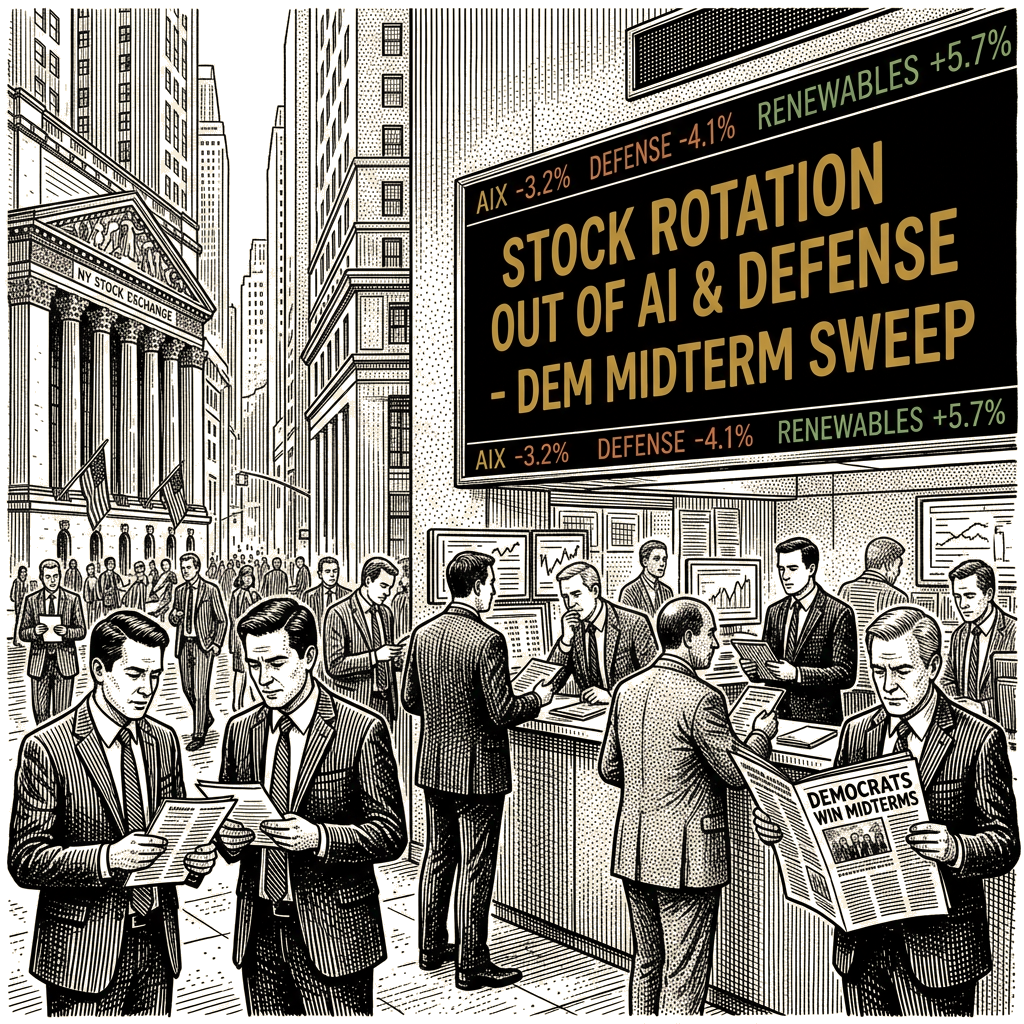
Then came the Associated Press report by Damian Troise on the way markets turned after the midterms, and MSI tracked the first session’s swing across AI, defense and energy. Democrats won and were set to take control of Congress in January. Wall Street began pricing a different country before the new Congress took office: slower data-center construction, a possible end to the U.S.-Iran war, restored or boosted Medicaid and ACA money, and tariff relief.
Northrop Grumman, Lockheed Martin, RTX and General Dynamics fell between 4 and 12 percent after Tuesday on hopes that the war would end. The market sold peace before peace had been signed.
The hospital trade was the clearest. HCA Healthcare rose 6.9 percent, Tenet Healthcare gained 6.2 percent and Universal Health Services added 10.4 percent because investors expected Congress to restore or boost Medicaid funding and Affordable Care Act subsidies.
No Medicaid payment had been restored. No subsidy had been renewed.
Wall Street treats rural patients as election wagers. A gain in a hospital company’s share price does not refill a county hospital’s vacancy list. It does not put a nurse behind the desk at two in the morning or keep the doors open when the next accident comes down Highway 13.
Those companies are not Adams County Memorial. Their stocks wager on what restored federal money will do to hospital margins. The market can price that wager before Congress restores a dollar. It cannot turn the wager into a county hospital service.
In mid-2023, the Cecil G. Sheps Center at the University of North Carolina counted 195 rural hospitals closed or converted since 2005—100 closures and 95 conversions—and 35 rural hospital closures since March 2020. That is a long dismantling of rural care, not the work of one election or one administration. Nor does the long record erase the coverage loss already recorded.
A closed hospital is not a stock. A converted hospital is not a new ward. You cannot reopen either because an election was held in November. Money has to arrive before care can return, and the market had already traded the money coming back.
The market valued the possibility that Medicaid money and the tax credits return in January. The households that lost their coverage this year got no refund, and they will not get one from an index.
In “The Mortality of Capitalism,” collected in The Unsettling of America, Wendell Berry described an enterprise that can remain a going concern while the community around it is stripped of its members and resources. Berry’s larger frame was the community’s membership: the people who make the things, buy the things, teach the children and answer to each other out of the same county. The market does not trade Main Street. It trades the trade that already happened, and Berry’s membership is not in the index.
Whether the building is a factory or a server hall, capital can leave and the utility bill stays home. A national company can build where cheap power, land and politics make the arithmetic work. The county still has to live with what remains afterward.
The country says the word affordability, and the trade in affordability goes to two homebuilders and a home-improvement chain. D.R. Horton gained 4.9 percent, PulteGroup rose 4.4 percent and Home Depot added 2.9 percent. The homebuilders did not make a home more affordable; their stocks rose on the word.
Federal Reserve Economic Data put the median sales price of a United States home sold at $393,300 on Nov. 7. A 4.9 percent gain for D.R. Horton does not lower anybody’s rent on County Z. It does not make a starter house in Adams County affordable to a family making county wages. It puts another number beside the problem while people keep looking for a way through it.
The market bid up Dollar General 2.5 percent. The Adams County Times-Reporter still has its office on Main Street, and I still open it when it lands on Wednesday. My grandfather’s Friendship had three hardware stores. It has none now. When my grandfather ran his, the town had three.
The chain did not need to take the last store to profit from a Main Street already hollowed by consolidation. I am not blaming the people who shop at Dollar General or the people who work inside. The shareholder saw a chain with a future in every county with an empty storefront. I see what the empty storefront leaves behind after the register closes.
The barrel was the part of this week’s trading that landed in my own county. Oil exploration and refining were among the biggest beneficiaries of the war, which had stifled global supplies since February and raised crude-oil and gasoline prices. Several large energy companies lost ground after the midterms because investors expected the fighting to end and oil prices to fall. Exxon Mobil and Phillips 66 were still showing solid year-to-date gains. The distinction sat clean on the tape: somebody was selling peace, and somebody else was still holding the war profits.
At the co-op counter, on the diesel invoice and behind the house on County Z, a war premium arrives as freight, fertilizer, feed and the cost of getting grain to market. No peace had been signed, yet the market sold peace anyway. Peace is a cheaper gallon. I will take it with both hands.
A tariff is a tax with a flag on it. The customer in this county pays it inside the price of feed, fertilizer and beer. Constellation Brands and Brown-Forman gained on expectations of tariff relief. Costco Wholesale added 3.4 percent, Procter & Gamble rose 2.1 percent and Dollar General gained 2.5 percent as investors anticipated cheaper goods, lower oil-price pressure and calmer conditions.
But hold on. The market sold the defense names on the same peace, and the same fighting emptied the magazines. The conflict depleted weapons stockpiles and could create federal demand for resupplies. That is federal money, and federal money is where the county’s Medicaid dollars come from.
The trade priced in three days says the war ends and the orders stop, while the arsenal sits bare and somebody has to buy it back. The market can punish peace and reward war on the same morning, then reverse the wager when the headlines change. The war was good business for the people who sold into it. It was expensive for everybody else, including us, right down to the price of a gallon.
And then there was the machine trade, which fits the same shape as the rest of the week. More than two trillion dollars came off technology stocks in the days after the election. The market hit the people who build the servers harder than the people who pay for them. It is the same shape as the hospital trade and the same shape as the hardware store. The market keeps what finances the thing and sells what makes it.
Nvidia and Lam Research swung sharply after Democratic victories in statehouses raised concerns about slower data-center construction, particularly in Texas. Amazon, one of the hyperscalers financing the buildout, fared better. The market did not sell all technology. It sold exposure to a buildout it expected a new Congress might slow.
Renewable-energy businesses stood to gain from a more industry-friendly Congress, while companies supplying power and equipment to data centers did not fare as well after data-center skeptics were elected to Congress or governorships.
At my bench, the AI question is not whether a chip stock is expensive. The question is who carries the new load and who keeps control of the grid. A server hall needs power, cooling, land and a road that can take the equipment. The Adams-Columbia Electric Cooperative, the largest rural electric co-op in Wisconsin, is headquartered in Friendship. It answers to member-owners; a hyperscaler answers to shareholders. The co-op’s members need dependable service whether or not somebody’s data-center stock rose on Tuesday.
Musk made the political price of capital just as plain. He spent more than $445 million trying to help Republicans retain control of Congress. The spending did not prevent the Democratic victory. SpaceX fell 5 percent and Tesla fell 10.1 percent on concern that a Democratic Congress would investigate Musk’s work as Trump’s cost-cutting chief in 2025.
Trump Media & Technology Group lost 33 percent of its market value in the three days after the election. Donald Trump’s stake, worth nearly $5 billion in March 2025, stood below $600 million at the time of the Associated Press report. A planned merger with TAE Technologies remained pending. The market did not punish a political principle. It marked down political exposure and the loss of leverage.
Put together, this week made a market rule visible: elections are turned into prices before the elected government changes anything. No Medicaid payment had been restored. No data-center permit had changed. No end to the war with Iran had been signed. The money had already voted.
Chapter 16 of We Too gives this the name Community Collapse Contradiction: community-values rhetoric set against the policy reality of consolidated extraction taking the members out of a county. This week the rhetoric was not the mechanism. The mechanism was the price.
Capital can serve Adams County from somewhere else and collect on it from anywhere. A hospital, a fire district, a school and a water line cannot move as easily. Neither can the family that depends on them.
Sara’s job at the school district carries our health insurance; my own shop’s coverage was unaffordable last year. I buy coffee at the Dollar General on mornings when the shop is closed and I need a cup before the first customer shows up. The people who got cut are people I drink coffee with.
I drive a 2014 Chevy Silverado with 187,000 miles on it. I own my forty acres because my grandfather’s ground came down to my father and my father left it to me, and nobody is going to hand that out as a scholarship. The difference between this county and the county that gets the money is not effort. It is whose paperwork says so.
The market’s version of a restoration is a 10 percent move in a hospital stock. The county’s version is duller and harder. The money has to arrive as money this county can use and account for: in the hospital’s own budget, through the county’s well-testing program, and through a reimbursement rate written for an emergency room one road in and one road out of a county. It has to arrive every year instead of once, because the thing that took the hardware store off Main Street is not going to hand it back on a good quarter.
Any serious rural policy must put Congress back on the side of the place, not the quarterly earnings. It should restore the Medicaid and ACA money already taken and use public money to strengthen local institutions—co-ops, rural hospitals, housing and repair capacity—that give residents bargaining power instead of selling every service to the lowest-cost national chain. A public rule can set the floor, but local institutions must retain voice above it.
The county fair comes in September. In 1957 they set up booths on the fairgrounds and raised money for a hospital, and that hospital is still standing almost seventy years later. That is the strongest argument I know for what a county can do when it stays in one room together for a week. Mike is eight and wants to see the hogs. Quinn is five and wants the pony ride.
What I want for them is not a speech about who won in November. I want a line item in January in this county’s name, and I want it every year after. I want the question of who owns the hardware store answered the way this county answered the hospital: together, with the money it can raise itself. On the section-line road, the power line still runs to the shop and the cemetery. Capital can collect from Adams County without belonging to it. The market can price the vote. It does not own the road.