
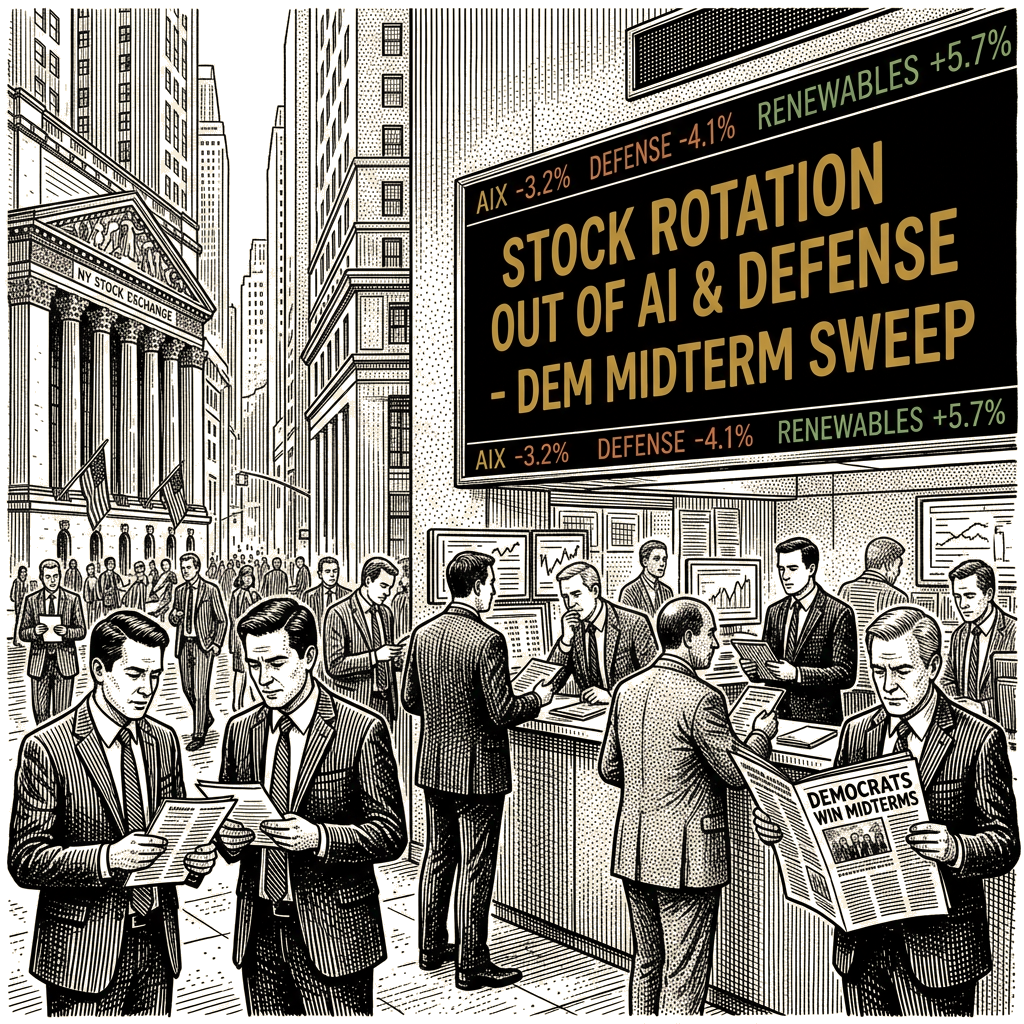
Wall Street turned our future into a trading position, and then called the result a market verdict. A Main Street Independent report, drawing on Associated Press analysis by Damian Troise, made the mechanism plain: after Democrats won the midterms and were set to take control of Congress in January, Nvidia and Lam Research swung sharply as statehouse results raised concerns about slower data-center construction in Texas; Northrop Grumman, Lockheed Martin, RTX and General Dynamics fell between 4 and 12 percent; HCA Healthcare, Tenet Healthcare and Universal Health Services rose between 6.2 and 10.4 percent; Tesla fell 10.1 percent, SpaceX fell 5 percent, and Trump Media & Technology Group lost 33 percent of its market value in three days. Every price was a wager on what a future Congress might do. Not one of them promised anything to the town that would have to live with the result.
The honest case for the tape is straightforward. Markets exist to carry uncertainty; futures markets were built for exactly that purpose. If Medicaid and Affordable Care Act subsidies are restored, hospital economics change. If the war with Iran ends, expectations for defense contractors and oil producers change. If tariffs ease, the cost of imported goods changes. If data-center construction slows, the prospects for chipmakers, power suppliers and cooling companies change. Homebuilders, alcohol companies and consumer staples gained on expectations of lower costs, renewed attention to affordability and relief from inflation. A price ought to move when the probability of future cash flow changes. No fraud or stupidity is required.
The report was also careful about the distinction between a forecast and a completed event. The moves reflected expectations, not actions already taken. Congress would not take control until January, and the pending Trump Media merger with TAE Technologies had not been completed. A trading position is not a policy. That distinction makes the machinery plainer; it does not make the institutions wiser.
No fraud is required for the betrayal either. A hospital became a discounted stream of government payments; a defense company, a geopolitical hedge; a homebuilder, a tariff trade; a data-center complex, a permission slip; an ordinary consumer company, a wager on inflation and shipping costs. These were no longer institutions in the civic sense, but positions whose value changed when Washington changed its mind.
A company may be merely a security. A community is not. It is a web of obligations, memories, customs and people who already know one another’s needs. Those obligations cannot be purchased at the open, though they can quietly be made impossible to honor. The market has been asked to price a future it cannot build, and we have mistaken its confidence for wisdom. What the price can discount is not the hospital’s civic vocation.
The financial abstraction did not merely describe the economy. It made capital’s mood their master. That is what conservatism should resist: not markets, but rule by an abstraction with no place in it.
Edmund Burke began with society as an inherited trust: “a partnership between those who are living, those who are dead, and those who are to be born.” Michael Oakeshott called conservatism a preference for “the familiar to the unknown, the actual to the possible… present laughter to utopian bliss.” The post-election tape forgot both. It knew Congress might change, and it treated hospitals, defense plants, oil wells, homebuilders and data centers as instruments in one national forecast.
This is the financialization of institutional life.
Price continuous. Duty forgotten.
I know the seduction because I lived inside it. I traded contracts on corn, cattle and beans before I had learned what a failed crop did to the people who planted it. A futures price is a machine for carrying uncertainty, and a useful one. It can tell a buyer what he may pay under conditions nobody controls. It cannot tell him what the farmer knows, what the county has carried for generations, or what ought not to be sold at all. The pit could price the crop. It could not possess the practice.
Paper could outrun dirt. A futures contract allowed a distant buyer and a local grower to meet at a common price without either pretending to own the other’s field. But when control passed to people who would never set foot in the country, mediation became command.
That limit matters in Adams County. The Chicago & North Western built Adams as a railroad division point in 1911–12; St. Leo’s parish dates from 1884; rural parishes consolidated; the VFW hall aged; storefronts went dark. I grew up in that country and watched the arithmetic from the other side of the counter.
Those institutions were not sentimental scenery. They were arrangements in which neighbors learned how to work, settle disputes, bury the dead, marry, teach children and answer for one another. When they weakened, the financial ledger called it consolidation, amenity conversion or seasonal housing. It can count the vacancy. It cannot tell you what the vacancy has done to the place. The last scheduled passenger train ran on July 23, 1963. The Wisconsin Rapids paper mill idled in 2020. Family farms across the region disappeared into larger operations. Those dates do not reset because an election changes the legislative weather.
A county is not a balance sheet. The spreadsheet calls its losses an adjustment. The town calls them grief.
Nothing in the tape shows that a hospital bed was filled or a war ended because a share moved. A rising ticker filled no hospital bed; a falling contractor’s share ended no war. HCA rose 6.9 percent on the hope that subsidies would be restored; no patient was treated because the ticker rose. Donald Trump’s stake in Trump Media, worth nearly $5 billion in March 2025, stood below $600 million when the Associated Press filed its report. These were paper fortunes and paper consequences. A market can price expected revenue. It cannot know the bedside, the barracks, the kitchen or the field.
Our earlier MSI coverage put a number on one side of this rotation: technology stocks lost more than $2 trillion on fears of artificial-intelligence regulation after the midterms. A trillion is the trader’s unit. It tells us what happened to holders of paper, not what remains in the county after construction changes, whose water and power the new economy requires, or which communities will be asked to carry the bills.
This is not an argument against markets. I traded them; I know what they are for. The market is a good servant of exchange and a bad master of political life. It can allocate capital, price risk and reveal preferences. It cannot remember a duty or consecrate a community. To make the price the measure of the world is to dissolve the institutions that make the world livable.
Nor will I cure concentrated private command by building concentrated public command. A generous federal program may be morally necessary and still be insufficient. I am not going to sneer at hospital shares if restored Medicaid and Affordable Care Act subsidies mean fewer people lose coverage. A human being is not a balance-sheet variable. A hungry child is not a market signal.
The correction begins with my own side. The answer offered by those who fear concentrated power is to make every local failure a federal vacancy and then enlarge the apparatus of command until the family, farm, clinic, parish and shop become clients of a distant state. If restoring Medicaid and ACA credits keeps care from being denied, that is good work. But if the new Congress restores the money while moving every decision away from county boards, hospital trustees, parish councils and cooperative members, it may repair access by hollowing out the body that gives care its civic form. If every Main Street waits for another federal program, dependence has changed owners, not disappeared.
The market temptation and the administrative temptation are cousins. The first hands every question to price; the second hands every answer to Washington. Both concentrate power, and a conservative must refuse both. Concentrated capital and concentrated state power are the same disease in two coats. A hospital chain can turn care into a quarterly utilization rate; a state agency can turn care into a claim code. The test must be symmetrical, not whether care is public or private. Who owns the residual claim? Who has voice, exit and appeal? Who bears the risk of a bad decision?
Human dignity outranks both ownership formulas. Property is real and good; it protects the independence of the household and the farm. But property answers to the universal destination of goods. The earth was given for all.
The administrative temptation would centralize to stop concentrated capital from owning the country, then give the state the deed and keep the deed office. Pius XI’s Quadragesimo Anno, §79, calls it “a grave evil” to assign to the higher body what lesser organizations can do. Public law may establish a floor, enforce fair dealing, finance infrastructure and check monopoly. It should not become the sole owner of every hospital, bank, utility and farm. A state can fund the floor; a county must still organize the room above it. Local bodies are not quaint when credit flows toward them. They are quaint only when they are asked to bear demands without authority.
The answer has to be built as a lattice, not a pyramid. In my own town of Friendship, the Adams-Columbia Electric Cooperative has about 31,560 member-owners across twelve counties and a member-elected seven-person board. That is not anti-market. It is market power with a memory. The farm cooperative I manage began from the same logic: farmers pool what they know and what they own so the largest buyer cannot dictate every price and every condition.
The Rochdale Pioneers gave the cooperative form its discipline in 1844; principles later codified by the International Co-operative Alliance in 1995 preserved voluntary membership, one member and one vote, member participation, education and cooperation among cooperatives. The Capper-Volstead Act of 1922 gave farmer-owned marketing cooperatives room to bargain. The Rural Electrification Act of 1936 used public credit to help rural electric cooperatives build service while leaving governance in the hands of the members. That is the pattern: public capital where scale requires it, distributed authority where the practical knowledge lives.
A credit union can decide a loan without a distant fund overruling it. A farm cooperative can pool a crop without surrendering the farmer’s judgment. A community clinic, mutual insurer or worker-owned manufacturer may fail, but each can put ownership and accountability nearer the people who bear the consequences. Organic Valley, headquartered in nearby La Farge, unites more than 1,600 family farms. Mondragon employed 70,085 people and reported €11.213 billion in sales in 2024. Scale is not the disease. Concentrated, unaccountable control is.
The form can cross scales, but it is harder here than selling a spreadsheet. Patient capital is scarce, members are exhausted, and the law must keep managers from using the co-op form as cover for private rule. Cooperatives can decay into managerial oligarchy. A 2022 review of 83 enterprises found that 63.5 percent resisted or regenerated in the face of degeneration, while only 9.5 percent fully degenerated; the near misses matter. Ownership means a vote, open books, member education, an elected board, a way to remove management and a rule that the surplus belongs to the members. No quarter’s earnings will teach you governance.
None of this will move the index. The point was never the index. It was whether an ordinary place can retain institutions that answer to its people before every hospital, farm, shop and utility becomes an exposure to Washington, Wall Street, war or tariffs.
Adams cannot be recovered from amber. The last scheduled passenger train ran on July 23, 1963; storefronts shut. We know. The choice is not between the past and the future. It is between ownership and authority remaining near those who bear the consequences.
At the farm-co-op counter I manage, someone knows which field drains, what buyer grades honestly and what price lets a family remain on the land. The board votes. The manager answers. The surplus either returns to the members or remains in their reserves. That is not a monument. It is ordinary work, and it is the only answer I know that does not make a town’s survival depend on the market’s confidence next quarter.
Leave the town its life.
The market can price a stock. It cannot keep a county alive.