
The Democratic Party’s religious left is conscripting Scripture into a campaign instrument.
Two rows behind me in a Sunday service, a woman with a grandson on insulin and a warehouse job their family expects automation to erase voted for the man behind the lectern marked “Love Thy Neighbor.” I love her. I will not let anybody use this column to make her feel small. She is not an ornament in the argument, and neither is the conviction that brought her to the ballot. A religious vote can be a serious demand that public power answer to something larger than itself. The trouble begins when public power answers by making that faith smaller.
It made a hell of a rally cry. It also documented the operation.
James Talarico won the Texas Senate race and ended his victory speech behind that lectern. “That barefoot rabbi didn’t stay in his room and pray,” he told the crowd. “He walked into the seat of power and he flipped over the tables of injustice.” Then he told Texas it was time to start flipping tables. Adam Hamilton won the Kansas Senate race after flashing his Bible at campaign events. Sarah Trone Garriott, a Lutheran minister, defeated a Republican House incumbent in Iowa while continuing to preach in churches across the state.
Three races, one new pattern.
The theologian Anthony Bradley called it “a Jesus-speak secret sauce that works.” That phrase is not a verdict on whether these candidates believe what they say. It is a description of why their message traveled: religious voters recognized a register they knew. The message was not merely that they were Democrats or that they favored expanded health coverage. The message was that they could speak as Christians, with confidence, to people who had been taught that political Christianity belonged to Republicans.
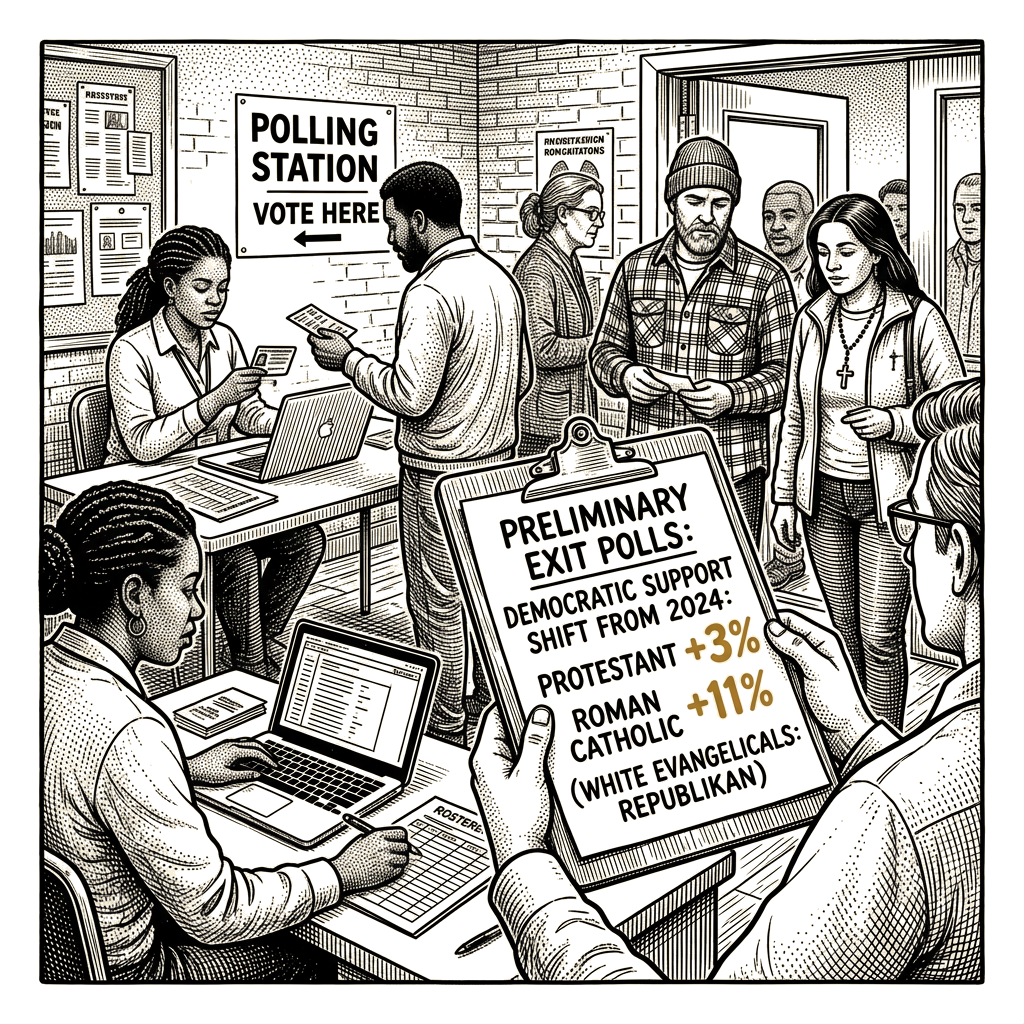
Preliminary exit polls showed Democrats gaining ground among Christian voters relative to 2024: a three-percentage-point shift in Protestant support toward Democratic candidates and an eleven-point shift among Roman Catholics. White evangelicals still overwhelmingly backed Republicans. Bill McKibben announced that progressive Christianity had won the 2026 midterms, and the arithmetic gave him a hearing. Michael Wear, president of the Center for Christianity and Public Life, hoped the election marked a break with a politics in which one party claimed to defend religion while the other treated faith as an affront.
This was not a repudiation of conservative Catholic politics. Kelsey Reinhardt, chief executive of CatholicVote, noted that Republican voters still supported the social-conservative measures their group had backed in Colorado, including restrictions on transgender athletes in girls’ sports and certain gender surgeries for minors. Nor was it a wholesale conversion of theology. A Pew Research Center survey released in October found President Trump’s approval falling among every religious group since the start of his second term. Sixty percent of white nonevangelical Protestants disapproved, along with 59 percent of white Catholics and 78 percent of Hispanic Catholics. Pope Leo XIV and the American bishops had spoken against the administration’s immigration-enforcement tactics, some of which particularly affected Hispanic Catholics.
The White House answered in its own register: “There has never been a greater president for Christian Americans than President Trump, and his strong record proves it.” That is a vacancy, not a mandate. And a vacancy is where machinery gets built.
Before the election, Democratic candidates were already using religious language and listening to reach voters. Afterward, the clergy-candidate victories across Congress gave the method an institutional future. The Democratic Congressional Campaign Committee held briefings for congressional candidates on outreach to faith voters and communities, according to its national political director, Brooke Butler. Nine Democrats who studied at a seminary or divinity school will serve in the 120th Congress. Talarico tied honoring God and following the Golden Rule to expanding health coverage, lowering the cost of living, and repealing billionaire tax cuts.
The machine did not begin with an idea. It began with repeatable speech.
A briefing does not tell us what every candidate believes. It does not make Talarico’s economic argument into nothing. But the briefings make an institutional effort to coordinate visible. Bradley’s “secret sauce” makes the method visible. A principle can be held up to Scripture and fail. A campaign message is built to move an audience whether or not the speaker can answer what it means. At its clearest, the difference is this: the first changes what a person does on Tuesday because of what they believe on Sunday; the second tells a candidate what to say on Sunday because it was decided somewhere else entirely.
I know the mechanism from the other side of the pulpit. For thirty years I taught women’s Bible studies—eleven years in Alabama and nineteen in Georgia—and I can tell you exactly how a religious coalition gets built because I helped build one. You find the theological fault line. You find the people who can carry it without embarrassment. You give them one sentence that fits in a fifteen-minute devotional and a thirty-second commercial break. You teach them to say it in the same words in every living room, every fellowship hall, every county courthouse. Then you make sure the invitations and the money run through people who will say it that way.
We did not call that political. That was part of the trick.
In my church, that sentence was Romans 13:1–7. I taught Romans 13 out of that workbook for fifteen years—submit to the governing authorities because they are God’s ministers, bearing the sword for the one in whose hand is the rod—and I taught it as though it were the most freedom-producing verse in the Bible. I was very good at it. That is not a compliment; it is a confession.
And that machine was built, which is the part the champions of both sides keep forgetting. It was built at Café Du Monde in New Orleans in 1967, when Paul Pressler and Paige Patterson began the strategy that would give them control of the Southern Baptist Convention. It was built in Houston in 1979, when Adrian Rogers took the presidency. It was built in Dallas in 1980, where Ronald Reagan told the assembled conservative pastors, “I know you can’t endorse me, but I want you to know that I endorse you.” That last sentence is the founding document of American religious politics. The Moral Majority, the Council for National Policy, voter mobilization, and modern candidate training carried that logic forward.
The infrastructure grew more sophisticated. Tim LaHaye founded the Council for National Policy in 1981 with money from Nelson Bunker Hunt and T. Cullen Davis; membership was secret and by invitation. James Dobson founded the Family Research Council the same year. In 2024, forty-three years later, Liberty University sat on Project 2025’s advisory board. Kristin Du Mez’s Jesus and John Wayne tells the story of what that fusion did to white evangelicalism: a nation, a masculinity, and a Savior welded into one identity and handed to a political class. And by 2022 the Southern Baptist Convention’s own commissioned investigation documented an Executive Committee that kept a secret list of roughly 700 people accused of abuse for two decades, belittled survivors, and put institutional liability ahead of care.
The religious left is not there yet, and saying so plainly is part of being honest. There is no religious-left analogue of the 1981 secretariat. There is a DCCC briefing, nine seminary graduates, and a set of victory speeches. The apparatus is at the drafting stage.
But the danger follows the direction. Once doctrine is filtered less by whether it bears fruit in the life of a church than by whether it moves a coalition, the texts stop being a check on power and start being a credential for it. The moral danger is the same shape, though the historical record is not equal; honesty requires saying so.
For the religious right, it was never a revival. It was a machine wearing revival’s clothes. I know because I was inside it for thirty years and did my share of the work. It had its drafting table, its issue campaigns, its favorite verses, its appetite. It took the Bible’s authority and called it America’s, then called the party that wanted nothing to do with the Bible the party that had abandoned God. Enough people believed that on both sides to build two political coalitions out of it.
The right one built its coalition. The left one is building its coalition now, out of the same workshop, with the same tools. The difference in direction is not a difference in kind. Neither machine is the answer.
I owe that history to Jemar Tisby’s The Color of Compromise, which traces the historical work I could testify to from the inside. Walter Brueggemann, in The Prophetic Imagination, warned that “the same royal consciousness that makes it possible to implement anything and everything is the one that shrinks imagination because imagination is a danger.” That is what a message machine does. It implements. A coalition whose allegiance changes when the coordination changes has evidence that coordination has substituted for conviction. That indicts the operation, not the believer’s capacity to be taught. A theology whose job is to make the dominant culture’s newest winning team more recognizable is not prophetic imagination. It is campaign research with a Bible index.
Now let me show you the verse, because Talarico’s sentence and the verse are not saying the same thing, and the distance between them is where this entire business lives.
Mark 11:15–18, 27. Jesus enters the temple precinct and drives out those selling and those buying. He overturns the tables of the money changers and the seats of those selling doves. Then he says, “My house shall be called a house of prayer; but you have made it a den of thieves” (Mark 11:17). The sellers and buyers are the ones he drives out; the tables are the instruments of their trade. The passage presents commerce obstructing worship and the authorities’ response: the chief priests and the scribes hear these things and begin plotting how to destroy him (Mark 11:18). Jesus does not seize the temple. He cleans it and keeps teaching in it (Mark 11:27).
The line he quotes joins Isaiah 56:7 with Jeremiah 7:11. He does not invent an indictment; he sets the prophets’ own words down at the place where they have been made false.
We need not allegorize every table into modern politics. The passage is about the temple precinct, those profiting within it, and the rulers whose authority depends on the arrangement. It does not describe a legislature. It does not give a candidate permission to appropriate Jesus’ authority as a credential for taking office.
Here is the chasm, and I want to put my finger on it. “He walked into the seat of power” is the campaign’s reading, not the text’s. The text has a Savior in it; the campaign has a metaphor in it. The question is whether that metaphor can bear the text’s claim or merely uses the text as a credential.
The lectern marked “Love Thy Neighbor” did not make the campaign’s theology wrong. A stage prop cannot indict a man. What the record does show is an operation: candidate briefings, repeatable language, and a victory instruction built from a Gospel verse useful for turning moral fury into campaign momentum. Mark 11 will not serve as a mascot. It is the standard by which the operation must be judged.
Now hear me on this, because I am not going to stand in a church and scold the women and men who voted for these men. I have sat beside people whose families were one bad quarter from losing everything, and I will not stand in front of them and correct their theology while their grandson’s insulin costs four hundred dollars a month.
Talarico’s economic program—expanding health coverage, lowering the cost of living, and repealing the billionaire tax cuts—deserves to be judged on its merits. The prophetic logic supports that direction, and I will not pretend otherwise. Amos 5:24 asks for justice to roll down like a river. Micah 6:8 asks what the Lord requires of a mortal. The frame is sound. The failure is not the economics. The failure is the conversion of Scripture into a credential that answers to no one.
Now take another verse. In Mark 12:13–17, opponents test Jesus with hard questions. He asks for a coin, examines whose image and title are on it, and says: “Render to Caesar the things that are Caesar’s, and to God the things that are God’s.” NRSV and ESV use “Render.” NIV renders the first clause, “Give to Caesar what is Caesar’s.” One word changes the cadence, not the boundary Jesus draws.
The plain meaning is not that Christians must flee public life. Jesus acknowledges that Caesar has a real claim. Nor does he give Caesar the name of God, and the coin in his hand proves the point: Caesar’s image is on it, and Caesar’s image is not God’s image. The claim has a domain. It does not reach the temple, the covenant, or the name of God. That is the line Jesus draws—in the temple, in the middle of the conflict with the authorities who ran that religion, one coin at a time.
Now name the two readings this line does not support.
The conservative habit of quoting “Render to Caesar” as though public authority must never be questioned is one error: it makes the verse a gag order on conscience, as though the only permitted use of a text about Caesar is to stop people asking questions about Caesar. The religious-left temptation is to quote Jesus as though a party platform carries his authority—to make “the seat of power” a seat Christ occupied and a campaign platform a table he overturned. That is the same error in a different coat. The chasm is worth naming plainly: Mark’s Jesus will not baptize Caesar, and he will not let Caesar baptize him.
I do not need to know what God intended in that temple to know what the text does. And the line between throne and altar that I draw from this passage is my judgment, not Mark’s verdict on the 2026 election. Mark gives the shape of the line—a real temporal claim that cannot annex the divine name. Whether the religious left has crossed it is a question I answer by watching what they build, not by pretending the verse settles it for me.
Micah 6:8 offers the same restraint: “What does the Lord require of you? To act justly and to love mercy, and to walk humbly with your God.” Applied to a candidate, that verse requires examination of the candidate. “Walk humbly” leaves the messenger accountable too. Micah does not endorse a platform because a politician set the verse beneath a headline.
Matthew 25:31–46 makes hunger, thirst, the stranger, sickness, and imprisonment the measure of discipleship. Jesus says plainly that whatever is done to “the least of these” is done to him. A candidate may claim that verse’s urgency. He may not appropriate the verdict by quoting it on the campaign trail. If “the least of these” can never embarrass the candidate, then “the least of these” has become a campaign possession instead of a judgment.
And Romans 13:4 calls the ruler “God’s minister”—a word about accountability, not about a permanent exemption from it. A Republican campaign that uses Romans 13 to sanctify state power while ignoring justice has misunderstood its own verse. A Democratic campaign that uses Matthew 25 to bless itself while avoiding the people it claims to love has misunderstood that one too. The Bible is not a plank in either platform.
Take Jeremiah 7:4–14, where the people stand in the temple chanting, “This is the temple of the Lord,” while doing detestable things. Jeremiah 7:12–14 turns that refrain into judgment on the house and city and denies them the false security of temple membership. That is the liturgy of institutional safety, and I have heard it in both directions this month: on one side, that the party which lost the faith has come back into the temple; on the other, that the party that has always been the temple’s has been run out of the temple. The verse does not pick a side. A building does not make a people holy, and a people do not become safe because the right people are running the building.
Sarah McCammon of Third Way is right that authenticity, inclusion, and respect for church-state separation are necessary, and right that people can tell the difference. But she has not finished the definition. Authenticity here has a harder test than sincerity: a candidate’s faith must be able to embarrass the candidate. The text he invokes must have standing in the room where he makes his decisions—standing to say no to him, to cost him a vote, to make him change a position. Micah says the messenger must walk humbly with his God. Mark’s Jesus keeps the divine name out of Caesar’s hands. The test is whether the least of these can embarrass the man who quotes them.
Talarico can serve well in the Senate. Whether he does is a question for his record, his votes, and his attention to the people who live beyond the applause. My question is narrower and harder: can the Jesus he keeps quoting say no to him?
A faith that can bless either party has not become political wisdom. It has been reduced to political seasoning. The religious left will show what it is when it wins—not by how many victories it can turn into a mandate, but by whether it can bear a Gospel strong enough to correct the winners.
Her ballot did not make the Bible a party program. It did not make the lectern an altar. It did not make the campaign’s sentence accountable to anyone except the campaign. The difference matters because the Bible cannot be attached to anything. That is the one item in the building nobody owns, and it is exactly why everybody wants it.
I am not going to tell you what God intends for this country or for either party. I have never known that with certainty and neither have you, and the people who claim they do are selling something. I know what the words say. I know what the machine does. And I know the operation’s counting does not serve the people it claims to count, whoever is doing the counting.
I am still in a pew on Sunday, honey. I did not leave the building; I left one sentence, and I have been wrong about sentences before. So read the whole book. Take it to the ballot and take it to the kitchen table. And when somebody hands you a verse to vote with—from either direction—ask them what the verse says about the woman two rows behind me and the stranger at the door.
The pews on Sunday still belong to the people in them, not to the consultants who count the votes. Let the people in those pews say the next sentence.