
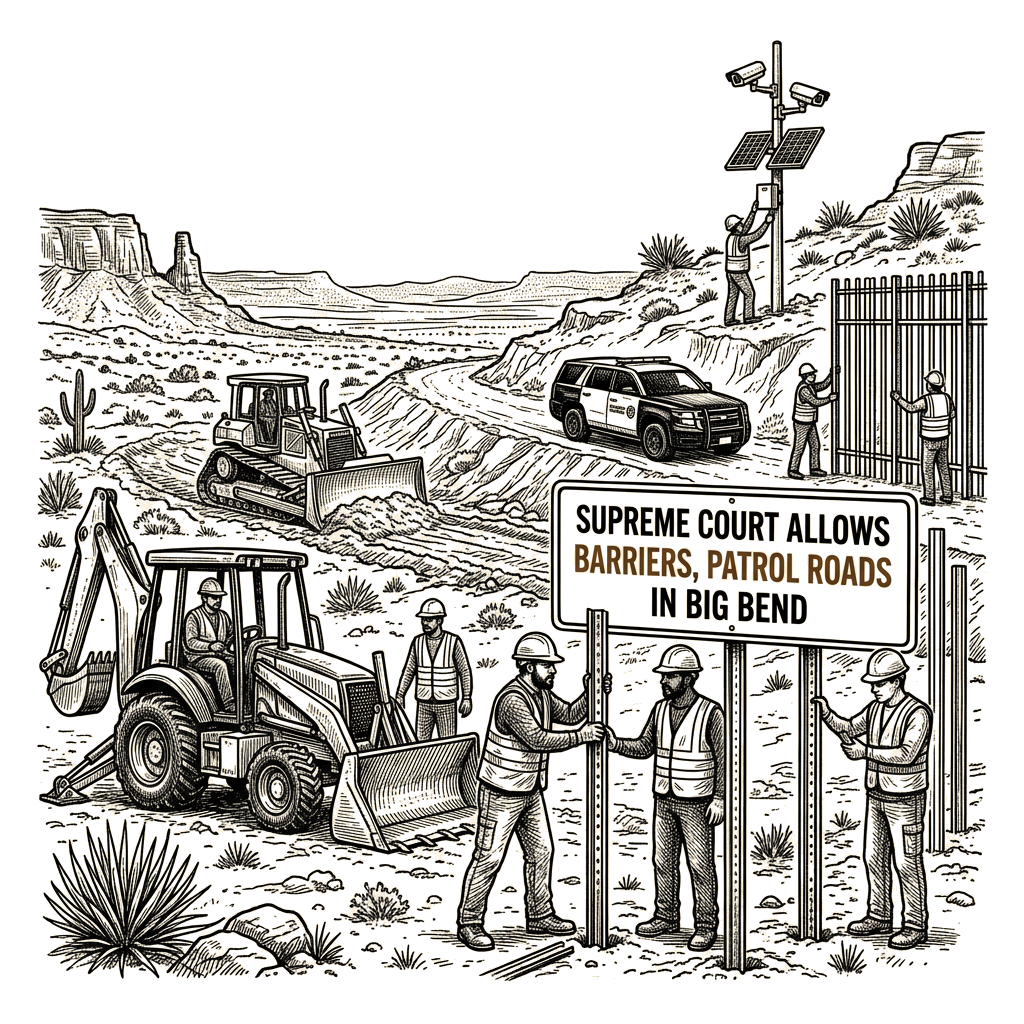
The Roberts Court is letting Trump bulldoze Big Bend without hearing the parties. Barriers, patrol roads, and surveillance infrastructure through Big Bend National Park can rise while the residents, conservationists, church preservationists, and landowner opposing them remain in court.
The strongest case for the Court is serious enough to state without embarrassment. Congress gave the Secretary of Homeland Security authority to waive specified environmental protections and committed the national-security judgment to the Secretary; a district judge cannot simply substitute his own view of border tactics. On Monday, the Court issued the five-page unsigned order, No. 26A560, granted the government’s emergency application, and stayed an order from a federal judge in El Paso halting construction. There was no ordinary merits briefing and no oral argument. Justice Ketanji Brown Jackson was the lone dissenter.
The governing instrument was section 1601(d) of Title 16. It permits the Secretary, after the required consultation, to waive environmental or cultural-resource protection laws when the Secretary determines the waiver is “necessary to protect the nation’s interests” and that “there is no practicable alternative.” Secretary Markwayne Mullin invoked it to set aside the National Environmental Policy Act, the National Historic Preservation Act, and the Endangered Species Act. The order reviewed the injunction for abuse of discretion—whether the district judge exceeded his lawful bounds—accepted his legal conclusions anew, and accepted his factual findings unless clearly erroneous. For the Secretary’s decision, it invoked the Administrative Procedure Act’s arbitrary-and-capricious standard: whether the agency had reasoned within statutory bounds, not whether the court would adopt the agency’s construction of the statute granting the power (16 U.S.C. § 1601(d); 5 U.S.C. § 706(2)(A)).
The order said the injunction “impedes the Government from advancing its ‘compelling interests’ in border security and integrity.” It described Mullin’s waiver as “a clear preference for expeditious border construction over the very harms respondents assert.” On the government’s best account, the Court corrected an overreaching injunction rather than decided whether Big Bend needs a wall. The dispute over the project could continue below.
The government’s security argument had force. In its late-October emergency application, Solicitor General John Sauer called the injunction “baseless” and “unprecedented.” He described an unbarred Big Bend as a “dangerous magnet for cartels and other bad actors.” The Big Bend Sector covers nearly 500 miles of the United States-Mexico border, more than a quarter of the entire border, and Customs and Border Protection data show it regularly records the fewest encounters along the Texas border. A gap can draw crossings diverted from other sectors even when its baseline traffic is low. The application supplied the danger label; its own encounter data supplied the limit.
That force did not answer the legal question. After Loper Bright Enterprises v. Raimondo, 144 S. Ct. 2244 (2024), a court determines the meaning of federal law for itself. The Chevron regime that allowed an agency to control the meaning of the statute that empowered it is gone. Arbitrary-and-capricious review may demand a rational explanation for an agency’s judgment; it does not let the agency’s judgment become the law.
Formally, the Court issued no holding construing section 1601(d). It did not decide that Mullin’s waiver reached this project or that the waiver forecloses judicial review of that question. Operationally, it recited the Secretary’s waiver conclusion, treated that conclusion as sufficient, and let construction proceed. It supplied the practical answer without writing the legal opinion that could support it.
The order promoted convenience to the status of a governing interest. “Expeditious border construction” became the value served; the asserted injuries to parkland, historic property, wildlife, and the local economy became the values deferred. That is not speed. It is a trade. The government received the physical result. The plaintiffs received more litigation.
The shadow docket Stephen Vladeck wrote about in The Shadow Docket is the Court’s emergency docket, where it can change rights without ordinary merits briefing or oral argument. Big Bend shows what that instrument can do. It handed the applicant the construction while the opponent’s claims proceed below. The claims remain available; the bulldozers do not wait for them.
This is not an aberration. It is the instrument. The Brennan Center’s emergency-application count through the end of 2025 records 34 applications by the second Trump administration, with the government prevailing in 80 percent. The first Trump administration filed 41 and prevailed in 28 percent. The Biden administration filed 19. George W. Bush and Barack Obama together filed eight over sixteen years. The second administration’s most productive route into the Court has been the emergency docket, and the returns are lopsided.
The machinery has also cut against state defendants. In Whole Woman’s Health v. Jackson and Merrill v. Milligan (595 U.S. 30 (2021); 141 S. Ct. 25 (2020)), emergency applications shaped litigation while the merits traveled on separate tracks. In Whole Woman’s Health, the emergency orders did not themselves resolve whether plaintiffs could sue before Texas enforced SB8; the merits did. In Merrill, the Court denied Alabama’s request to stay a district-court injunction against its redistricting plan, and Roberts dissented from that denial. The procedure was created for emergency relief, not one side.
Laiken Jordahl of the Center for Biological Diversity put the effect on Big Bend plainly. The order “greenlights the contractors and allows the bulldozers to come roaring back into the region,” and it “allows the dynamiting of national park canyon walls, the bulldozing of pristine desert.” The suit brought together the Center for Biological Diversity, a nonprofit working to preserve a historic church near the border, and a landowner who stands to lose border property. The plaintiffs contend the project is unconstitutional and will cause irreparable harm to parkland, Indigenous sites, wildlife, historic property, and the tourism economy. Big Bend residents across the political spectrum say a wall is unnecessary. The Court did not need to decide whether every mile of border barrier was wise. It needed to decide whether the government could take the irreversible step before the lower court resolved the challenge.
An honest application would have required the Court to construe section 1601(d), demand the government’s waiver and supporting papers, preserve the injunction until the district court ruled, and explain the result in a signed opinion. Instead, the Court granted the concrete outcome and left the contested statutory question to a case proceeding in the shadow of construction already underway.
Monday’s decision included an unsigned order clearing construction and a signed dissent explaining why the order was wrong. The only opinion issued with an author was the one that lost.
In Merrill, Roberts dissented when the Court refused to let Alabama evade a district-court voting-rights remedy; Vladeck called that dissent the canary in the coal mine. In Big Bend, Roberts joined the order that handed the administration the bulldozers in the park. The government got the physical result. The plaintiffs got more litigation.