
The best labor law ever written is one signature line, and Ángel signed his at 4:40 in the morning, before the sun could watch. He is a guest on the sweet-potato ground I own outside Vardaman, Mississippi, a guest being a man whose departure requires my countersignature, and the paper he signed governs his 10 months: the deductions schedule, the gear he rents back from me, the training checklist in a language he doesn’t read. I have never lost a case that ended in one. You’ll eat the proof in 2 weeks. The casserole on your Thanksgiving table came off Ángel’s rows, the #1s with no soft spots, and under your marshmallows sits $58 of his wages I keep for boots the regulation says I hand him free. Paragraph 9. He initialed it in the same dark, because my orientation packet deserves obedience more than the men can afford to give it, and its first page carries my only creed: the poor are always with us; payroll simply decides the season. The Editorial Board argues in Protecting a Supreme Court Landmark that the Court should extend its Jarkesy ruling to Department of Labor v. Sun Valley Orchards, where the Department of Labor dunned a New Jersey farm more than $550,000 over the terms of its guest-worker contracts, charged, judged, and collected in the agency’s own in-house tribunal, penalties that in part shut the farm down. I agree with everything alarming in it. You are about to finish handing me the courthouse, and I want to thank you while the ink is wet. I hold no brief for the farm; my quarrel is with the arithmetic that caught it, and on the destination we are allies: fewer rooms where that arithmetic gets a hearing. The government drafts my contracts for me, wages and housing and dates, then adjudicates me against its own drafting, which is slow, portentous, and occasionally bills somebody. So bring the courthouse. Bring the jury too. You call the landmark protection for property. I call it repaving a road I’ve been walking since the nineties, and I would like the paving crew to finish the job. I want to congratulate the Board and collect.
Follow the pen. You believe a contract binds the parties who sign it. You believe a signed agreement ends the argument — your own editors believe it, it is the whole editorial page. And you believe no agency should be prosecutor, judge, and jury in its own cause. Three yeses. Ángel gave me all three at 4:40 in the morning, in a camp I own, on a visa I sponsor, carrying a recruiter’s debt he is still paying off in Monterrey. You haven’t conceded the tribunal to me.
You’ve conceded the fence.
Now the field, and the arithmetic under it. Before the diggers roll, the rows get a chemical pass, and the label on the jug says the crew stays out 24 hours.
Mine goes back in at 12.
The 12 hours, spread across the harvest, comes to $0.018 a bucket. I’ve kept the interval every season and I’ll keep it again, because buckets are the only arithmetic the ground respects. By ten o’clock the numbness starts in Ángel’s fingers. He wipes his eyes on the wrist of the gloves I charged him $21 for — the gloves are also paragraph 9 — and keeps picking, because the quota has never heard of a label.
His hands go numb by ten.
He finishes anyway.
Paragraph 9 has no clause for fingers.
A guest does not file the complaint about the interval, not in the tribunal the Board disdains and not in the courthouse it prefers. Before either venue hears him he must get past the checklist he signed, the training he signed, the boots and gloves he signed for, and the season he needs renewed. The wage was never the money. The wage is the rehire.
Ángel is the rule. Tiburcio is what the rule does when it’s tested. Tiburcio cut my rows 3 seasons and asked about the deductions one Tuesday, polite as a deacon. Nothing happened to him. Nothing is the mechanism. In November the recruiter’s list came back from Monterrey and Tiburcio’s name wasn’t on it, and nobody told him why, because the not-telling is the function. He still owes the recruiter $1,900 for a job that no longer exists, and the debt didn’t grieve either. The list costs me nothing. It buys the quiet, and the quiet is the cheapest input on the farm.
Put your finger on the carve-out your Board itself blesses, while you’re counting: immigration stays administrative, a public right. So his body is the government’s filing and his wage is my ink. The asymmetry isn’t a flaw in the architecture. It is the architecture.
Same contract, colder draw: the wild-blueberry barrens I rake outside Columbia Falls, Maine. Teodoro is a return ticket there — he has come back 9 Aprils running, because coming back is the only permission the contract grants — and every April I hand him a paper promising a cookhouse, a ride to town, and a wage that runs through October 4. For 9 of those years I have billed his crew for the single stove I installed instead of the two the paper promised. The second stove was a $430 question. My answer prices out at $0.11 a day, per man, across a season of about 180 days. The room that might someday check that math is on your payroll.
Here’s the part worth the price of the lesson.
Teodoro’s contract runs through October 4. The year the hail came, the barrens raked out on September 12, and I released him and 11 men that Friday. A release, by which I mean 22 days of wages a family outside San Marcos had already spent. I say “release” at the fall supper because the honest words stop the table. You’re perhaps expecting the 22 days to weigh on me. They weigh where they bought something: the crew bus didn’t run a second route that September, and the second route was $640 in diesel I did not spend. Teodoro asked about the remaining weeks. I showed him the clause that lets me end the work when the work ends. The clause is real. The work ended. He flew home on a ticket I issued, owing a recruiter in Guatemala City $2,100 for the season.
The tribunal never heard his name.
The tribunal hears mine.
Look at the pair of them, because that is the whole arrangement. The room exists for me. It runs on filings I can answer and penalties I can price. A man released early has no filing, and a man with no filing is a man the machine never turns on. One field over, same barrens: Eugenio, whose early release the investigator did catch, and whose back wages the board eventually priced at $3,900 plus interest — the only figure in 20 years anyone has taken from me at interest. Eugenio is Teodoro with a better investigator and 3 fewer Aprils of good luck. That is the entire difference between those 2 men, and your landmark is scheduled to remove it.
Let me put the numbers where you can see them, because a penalty case reads like weather until you’ve stood in it. In 2017 a wage-and-hour investigator counted my deductions — paragraph 9’s boots and gloves down south, the stove up here — and the machine your editorial describes did its work: the agency wrote the rule, the agency charged the violation, an administrative law judge ruled on the agency’s own charge. I won’t defend the room. It was the most efficient room I have ever lost money in. One investigator. One filing. 11 months. $18,600 entered against me by a salaried judge who read my own contract out loud, affirmed by the board above him, also salaried, also unhurried, also reading my contract. I call the deductions creative. He called them the contract. Same ledger. Different seating.
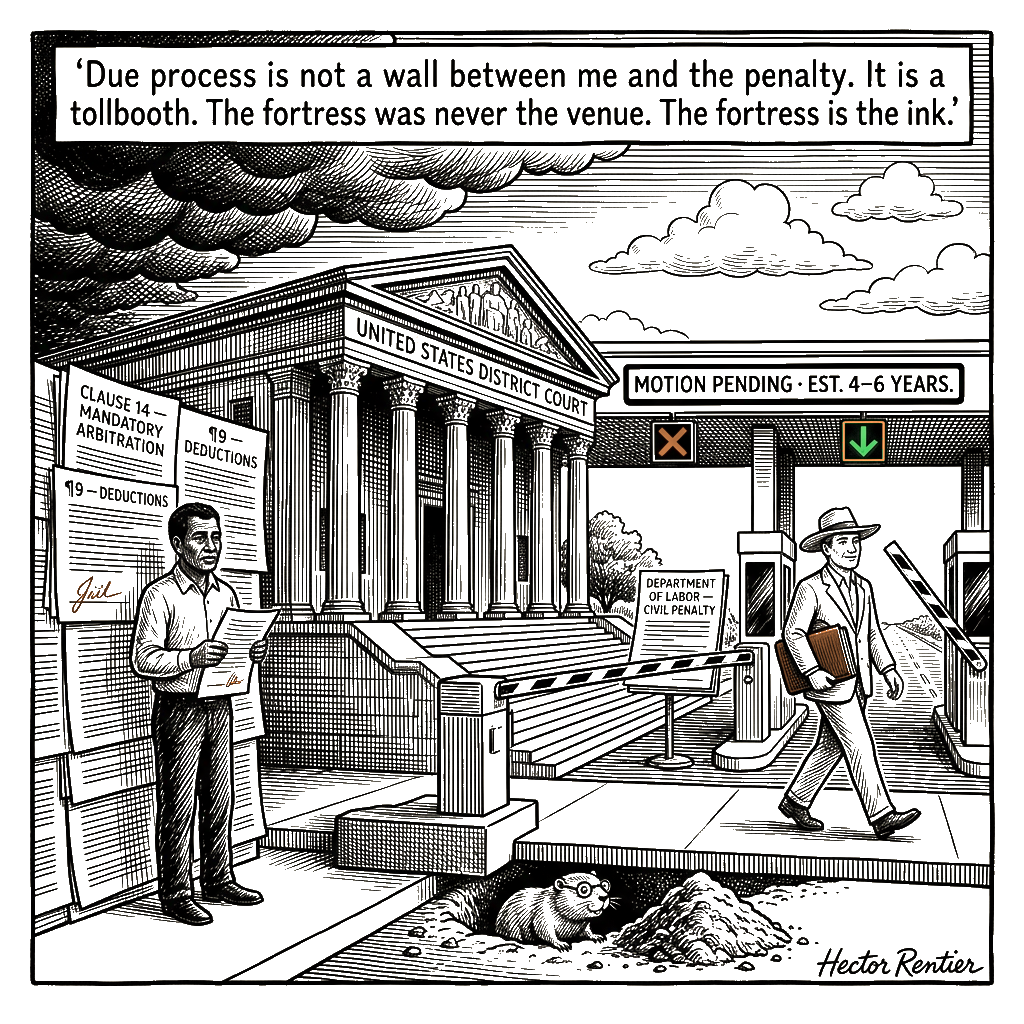
In 2024 the Justices said penalties like these belong before a jury in an Article III court, and the Chief Justice called money damages the prototypical common law remedy. Beautiful. Watch how the arithmetic moves. A tribunal is one filing and 11 months. A federal case is a complaint, an answer, discovery, expert witnesses, a venue my counsel can spend a year choosing, and 4 to 6 years of motions billed by the hour. The department has a docket and a budget. I have a calendar and a holding company. A jury is a slower inspector, and a slower inspector is a kinder one, because kindness is mostly a question of who outlives the process. Extend it to the safety agency while you’re in there. Extend it to the housing inspectors. I’ll wait. Waiting is the one expense I have never once declined.
Widen the frame, because the doctrine your Board is restoring is older than its docket. In 1908 the Supreme Court held in Adair v. United States that a railroad could fire a man for joining a union and the signature would hold. Liberty of contract, the courts called it, and for a generation the ink outranked the body in every courthouse in the country. In 1932 Congress took the pen back; Norris-LaGuardia was the first stone of the settlement your own pages have mourned in print for a century.
And the one time men like me met a jury, in 1911, the owners of a locked New York garment factory stood before one over 146 dead workers and walked out acquitted. The families settled at about $75 each. The insurance paid the owners more than the fire had cost them. I do not read that record as an embarrassment. I read it as a rate card. Due process is not a wall between me and the penalty. It is a tollbooth. What Tuesday’s argument reopens is not a procedure. It is that doctrine wearing this decade’s vocabulary: declare everything between master and hand private, and the state becomes a stranger at my fence.
“Servants, be obedient to them that are your masters according to the flesh, with fear and trembling, in singleness of your heart, as unto Christ;”
— Ephesians 6:5 (King James Version)
That verse has governed masters and servants for 2,000 years, and it contains no tribunal. No jury. No docket. The contract I hand across my desk every March is the same instrument wearing a wage rate and a clause number, and the landmark your Board is protecting does not amend the verse. It amends the venue. Your Board believes the courthouse is the fortress for men like me.
The fortress was never the venue.
The fortress is the ink.
The forecast is good news, so I’ll give it plainly. Extend the holding and the claims migrate to district court, where most of them die of expense. When a penalty costs the agency more to bring than it returns, the docket thins, and a citation that never gets written never needs an answer. I have watched dockets thin before. The field doesn’t notice. A man at the co-op mentioned to me that the same department that duns employers is the one that certifies the visas my crews land on. Interesting observation. I’ve decided not to develop it. The certification came through in March the way it has for 9 years, and the barrens get picked by Columbus Day with or without a courtroom.
Back to the floor, where the arithmetic actually lives. Your landmark hands the department a jury. It hands Ángel nothing, because clause 14 was there first: mandatory arbitration, class waiver, initialed in the same dark, in the camp I own. The only courthouse he was ever offered, he signed away before the season began, before the clause had a use, which is the only way clauses like that ever get signed. And here is the part I find genuinely elegant. The recruiter’s fees in Monterrey have gone up every season I’ve docked the boots and the gloves. He calls it demand. I call it my supply pricing itself: the men still come, fewer each year, deeper in debt, quieter each season. Whether the debt ever outgrows the wage is arithmetic the recruiter keeps. I’ve never asked to see his ledger. My rehire list is full.
It is always full.
Ángel re-signs in March. The numbness is past the knuckles now, and paragraph 9 will be waiting at 4:40, updated, in the same dark. The casserole is safe either way; the #1s keep. Thank you for your business, sincerely — he graded every one of them by hand, in the hours the label would have taken from me.
The berries don’t wait for anyone. Neither does the field. The courthouse is my weather. It has always been my weather, and your editorial page has finally learned to read the sky.
Sterling A. Varice holds the Hayek-Friedman Chair and serves as Dean of Instruction at Warden University’s College of Business and Economics in Richmond, Virginia. He is the author of three textbooks: Divine Mandates for Labor Utilization, Social Obligations for Profit Maximization, and Calibrated Deprivation: A Manager’s Guide to Employee Motivation.