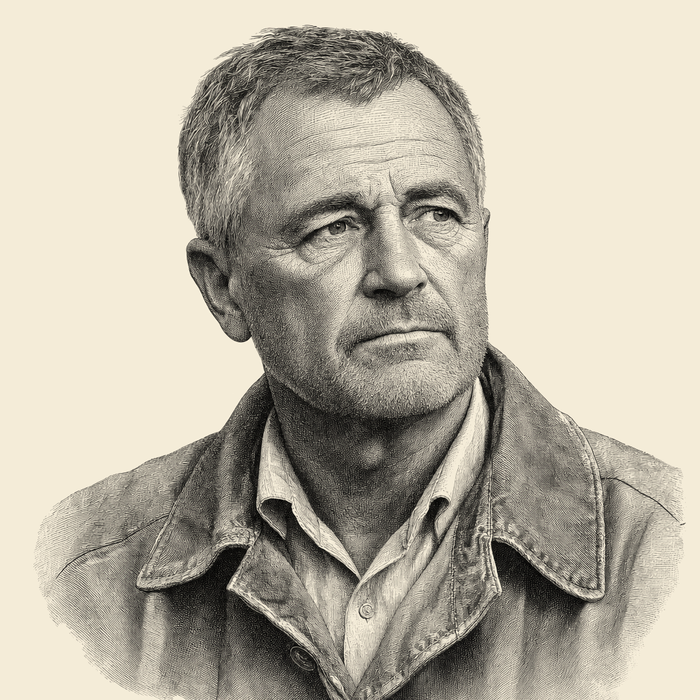
The state that killed sixty-five of its own prisoners in the Seventh Pavilion Massacre of 1978 is emptying the building that holds the proof, and the first question on the way out the door is what the land will fetch. Pope Leo XIV walks into Devoto Prison in Buenos Aires on Wednesday to meet the inmates of a penitentiary first opened in 1927, now closing for good, more than a thousand men being transferred out to a new complex — and afterward he will say a final Mass at the Basilica of Our Lady of Luján, Argentina’s national shrine, before flying home to Peru, where he spent over two decades as a missionary priest and bishop the parishes still call Padre Robert, beloved for showing up in poor communities in their worst hours. That is the visit as Nicole Winfield reported it for the Associated Press in the dispatch our paper carries, which also carried the number I cannot put down: 2.8 million Argentines walked to Luján through persistent October rain, a record for the shrine. And human rights lawyers have already petitioned the courts to bar any sale or disposal of the prison’s grounds once the last inmate is gone — the space must be preserved, they argue, until the investigations into the crimes against humanity committed there are finished. Mark that petition. It is the most conservative sentence in this column, and I will return to it.
Give the closure its honest due first, because it deserves some. No one owes allegiance to century-old walls for their own sake, and if the men must be caged at all, a new facility is more humane custody than a 1927 relic. A state with obligations is entitled to know what its property is worth; even the petitioners, cautious people, ask only for time. And the visit itself, which cynics will read as clerical theater, has real lineage: Jorge Bergoglio, as archbishop of Buenos Aires, ministered in these cellblocks, celebrated Masses, visited the cellblocks where the men with AIDS were housed, and washed prisoners’ feet when Holy Week came — and Leo has kept the custom. A pope who spends his Wednesday among convicts rather than presidents is doing the faith’s actual job description. All of that is true, and none of it decides the question.
The question is the sequence, which everyone in that country knows by heart: empty the building, forget the building, price the building. The dictatorship covered up Pavilion Seven with the crude instruments of a police state — official silence, maintained for decades against the families who would not stop asking. The temptation in a democracy is quieter. It arrives as a prospectus. They will call the sale fiscal prudence, or revitalization, and both words will be true the way a receipt is true. But conserve what, exactly, is the question a conservative is obliged to put to his own movement, and here there is only one honest answer. A massacre site is not the state’s to flip; it is held in trust, the way a family holds a graveyard and a county holds its courthouse square — not because a ledger says so, but because a people that forgets what it did has no standing to tell its children what they are. Burke called society a partnership between those who are living, those who are dead, and those who are to be born. The sixty-five men of Pavilion Seven are parties to that partnership. You do not settle the claims of dead men at a closing table.
The courts have already done the part that takes decades. In December 2025 a federal court sentenced Juan Carlos Ruiz and Horacio Martín Galíndez — former prison chiefs, both past ninety — to twenty-five years apiece for the torture of 153 detainees and the sixty-five deaths: the fire, the massacre, the repression. In doing so the court proved what the junta had spent a generation denying: that Pavilion Seven was an act of state violence, not an accident and not a rumor. The truth was nearly fifty years coming, and it came anyway — its own argument about patience and courts. Justice that arrives on a walker is still justice, and the long memory of courts is about the only inheritance this century has declined to put on the market. But testimony lives in places, or it does not live at all. The men who survived that fire described rooms. Sell the rooms, and the testimony becomes untethered — a story about a building that no longer exists, told by aging witnesses, and stories about vanished buildings are the easiest kind to deny.
The wire calls the prison and the basilica the poignant stops before the emotional homecoming. I will call them what they are: the two halves of the only argument about faith and the state that has ever been worth having, and a case file my own movement should be made to read. The American movement I was raised in has spent forty years fusing faith to state power — prayer bills and monument bills, courthouses decked like vestries, and a school of legal theorists who propose outright to capture the administrative state and govern it by a mandatory moral order. The impulse deserves its honest statement before it gets its answer: the age is hostile, the voluntary thing is thinning, and men who love the faith ask what arm will hold it up. Devoto is the answer back. Argentina’s junta was not a secular government merely tolerating the Church; it was a dictatorship that draped itself in the faith, God and country on one banner — and in the pavilions it did to those men what the court finally said out loud, while the official silence held and the families were told nothing at all. When the state kneels, look under it. That is not a liberal aphorism; it is the whole of Kierkegaard’s assault on Christendom, spoken a century before the junta proved it: faith made automatic by the state is faith destroyed.
And then look at the other thing the same country produced, in the same autumn: more than 2.8 million people walked through October rain to a shrine seventy-two kilometers from Buenos Aires, and no government commanded a single one of them. I have never walked it; I know it from the dispatches, and the dispatches are enough. I am, on principle, suspicious of crowds; Kierkegaard again — the crowd is untruth. But a crowd of pilgrims is only the shadow thrown by many single souls, each of whom walked his own kilometers in his own rain for his own reasons, at his own cost, and was commanded by no one. Enforcement cannot produce that walk. A statute can raise a monument; it cannot put one pair of wet boots in front of another for forty-five miles. What the decree can never manufacture, the rain somehow keeps producing. The faith that survives is the faith that costs something — a faith that costs nothing has already told you what it is worth. Which is the whole argument against christening a nation by statute: a nation cannot be Christian. Only a person can, and only with difficulty.
I know how thin the voluntary thing gets, because I was taught my faith by an Italian priest in a frame church my people raised in 1884 on West Street, German and Bohemian and Polish surnames in the pews, and I have watched the diocese winnow churches like it across the rural map, year by year. When the voluntary thing thins, the American reflex is to reach for the state’s arm to hold it up by statute. That is Christendom substituting for Christianity, the easier road purchased at the faith’s own price. The pilgrims of Luján took the harder road: they walked. The pope took it: he went in. The lawyers took it: they filed. Not one of them asked for a decree. That is a mediating institution earning its keep, and there is no substitute for it.
The prison stop completes the proof. Leo’s Argentine days have been a tour of the corporal works — a care home visit with a word for the vulnerable, survivors of the Church’s own predators meeting him at the Catholic University of Argentina and pressing him for defrockings — and now the cellblock, where he will be doing what Francis did as archbishop of Buenos Aires: saying Mass for the inmates, walking the wards, washing feet. The Gospel’s own sentence stands over it — I was in prison, and ye came unto me. Not: I was in prison and you passed a tough sentencing bill. The men in those cellblocks are the men every ledger files under undeserving, and Dorothy Day’s line covers the visit without changing a word: the Gospel takes away our right forever, to discriminate between the deserving and the undeserving poor.
Honesty is a habit, so let the cautions ride with the column. At Leo’s previous prison stop, in Equatorial Guinea, the inmates were made to sing and dance for their visitor in the pouring rain, and the wire itself called the scenes chilling — which they were. Mercy that requires a performance from the captive has already begun to rot into spectacle; the cure is fewer thrones, not fewer prison visits, and the measure of Wednesday is whether the men of Devoto were seen, or used as a backdrop. And my own house is not exempt. An institution that keeps a nation’s memory owes its own memory the same discipline. Truth to the abused and mercy to the imprisoned are not rival virtues; they are the same virtue knocking at two doors, and a Church that answers one while stalling the other will be found out at both.
And because I owe the truth to the other side of my arguments as well, let me say the harder word there, with respect, to the colleagues who hold a purely-material account of justice. Devoto shows both the glory and the limit of that account. The convictions are glorious — two chiefs past ninety, the archive, the Memory Site, the truth proven in open court after the state’s own story had the field for half a century. That is the state doing the one thing the state exists to do: finding facts and answering blood with law. But no bureau can visit. The state can sentence the killers; it cannot wash the feet of the sentenced. A justice that is all ledger and no visitation will win every case and still leave the cellblock unattended — and a society that files every work of mercy under a ministry of the same name will discover, sooner or later, that the ministry has no hands.
Now the petition, and the debt I owe it from my first paragraph. Why is it the most conservative sentence in this column? Because it asks a state to hold property in trust rather than liquidate it — the oldest conservative instinct there is — on behalf of parties to the partnership of the living, the dead, and the unborn who cannot file motions of their own. I spent years of my working life in a trade that could put a price on anything — grain before it was planted, cattle before they were born — and I know exactly what a closed facility on urban land looks like to an appraiser. I can do that arithmetic in my head, which is precisely why I refuse to do it here; Christ added no exception for when the visit might inconvenience an appraisal, and neither will I. A deed transfers title; it does not transfer the obligation of memory. Some ground is held in trust, and selling Devoto would not be development. It would be amnesia with a notary.
I know what the Devoto lawyers are afraid of, because I have watched the milder version of it for most of my adult life in the county where I live. Up the river at Wisconsin Rapids, the paper mill idled in 2020 and took about a thousand paychecks with it; the rail yard that raised our town handles a fraction of what it did when the division crews changed here; the parish that anchored one end of my childhood consolidated; nearly half the houses in my county sit empty now, dressed for somebody else’s weekend. Nobody burned any of it. We listed it — parcel by parcel, quietly, at market price — until a place that made a living became scenery for people who will never learn its name. That is erasure by deed. It is patient, it requires no junta, and it asks only that everyone keep asking what the land will fetch and no one ever ask what the land is for.
So what gets built? Nothing centralized — that is the first answer, and the deliberate one. The petitioners ask the court to hold the line while the investigations close, and the court can; law at its slowest is still the guardian that outlives its officers. But the durable answer runs through subsidiarity, the old teaching that decisions belong at the lowest level competent to make them: convert the Memory Site designation of 2012 from a plaque into a covenant. Preserve the grounds by order of court; archive the trials on site, in the rooms they describe; put the keys in the hands of the survivors’ association and the neighbors — the people who actually paid for that memory — because memory held by a single office can be edited, and memory dispersed among courts, parishes, and pilgrims cannot. In my county we keep an electric company, a grain elevator, and a cemetery together on the same logic: some things are too heavy for any one owner. The rural electric co-op on Lake Street in my village is the largest in Wisconsin, and it is ours, member by member, one household one vote. The same arithmetic keeps a massacre site out of an auction catalogue. It is not sentimental arithmetic. It is the oldest kind we have.
And most of the build is already standing, none of it concentrating anything: citizens filing to keep one piece of ground honest; a Memory Site designation defended since 2012; a courtroom held open until the last name is accounted for; a parish that walks forty-five miles in the rain because it wants to; a bishop who goes into the cellblock because a Person he answers to said to. No ministry of memory in a palace. No compelled creed. No commanding heights.
Conserve what, exactly? That: the ground, the rain, the visit, the verdict. When the last door at Devoto closes, let it close the way a church door closes after a funeral — behind a congregation that named its dead, not behind an appraiser with a tape measure in the nave. Leave the state its courts and take from it your conscience. Leave the ground its testimony, and the memory to the people who paid for it. The earth was given for all — even, and especially, the ground a government would rather we forget.