JD Vance defends tearing children from their parents and calls it love.
In January 2025 the Vice President of the United States told a television audience that Christian love works in expanding circles: family, then neighbor, then community, then fellow citizens, and the rest of the world after that. When he was corrected, he answered with two Latin words — ordo amoris, order of love. The teaching was being put to work in public on behalf of a policy that takes children from their parents and calls the result enforcement.
Two weeks later the Bishop of Rome answered him in writing. “Christian love is not a concentric expansion of interests that little by little extend to other persons and groups,” Pope Francis told the bishops of the United States on February 10, 2025. The true ordo amoris, he wrote, is the one the Good Samaritan teaches: love that builds a fraternity open to all, without exception. And an American cardinal who had given two decades of his life to Peru said it in one sentence — “JD Vance is wrong: Jesus doesn’t ask us to rank our love for others.” That cardinal is Pope Leo XIV now. On Friday he came home to Chiclayo, and down there they still call him Padre Roberto.
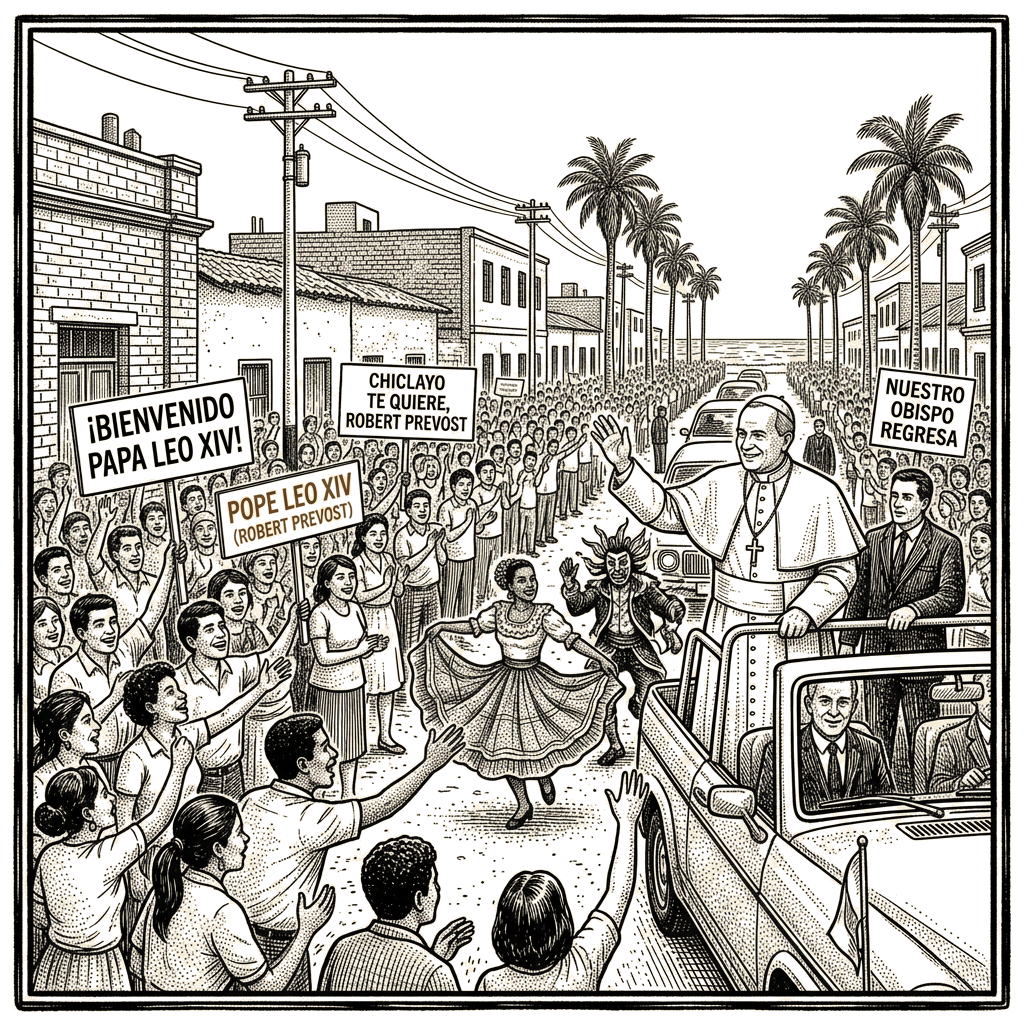
The plane that set him down carried the message along its side in Spanish: “Leo XIV flies home.” Dancers met him with the marinera. Dozens of children waved the yellow and white of the Holy See while the motorcade passed, and organizers said as many as a million people could turn out for his first big Mass in Peru, on a massive field outside the city Friday morning. Chiclayo is a commercial hub of 700,000 on Peru’s northern Pacific coast, and much of the world learned its name only on May 8, 2025, when he gave the city a shoutout in Spanish from the loggia of St. Peter’s. In a restaurant off the square they keep framed photographs of him riding a horse and wading through the floods in rubber boots, and they have marked his favorite table: mesa bendita, blessed table.
What formed the man is written in the place. He came to Peru in the mid-1980s and lived through the terror of the Shining Path and the authoritarian crackdown that answered it. He served in Chulucanas, then Trujillo, then the diocese of Chiclayo, which he took over in 2014. He was there for the surge of Venezuelan migrants in 2018. He was there for the floods of 2023, wading toward families who had lost their homes; Rocio Zena, who lost her family home in those floods, says he helped her. In the late 1990s he led a signature campaign to commemorate the fiftieth anniversary of the Universal Declaration of Human Rights. His Augustinian housemate of more than a decade, the Rev. John Lydon, says these are the kind of things that just mark his identity. He has said the place and its people taught him how to be a shepherd. Take him at his word. He learned the trade among the displaced.
While Chiclayo sang, the country of his birth counted beds. Congress put forty-five billion dollars into immigration detention in 2025, enough to push the system toward 100,000 beds. The two private prison companies that fill most of them booked $2.2 billion and $2.6 billion in 2025, one’s profit up about seventy percent and the other’s up about seven hundred, after roughly $2.8 million in combined giving to the 2024 campaign and inaugural fund. A bed in this system is not mercy. A bed is revenue, and revenue requires bodies. Donald Trump is caging and expelling the strangers God commanded us to welcome. And the bodies are gathered in the pre-dawn raids I grew up around in El Paso, when classmates disappeared and the school day went on as though the empty desks were ordinary.
I know what it does to a place when the vans come for someone’s mother. What I have never been able to get past is how calmly we all went on learning our letters.
Before I name anyone else’s house, my own. The Church that formed Padre Roberto also blessed the conquest of this continent, and its blessing accompanied the enslavement of the very people St. Turibius de Mogrovejo spent his life defending. He learned Quechua and Aymara so that the people he served could hear the faith in a language they understood. That same Church, in the same century, baptized the people its conquerors owned. And that same Church hid priests who raped children while its bishops preached mercy from the pulpit, and Pope Leo plans to meet clergy-abuse survivors across Latin America on this trip, as he should. The accounting begins with us. The pews I sit in helped build the appetite this machine feeds on, and I have taken work in my life I should have refused. And the machine that removes people from this country is older than any president now operating it — Adam Goodman’s history counts roughly eight million formal removals over the past century against some fifty million through what the paperwork called voluntary departure, nine of every ten of the people it removed have been Mexican — while the pilot that began separating families ran unannounced in El Paso in 2017, before the 2018 policy had a name. Democratic administrations ran this machine. Republican administrations ran it. Every one of them answered for it before God and before the neighbors who watched the vans come and said nothing. The five principles the bishops of the United States and Mexico wrote together in 2003 bind every party, and I will name the next crowd’s violations as readily as this one’s.
So set the shelf beside the conduct. The politicians who built this machinery claim the same book the pope reads, and the tradition they claim is not silent about the stranger and not ambiguous about him. “I was a stranger and you welcomed me,” Jesus says in the twenty-fifth chapter of Matthew, and the same chapter says what becomes of those who did not: “I was a stranger and you did not welcome me” — both verdicts in the same chapter, and no nation has ever been excused from either. The Torah returns to it more often than to any other commandment: “You shall not wrong or oppress a resident alien, for you were aliens in the land of Egypt” (Exodus 22:21); “you know the heart of an alien, for you were aliens in the land of Egypt” (Exodus 23:9); “you shall love the alien as yourself” (Leviticus 19:34). Leviticus sets the stranger beside the citizen under the same law. Isaiah has the word for a country that calls this security: “Woe to those who call evil good and good evil.”
Now the conduct. More than 5,500 children were taken from their parents at the southern border between 2017 and 2021, and as of 2024 as many as 1,360 of them had still not been given back. In 2025 humanitarian parole was revoked for more than half a million people, and the appointments that once let people present asylum claims lawfully were cancelled — the app that replaced them schedules departure. In 2025 the country of his birth also moved to strip temporary protection from 350,000 Venezuelans and as many Haitians while the courts argue. About 570 immigration judges remain, each carrying some 5,500 cases; the administration calls the completion rate efficiency, and it is a queue with a verdict at the end. Neighbors who have lived among us ten, fifteen, twenty years — who pick the crops and frame the houses and sit in the pews beside us on Sunday — are seized and removed, and the seizure is defended in the name of the same God to whom the seized ones pray. Tearing children from their parents is cruelty. Naming that cruelty as love is calling evil good, and no Latin phrase makes it otherwise. The record is public, and I will say what it shows in my own words: this is cruelty, arranged and budgeted. Óscar Romero had a name for arrangements like it — pecado social, social sin: a regime that secures privilege for a few and leaves the many in inhuman conditions, and the sin belongs to the arrangement, not the weather.
A shepherd formed like that does not speak about migrants in the routine piety of officeholders. Leo has said publicly that a man who opposes abortion but is “in agreement with the inhuman treatment of immigrants in the United States” — he did not finish the sentence — “I don’t know if that’s pro-life.” He said people who have lived good lives here for ten, fifteen, twenty years are being treated “in a way that is extremely disrespectful, to say the least,” and that this is not acceptable. He has also said no one has claimed the United States should have open borders, and that every country may decide who enters and when — “we have to look for ways of treating people humanely, treating people with the dignity that they have.” He has named the thing from the chair of Peter. Inhuman treatment. The words are on the record.
What a humane policy requires is no mystery, and it is not open borders. Keep the border. Keep the courts. Keep families together. Let the man who has lived here twenty years stand before a judge before anyone calls him a criminal. Treat papers as a legal question and the person in front of you as a person. That is the whole of what Catholic Social Teaching has ever asked of a government, and the same pope who washed the mud off his boots in Chiclayo has also denounced machismo and the violence done to women in the culture that raised him, because the teaching runs in both directions or it runs in none.
I am speaking to you, Vice President Vance, and to every Catholic in public office who follows you into this. You are not defending the faith. You are using it. The documents you invoke were written by men who meant every word of them, and every word stands against what is being done with them. You can come back from this. The door of the Church you claim is not shut to you. But you cannot walk through it while you are still defending the policy that takes other people’s children from them.
The night before Chiclayo, sixty thousand young Peruvians sang to him in a Lima stadium until he wept. Plain words from a shepherd are not homecoming decoration. They are orders. He has already given his own about immigrants in the country of his birth.
And to the agent at the door at four in the morning: you are a person, and I am not your enemy. You are told the opposite every shift. Romero stood in the cathedral of San Salvador on March 23, 1980, the day before they killed him, and spoke to the soldiers of his own country: no soldier is obliged to obey an order against the law of God, and an immoral law no one has to keep. Then he raised the imperative — les suplico, les ruego, les ordeno — ¡cese la represión! I beg you, I beseech you, I order you: stop the repression. He named the harm in exactly those terms, and he left the soldier his conscience and his soul. Both halves were one act. It was not true then. It is not true now. You can lose the job instead of the soul. The door of return is not a narrow door. The Shepherd who ate at a blessed table in Chiclayo set it for you first.
Before the motorcade reached the main square on Friday, a woman named Cynthia Charrary was out sweeping the streets near the cathedral. “We want our city to be cleaner than ever,” she told the Associated Press. Someone is always out there before mercy arrives, sweeping — a broom, a street, a place made ready for the One who comes as a stranger.
There is bread enough for every table in this country, and the same hands that set the fence could set the table. Mesa bendita. Go and do likewise.