Keiko Fujimori wants to warehouse Peruvians in a foreign strongman’s prison and call it safety.
Days before Pope Leo XIV landed in Chiclayo, the president of Peru flew to El Salvador and walked through Nayib Bukele’s Terrorism Confinement Center — the megaprison built to hold tens of thousands of men — and she has said she wants to build one of her own. She has already declared states of emergency, over Lima in August and over the prisons in September. The fear that carried her into office is real, and it deserves to be honored before it is argued with: Peru’s homicide rate has nearly doubled in five years, from 5.8 to 10.7 for every 100,000 people, and extortion reports have climbed from 2,421 in 2019 to 26,734 in 2025 — elevenfold, in a country where the shopkeeper pays at the door or does not open it. Peru’s suffering is not invented. The whole question her presidency has answered is what a country is permitted to do with its fear. You looked at a country in pain, señora, and you reached for the cruelest tool in the hemisphere.
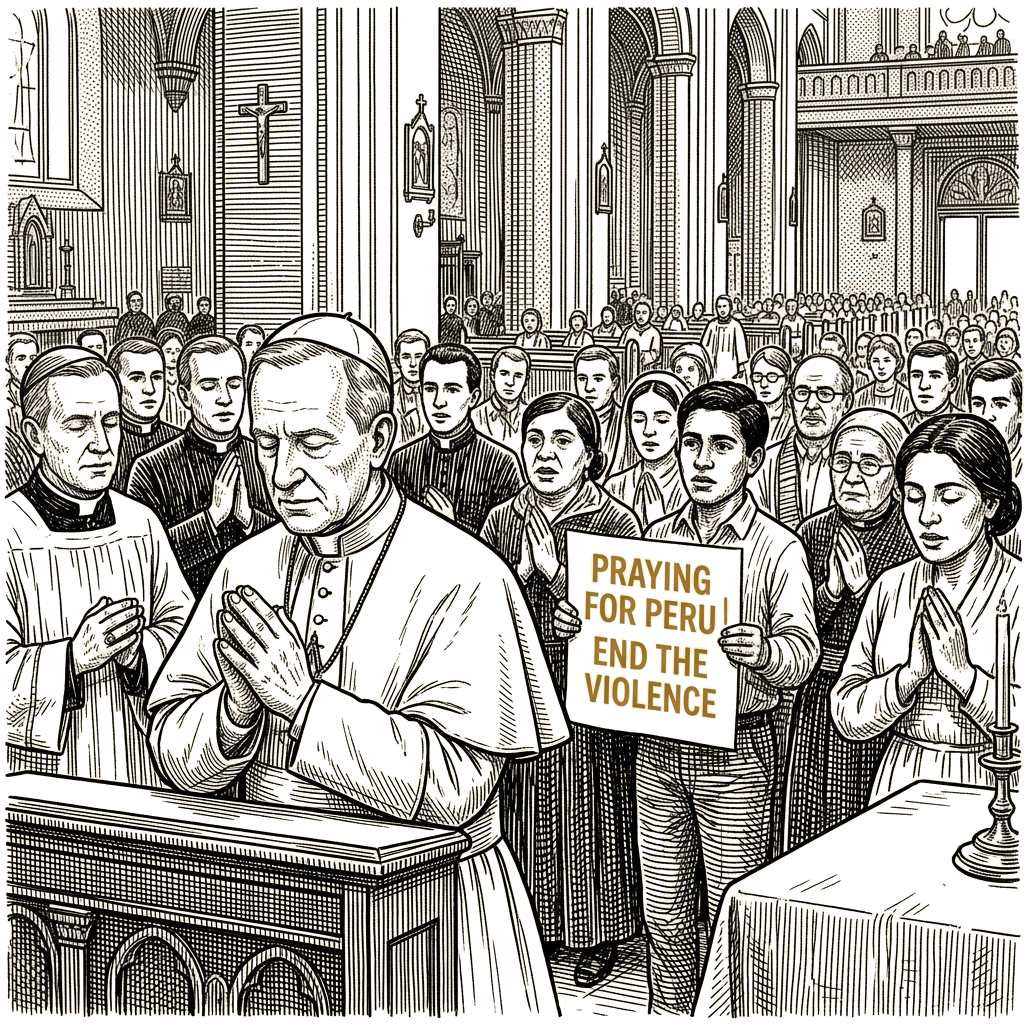
The pope answered it from a mountain first. He went up by helicopter to Santa Cruz de Succhabamba, 150 kilometers and 2,035 meters from his old cathedral, a village at the far edge of the diocese he shepherded for nine years as Bishop Robert Prevost — a village he used to reach himself, in his own pickup truck, because a shepherd who will not go to the peripheries is not shepherding, and Chiclayo has never forgotten who drove out to it. There, among people who live with the violence every day, he said: “Selfishness, injustice and evil are not overcome by brutality, but by prayer, patience and perseverance in denouncing what is wrong, by making our pleas with determination and working diligently to bring about the necessary changes.” In the cathedral before he left he had named the darkness plainly — “the unspeakable suffering that continues to afflict so many of our brothers and sisters” — and then insisted that “God’s gift continues to shine before our eyes.” He did not tell Peruvians their fear was exaggerated. He told them what their fear is for. He came home to pray in the cathedral he served and told them what the darkness is for.
A pope formed in Peru stood in a mountain village and said evil is not overcome by brutality. A president elected by Peru had just returned from touring brutality’s flagship, built to store men in bulk. Both were spoken into the same darkness. A country cannot drive both roads at once.
Here is what she went to study. To fill CECOT, Bukele suspended the constitutional guarantees of his own people and sent the security forces into the barrios; tens of thousands went in, and human rights organizations have documented thousands arrested with no connection to any gang — teenagers taken for their tattoos. Inside, the reporting is plain: the men are held without family visits, without work, without a face at the glass, and their images are published like inventory. Christ put the test on the visit — “I was in prison and you came to me” — and CECOT is engineered so that no one can come. That is the product.
Before I name what is wrong with the showroom, I will name what is mine. The coalition you joined is American, and so is the appetite behind it: we consume the drug that flows from Peru’s coca fields, and we answered the consequences with our own supermax prisons and our own mandatory sentences, under presidents of both parties. In the ministry to the people this country has agreed not to see, I have sat with men who did their years inside and came out missing the parts of themselves the sentence took. The cage does not stop working when the door opens. The standard I am about to hold you to is one my own country breaks every time it confuses punishment with repair — not an excuse for you, but the reason I have standing to say it at all. And the force you have aimed is not even aimed well. Beside your emergencies for Lima and the prisons, and your military coalition for the cartels — Peru has joined the “Shield of the Americas,” Washington’s coalition for joint operations against them — stands 1,261 women killed for being women between 2016 and 2024, an annual toll that grew 44 percent across those years, which is what Leo named in Lima on this same trip when he denounced machismo and the killing of women outright. A state can fill a prison and still leave untouched the house where the violence starts. None of what you have declared is addressed to that number. Peru does not even need the import: its own courts already convicted a former president, Alberto Fujimori, for the killings and disappearances his security forces carried out under his emergency rule. Presidents tour one another’s prisons the way they once toured one another’s dams.
El Salvador has exported two things to this hemisphere in living memory. One is Óscar Romero, who told the soldiers in March 1980 that no order to kill bound them before God — in the name of God, and in the name of a suffering people, I beg you, I beseech you, I order you: cese la represión, stop the repression — and who was shot while he said Mass the next day. The other is CECOT. The same small country gave the church its clearest voice against state cruelty and built the hemisphere’s largest temple of it, forty-three years apart — and the president of Peru flew in to admire the second one.
Jesus said he wanted mercy and not sacrifice, and the prophet asked for something plainer still — to do justice, and to love kindness, and to walk humbly with your God. A country that wanted fewer killings would build the things that make a killing unnecessary: courts that hear a case in months instead of years, police who investigate an extortion crew without becoming one, wages in the towns where a gang is the only employer, and protection a woman can actually use when the man she lives with decides she is his. None of that photographs well. All of it works. That is what Catholic Social Teaching means by the common good — not a softer word for weakness, but harder work than a bigger cage. The church has buried too many of Peru’s dead to patronize the demand for real security. Catholic teaching gives the state a true duty to punish wrongdoing and protect its people; it also holds that punishment exists for the correction of the person, that dignity survives conviction, and that a man in a cell remains a man — the same logic by which this pope has said that agreeing to the inhuman treatment of immigrants leaves a person unable to call a policy pro-life.
So, Madam President: you ran on the fear your people handed you, and the fear was legitimate. But the men inside those walls are somebody’s son — some guilty, some teenagers with the wrong tattoos — and every one of them is a person in the sight of God, which no sentence and no statute can revoke. You can still refuse the showroom. Build the courts. Pay the judges. Chase the money and protect the woman walking home, and let the prisons you keep be places a mother can visit her boy. The door of return is open, and it is open for presidents too. The darkness he named is real, and what you do with it is the whole question. And the model is a pickup truck on a mountain road — he drove it himself out to Santa Cruz de Succhabamba, because the people at the edge of the diocese were his flock too.
Romero’s order did not lapse when the bullets found him — cese la represión, stop the repression — and this week it is addressed to a president standing in a Salvadoran showroom. A country chooses, in this decade, between the truck and the concrete: a leader who drives up into the mountains to meet its people, or a leader who builds somewhere to put them. In the cathedral, the pope asked that the gift keep shining through the darkness. The gift is the man in the cell, the woman on the road, the boy with the tattoos. Do not store what shines.