
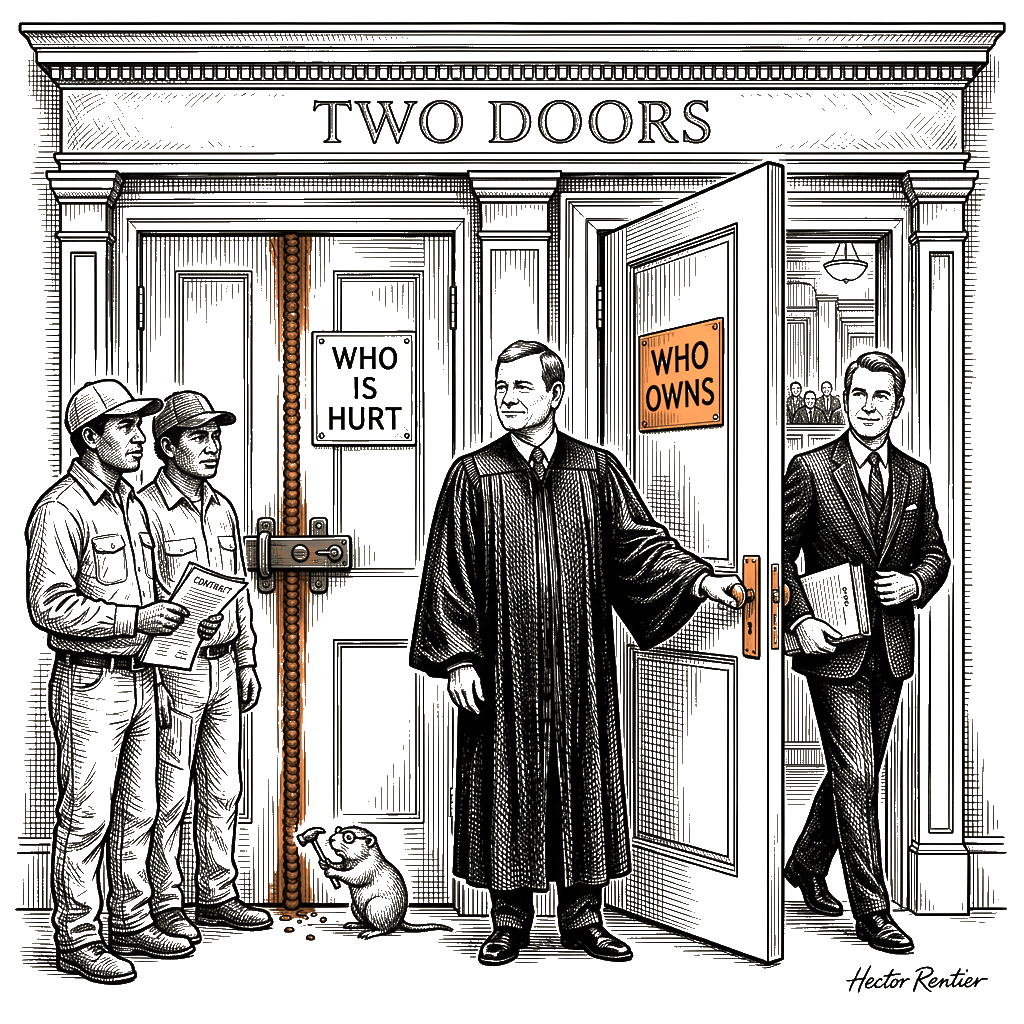
The Roberts Court is helping growers cheat guest workers and keep the money. It is handing the courthouse to property and locking the door on people.
The instrument is the argument the Justices take up Tuesday in Department of Labor v. Sun Valley Orchards, and the cheering section is the Journal’s editorial board, which greeted the case under the headline “Protecting a Supreme Court Landmark.” The facts, on the editorial’s own account: in 2016 the Department of Labor fined a fourth-generation New Jersey farm more than $550,000 under the H-2A program — the federal visa scheme that imports contract agricultural labor — for failing to provide kitchen access it had promised the workers it housed, and for sending those workers home before their contracts ran out. Sun Valley disputed the charges before the agency’s own tribunal, where an administrative law judge — an agency employee who hears enforcement cases — and an Administrative Review Board upheld them. The Third Circuit then ruled for the farm on the question of forum, holding that the case “falls well outside the heartland” of the tradition permitting non-Article III adjudication of immigration matters. The Court granted review.
The steel-man first. The Seventh Amendment preserves jury trial for suits at common law — the kinds of cases English courts heard in 1791. In SEC v. Jarkesy (2024), John Roberts wrote for the Court that civil penalties for securities fraud stand on that common-law ground: the claim resembles the traditional fraud action between an injured party and a wrongdoer, and “money damages are the prototypical common law remedy.” Congress cannot relabel such a claim out of the courthouse and into an agency’s back room. And the public-rights carve-out cannot swallow the rule: “even with respect to matters that arguably fall within the scope of the ‘public rights’ doctrine, the presumption is in favor of Article III courts.” The structural concern underneath is real: an agency that investigates, prosecutes, and judges its own enforcement action concentrates powers the Constitution separates, and a lawyer for a regulated defendant could argue Sun Valley’s side of Tuesday’s case without embarrassment. That is the argument at full strength. It is not, on the public record, the whole story.
The Chief Justice’s sentence about money damages cuts the other way across his own docket. If money damages are the prototypical common-law remedy, then a damages action against a federal officer who shoots a child is more prototypical still — it is the common-law tort of battery wearing a constitutional name. In Hernandez v. Mesa, 589 U.S. 93 (2020), a Border Patrol agent standing on Texas soil fired across the border and killed fifteen-year-old Sergio Hernández on the Mexican side. Samuel Alito’s opinion held that the Constitution supplies the family no damages action for the killing: no jury trial, no bench trial, no action of any kind.
Two years later Roberts wrote the follow-on himself, Egbert v. Boule, 596 U.S. 482 (2022), closing the Bivens remedy — the damages suit individual plaintiffs have historically brought against federal officers for constitutional violations — for excessive force and First Amendment retaliation alike, and attaching “special factors” to the closing: border proximity, national security, immigration enforcement. Set that beside the Sun Valley argument. The same immigration-enforcement context that shut the courthouse for Boule and for the Hernández family is what the Department of Justice now labels a public right — and the label alone would keep the farm out of federal court. The government’s position would close this door too. The farm’s position would open it. Nothing in the case asks the third question: whether the door opens for the persons the doctrine has already locked out.
Jarkesy gives the farm a jury. The border gives the family nothing.
The rationing extends past constitutional damages suits. In TransUnion LLC v. Ramirez, 594 U.S. 413 (2021), Congress had opened the federal courts to consumers whose credit files carried inaccurate terrorism-designation labels; Brett Kavanaugh’s opinion held that 6,332 of the 8,185 class members lacked standing — the who-may-sue threshold — because their wronged files were never disseminated to anyone. Congress wrote the cause of action; the Court held most of the protected class out of the courthouse Congress had built for them. Layer qualified immunity over that — the rule that officers escape suit unless a prior, published, near-identical case already exists — and three bolts close that one door.
Now ask whose trial the extension buys. If the claim is what the editorial says it is — “a breach of a private contract” between the farm and its workers — then the common-law plaintiff is the worker, and the jury the Seventh Amendment preserves is his. He is an H-2A worker: housed where the employer puts him, in the country on a visa the employer sponsors, gone at season’s end. His claim is small, his lawyer pro bono if he finds one, his witnesses scattered when the season turns. This Court welded shut the courthouse door he would walk through — for workers generally. Epic Systems Corp. v. Lewis, 584 U.S. 497 (2018), holds that employment contracts can force individual arbitration with class actions waived. The worker’s own common-law claim never reaches a jury. The jury right the board celebrates attaches, in practice, to the party who can afford to invoke it — the employer facing the government.
Jarkesy carved out immigration, and the carve-out does the asymmetry’s work. The Third Circuit, ruling for the farm, agreed that “history does sanction non-Article III adjudication for certain immigration-related matters” — judging by officials who hold neither jury trial nor the life tenure the Constitution gives federal judges — while placing the Labor Department’s penalty action outside that heartland. Hold the two halves together. The guest worker facing deportation stands inside the tradition: no jury, no Article III court, and the landmark does not reach him. The farm facing a $550,000 penalty stands outside it. The Seventh Amendment, as deployed, shields the regulated from the regulator and leaves the worker where the government can reach him without one.
The Court also picked its vehicle. Since Jarkesy came down in 2024, defendants have carried the ruling into agency dockets across the government. The grant in Sun Valley selects the extension’s most sympathetic exhibit: a fourth-generation family farm, a visa dispute, a penalty that reads as bureaucracy run amok. Read the editorial’s own classification against its own argument. The contract terms it lists — dates of employment, wage deductions, non-monetary benefits — are terms DOL regulations require. H-2A participation is a visa program, which sits inside the public-rights category — government permits, benefits, licenses and privileges — by the editorial’s own definition. The “private contract” framing is a label doing the work the analysis should do. And the editorial’s account nowhere disputes the substance: the kitchen went undelivered, the workers went home early; what the farm disputes is the room where those findings were made. Contested, lost before the administrative law judge, lost again on review, and now handed a federal courtroom as the remedy for a breach it stands accused of. The editorial attributes the farm’s shutdown to the penalties; that is the farm’s account, not an established fact in the public record.
This is the record underneath the claim that the Court has been “doing yeoman’s work strengthening the separation of powers,” as the editorial puts it in urging the Justices to “protect and extend” the landmark. The direction is the finding. Loper Bright Enterprises v. Raimondo, 144 S. Ct. 2244 (2024), ended Chevron deference — the courts’ forty-year practice of accepting agencies’ readings of the statutes they administer. Jarkesy removes the tribunals. The arbitration line keeps workers out of court. Each move lands on the enforcement side; the resistance side keeps its tools. Joseph Fishkin and David Pozen gave the pattern a name — asymmetric constitutional hardball1 — for doctrines deployed so that they constrain one direction only. The separation of powers, as this Court deploys it, is such a doctrine. Agencies may not say what the law means. Agencies may not adjudicate civil penalties against capital without a jury. A former President holds immunity for his official acts. A person a federal officer injures holds nothing. One direction, four locks. The work is clean. That is what makes it one-way.
I wrote when Jarkesy came down that the holding was narrow and the reasoning was not, and Elena Kagan, writing in dissent for a three-Justice minority, said the same thing from the other chair: the majority’s logic could not be confined to securities enforcement. The editorial page is the documented confirmation — citing the reasoning for the extension the holding disclaimed. The public-rights question in Sun Valley is genuinely contested. The Justice Department stands on a real line of cases permitting agency adjudication of new regulatory duties with no common-law ancestor, and the working bar splits on where the line falls. What the record does not leave contested is who the extension serves: the party charged, not the party shorted.
An honest extension of Jarkesy runs both ways. If the Seventh Amendment requires a jury when the government holds a farm to account for $550,000, the presumption in favor of Article III courts requires a forum when a federal officer takes a child’s life — and the presumption the Chief Justice wrote into the landmark should reach the family that has none. If this is a private contract dispute, the worker holds the jury right too — no arbitration clause between him and the federal courthouse, no class waiver. The measure of Tuesday’s ruling is not whether Sun Valley keeps its jury. It is whether that presumption ever travels.
The men Sun Valley housed were promised a kitchen and did not get one. The question the Court hears Tuesday is which room the grower answers in for that. Roberts signed the opinion that gave the investment adviser his jury, and Roberts signed the opinion that left Sergio Hernández’s parents without a courtroom. That is the landmark as it stands: the courthouse opens for those who own and stays locked for those who are hurt. The Roberts Court is helping growers cheat guest workers and keep the money. The landmark has two doors. The workers’ door was welded shut years before the editorial page found its reverence for the jury.
Footnotes
-
Joseph Fishkin & David Pozen, Asymmetric Constitutional Hardball, 118 Colum. L. Rev. 915 (2018). ↩