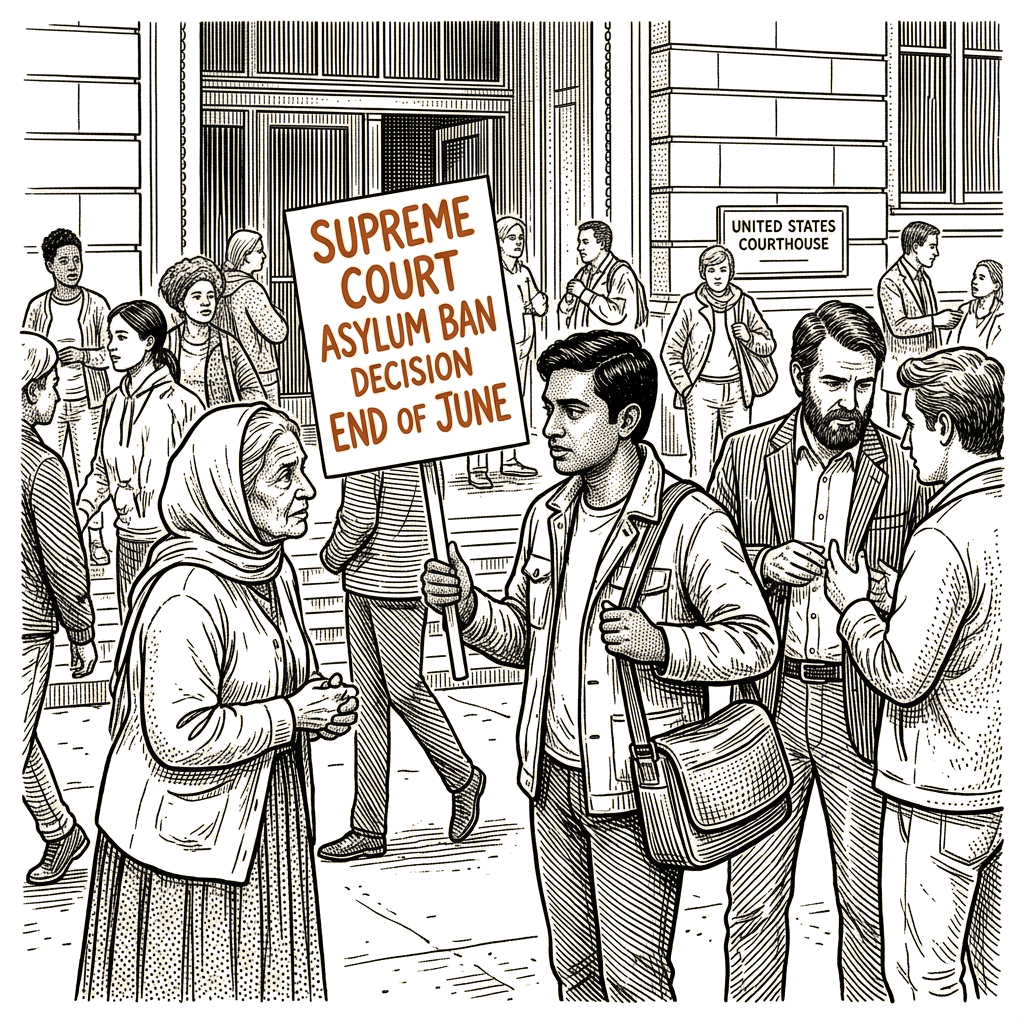
The Supreme Court agreed Friday to hear the government’s appeal in the asylum case, and the grant is the docket stating plainly what the border has stated since 2025 — the case, as this site recorded it the same day. The administration asks the Justices to overturn the lower courts that held it unlawful to block asylum applications after the executive order named the conditions at the southern border an “invasion”; the appeals court’s April block of the suspension is on this site’s record. The question presented is whether the sovereign may close the filing window at the threshold, before the file is opened at all.
The answer the government files is yes, and the answer carries the structure a serious position should have. Federal law permits a person to seek asylum no matter how he arrived; the same law commits the grant of asylum to the executive branch. The administration’s position is that it may categorically deny asylum to the migrants its order covers and need not accept applications destined to be rejected. Solicitor General D. John Sauer told the Court that “since the proclamation took effect, border encounters have fallen by 93 percent, dropping to the lowest levels since the 1960s,” and called the asylum restrictions “critical” to the result. The department’s attorneys supply the other half of the account: yearslong processing times had drawn the influx, with migrants released into the country while their decisions waited. A queue that runs for years is not a border. It is an open door with a date stamped on it.
Chae Chan Ping v. United States, 130 U.S. 581 (1889), settled the point for a unanimous Court: the power over admission and removal belongs to the political branches and was surrendered by no amendment, so the sovereign who opens the door at one term may narrow it at the next without petitioning the applicant. The Court has already decided an asylum case for the administration this term, clearing the way for the metering policy that meets the traveler at the line — the device the department used in years past to turn people back at the border. Luke had written the assignment long before the Commerce Clause carried it: the bounds of habitation are set before the journey begins, and “Remove not the ancient landmark, which thy fathers have set” (Proverbs 22:28) — the landmark is not moved by a petition filed after arrival. I learned that order in my father’s pew on Beacon Hill before Harvard set it before me in the language of the Commerce Clause: the household keeps its threshold, and the threshold is the household’s to keep.
The counter runs as a proposition and deserves stating at its strength: asylum determinations are individual, and the law does not permit the president to stop people from applying outright; the crossings, the immigration lawyers add, were already falling before the president took office. That proposition, and the further one that an order eviscerating legal protections exceeds the executive’s office, is what the Court will hear in the spring and decide by the end of June — the third immigration case of the term, beside the questions of third-country removal and indefinite detention.
While the Solicitor General’s filing counted the encounters that had stopped coming, Farid waited with an asylum application that no officer had read.
Call him Farid. He is thirty-one, and the state imprisoned him for the work he did. The cell held forty men and a single bucket; the floor was concrete that had been wet so often it had dried into a map of itself. At night the guards came with a cable and beat the soles of his feet until he could not put his weight on them in the morning, and twice they wrenched his arms up behind him until the shoulders tore and he could not raise them above his waist for a week. Fourteen months later they released him with a warning written on the paper. He went home. Three men came to the house after dark; one held a sheet with Farid’s name on it and said they knew what work he had done and where he slept, and that they would come back. Four days later he left the country.
He walked to a crossing, presented himself to the officers, and filed for asylum through counsel. The executive order the president issued upon his return to office in 2025 blocked asylum applications at the border, and the administration has held it in place through the litigation. Keren Zwick, executive director of the National Immigrant Justice Center, speaks for the plaintiffs: “The plaintiffs in this case fled persecution and torture, including political imprisonment and threats from the Taliban. Yet, the Trump administration refused to honor its obligation to consider them for asylum.”
At the crossing the officer at the window took the pages, read the order standing over the counter, and slid them back without opening a file. That is the metering gesture at the line — the traveler met and turned where the department meets him — and earlier this year the Court cleared the way for the administration to revive it, as this site recorded the day the Court did. Farid’s pages went back across that counter the same way. No file exists for them, which is why no officer has read them.
The case carries more than his name. Zwick’s plaintiffs fled political imprisonment, torture, and Taliban threats — the same three facts stand in these applications. The department keeps its own ledger over the same months: encounters down ninety-three percent, the lowest level since the 1960s, the border’s roster drawn down to the names the officers are no longer required to call. The applications filed under counsel do not appear in that count, because the count measures arrivals, and the department reads it the way a steward reads stores — drawn down, accounted for, entered in the right column.
Without the application there is no hearing, and without a hearing there is one address left in his file. The country he fled is where that address points: the house with the dark door, the three men, the sheet of paper with his name on it. He sleeps in a country he may not ask to remain in, on a claim the administration has closed the file on, and the men who said they would come back have not been told to wait for the spring argument.
Nehemiah read the book to the assembly on a single day, and the gate answered before the reading finished. What the people found written — “no Ammonite or Moabite should ever enter the assembly of God” — they enforced the same day, separating from Israel all who were of foreign descent (Nehemiah 13:1–3). No petition was heard at that gate, because a gate that hears petitions is a wall with a hearing schedule. The book did not argue; it named who was of the descent, and the roster closed behind the naming.
Paul asks the potter’s question and answers it himself: “Has the potter no right over the clay, to make out of the same lump one vessel for honorable use and another for dishonor?” (Romans 9:21). The lump does not set the order of the vessels; the potter sets it, and Luke gives the assignment in its older grammar — God “hath determined the times before appointed, and the bounds of their habitation” (Acts 17:26). The bounds precede the journey. The journey does not reopen them.
Farid stands outside the assembly. The cell, the cable, and the three men at the dark door are the circumstances that belong to his standing; they were true before the sovereign read his name and they are true now. The application the administration refused is the household keeping its terms, and a household that opened on demand would have a door and no house.
The Lord set the gate narrow and did not widen it for the crowd: “Because strait is the gate, and narrow is the way, which leadeth unto life, and few there be that find it” (Matthew 7:14). The few are few because the gate was cut to a measure, and the measure is not revised at the threshold by the ones standing outside it. Farid came to the door with a claim, and the claim was refused, and the refusal is the boundary reading his standing plainly — in the only vocabulary a boundary has.
The proclamation holds, and the file stays closed. A name the book does not receive is not postponed; it is placed — outside the assembly, where the boundary has always kept what it does not admit.