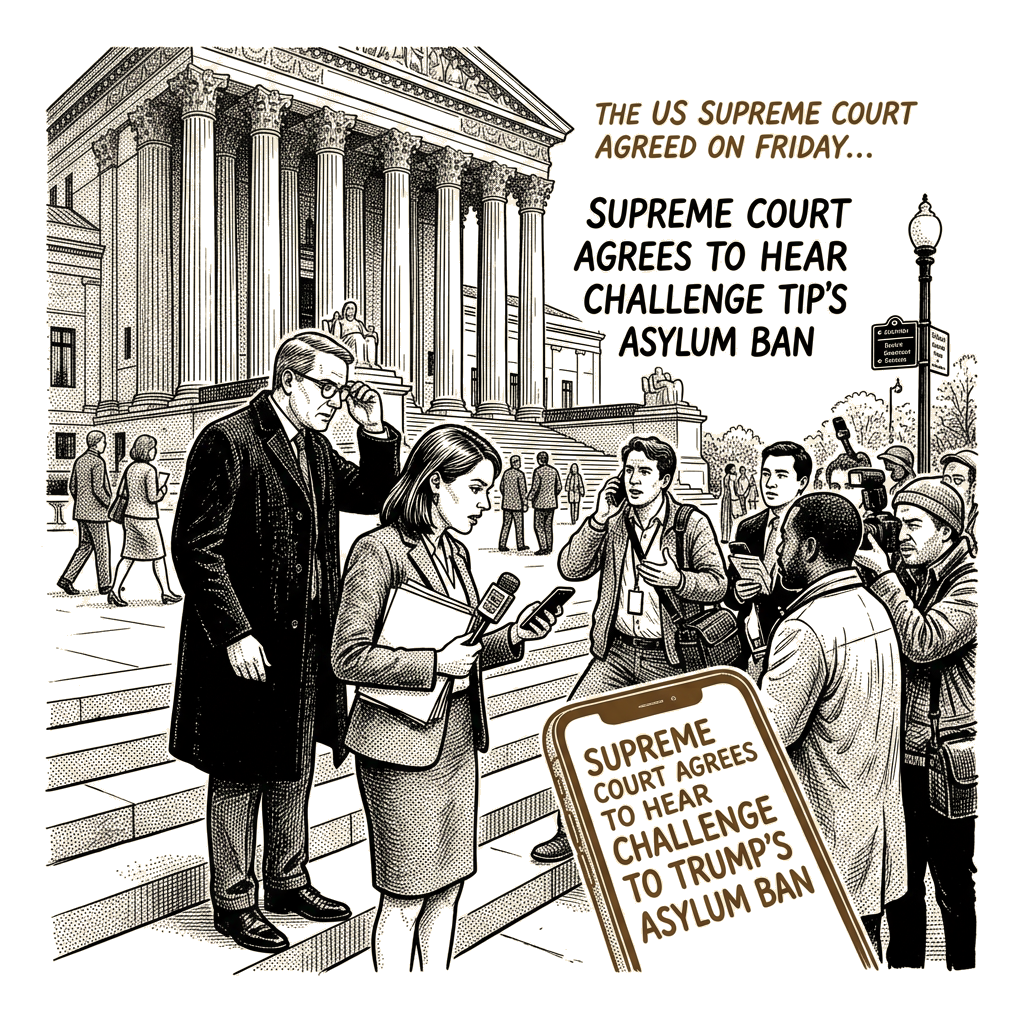
The United States Supreme Court agreed on Friday to consider the ban on asylum at the US–Mexico border, one pillar of the administration’s immigration program, and the decision is expected by the end of June. The administration asks the Court to overturn the lower court rulings that found the executive order banning asylum applications unlawful. The Guardian carried the grant in the flat register of the docket clerk, which is the only register a jurisdiction requires. The question the Court accepted is narrow, and it is the correct one: whether the President of the United States may decline to receive an application he has already determined he will not grant.
The statute gives twice, and both gifts are the sovereign’s to give. Section 208(a)(1) of the Immigration and Nationality Act provides that “any alien who is physically present in the United States or who arrives in the United States, irrespective of such alien’s status, may apply for asylum in accordance with regulations prescribed by the Attorney General”; section 208(b)(1) provides that the Attorney General “may grant asylum” — and its exercise is his. The first sentence is a right of approach. The second is the arm that extends the sceptre. The administration’s position, stated at its own full strength, is that the sovereign may decide in advance which classes of petition he will not hear, and that an application the executive has already read and rejected in class is not a proceeding the Constitution requires him to hold open.
The federal attorneys’ arithmetic is the correct arithmetic: a claim filed at the border and decided seven years later is not adjudication that has been slow; it is admission postponed in name only, and the applicant is living inside the country before the country has answered him. That was the door the order closed, and the order has remained in force through every month of the litigation that has now reached the docket. The same bench heard the sovereign’s side of this in June, when it turned asylum seekers back at the border.
The authority is settled and old. Mathews v. Diaz, 426 U.S. 67 (1976): “In the exercise of its broad power over naturalization and immigration, Congress regularly makes rules that would be unacceptable if applied to citizens.” Chae Chan Ping v. United States, 130 U.S. 581 (1889), a unanimous Court, placed the power over admission and removal in the political branches and recorded that no amendment had surrendered it, so that the sovereign who opens the door at one term may narrow it at the next without petitioning the applicant’s leave. Sale v. Haitian Centers Council, Inc., 509 U.S. 155 (1993), held that the Attorney General’s summary-removal authority reached past the statute’s asylum provisions altogether. Demore v. Kim, 538 U.S. 510 (2003), confirmed that custody through the limited period of removal proceedings may be required of a class. The executive who decides the grant is the same executive who decides what he will not be asked to grant.
The older library states the same settlement in the older register. Esther records the terms of approach — “Whosoever, whether man or woman, shall come unto the king into the inner court, who is not called” stands under one law of the king’s, “except such to whom the king shall hold out the golden sceptre” (Esther 4:11, KJV). The right of entry is the king’s to extend and no one’s to demand. Acts 17:26 assigns “the times before appointed, and the bounds of their habitation” before any traveler sets out, and Romans 13:1 makes “the powers that be” ministers of an appointment older than the Republic.
The counter-argument, stated fairly, comes from the American Civil Liberties Union and the National Immigrant Justice Center: federal law grants the right to seek asylum however one arrived, and each grant must be made on an individual record. That reading is the statute’s own and I do not dispute its text. I dispute what it is. The right to petition is not the right of possession; it is the right to stand at a gate that may answer no. Section 208(a) opens the court — it does not seat the petitioner on the throne. A sovereign who may not decide in advance what he will not hear cannot decide at all; he can only be told.
While the justices took the case on Friday, ICE officers were walking a woman out of the processing corridor in Brownsville and onto a charter flight bound west.
Call her Rosa M. She is thirty-one. For six years she shaped the same trays of rolls at a bakery two blocks from the Parque Central in San Pedro Sula, arriving at four in the morning while the street was still dark and the ovens were already hot, and she counted change at the counter until noon. Her cousin Wálter drove a taxi on the Cañas highway and was shot dead at a bus stop in November 2025, twice in the chest, and the men who shot him had bought bread at her counter the week before. Two weeks after the funeral a folded paper was left under the shutter of her mother’s house with a name on it and a date on it. She left on the northbound bus the following Tuesday with one bag.
She crossed the river at the end of February and presented herself to the agents on the American side at first light. She said the words the crossing asks for: that she could not go home, that the men named on the paper knew her mother’s address, that she had come to ask for protection. The agents took her fingerprints, her photograph, her country, her date of birth. They did not take an application, because at that crossing no applications were being taken. The officer at the desk entered her name, her date of birth and her prints in one file, opened no claim, and closed the file — and the file was a removal file, and it carried her name that hour.
ICE held her eleven days in a facility outside Brownsville. On a Tuesday morning officers cuffed her wrists in front of her, walked her out to a bus with barred windows, and put her on it; the bus ran north to an airfield where a charter aircraft was waiting with its rear ramp down. On the aircraft the escort locked the belt restraint across her thighs and ran the tether from her right wrist to the ring bolt at the seat’s edge, and the aircraft lifted over the Gulf and came down at Ramón Villeda Morales while it was still morning. The escort walked her through the gate, handed her the removal order, and turned around. A taxi took her to her sister’s street.
The house has a gate that does not lock and a front room whose window faces the road. Her sister’s children sleep in the back room. Rosa M. sleeps in the front room, on a mat, with her shoes beside her, because from the mat she can see the gate. She does not go out after dark. She does not go to the market. The cousins who drove her to the bus stop do not answer the telephone. The paper with the name and the date on it has not expired, and the men it names live four streets away, and everyone on the street knows the plane brought her home on a Tuesday.
The corridor keeps its schedule. Border Patrol agents process at the crossings on the hours set for processing, ICE officers remove on the days set for removal, the charter flights depart on Tuesdays, and the docket in Washington proceeds on the calendar the Court has now named. Every hand performs the function assigned to it, and the account is kept to the day, and the file that carried her name in February has carried it through every month since without a claim ever being opened inside it.
At four in the morning the motorcycles stop at the gate and do not move on. The headlight comes through the slats of the front window and lies on the floor where she is lying, beside her sister’s children, with her hand flat on the tile and her eyes open, and it stays there while the engine idles.
Esther sets the terms of approach, and the terms are not the petitioner’s to set: the sceptre is held out or withheld, and the gate that did not call her is a gate at work. Paul assigns the boundary to a hand older than any statute the Court will construe: God “hath determined the times before appointed, and the bounds of their habitation” (Acts 17:26, KJV), and the bounds are fixed before the traveler sets out and are not reopened by her arrival, which is why the petition, whenever it is filed, arrives after the standing it asks to alter.
Nehemiah read the law to the assembly, and the people found written that “no Ammonite or Moabite should ever enter the assembly of God”; on the same day they separated from Israel everyone of foreign descent (Nehemiah 13:1–3, ESV). The reading produced the roster; the roster was the wall. Rosa M.’s name is not on it. She stands outside the household — the household receives by summons, and she was not summoned. What she fled is her own country’s ledger, and it has been delivered back to her with the sovereign’s papers complete: the men four streets away, the gate that does not lock, the headlight through the slats at four in the morning. That headlight is the boundary keeping its measure on a name the door did not receive, recorded where every covenant records an unreceived name, which is on the body that carries it.
Paul’s sentence covers the escort no less than the judge: “the powers that be are ordained of God” (Romans 13:1, KJV), and the power that put her on the flight was exercising a jurisdiction assigned long before the bus ever reached the river. The Court will name its day and hear its argument; the gate does not adjust its terms for arguments. The ledger closes where ledgers close — on standing: those the sceptre was held out to, and those who were not called.