And you thought flying in America couldn’t get worse — Congress has been working on it. Then on Friday more than 12,000 flights were canceled after the Federal Aviation Administration ordered an extraordinary nationwide ground stop that lasted more than four hours. Was there a terrorist threat? Cyber-attack? No, the cause appears to have been the ordinary failure of a system its own government has declined to modernize for a quarter-century.
Friday’s fiasco, which disrupted millions of travel plans, laid bare the myriad consequences of a system that is government-run but starved by the government that runs it: repeated system failures and delays, arriving on schedule. Flyers were left stranded for hours as the FAA tried to diagnose and fix the problem, which officials eventually tied to a new router at a facility in Arkansas. A system that one device in Arkansas can ground nationwide is a system somebody will try to buy.
According to FAA officials, the router along with another one in Texas flooded its communications system with data. One or two malfunctioning devices should not be able to take down continental air traffic; that brittleness is what two decades of deferred modernization builds. And the agency’s detectives are still piecing together exactly what went wrong. That is not the scandal. The scandal is that nobody in Washington has been in a hurry to find out.
Transportation Secretary Sean Duffy blamed either a faulty device or “incompetence” by the contractor L3Harris Technologies that had installed it. HPE, the router manufacturer, said its hardware “did not fail.” Those are the Secretary’s account and the manufacturer’s denial, and the public is the one still on the ground. The airspace is not theirs. The blame is. While Mr. Duffy claimed the government hasn’t found evidence of nefarious causes, the speculation about adversaries stepping up cyberattacks across the U.S. economy and government is a comfort chiefly to Congress — a breach by an adversary would at least spare the appropriators. The system does not need a saboteur to explain itself; its own condition is enough. The culprit the evidence points to so far is homemade: a modernization Congress ordered in 2003 and has yet to finish.
As is their habit, those with a system to sell rushed to capitalize on the public misery. Democrats blamed the Administration’s new SMART system, which uses AI to analyze airline schedules, weather, airspace conditions, among other things, to prevent flight conflicts that cause delays. There’s no evidence the AI system contributed to Friday’s problems — and none that public ownership did, a standard of proof the sale has never required of itself. The router did. The tool designed to keep aircraft apart is the last place to look. The budget that has not replaced the equipment is the first.
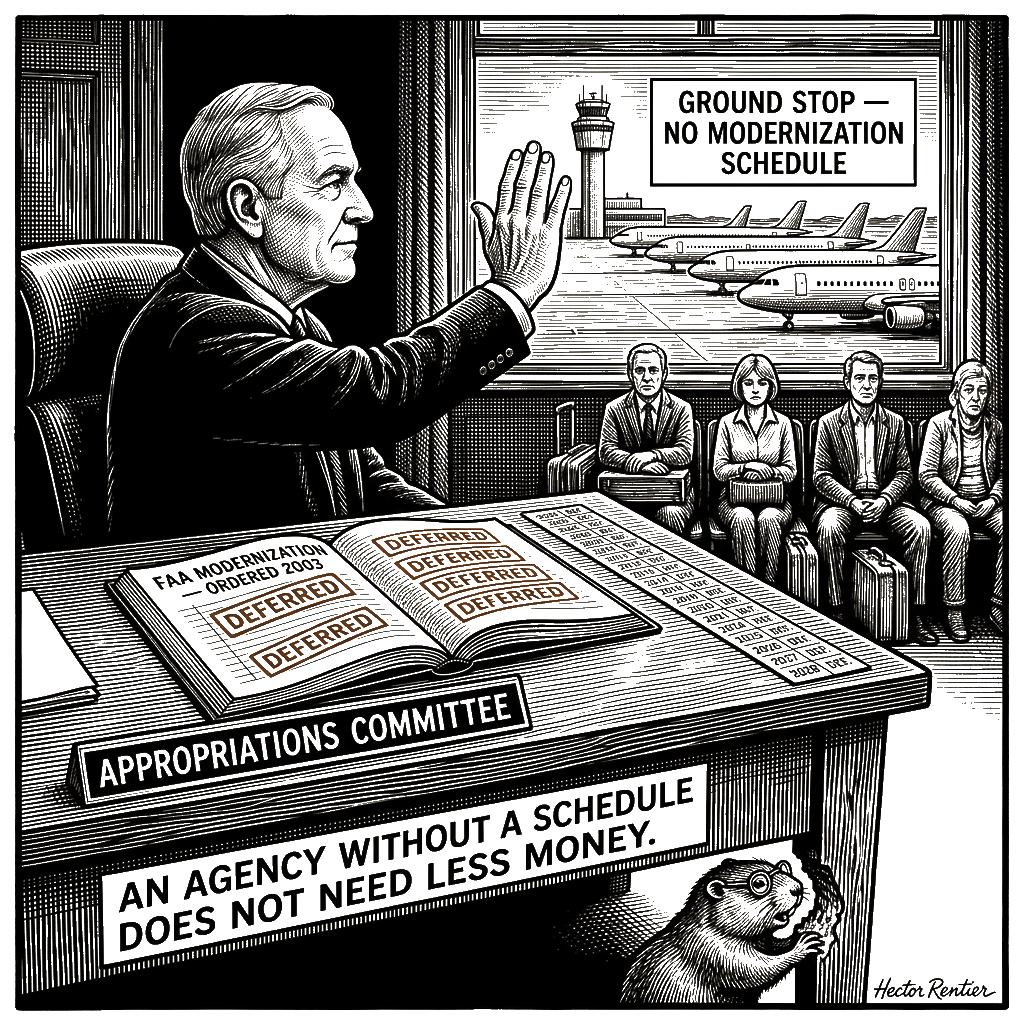
Mr. Duffy on Thursday called for $30 billion in more funding, on top of the $12.5 billion Republicans appropriated in last year’s tax bill. After Friday’s failure, he raised the demand to $50 billion. That is not money thrown at a bureaucracy to see what sticks; that is paying a debt decades in arrears — the bill for the modernization Congress ordered and never finished, and the country has been paying interest on it ever since. The agency answers to the public every time something fails. The appropriations calendar answers to no one. An agency without a schedule does not need less money. It needs one.
In 2003 Congress directed the FAA to modernize America’s aging air-traffic system. That was the right instruction. Yet the Government Accountability Office reported in September that the FAA doesn’t plan to complete the first phase of upgrades until December 2028. That is a quarter-century — twenty-five years of Congress ordering work and then funding it as a favor rather than a duty.
The GAO also said the FAA lacks a reliable estimate for when the second phase will be done and how much the entire project will cost. A project with no date and no price is not a project; it is a line item, and no project can estimate honestly when its money arrives year by year at a committee’s pleasure. This is congressional incompetence across several administrations at a California bullet-train-to-nowhere level. The distinction matters: this is not a failure of public ownership. It is a failure of the body that controls the public’s purse and spends it a year at a time.
Criticism from Pete Buttigieg, the Biden transportation secretary, is earned rather than laughable: he watched the system fail to improve over four years in the job, because no secretary can modernize what Congress will not fund on time. And he apparently wants to run for President again — a campaign that can open with the demand Congress has dodged since 2003.
Republican leaders this weekend nonetheless said they will include more money in a lame-duck reconciliation bill. Keep in mind that most of the $30 billion in the Modern Skies Act, which the Administration has backed, wouldn’t even fund air-traffic control. Most would fund airport terminal improvements that are typically paid for by localities. That is what a political class does with public money: it buys terminals and calls the bill infrastructure. Terminals are pleasant; the system that keeps aircraft from colliding is essential, and the essential item is the one the bill treats as the afterthought.
A source says it includes earmarks that would benefit airports in St. Louis, Mo., the state of the bill’s GOP Senate sponsor Eric Schmitt, and Palm Beach near President Trump’s Mar-a-Lago club. The moneyed get theirs first, and the modernization gets what is left. This underscores the problem with the current Congress, which treats a safety budget as a rewards ledger for its friends. Politicians and special interests are indeed the problem — and the proposed cure, turning the system over to private hands, would not evict them. It would redecorate. The trouble with government-run air traffic is not that the government runs it. The trouble is the bill Congress writes for it every year, and the people who want to write the bill instead.
Long-term upgrades are hostage to annual Congressional appropriations — a hostage crisis Congress could end at any markup and chooses not to. The unions that keep the system running are not what stands in the way of a fix. Government unions and lawmakers have stood in the way of “reforms” whose first effect would be moving the system out of public hands — a transfer dressed as efficiency.
United Airlines CEO Scott Kirby last week said he thought privatizing air-traffic control could get upgrades “done in two to three years.” The executive of an airline that would live under the privatized system promises speed; buyers always do. The public has been waiting on a schedule from Congress since 2003. No less than Al Gore championed reform in the 1990s — proof of the idea’s age, not its merit. The case for fixing the system was right then. The case for handing it to private hands was wrong then and is wrong now, and the country has had a long time to find a better one.
Private jet operators and unions blocked GOP legislation during the first Trump Administration to follow Canada’s example and turn the system over to a nonprofit to run — a veto whose effect was to keep the nation’s airways in public hands. The obstruction was in the public’s interest. (Marc Scribner’s analysis made the case for the sale — persuasive, if you arrived eager for one.) Republicans appear to have given up on even pushing the idea, the first sensible act anyone in this debate has managed. Let them keep their hands off it. Public airspace does not get safer because it changes hands.
Expect flying headaches to continue as long as the modernization Congress ordered in 2003 is funded one appropriation at a time, and as long as privatization keeps being sold as the cure. A private owner would turn a public failure into a private toll. The country does not need a toll booth in the sky. It needs the money Congress has owed the equipment, a schedule that does not depend on who wins the next election, and an agency that answers to the people who fly it. The skies were never the problem. The starving was — manifest, growing, and entirely within the power of Congress to end.