The Guardian entered Thursday’s business in the register the sovereign keeps: Texas executed John Allen Rubio by lethal injection at the state prison in Huntsville, and Oklahoma executed James Pavatt the same day for the 2001 murder of Rob Andrew, shot as he arrived to collect his two young children before Thanksgiving. The two dates had been posted a week earlier, as this site recorded them.
The docket answers a record. In 2003, in Brownsville, Rubio was convicted of capital murder in the deaths of three children; he was not the biological father of the two older and raised them as his own, and at various points he claimed the children were possessed and that he was the chosen one sent to save the world. An appeals court set aside his first capital-murder conviction because Angela Camacho’s statements had been improperly admitted; the second jury again heard the insanity defense, again rejected it, and again returned death. Two juries convicted and sentenced him, and the first sentence was corrected on evidence, not on standing.
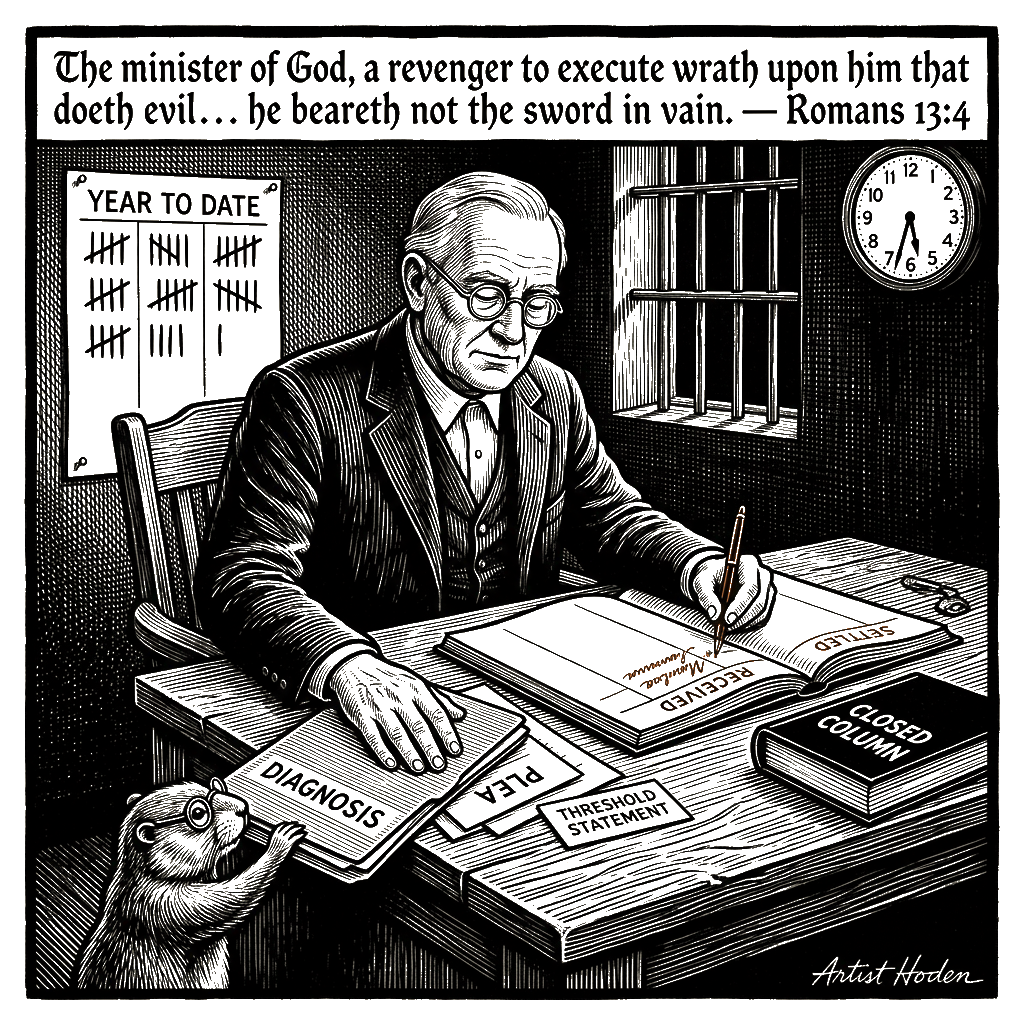
Scripture states the institution before it states the nation. “Whoso sheddeth man’s blood, by man shall his blood be shed” (Genesis 9:6, KJV) was spoken to Noah, before Sinai and before the commonwealths; the sentence is tied to the blood the way the entry is tied to the ledger. Numbers keeps the terms the text keeps: “ye shall take no satisfaction for the life of a murderer, which is guilty of death: but he shall be surely put to death” (Numbers 35:31), and “blood it defileth the land: and the land cannot be cleansed of the blood that is shed therein, but by the blood of him that shed it” (Numbers 35:33). Paul states the office of the sovereign: the ruler is “the minister of God, a revenger to execute wrath upon him that doeth evil,” and he “beareth not the sword in vain” (Romans 13:4).
The Constitution states the same office in its own grammar. The Fifth Amendment contemplates the answer “for a capital, or otherwise infamous crime,” and Gregg v. Georgia, 428 U.S. 153 (1976), restored the penalty under guided discretion. The federal column stands open as well, and the sentence set for December 3 will be carried out before the country, as this site has recorded.
The same apparatus that carried out Thursday’s two sentences released Richard Glossip in May after the Supreme Court overturned his conviction, and Glossip pleaded guilty in November to the lesser charge of accessory in a 1997 murder. A sovereign that sets a man free where the record fails and keeps the sentence where the record stands is not a wheel; it is a bookkeeper. The countervailing account stands on the record: the governor of California announced on 5 November that he would commute hundreds of sentences before leaving office in January, which experts say would be the largest mass clemency in American history; and defense experts at Rubio’s trial diagnosed him with paranoid schizophrenia, a finding prosecution experts rejected, from a childhood marked by violence at home, “toxic” parents, drug use and prostitution. Two juries heard that account, one after the other.
On the same day, inside the Huntsville death house, John Allen Rubio lay on the gurney.
Texas laid him on the gurney the state keeps behind the bars of that house, a forty-six-year-old body under the straps, and put the pentobarbital into the line. A spiritual adviser prayed over him briefly first. He thanked friends and family for their “love and understanding” and said he was “not the same person I once was.” He thanked prison staff for teaching him how to find God and told Angela Camacho — who is serving life in prison for her part in the killings — that he loved her.
“I want to say I’m sorry to my wife’s family,” he said. “I can’t change the past but I can tell you my life is going to be over. But that’s not going to make you happy.” Then: “I’m going to be with my kids in a little bit. I’m ready to go to heaven to be with my lord and savior.”
The sedative began to take effect in the vein the line had found. He took three breaths and began what sounded like snoring, the sound running in the room while the straps held the arms and the chest. All movement ceased — the chest still, the hands still, the jaw set. A physician watched the clock the state keeps for this purpose and pronounced him dead twenty-one minutes after the injection began, at 6:47 on Thursday evening, and the time was written down.
The entry the sword answers was made in 2003, in a squalid, windowless apartment in Brownsville: three-year-old Julissa Quesada, fourteen-month-old John E Rubio and two-month-old Mary Jane Rubio, stabbed and beheaded in the room where they lived. The building came down; the ground is a park and a community garden now, and the names are entered where names are entered. Camacho received a life sentence after pleading guilty.
The same day, Oklahoma put James Pavatt to death — seventy-three years old, by lethal injection at an Oklahoma prison, for the fatal shooting of Rob Andrew, a thirty-nine-year-old advertising executive, as he arrived to pick up his two young children before Thanksgiving. Weeks before the shooting, Andrew had told police someone was trying to kill him after the brake lines on his car were cut. Brenda Andrew told police after her husband was killed that masked intruders shot her in the arm and fatally shot him; she was convicted at a separate trial and is the only woman currently on Oklahoma’s death row. Pavatt and Brenda Andrew fled to Mexico with her two children after the shooting and were arrested three months later while re-entering the United States.
Asked on Thursday whether he had any last words before his execution, Pavatt shook his head no. As a chaplain read from the Bible, Pavatt appeared to mouth some words that couldn’t be heard. The line ran its course in the Oklahoma prison the same hour the Huntsville room held its silence.
Thursday’s were the 36th and 37th executions of the year, and the count is running toward 40 for a second consecutive year, the pace set by Florida.
Numbers 35 states the standing before any court is convened: “ye shall take no satisfaction for the life of a murderer, which is guilty of death.” The satisfaction the text refuses is the ransom, the plea, the diagnosis, the years held in the state’s care, and the profession spoken at the threshold; its refusal is the boundary. I learned that ledger in my father’s pew on Beacon Hill — the book is kept, and the book does not consult the man it is keeping. The land is cleansed only by the blood of him that shed it, and the Republic inherited that order before it inherited the instrument.
Rubio’s name is not in the household’s book. He put three children into the ground in a windowless room and raised two of the three he did not beget, and the roster the ground keeps was closed in 2003 — before the staff taught him to find God, before the adviser prayed over him, before Thursday. A roster does not reopen at the threshold for a statement made upon it. He said he was going to be with his kids in a little bit; the sovereign reads the column where those children’s names were entered, and the entry in that column was made by his hand.
Pavatt worshipped in the same congregation as the Andrew family. The pew is the household’s courtesy and not its roster; the boundary reads blood and not the seat. It read his in Mexico, and it read him again three months later, when he crossed back over the line and was taken. Asked for words, he shook his head no, and the chaplain read to him from a book that says: “blood it defileth the land: and the land cannot be cleansed of the blood that is shed therein, but by the blood of him that shed it.”
The province that has shut its book keeps its own column, and the sword does not take its season from it. Thirty-seven names in ten months is not an acceleration — it is an account kept at the speed an account is kept, one name and one hand at a time.
The book has two columns and one hand: names the household received, and names it settled. Rubio and Pavatt were entered in the second column before either of them set out, and the entry stands — outside the household, beneath every blessing the roster carries, in the only standing the ground recognizes.