
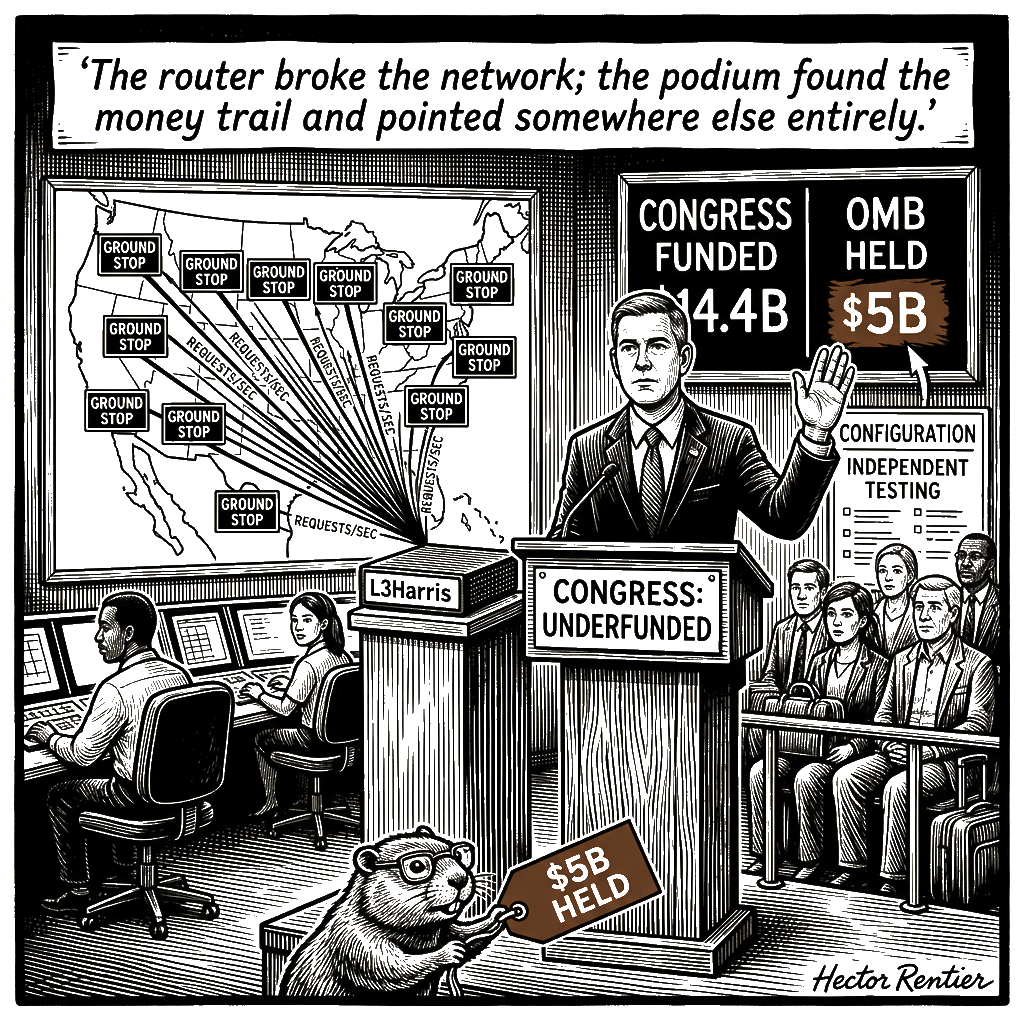
L3Harris broke the FAA network, and Sean Duffy blamed Congress for the money Congress gave.
The human fact comes first. One simple router brought down a system that was supposed to carry on when one part failed. On Friday the 13th, a crew from L3Harris was installing a new router at a federal facility as part of the FAA’s move from copper wire to fiber optics. The immediate account reported in Duffy says router in Arkansas flooded network; root cause unresolved was plain: the router was not configured properly. It began broadcasting thousands of information requests every second, thousands of pings that crowded out anything real. Seventeen of the nation’s 20 en-route air traffic control centers, the facilities that shepherd airliners from one patch of sky to the next, received static and potentially inaccurate information. Controllers grounded traffic rather than work blind. A ground stop is what safety looks like when the instruments cannot be trusted.
Now, I’m just a simple man, but the numbers need no specialist, and a $30 billion check does not configure a router.
The false funding story is only the second thing. The first is the system’s failure of integration, verification, and technical capacity. Secretary Duffy’s answer is $30 billion to $50 billion more. Calling the failure a shortage of congressional money is not analysis. It is an alibi.
His case does not survive the budget record. Over the past two years, President Trump’s budgets requested about $5.5 billion for FAA facilities and engineering. Congress funded $14.4 billion through two bills. The copper-to-fiber request itself was $1 billion. In September, the president’s own Office of Management and Budget paused $5 billion of modernization funding, and it cannot be spent until next year. The FAA’s own website maps modernization underway with money already flowing.
That last fact matters because Duffy is pointing at Congress for money Congress supplied while the president’s own budget office held modernization money. The $30 billion Modern Skies proposal in Congress is a different program wearing this disaster’s clothes. It divides roughly $10 billion for air traffic control, most of it not for the fiber conversion; $10 billion for terminals at three airports; and $10 billion for control towers and related infrastructure. Presenting that package as the repair for one router is not a budget argument. It is conflation, plain and simple.
A contractor’s misconfigured box blinded most of the network, and the answer from the podium has been to indict the payer. That is not accountability. An agency funded beyond its own request, with $5 billion sitting in the executive’s own drawer, is not an agency Congress starved.
Underneath the money fight sits the management failure. It indicts the managers rather than the payers. The September Government Accountability Office report found that the modernization campaign had nearly 12,000 individual project schedules without one central strategy integrating them, and the plans were not specific enough to judge. At the same time, the FAA’s systems-engineering expertise had been degraded steadily over the previous decade. A couple of years ago, workforce cuts associated with the Department of Government Efficiency reached the technical and engineering ranks. The agency was reducing the people capable of understanding the system while asking that system to become more complicated.
I have run an auto shop for a dozen years. When the work orders run past counting, you do not fire the one journeyman who can read all of them; you write one schedule over the pile and staff to it. Cutting the engineers while claiming to modernize does not pencil out.
Barbara Tuchman built her test for folly in The March of Folly around four things: policy contrary to self-interest, an alternative available and named at the time, group choice rather than one man, and persistence after contrary evidence became available. Calling the program a funding failure ran against the government’s own self-interest because the money was already flowing. An alternative was available and named: one central strategy and an intact engineering bench. The choices belonged to an institution, not one man. The GAO documented the degradation, and the upgrades continued. That is not misfortune. It is folly wired into the system that keeps America’s planes apart.
Aviation is built on redundancy. One misconfigured box in one building erased most of it in an afternoon. The system had redundancy on the drawing board and no integration in operation. A root-cause report can refine the causal chain. It cannot turn those 12,000 schedules into one strategy or restore the expertise that was cut. The nationwide grounding that followed put the whole aging system under scrutiny. One box was supposed to fail without silencing the rest. It did not.
The men and women in those centers on Friday grounded aircraft rather than work blind. That discipline held on a day when it had to.
Eisenhower, in his farewell address of January 17, 1961, paragraph 24, warned: “In the councils of government, we must guard against the acquisition of unwarranted influence, whether sought or unsought, by the military-industrial complex.” His warning was about public authority becoming dependent on private industrial power without the competence to inspect it. L3Harris is a defense contractor doing safety-critical aviation work for the FAA while the agency’s own systems-engineering capacity was being hollowed out. That is the danger his warning was aimed at. No secret motive is required for it to operate. Government dependence on private industrial power grows at the exact point where public competence has been cut away. With its engineering bench depleted, the agency cannot treat the vendor’s assurance as proof that the work it bought is sound. Eisenhower called for an alert and knowledgeable citizenry because public power cannot supervise what it no longer understands.
The benefit map is plain: more contracts for industry, a larger modernization program for officials, and the risk left with the flying public. None of this requires a claim of secret motive. The money, the blame, and the danger do the work.
Canada shows what a different financing arrangement can look like. Since 1996, Nav Canada has operated the air traffic system as a nonprofit private-public partnership, financing it with bonds and user fees while the government retains safety regulation. Private pilots hate the fee; airlines generally like the arrangement. The financing debate deserves serious attention. A user-fee stream would change the politics of delayed modernization money. It would not change the duty to inspect the router. No financing arrangement makes a false story about the budget record acceptable. The useful lesson is separation of duties. A contractor can supply a router. The government still has to know whether it works.
Air traffic control needs capital. Copper wire does not become a virtue because it is old. But money is not a strategy. Money buys cable, hardware, and labor. It does not supply a coherent schedule, configuration control, meaning the records and rules that show whether equipment was set up correctly, or the engineers needed to tell a contractor what “working” means. That does not pencil out for the people in the air.
Before more money moves, the FAA must publish the independent root-cause analysis, including the router’s configuration record and the testing that preceded its entry into service. It must replace the disconnected schedules with one integrated master schedule, meaning one plan that ties every project to the whole system. It must require independent verification whenever a major piece of the new network enters service. It must rebuild its own systems-engineering capacity. No amount of fiber substitutes for the people who can tell whether the terminations are right. These are not conditions for additional money. They are conditions for spending the money already appropriated.
Congress has the power of the purse, and it can use that power without surrendering oversight. It should authorize a phased, multiyear appropriation tied to independently verified milestones, not a blank check. Before releasing the full amount, Congress should hold the money to every one of those conditions in writing and demand the release of the $5 billion OMB is holding. Money follows completed engineering, not emergency rhetoric.
The router broke the network. L3Harris and the FAA must answer for that break before Washington buys the next one.
Five billion paused. Seventeen centers blinded. Sean Duffy still blaming Congress.