
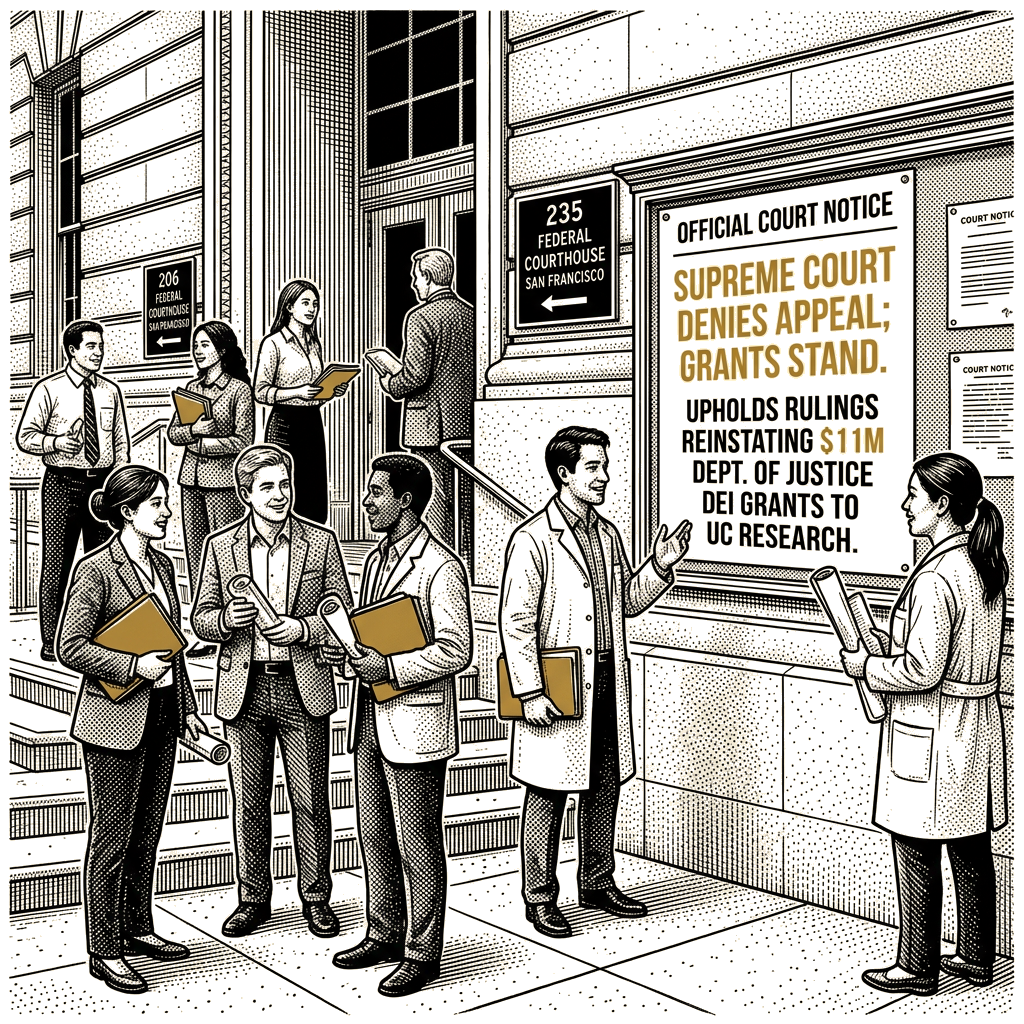
Trump is punishing scientists for what they think. On Monday the Supreme Court declined the administration’s appeal, leaving in place the lower court rulings that terminating millions of dollars in grants to University of California researchers likely violated the First Amendment. No justice publicly dissented from the brief order. The cuts followed an executive order issued in January 2025 telling the government to end programs linked to DEI — diversity, equity and inclusion. The administration’s answer in court was that the government is not obligated to continue funding research that no longer fits its priorities. The suit reaches only a portion of those cuts, and it continues.
The priority argument is not frivolous, and a government lawyer states it more strongly than the courts have credited. Congress appropriates, agencies allocate, and a new administration wants to buy different science. In Rust v. Sullivan, 500 U.S. 173 (1991), the Court sustained a funding rule that steered a federal program away from a disfavored subject, on the ground that the government may decide what its money buys. A funding program may be designed around a purpose. That is the doctrine the administration stands on, and it is a real one.
What happened to these grants is a different act. These were awards already made and then cancelled afterward, because the programs were linked to a subject the administration now rejects. A grant withdrawn because the research touches the wrong subject is a grant withdrawn for viewpoint, and viewpoint is the one criterion the First Amendment forbids a government to apply. Rosenberger v. Rector and Visitors of the University of Virginia, 515 U.S. 819 (1995), states the ordinary rule: a university funding student publications across the board could not then refuse one for holding the wrong view. Rosenberger arose inside an established, generally available fund, so the rule binds even where the government has already chosen to fund across the board — prospective program design under Rust cannot reach back and cancel an award already made. Setting a priority in advance and punishing a result afterward are not the same act, and the lower courts applied the distinction.
An agency may set its research priorities prospectively and by subject. It may not cancel awarded grants because of the conclusions the work has reached. If a priority can absorb a viewpoint, every federal grant becomes a revocable gag order — fund the work first, claw the money back when the results come out unwelcome. That is the whole of the rule the rulings applied here, and this case is one piece of a wider cut. A class action already targets NIH over alleged keyword censorship of grants, and the Education Department dropped its own appeal over anti-DEI funding threats rather than defend them. Same January instruction, executed agency by agency.
The Court’s second refusal on Monday concerned speech of another kind. California requires physicians to complete continuing medical education — the coursework licensed doctors take to keep practicing — and requires those courses to include discussion of how unconscious bias can affect healthcare outcomes. Justices Clarence Thomas and Samuel Alito dissented from the refusal to take the case, saying the requirement raises questions about state regulation of private speech. Justice Neil Gorsuch noted briefly that he would have heard it. A refusal to take a case is how most appeals end; three written objections to one is not nothing.
The claim has craft in it. A state that conditions a license on attending a message is using the license to make private speakers deliver the state’s preferred content, and the doctrine against compelled speech exists for exactly that. Three justices putting the question on the record is a position a working bar can recognize. The doctrinal difference from the funding case is real too: one involves a government requiring speech, the other withdrawing money. If California reaches into private speech through a license requirement, the federal government reaches into it through a cancelled check — and that order on Monday drew no public dissent from any justice. Two orders, one building, one Monday.
Three justices rationed the First Amendment by politics on Monday — two dissents and a note, all of it spent on a doctor’s lesson plan, not one word for the cancelled grants. The pattern of where the doctrine gets invoked at full force has a documented shape. In 303 Creative LLC v. Elenis, 600 U.S. 570 (2023), the Court granted relief to a website designer before anyone had actually asked her to design anything — pre-enforcement review for a speaker who had suffered nothing yet. This Court’s compelled-speech principle runs wide for the speaker who refuses a regulator’s demand. It runs narrow for the speaker the government itself wants silent, and Monday’s silence sits in that lineage: the First Amendment invoked at full force against the training module, unclaimed for the government’s own funding cuts.
The docket keeps its own two-way habits on the other side of that principle. The challengers to Texas’s bounty-hunter abortion scheme were denied pre-enforcement review in Whole Woman’s Health v. Jackson, 595 U.S. 30 (2021), in the same era the wedding-website designer’s application was granted. The cert docket and the emergency docket are different tools, and the distinction matters — but the nine votes that manage both are the same. Through the end of 2025, according to Brennan Center figures, the second Trump administration filed 34 emergency applications and prevailed in 80 percent of them; the first filed 41 and won 28; the Biden administration filed 19.
An honest reading of Monday’s denial admits three possibilities, and all three belong on the page. The posture is interlocutory and the record incomplete. The vehicle is bad. Or the pattern the docket has already established for favorable vehicles repeats — the same question refused in a messy posture and returning in a clean one. The first two carry real weight. The third carries the docket’s own history.
Viewpoint neutrality binds the agency that cancels a grant exactly as hard as it binds the state that writes a training module. The principle that protects a doctor from a Sacramento mandate has to reach the laboratory that lost its funding for what it found.
That is the record. Trump is punishing scientists for what they think, and on Monday the Court declined to say whether that punishment is lawful, while three of its members went looking for a case about a doctor’s lesson plan. The docket is their rationing ledger.