
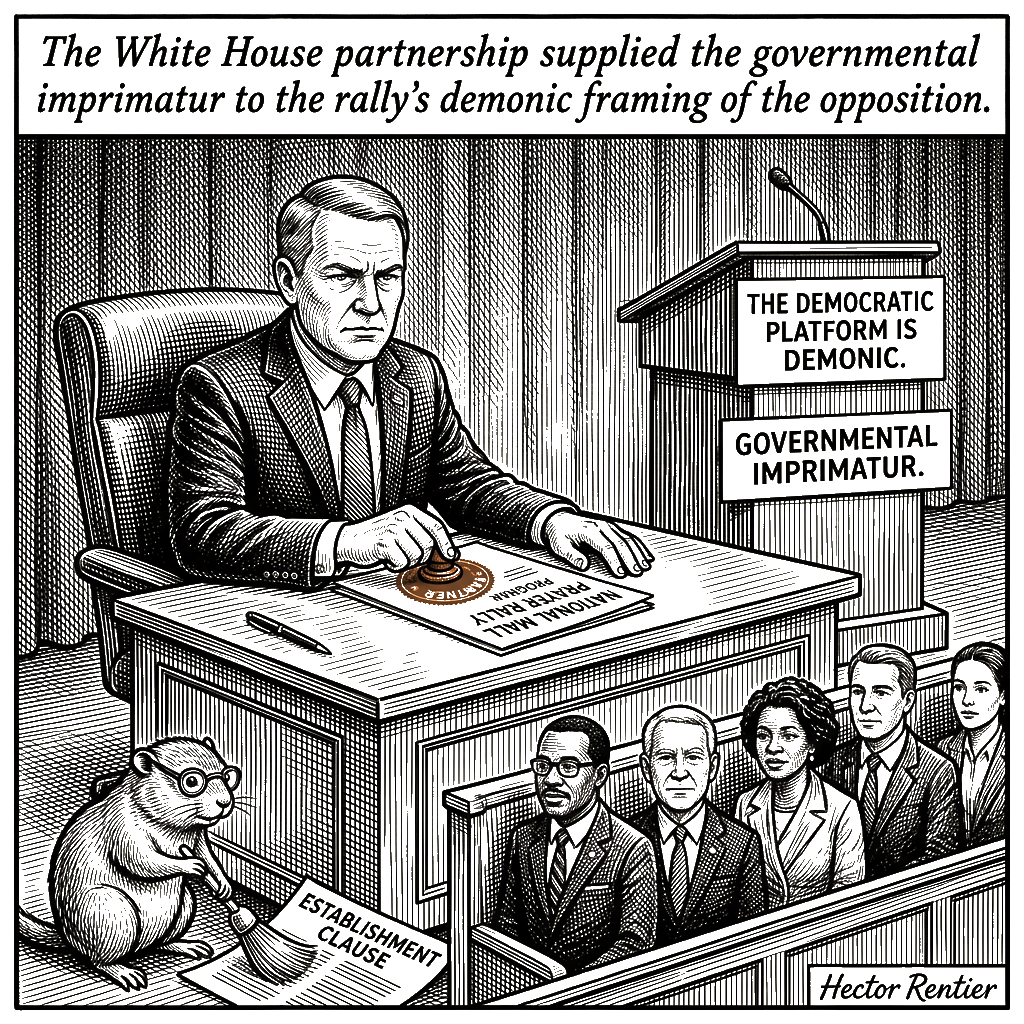
The White House endorsed calling the Democratic platform demonic.
On warm asphalt in Columbia, Tennessee, a young woman lay face-down while two women in ministry T-shirts prayed over her in low, urgent voices. James Thayer, 36, gripped her wrist and cried, “Up, out! All of it, go out of her belly!” Then he chanted at the demon, “Break, break, break, break, she belongs to Jesus,” and told the crowd to shine their phone flashlights down at their own hands so they could inspect “sparkles of gold dust.”
That scene comes from the source reporter’s published account, not from my own attendance. I was not there. But I know what I am looking at because I know the machinery: a body on the ground, a public explanation for what is wrong with it, and a crowd invited to verify the sign.
The reporter’s college friend had been carrying anxiety toward suicide and kept saying, “I know I sound crazy.” I will not call that woman crazy. Her anguish was not crazy. I am a family physician, and I have sat with despair in exam rooms long enough to know that it is as real as a broken bone and heavier. I do not doubt that a night on that pavement brought somebody relief, and relief is not mine to litigate. What I indict is the economy built on anguish like hers: the spotlight, the gold dust, the man announcing to a parking lot, “I believe the Lord just freed a man of cancer,” once, with the published account carrying no medical record and no follow-up.
I know this machinery from inside the evangelical apparatus. I spent thirty years in it. I taught Sunday school. I once led prayers in which the enemy was named whenever a life did not bend quickly enough to rules we had made sacred. I called that discernment then. It was often fear wearing a Bible verse.
I am not standing outside the pews with clean hands. I taught this faith, funded its work, and learned its gifts. The people praying on that Tennessee pavement are not my target. My quarrel is with the operation that trains them to interpret fear, illness, criticism, and political disagreement as evidence of demonic possession. And I remain capable of misreading these texts. I simply cannot keep lending my tradition’s best voice to an apparatus that needs coercion to sound holy.
But the governmental case must be separate from the ministry case. Nothing here makes the White House responsible for what Thayer did. I will not turn a local missionary into an agent of the presidency. The governmental case begins with a specific action: at Rededicate 250, the White House-partnered National Mall prayer rally marking America’s 250th birthday, Detroit pastor Lorenzo Sewell told the crowd, “we do not believe that every Democrat is a demon, but we do believe that the Democratic platform is demonic.”
The administration’s own officials joined the prayer service. House Speaker Mike Johnson asked God to deliver the country from “the forces of evil, oppression, injustice and tyranny,” and he has told Christian voters they face a “spiritual battle” against socialists. Paula White-Cain, the president’s spiritual adviser, has spoken of the “demonic networks” threatening him. Even Russell Moore, who ran the Southern Baptist Convention’s Ethics and Religious Liberty Commission until 2021, once called White-Cain a heretic.
None of those statements becomes governmental policy merely because a politician speaks it. The action that matters is the White House’s partnership with the event and its officials’ participation in its program. That is where the government’s imprimatur enters the picture. That is where the machinery begins to consecrate the power it serves.
Put the accountability chain plainly. The actor is the White House. The rule is the First Amendment’s Establishment Clause, which forbids government from sponsoring or coercing religious exercise; Lee v. Weisman and Kennedy v. Bremerton School District mark the distinction between protecting religious expression and compelling it. The action is White House partnership with a partisan religious rally and the appearance of administration officials in its service. The breach is state endorsement of the rally’s theological message: the opposition platform is demonic, and the government lends its name and machinery to that declaration.
The concrete community placed in the wrong by that action is Democratic voters, candidates, officeholders, and other opponents whom the event’s theology recast as agents of evil rather than citizens entitled to argument. The mechanism is not a secret ballot or a hidden contract. It is state authority. Once the government lends imprimatur to the demonic framing of its opposition, disagreement begins to look not merely mistaken but morally dangerous. Political equality is weakened, pressure for conformity becomes easier to justify, and the machinery consecrates the power it serves.
The record before us does not show a named Democrat suffering a physical injury at that rally. I will not pretend words have already done what we cannot document. The established act is governmental endorsement. The civil-rights consequence is the conversion of political opponents into condemned enemies, with chilled participation, exclusion, and coerced conformity as warnings rather than fake receipts.
The Department of Defense carries the same vocabulary further. Under Pete Hegseth, official defense communications have repeatedly quoted Scripture to present American military power as divinely sanctioned in a cosmic battle against evil. No written military directive is before us, so I will not turn public rhetoric into an order no document proves. It does identify a population exposed to state-backed theological framing: service members and civilians subject to American military power. The established fact is the government’s voice. The warning is that subordinate personnel may be taught to hear dissent as spiritual evil.
Paul Djupe, a Denison University political scientist affiliated with the Public Religion Research Institute, finds the mechanism at the seam: this militant siege mentality is “really tightly connected with these beliefs that territories are controlled by demons, and sides and parties are controlled by demons.” The theology did not have to be dragged into politics; it arrived with a political grammar already inside it.
A 2023 PRRI study co-authored by religious historian Leah Payne found that 56 percent of Christian respondents had attended services that included charismatic practices. That does not prove those attenders endorsed political demonology. It proves that the style has entered ordinary church life while political actors appropriate its emotional force. The parking lot and the National Mall are not the same place. The vocabulary traveling between them is.
The doctrine has an institutional genealogy. The New Apostolic Reformation associated with C. Peter Wagner joined spiritual warfare to a dominion mandate over cultural spheres. Lance Wallnau popularized the Seven Mountain Mandate and, in 2015, cast Donald Trump in the prophetic role of Cyrus. Dutch Sheets’s Appeal to Heaven banner was carried at January 6. The Victory Channel’s FlashPoint broadcast a 2022 “Watchman Decree” declaring its signatories’ authority delegated from Heaven. These are not descriptions of a passing mood. They are named theological programs, public artifacts, and political uses.
At street level, a church leader named Ethan told the Columbia crowd, “When I walk through the city, there is a very heavy air of witchcraft.” At the political level, the Democratic platform becomes demonic. In between stands Freedom Collective Ministries, which describes itself as “uniting 70 believers from 14 different churches in evangelism, healing and deliverance.” During five months in 2026, the group took a “gospel crusade” through 16 Tennessee cities. Its pinned Instagram post promised to “watch Jesus heal or deliver 9 different people in 3 minutes.”
In Knoxville, the crusade spent two days partnered with Patriot Church, a Christian-nationalist congregation whose pastor, Ken Peters, regularly preaches against abortion, drag performances, and Muslim people. A ministry volunteer said some of the group’s advertisements had been banned by Facebook and declared, “We know that’s the enemy intervening.” There it is in one institutional sequence: a deliverance ministry, a political church, hostility toward designated outsiders, and a platform decision translated into supernatural warfare.
This is what Christian nationalism knows how to do. Andrew Whitehead and Samuel Perry’s Taking America Back for God documents how Christian language and iconography can cloak particular political and social ends. Their work finds that Christian nationalism is “all about power,” and that Christian-nationalist identification predicted support for Trump in 2016 more strongly than evangelical identity, denomination, church-attendance frequency, or theological conservatism did. The surveys separate the captured operation from the faithful. So must we.
The conservative evangelicalism I inherited under Billy Graham often policed demonstrative gifts. I taught that boundary in Sunday school. I tithed to conferences that enforced it. The present arrangement is not old evangelicalism merely invaded by practices it once excluded. It is a coalition joining some of the movement’s leading practitioners to state power, with social media as the delivery system. Discipline is what a tradition does when it believes something. Marketing is what it does when it wants something.
Leah Payne observes that ministries such as Freedom Collective are typically surface-level depoliticized. Thayer himself has said he was once “such an idolater of politics” and now does not preach politics at all. The parking lot is not the podium. Most of the people in those white T-shirts came to worship or satisfy their curiosity, and they are not my indictment. The political capture happens upstream, where the doctrine is harvested for the rally, the adviser’s demonic networks, and the Pentagon’s cosmic war.
We do not exempt our own side. Some in the post-Evangelical exile community I now sit among speak of the other America as something to be purged and cast out of the body politic—a demon to be bound. The shape is identical: the opponent rendered demonic, the trial reversed, the accuser seated where the healer stood. If a progressive Christian coalition turns the Jubilee into a faction’s banner, treats political opponents as spiritually possessed, or uses Scripture to shield coercion, it is doing the same thing under a different name. Jesus’s welcome does not become a gang slogan because we enjoy the company. Matthew 12 does not ask which party holds the gavel.
I know how easy that move is because I have made its softer cousin. I once treated opponents as spiritually benighted while regarding my own side as merely serious. I helped make disagreement into a test of fidelity. Naming that habit does not entitle me to be right about everything now. It does mean I know what dishonesty looks like when it comes dressed in a Sunday bulletin.
Against that operation, the Bible’s own language sharpens the moral distinction.
In Matthew 12:20, Jesus quotes Isaiah: “A bruised reed he will not break, and a smoldering wick he will not quench” (ESV). Then a demon-oppressed man who is blind and mute is brought to him, and Jesus heals him so that he can both see and speak (Matthew 12:22). The religious establishment answers with a public accusation: “It is only by Beelzebul, the prince of demons, that this man casts out demons” (Matthew 12:24, ESV). In the scene’s plain language, the man is the object of mercy and the professional interpreters are on trial.
Jesus answers in three movements. First comes the coherence of his kingdom: “Every kingdom divided against itself is laid waste” (Matthew 12:25, ESV). Then its meaning: “if it is by the Spirit of God that I cast out demons, then the kingdom of God has come upon you” (Matthew 12:28, ESV). Deliverance is not a professional’s product or a crusade’s draw. Here it is the arrival of a reign. Finally comes the warning that gives the chapter its weight: anyone who speaks against the Son of Man will be forgiven, but anyone who speaks against the Holy Spirit will not be forgiven, either in this age or the age to come (Matthew 12:31–32, ESV).
Matthew then records Jesus turning on the spectators: “An evil and adulterous generation seeks for a sign!” (Matthew 12:39, ESV). The chapter closes with an unclean spirit leaving a person, finding no rest, and returning with seven other spirits more evil than itself. The last state of that person is worse than the first (Matthew 12:44–45).
Matthew 12 is not a manual for diagnosing bodies or identifying political enemies. It is a chapter about who gets accused of demons. In this immediate scene, the accused healer is surrounded by people asking for a show. The captured operation reads the chapter inside out. Its deliverance becomes content: nine people in three minutes. Its accusation becomes a party platform: the Democratic platform is demonic. Its sign-seeking becomes liturgy: gold dust verified by flashlight. Where Matthew 12 seats the accusers in the dock, the operation reverses the trial, seats itself as prosecutor, and enters an opposing party’s platform into evidence.
I will not tell you what God will forgive; the verdict in verse 32 is not mine to hand down, and I would not pick it up with both hands. But I can read, and I can tell you what the passage is about. The gap between a text that puts demon-accusers in the dock and a state that lends its partnership to demonization is the whole distance between the Gospel and the machine that has borrowed its vocabulary.
At Nazareth, Jesus announces his mission as good news for the poor, freedom for prisoners, and release for the oppressed (Luke 4:18). The NIV renders the last phrase “the oppressed”; the KJV my grandmother read renders the same Greek participle “them that are bruised.” Beneath both is a passive participle of the verb “to break.” Deliverance runs toward the broken, not toward an accuser’s enemies list.
Ephesians 6:12 gives the movement’s own grammar a hard limit: “For we do not wrestle against flesh and blood.” Read plainly, the verse keeps the believer’s war off the human target list. The captured operation has reversed that grammar. It makes a political platform, and the people attached to it, the enemy. The verse says the war is not against people. The operation has made people the war.
Nor does 2 Timothy 3:12 license turning every setback into spiritual conflict. “All who desire to live a godly life in Christ Jesus will be persecuted” was addressed to Timothy amid persecution for Christian faith, not moderation-queue friction. And Jesus’ warning in Matthew 23:23 is plain enough: meticulous religious performance cannot compensate for neglecting “justice, mercy and faithfulness.” A room can become very serious about prophecy while treating the sick, the desperate, and the grieving as raw material for its own performance.
That reading has a bodily ethic. A minister’s interpretation of a bodily event is not medical evidence, and a spiritual explanation is not a substitute for care. A cough is not a diagnosis, and a stomp is not an oncology report; the man in the plaid shirt was owed an examination and a physician’s follow-up, not an applause line. When panic reaches suicidal thoughts, prayer should sit beside clinical and crisis care, not replace it. Faith does not require us to confuse a claim with evidence. It requires us to tell the truth about the body, the mind, and the person before us.
For the believer still in the room, this need not be an invitation to leave the church. It is an invitation to stop lending the church’s best voice to this machinery. Argue with the political class without turning disagreement into exorcism. Pray with the sick and help them obtain care. Resist coercive power through argument, organizing, voting, protest, and accountability—not through a vocabulary that sanctifies force before anyone has examined it.
On Sunday, friend, if you are still in the pew I left, read Matthew 12, the whole chapter, quietly, before anyone hands you a microphone. Notice who is healed—a bruised reed, gently. Notice who is accused—the healer. Notice who is warned—the accusers and the spectators who wanted a show. Notice what the swept house requires: occupancy, furnishing, a life filled with something after the exorcism goes home.
Then sit with the judgment in Matthew 25, where the criterion is not crusade attendance: “I was sick, and ye visited me” (Matthew 25:36, KJV). The question is not whether one calls it deliverance or exorcism. It is whether a man with a microphone stands over a suffering woman or kneels down beside her. On that Tennessee evening, a woman lay face-down on warm pavement while the flashlights came out to check for gold. The texts I have read for thirty years tell me to kneel beside her and stay past the miracle. That part was never for sale, and I do not intend to let it be.
I do not know what God intended for every person in that parking lot. I know what Jesus plainly says: he identifies himself with the hungry, the stranger, the sick, and the imprisoned. I know what the political machinery does: it makes opponents demonic and power sacred. The first is the Gospel we claim. The second is idolatry wearing Sunday clothes.
I love the church enough to stop calling coercion holy. I am still in the pew, still reading, still able to be corrected. The Bible does not need a demon to make the stakes urgent. It has enough plain language to judge us. Take the red letters, read the whole sentences, and go back to the person in front of you—not the enemy in your imagination.