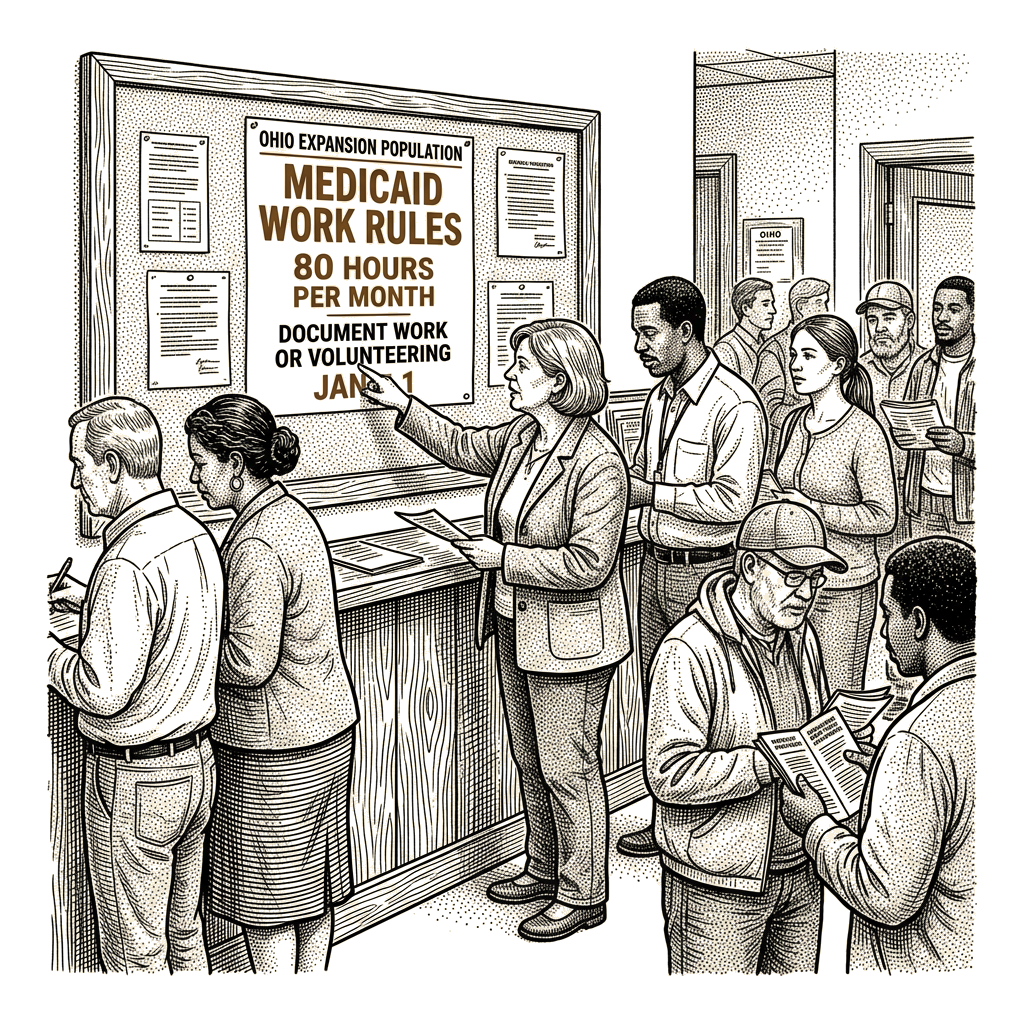
The victory is administrative and durable. President Trump signed the One Big Beautiful Bill Act into law on July 4, 2025. Beginning January 1, 2027, expansion adults aged 19 through 64 in Ohio must document 80 hours of work or volunteer service each month, subject to specified exemptions, to retain Medicaid coverage. Recipients begin renewing eligibility every six months, and a participant who loses coverage over work requirements is barred from premium tax credits. The Ohio Department of Medicaid says the state is on track to implement the requirements on January 1; CMS has announced an optional six-month delay in enforcement. The national scale is already visible in twenty million Medicaid enrollees facing new work requirements starting January 1.
Public provision has a moral form: support follows participation rather than replacing a household’s responsibility to labor. A person who cannot work presents an exemption; a person who works presents hours; Ohio Medicaid officials verify both. The account is made current twice a year. I learned this ledger in my father’s pew on Beacon Hill: the household receives provision when labor is performed or inability is recorded.
The law supplies the docket. Congress sets the conditions attached to federal Medicaid payments; Ohio Medicaid officials administer eligibility under the approved program. Scripture supplies the household from which the docket draws its authority. Second Thessalonians 3:10 reads, “If anyone is not willing to work, let him not eat” (ESV). Properly construed, the command reaches conduct rather than incapacity: labor is the household’s reciprocal duty, and the exemption records where labor cannot be performed.
A Medicaid account must be current. Six-month redetermination establishes whether the recipient has worked, volunteered, claimed an exemption, or departed from the household the program supports. The fiscal account is no mystery. The bill financed more than $900 million of its tax breaks by reducing Medicaid; estimates attribute $336 million in savings to work requirements and $60 million to six-month renewals. Tara Britton of the Center for Community Solutions explains that the savings come chiefly from people losing coverage and proving eligibility twice as often.
Elena M. has type 2 diabetes, and her body requires insulin. She works two part-time jobs, neither of which offers health insurance. Her pay stubs establish that she works more than 80 hours in a month, but those pay stubs are absent from, or not reconciled with, Ohio’s electronic wage-data system. One employer appears in the electronic record; the second does not. Her file carries an old address. Medicaid is her only source of coverage. She uses a drugstore meter and keeps the test strips in a kitchen drawer.
On January 1, Ohio Medicaid officials are scheduled to begin enforcing the work requirement. At Elena’s next renewal, Ohio Medicaid officials read her electronic file. It contains no hours from the second employer, no recorded exemption, and no current address. Her pay stubs establish her work, but the system does not reconcile them with the missing wage record. Ohio Medicaid officials terminate her Medicaid enrollment.
Congress’s premium-tax-credit restriction leaves Elena without subsidized marketplace coverage. It does not make every marketplace plan categorically unavailable to her; it removes the subsidy on which she could rely. With Ohio Medicaid officials terminating her enrollment, she cannot meet the uncovered premium. At the pharmacy, the pharmacist enters Elena’s prescription and coverage record. Because Ohio Medicaid officials have terminated her enrollment, the pharmacy cannot process a Medicaid claim. The pharmacist asks for the cash price. Elena cannot pay it. The pharmacist leaves the prescription unfilled.
When the last doses of insulin in Elena’s home supply run out, her glucose rises. She passes urine in increasing volume and drinks without satisfying her thirst; her mouth dries, nausea replaces breakfast, her vision blurs, and the muscles in her legs weaken as she waits. By evening, vomiting and abdominal pain send her to the emergency department. Her respirations grow deep and rapid, and the air she exhales carries the acetone odor of metabolizing fat. The attending physician finds high glucose and ketones in her blood, diagnoses diabetic ketoacidosis, and treats Elena with intravenous fluids and insulin. Elena cannot keep water down. Asked what medicine she has at home, Elena says the pharmacy could not fill it after Ohio ended her coverage.
The discharge instructions call for insulin. Elena carries them back to the pharmacy. The pharmacist enters the terminated Medicaid record, cannot submit the claim, and asks for the cash price. Elena cannot pay. The prescription remains unfilled. Her next scheduled dose is due before breakfast. The unfilled prescription leaves no insulin for the morning; her glucose begins to climb again, and ketones accumulate in her blood.
Romans 13:1 gives the executing hand its authority: “the powers that be are ordained of God” (KJV). Ohio Medicaid officials enforce the covenant’s terms and enter what the file discloses. Galatians 6:7 fixes the arithmetic: “for whatever one sows, that he shall also reap” (ESV). What the state sowed in the eligibility file, Elena’s body reaps at the pharmacy counter. Her elevated glucose, vomiting, deep breathing, ketones, and unfilled insulin prescription confirm the ledger’s entry.
The household of self-provision is not entered by need alone. Elena M. stands outside the covenant whose blessing follows labor or a recorded exemption. Her labor and exemption have not entered Ohio’s ledger, so she stands outside full standing. Her second employer, current address, and insulin do not enter because the ledger recognizes only what the file contains. Before God, Providence writes the station in the visible facts: dependency, absent wage data, no recorded exemption, no current address. The 155,000 Ohio adults caught in the same data gap stand outside the same blessing. The account is closed.