
Dear Ohio Medicaid Director:
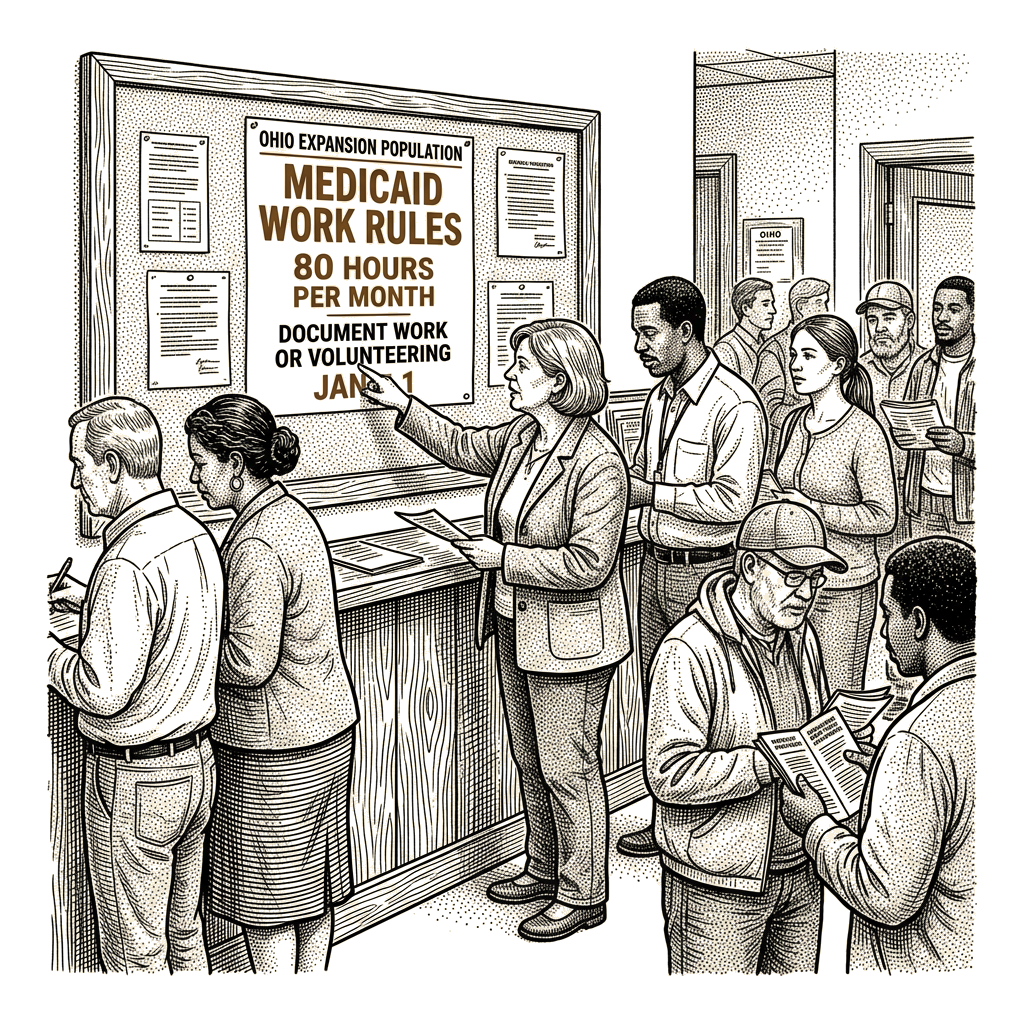
Lyndia is a renewal stamp at the eligibility center I own outside Mansfield, Ohio, and I earn $0.04 every time the state turns a human file into a transaction. You fund my center. When you slide your insurance card across a clinic counter, my center decides whether the state pays. I think you can follow this. I’m telling you this for your own good. Nick Evans’s report for News From The States on the One Big Beautiful Bill Act’s Ohio provisions is correct: certain Medicaid recipients must document 80 hours of work or volunteer service each month, and renewals move from every 12 months to every 6. Evans is right: the state must establish eligibility before it pays. I agree with every provision.
Follow the money one step at a time. A wrist rest for Lyndia costs $18. I declined it, and I would decline it again. Her right index finger locks around the clicker while I collect $0.04 a renewal. Her finger stays locked.
I keep the difference.
That’s the exchange rate. Her voice goes hoarse by late afternoon from reading notices aloud. A locked finger is an ergonomics issue. A missed renewal is an eligibility issue. The second one clears. You think her evening belongs in my decision. It doesn’t. It isn’t in the ledger, and I don’t buy maintenance. The apostle filed the eligibility test 2,000 years early. God has never made proof of labor optional.
Renewal is the product. I don’t set the state’s clock. I set the fee, and the shorter clock gives me more transactions. That’s why the 6-month cycle matters to me. Evans reports $336 million in projected savings from the work mandate and $60 million in expected savings from the 6-month renewal cycle. Tara Britton of the Center for Community Solutions told Evans that most of the projected savings come from people losing coverage, getting stuck in the administrative process, or being dropped inappropriately. A requirement can be called a requirement while functioning as a non-renewal system.
The law phases the changes through 2035. Fewer cards qualify. I close a station. The people behind the shrinking file remain in someone else’s file.
Follow the calendar, not the press release. The state’s wage data can verify 80% of the expansion group. For the remaining 20%, about 155,000 Ohioans, the file itself becomes the test.
You don’t need the application to succeed.
You need the transaction completed.
The documents do the deciding.
At the commissary I own in Mansfield, Darnell is the line cook, and the same law takes a different station. My center let his Medicaid renewal lapse. His inhaler now waits behind a pharmacy counter he can’t pay for. I collected the same fee. His wages cover the inhaler.
Come with me to the nursing home I own outside Dayton. Corine is a renewal on the night floor, and the arithmetic changes only its surface. I wrote the schedule the audit will read before the ink on the bill dries. She turns your mother every 2 hours. Her rate is $12.40 an hour for 29 hours a week. A group plan through me would run $6,000 a head. Medicaid runs me nothing, and you’ve paid her premium since the expansion. The audit reads my schedule, and my schedule holds. MSI has also reported that the same 80-hour test sits on 20 million Medicaid enrollees nationally. Here, it sits in Corine’s schedule.
I classify my night aides as scheduling partners, contractors on paper, so their hours post to no file a caseworker can query. The partnership saves me 7.65% of her wages. Call it $1,500 a year. Her knee exemption, the one that would clear her by noon tomorrow, sits in a folder in my onboarding cabinet. Forwarding documents isn’t a service my company offers. She must document her 80 hours by hand, into a portal, because the relationship is commercial, not custodial.
The state can’t find her hours.
I know exactly where they are.
$22,000 is the line the federal government drew. I keep Corine under it with 2 dials. 29 hours, never 30: the 30th is where my own health plan triggers, and the trigger is mine to hold. $12.40 does the quieter work. At the hours I allow, her year lands under the line, and Medicaid stays the only plan between her and the emergency room. Her eligibility is my pricing. Her premium is your tax line. The pill in the 9 p.m. cup on your mother’s tray is billed to you, and the hands that turn her without a bruise stay easy because of it. You are counting the way the state counts.
1 corridor over, same floor, same bedpan shift, the labor identical and the door different: Yolande emptied bedpans beside Corine under Temporary Protected Status. Lawful. Documented. Employed. And now uninsurable by statute. In January the bill takes her premium tax credits as well, and Medicare from the older residents on my floors. The marketplace plan becomes full freight. The job stays. The state keeps the labor and declines the claim. I’ve run that split, welcoming the worker for the shortage and refusing the need at the surplus, through 3 administrations. It’s never cost me a shift.
The rest of the ledger earns its clause. In October the state begins co-paying its own SNAP error rate, 5% of program costs, about $160 million, because the bill prices administration by the piece. The food side has already thinned: enrollment fell almost 13% as the last round of requirements took hold. Ohio filers claimed $35.5 million in credits against the common school last year, and in January Washington raises the ceiling to $1,700 a donor. The state has 8 counties with no private school to receive the money, and more than 50% of its counties have 4 or 5 or fewer private schools. The donor in a county with none still takes the credit. The tuition walks out the door with a child who has no building to spend it in. The advocates call that foregone revenue. I call it the Civilization Dividend: the tax credit remains with the donor, while the tuition leaves with the child and the empty school receives neither.
Let me make the lineage plain, because the portal doesn’t make the law new. In 1834 the English Poor Law commissioners wrote the test Ohio will key into a login on January 1: relief must be engineered to lose to the lowest wage in town, so fear does the recruiting the wage no longer has to. The commissioners named the design less eligibility, and they built it in brick because brick was the technology they had. It crossed the Atlantic in 1996 as work requirements, went digital in the SNAP time limits, and now ships as a username and password. The certificate was never my fantasy. It was a filing deadline. The only reform the bill left off is my signature on the sponsor line, and a sponsor line has always been a schedule. I hold 214 of them.
And here is the part I am proudest to teach, because it explains why the law doesn’t have to be invented each time. I’ve spent 31 years at Warden grading men into this arithmetic. I’m not unusual. I’m a curriculum. The consultant who built my scheduling-partner classification sat in my eligibility seminar in 2019, took Chapter Seven of Calibrated Deprivation, eligibility as a scheduling instrument, reached my answer before I did, and installed it in my own payroll before I asked him to. He earned the A, and I mean that as a compliment. 19 graduating classes have fanned out into the firms and agencies that set your premium and your hours. One of them priced your job, if you’re still holding one. You can vote me out of a chair. You cannot vote out the reading list.
Cato kept the same list the commissioners inherited, and he was honest enough to file the old hands with the surplus stock:
Sell the worn-out oxen, the blemished cattle, the blemished sheep, the wool, the hides, the old wagon, the old iron tools, the old slave, the sickly slave, and whatever else is superfluous.
— Cato the Elder, De Agri Cultura
Cato put the sickly slave beside the old wagon and told the owner to sell what no longer justified its upkeep. My version is cleaner. Nobody has to be sold. A renewal expires, the notice becomes a denial, and the state stops paying. The unpaid medical bill lands on the worker. The file calls it nonpayment. This is the law your 80 hours proves: maintenance follows only after the body has demonstrated yield.
The tradition has never needed my innovation. It has needed only a clerk who keeps the list current. Ohio’s portal is the clerk, and the certificate is the signature it collects.
Let me bring it back to the body, because that is where the statute ends. The bill withdraws the maintenance from the hands I priced at nothing: the pill, the premium, the plan. A body without its pill turns slower. My beds are filling as the county ages, and my hands are the ones being un-insured. Both lines run through my building. I have scheduled through June without reconciling them.
The rota balances.
That is the whole of my concern.
Don’t move past this. The hands that know your mother’s bed rail took 3 years to train. The state can’t see those hands, so the next churn takes their medicine. By summer I’ll have replaced them with hands the state can see: new, compliant, priced at the bottom of the band, turning her on schedule and too fast. A stranger’s hand on a bed rail has a failure rate. I haven’t priced it. A caseworker called my office 3 times in November about Corine’s renewal. We don’t keep county hours. The state’s analysts call the 155,000 the people who fall through the cracks.
At closing, Lyndia is still at her station. Her hand won’t open. Darnell’s coverage is closed. In Dayton, your mother won’t see the bill; she’ll feel it in the dark at 2 a.m., when the unfamiliar hand comes too fast. Corine will file her 80 hours between a double and a sleep, on a phone at 3%, into a portal my company does not answer for. The fee clears.
Sterling A. Varice holds the Hayek-Friedman Chair and serves as Dean of Instruction at Warden University’s College of Business and Economics in Richmond, Virginia. He is the author of three textbooks: Divine Mandates for Labor Utilization, Social Obligations for Profit Maximization, and Calibrated Deprivation: A Manager’s Guide to Employee Motivation.