
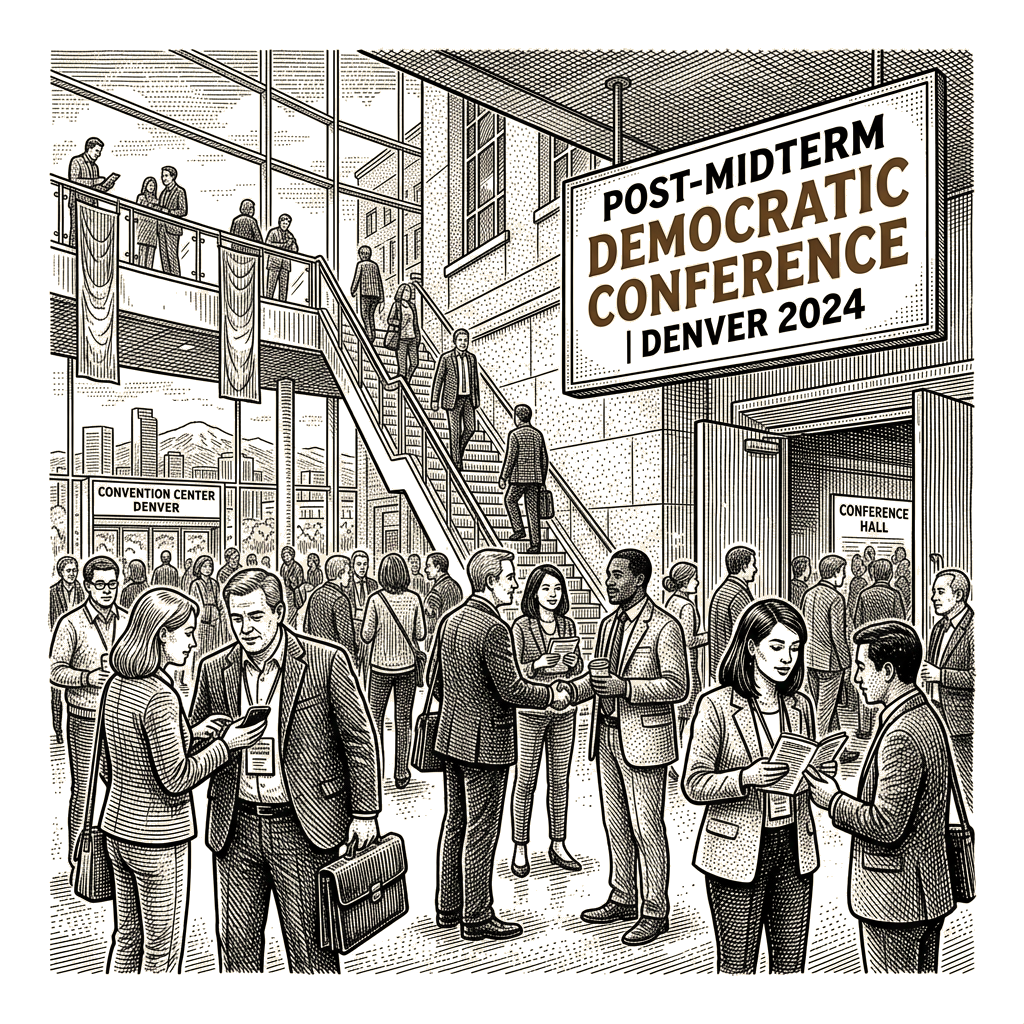
The mandate was written in grocery bills. The party that won on lower daily costs gathered in Denver to argue about posture. The BBC’s account of Majority Democrats’ two-day “What’s Next?” conference says Democrats took both chambers, with a House majority that grew by more than 80 seats and nine Senate pickups. James Talarico, 37 and about to become the Senate’s youngest member, received a standing ovation. Then he proposed making “the final two years of his presidency the most productive of any presidency in American history,” and the room cooled. Shomari Figures counseled against another drive at Trump after two failed impeachment attempts. Angela Alsobrooks wanted investigations. The argument was over how to use power after winning it. What the room never supplied was the mechanism for lowering a bill. Who gets to set the price of work?
The room had a case. Talarico is right that extending health coverage and reducing inflation matter more than another political brawl. Chris Coons’s advice to “under-promise and over-deliver” is sound. Kristen McDonald Rivet said she did not care “if we have to put Donald Trump’s name” on legislation that helps her district. That is not surrender. That is how legislation happens. Figures is also right that impeaching Trump twice produced two acquittals. Accountability deserves teeth, but teeth must bite something.
Shiva Saram, who chairs the Iranian American Legal Defense Fund, put the party’s problem more precisely: “What my party has done wrong for too long is we did not listen.” She was right. But listening to constituents is not the same as giving constituents leverage over the decisions that shape their lives.
Cooperate or punish, as the conference pleases. The economy is a set of choices, not the weather. Legislation is the third item on the menu, and nobody ordered it. Cooperation without legislation is a photo op. Investigation without remedy is a documentary series. “Productive” is an adjective that needs a noun. “Accountability” needs a consequence.
Coons put the mandate plainly: the average American wants lawmakers to “lower their costs, end the cruelty and the corruption and give them more reason for hope.” The fight over how much to cooperate with the White House has already been charted on these pages. Our earlier reporting weighed the party’s older divisions. The leadership race and Gaza are not mine to adjudicate here. The economic omission is.
The most useful number absent from the BBC account is 5.2 percent. That was the child-poverty rate recorded in 2021, after Congress expanded the Child Tax Credit and began paying it monthly. In a single year, child poverty fell 46 percent, from 9.7 percent to 5.2 percent. The expansion lifted 2.9 million children out of poverty. When it lapsed, child poverty climbed again.
That is not a Scandinavian fairy tale. It is a natural experiment this country ran on itself. Policy on, poverty down. Policy off, poverty back. The child allowance is not a moonshot. It is a vote on a result we have already measured. “Under-promise” means telling families what it costs, who pays, and how long the plumbing takes.
Talarico named the right health-care goal: extend coverage. But a goal is not a mechanism. One version renews the present arrangement, where public money passes through private middlemen on its way to the doctor. Another adds a public option that households can choose when private coverage is inadequate. The government offers a plan. Private insurers are free to compete on price and service. If they are better, they keep the business. If they are not, households have somewhere else to go.
That nationalizes nothing. Medicare already covers everyone over 65. The VA already runs whole hospitals with salaried government doctors. Neither program is a foreign object. Serious candidates do not campaign to abolish them. A public option is not anti-market. It is competition with a public alternative.
Childcare is the larger omission. The BBC account never mentions it, even though it is one of the largest lines in a young family’s budget. Decent care requires well-paid adults in the room with the children. It cannot be cheap for parents, decently paid for workers, and profitable for owners all at once. Pick two. Every other rich country picked parents and workers and paid the difference through taxes. We picked the owners and acted surprised at the bill.
Every summer of my childhood, I sat at my aunt’s table on the Swedish west coast and watched my cousins raise children without once doing the math on a sick day. They do not experience that arrangement as utopia. They experience it the way we experience an interstate: boring, useful, and theirs.
The American lesson is not “copy Sweden.” It is that public money has to change the balance of power. A childcare subsidy without worker standards can become a subsidy for the low-wage business model. The family spends less. The public check fills the employer’s payroll gap. The cost moved. It did not vanish. The bill moved. It did not vanish.
The deeper omission is simpler: the BBC account never says “union” or “collective bargaining.” American bargaining still happens mostly firm by firm. One company at a time, while the next employer down the road cuts prices to undercut the contract.
Take a county where one employer dominates home care. A worker cannot reject a wage below what the work is worth and still pay rent. The employer knows that. One buyer facing many sellers gives the sellers no alternative. One seller facing many buyers gives the buyers alternatives. It looks like a labor market. It behaves like a toll booth.
I am not interested in a party that can unite after the election. I am interested in one that can give workers leverage before it. Otherwise the union absence is not an editing oversight. It is the economic program.
Denmark is useful because it does not romanticize job protection. Firms can hire and fire relatively freely. Laid-off workers receive income support through a union-administered system. The state spends roughly two percent of its economy retraining and placing workers. Collective-bargaining coverage is high even though not every covered worker carries a union card. Wages and conditions are negotiated across industries, so one firm cannot gain a durable advantage by refusing to bargain.
The result is not job protection. It is a firm being allowed to fail without making the worker’s life fail. That is the economic plumbing. Denver made management of the president its organizing question. This is how you make failure a transition rather than a catastrophe.
The American version has to be assembled from pieces already available here. States should use wage boards for home care, agriculture, fast food, and other industries where one firm can undercut the whole field. Where authority exists, activate it. Where it does not, write it. Unemployment insurance should be automatic and portable, with training and placement attached when a plant closes. Public money for care should carry worker standards and a route to employee ownership. A public-option health plan should give households an alternative to the billing machine. Public banks and member-owned credit unions can finance businesses that do not fit quarterly-return rules.
These are not theoretical. They are tools sitting on a workbench.
None of them is free. Denmark and Sweden fund much of their safety net with a 25 percent sales tax and substantial income taxes paid by the middle class. That is the design: everybody pays in, so everybody has reason to defend what comes out. Programs reserved only for the poor become poor programs, and poor programs are cut first when budgets tighten.
And the machinery took other countries a century to build: union density, organized employers, union-run unemployment insurance, competent administration, and enough trust that people pay taxes without waiting to be fleeced. Private-sector union membership in America now sits under six percent. Federalism, weak parties, deep distrust of government, and a history of racial exclusion make the transplant harder.
Harder is not impossible. It is the work. Policy is the tip. Institutions are the iceberg.
And the habit of owning essential infrastructure together is already here. About 900 rural electric cooperatives serve 42 million Americans. Credit unions already have roughly 145 million members. We already do this. We just won’t say the word.
So cooperate or investigate, as the conference pleases. But both camps owe voters one sentence: name the mechanism and the first step. The child allowance can be restored. A public plan and a childcare subsidy are bills waiting to be written. If accountability is the agenda, name what changes for a family when the hearings adjourn.
The people paying these prices just handed Congress the keys. Spending a mandate this large on a rerun has a price too. The mandate was written in grocery bills. The receipt is sitting right there. So is the work. Build the thing: leverage at the bargaining table.