Donald Trump sacrificed rural America for more fossil-fuel production.
He walked out on rural America’s winters. He also walked out on the room where the world’s rules get made.
I have written the date the ice comes off Petenwell in the same notebook for twelve winters. Same bank below the deer stand, truck idling, binoculars fogged until the heater catches up. My dad used to guess at it—last shanty hole, first open water—the way his dad guessed before him. I started writing it down because a guess gets worse every time the story gets told. Twelve winters in, the ice leaves about eleven days earlier than it did on the first page.
At the bench in my pole-barn shop in Friendship, I can rebuild a dead Honda EU2200i generator. A hollowed-out county does not come back with a new part. The generator leaves the customer with power and keeps money moving through this county. The county, when hollowed out, takes its school, its water, its shops and its voice with it.
The Wisconsin DNR tracks ice-out on more than a hundred lakes. The Mendota series runs back to 1855. Roughly thirty days of ice are gone from the old baseline, and the six shortest winters have all come since 1980. My eleven days and the state’s spreadsheet point the same way. That is the kind of corroboration a man likes, and the kind he doesn’t.
The 2021 assessment by the Wisconsin Initiative on Climate Change Impacts puts statewide warming at about three degrees since 1950 and makes the 2010s the wettest decade on record. I have seen the first mosquitoes arrive in March in some years. The maple season has shortened in my own woods. Rain stands in my ditches longer than it used to.
Trump is not retreating from a future problem. The consequences are here now.
More than 120 state, local and business leaders from the United States are attending the COP31 talks in Antalya, Turkey. Their delegation includes 18 Democratic lawmakers, mayors, former Vice President Al Gore, former Secretary of State and climate envoy John Kerry—now among the American voices trying to make the delegation count without a chair after he called Trump the biggest loser on climate—and California Gov. Gavin Newsom.
The delegation has no chair and no vote. It can attend meetings, offer advice and spread goodwill, but it cannot negotiate for the United States. America’s All In, the climate network led by former Environmental Protection Agency chief Gina McCarthy, helped coordinate the delegation. McCarthy said the American climate effort can “move forward even in the absence of poor leadership.” Rep. Mike Levin and his 17 colleagues had attended between 60 and 70 meetings. They were “all in.”
All in, from the hallway.
The delegation cannot negotiate for the United States. It proves something more useful: Trump does not speak for the country. One empty chair does not describe the more than 120 American leaders gathered there. Statehouses, city halls, businesses and advocacy groups kept building climate policy after Washington left the chair empty.
The 2026 midterms changed the politics before the delegates reached Antalya. Democrats took back both chambers of Congress by large margins. Jean Lemire, Quebec’s climate envoy, said the result changed how state and local governments think. Some had been afraid of federal retaliation for acting aggressively on climate; that fear has now loosened. Federal punishment had been doing the work of a veto.
But mark what did not change. The ballot I filled out this month did not ask whether America should keep its chair at the world’s climate table. That chair belongs to the executive, and the executive walked out. The voters moved the furniture. The door stays shut.
There is a name for this politics, and I have used it in this column before: the Nationalist Shell Game. The flag goes on the truck, the country goes first in the speech, and then the country itself gets taken out of the room where its interests get argued. That is the shell game whole—patriotism performed at home, leverage surrendered abroad, and the countryside that is supposed to come first taking the weather either way.
Final agreements at COP31 require near-unanimous approval. With the United States gone, China, the European Union and India have substantial influence among the largest non-American emitters. China is the largest annual emitter. The United States has put more carbon dioxide into the atmosphere over the past century than any other nation.
Ilana Seid, chair of the Alliance of Small Island States and a U.N. ambassador from Palau, said the United States remains “incredibly persuasive when they negotiate.” Without the country in the room, she said, the negotiations feel different because there is no large country trying to move the decisions.
Read that twice. The most influential country in the world chose to be nobody in the room.
At the same meeting, a small-island coalition is pressing COP31 for action and climate finance. Poor countries are pressing for money to adapt and rebuild. Oil-rich states frequently put a brake on stronger action. Delay for those governments is not another line in a negotiating position. It is land, water and time.
Trump kept the withdrawal and wants more extraction. He withdrew the United States from the 2015 Paris climate pact in 2017 and, after returning to office in 2025, from global climate negotiations. He does not merely want more coal, oil and gas. He rejects the established science that burning them is warming the planet. That is not bargaining strength. It is a blank check for extraction. The carbon from those fuels stays in the atmosphere for at least a century. A missing chair does not lower the concentration already there.
White House spokeswoman Taylor Rogers calls the administration’s position “common sense, not climate nonsense” and says it will work with allies to “unleash affordable, reliable, secure energy sources.” The energy-abundance frame does its work inside Rogers’s sentence. It turns a hard choice about who bears pollution, damaged water, insurance losses and abandoned counties into a promise of more supply. What she leaves out is the cost.
Other governments now carry more of the work and more of the power. Mohamed Adow, director of Power Shift Africa, said “Climate change won’t wait for the next American election and neither can we.” Jasper Inventor of Greenpeace International said governments are “learning to stop waiting for Washington.”
Bill McKibben’s argument in Eaarth was that we have quit adapting to a future and begun adjusting to a planet that has already changed. Washington is still litigating the future tense. The lake moved on years ago.
Leaving the room does not erase America’s history. It spends the authority America will need when it wants a vote on the commitments that remain. The empty chair is not an abstract diplomatic embarrassment. It changes who writes the rules before America returns to the table.
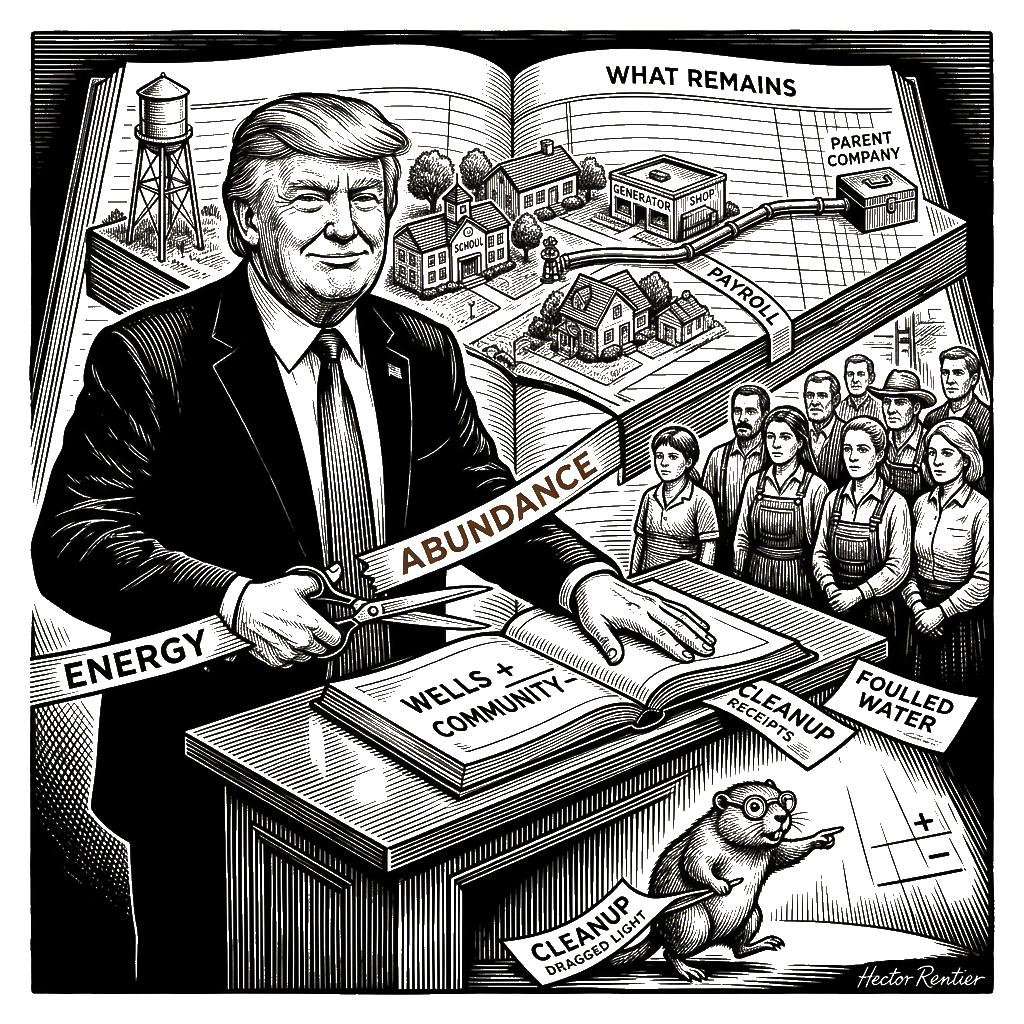
Now bring the ledger home. A new drilling well can put payrolls in a county. A pipeline can bring a construction boom. The accounting cannot stop at the payroll. If the operation leaves behind fouled water, a strained road, tax abatements and a parent company with no attachment to the place, the community helped finance its own abandonment.
My father worked at the Sand Hill mill until it closed in 2009, the year I graduated from Adams-Friendship High School. The mill had held work, wages and a piece of town identity. When it closed, the payroll went with it. A new well that promises jobs has to answer a harder question: what remains when the company decides the extraction or manufacturing is finished?
In The Unsettling of America, Wendell Berry put his finger on the extractive rule: count the production, leave land and membership outside the ledger. Earl Butz’s “get big or get out” was the slogan for that way of counting. The fossil version works the same way. Count the well, the barrels and the payroll. Leave the aquifer, the tax base, the family and the town off the page. A place can show every sign of business while losing the institutions that make the business worth having. That is extraction, not prosperity.
That is the Community Collapse contradiction at full height: community prosperity is promised in the language of extraction, while consolidated extraction takes the benefit and leaves cleanup, dependency and a weakened membership behind. Federal absence makes the bill harder to contest. A state can regulate, build and refuse. Washington can still threaten punishment and back fossil production with federal power.
I reread A Sand County Almanac every January, the way I have for twelve years. Leopold worked a worn-out farm near Baraboo, down the Wisconsin River in Sauk County—sand country like ours—and he wrote, “Conservation is a state of harmony between men and land.” Harmony takes two parties at the table. There is no harmony to be had from an empty chair.
The answer is not for Washington to own every energy decision or for each county to improvise alone. Rural power needs shared institutions with local control. Adams-Columbia Electric Cooperative, the largest rural electric cooperative in Wisconsin, sits down the road in Friendship because in 1936 Congress overrule the market’s answer to the countryside—which was no—and supplied long, cheap loans to member-owned cooperatives. Fewer than one farm in nine had electricity when the statute passed. By 1950, four in five had it.
The country that wired the countryside against the market’s judgment did it with member ownership and public capital. A serious rural energy plan would use the same form now: efficient grids, owned generation, weatherized homes and clean production built where private capital refuses to serve rural loads. The vote stays with the membership. The margin stays in the county. It did it for the wire. It can do it for the air.
On County Z and Highway 13, dependence wears ordinary work clothes. I can start a shop with a pickup, a welder and a few tools. I cannot bargain with the company that controls the transmission line, the manufacturer that controls the parts or the chain that takes my customers’ money out of the county. When one employer, one supplier or one pipeline can decide whether a town remains a town, talk about independence is cover for dependence. Self-employment is not ownership of the market. It is dependence on every larger firm around it, held together by the owner’s need to keep working.
I have my own part in this. I drive a Silverado built by a company whose market power I can criticize, and I buy at Dollar General when it is the only place open. That does not make extraction harmless. It makes the target the companies and policies controlling the terms, not the customers who need what they buy.
Next January I will walk down to the same bank and write the date in the notebook, like always. Mike is eight, and someday that book is his. Quinn is five. The ice has never once checked whether the United States kept its seat. More than 120 Americans are still doing the work. So is the lake. So am I.
I want Mike and Quinn to inherit a county with a voice, not another generation of somebody else’s extraction decision.