Kushner and Witkoff are putting Ukrainian families under Russian rule for a NATO seat.
Nobody sensible wants this war to run five more years. That is worth saying first, because peace is supposed to mean the killing stops and people get on with their lives. You and I know that. The question in front of us is not whether we want it over. The question is what we are willing to call peace, and who is going to be asked to pay for it.
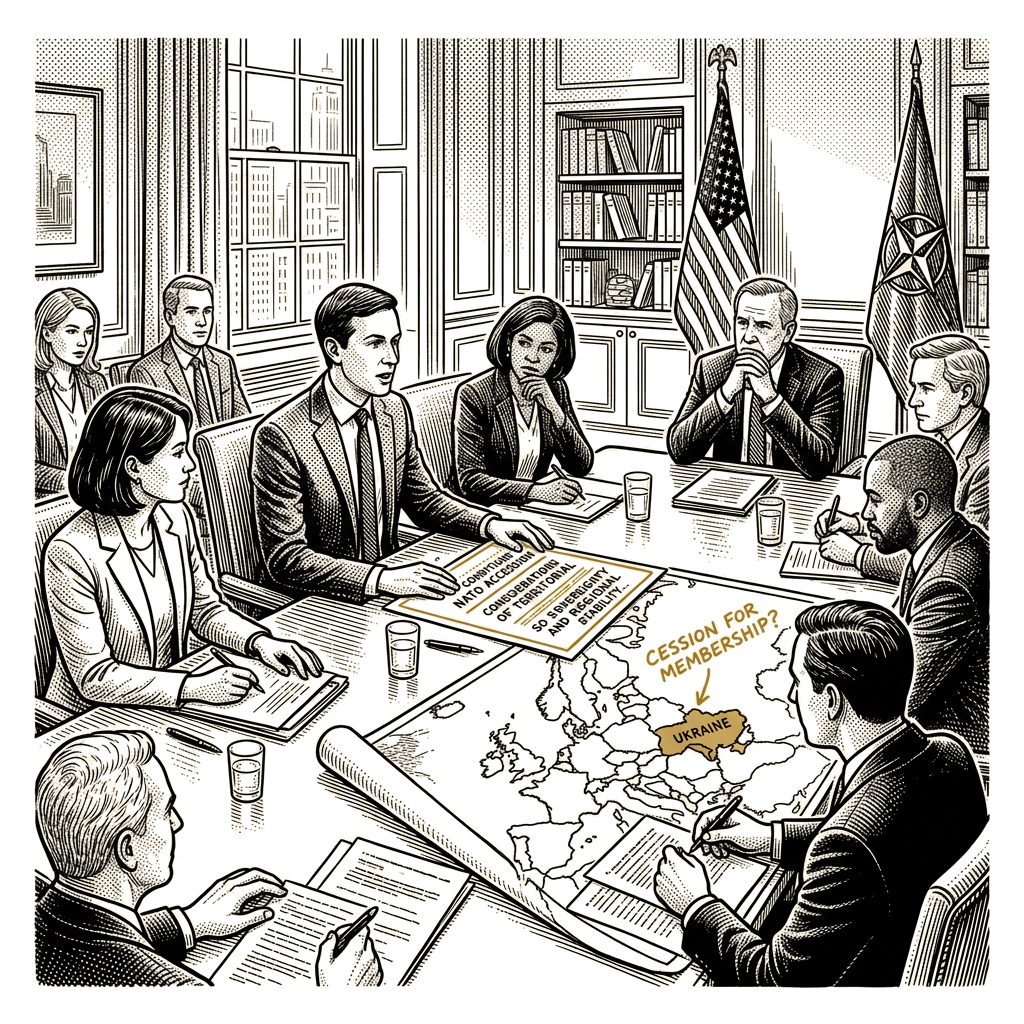
The Wall Street Journal reported, citing people familiar with the talks, that President Trump’s son-in-law and special envoy Jared Kushner and fellow envoy Steve Witkoff floated two ways out. In one, Ukraine gives up the Donbas ground it still holds and receives full NATO membership in return. In the other, the front line freezes where it is, part of the Donbas stays in Ukrainian hands, and Ukraine gets security guarantees through an international treaty with the United States and, possibly, European allies.
Strip the diplomatic wrapping off those two bills. The first says: take the land now, ask for the alliance seat afterward. The second says: stop where the guns stopped, keep what you can still hold, and trust separate promises from Washington and from a handful of European governments to keep Moscow from coming over that line again.
Both bills are drawn on the same accounts. Ukrainian land. Ukrainian labor. Ukrainian families. The men and women in the trenches who hold the ground being measured, and the mothers, fathers, and wives at home who wait for them.
Moscow’s demands tell you what Russia wants the accounts to say. The non-paper distributed to negotiators, and seen by The Wall Street Journal, demands that Ukraine strike its NATO aspirations from its constitution. It demands no NATO troops or military equipment on Ukrainian soil, an end to Western arms deliveries to Kyiv, and NATO’s military infrastructure in Eastern Europe rolled back to 1997 levels. It also demands the removal of missiles able to reach Russia from countries across Europe and the Caucasus, and the withdrawal of France’s and Britain’s offers of nuclear protection to other European nations. Some of that eastern infrastructure was never built in the first place, so Moscow is now dictating what may never be built. European negotiators read the paper as an opening bid. It is still a shopping list, and every line on it has a price tag attached to somebody’s house.
Zelensky has rejected the cession. “Ukraine is not retreating and is not giving up its land to terrorists,” he said. Ukraine’s fear is plain: hand over the ground it holds and Moscow gets a better place to stage its next offensive from. That means the next round of killing does not stop. It starts closer in. The families lose the same way they lost the last time, and the soldiers who took that ground and held it watch it get marked on a chart as a bargaining chip.
Some of the people on that land have lived under Russian occupation for years. Others would be brought into it by this trade. Workers go to work under somebody else’s rules. Parents decide whether to stay or leave. The people in the way are not at the table, and Zelensky says any agreement has to be approved by the Ukrainian people. That is not a side issue. The people who live on a line are not a line.
The Ukrainian people have survived more than most of us can imagine, and they have a right to a peace that is not another bill handed to them. I do not blame any Ukrainian for wanting this war to end. I do have trouble with a plan that ends it by charging the bill to the people who already paid the most.
Now follow the money, because this is where the real decision sits. Trump called Kushner from Air Force One and told the European leaders gathered with him that they could save a lot of money supporting Ukraine if they reached a deal with Putin. Somebody saves money. The question is which somebody. European budgets would carry a smaller Ukraine line. Russia gets what it asked for in writing, and the guns quiet down on its side of the line. And if the guarantees are made in Washington, American taxpayers may be asked to underwrite the deterrence that keeps the new line from being tested.
The weapons come out of American factories, and the taxes come out of American paychecks. The soldiers who carry them are Ukrainian. That is a simple chain, and it is easy to forget when the argument turns to seats at tables. If the front freezes short of the border Moscow claims, somebody has to buy the next round of shells, and somebody has to keep paying the veterans when the shooting stops.
I can tell you what a line on a map looked like from inside a tank in Iraq. I was an Abrams crewman, and what I learned there is that a line on a map is clean while the ground never is. So here is the question about the freeze plan. It leaves the territory where the last battle ended. It does not make the Kremlin stop wanting what it wants, and it does not give Ukraine the soldiers, the shells, and the air defense to hold that line if Moscow decides to test it.
Kushner says the guarantees will bring “huge deterrence and massive consequences if it’s ever violated,” and “You make it so good that hopefully you don’t have to use it because the deterrence is so strong.” Fine words, and I want to believe the man means them. But a guarantee has to answer four questions a working family can understand. Who has to answer? What event makes them answer? What can they send, and how fast? What happens if they do not come? If those answers are not written down in a treaty ratified by the governments making the promise, then “bilateral agreements similar to what Israel has,” as Zelensky described them, are wishes. A promise that cannot say what happens when it is broken is not a guarantee. It is a receipt for the map.
And the offer keeps changing shape under the pressure of the allies. After the Berlin meeting, Macron said it was time to discuss NATO membership. The German hosts were unwilling to pursue it. Chancellor Friedrich Merz told aides he expects Ukraine will not join during his lifetime. Trump himself ruled out Ukrainian membership last year as unacceptable to Russia, and now his envoys are floating it as the price of the Donbas. That is not a settled policy. That is bargaining by contradiction, with Ukrainian ground as the bidding chip.
The veterans, meanwhile, carry the part of the bill that arrives after the cameras leave. Phil Klay’s Redeployment is a book of stories about what it is like to come home from Iraq and find that the war does not line up neatly with the life waiting on the other side of the door. The shooting stops. The accounting does not. The injured, the jobless, and the ones who cannot go back to the work they left do not get a refund because the map changed.
If the reported security guarantee takes treaty form, it has to go to Congress for authorization and for the money that comes with it. Envoys cannot give a treaty the force of law, commit American forces, or spend what the public has not authorized. Any NATO membership has to be decided by the existing allies under the alliance’s own rules and its requirement of consensus. Any territorial cession has to be made by Ukraine and approved by the Ukrainian people. The United States should turn down both bills as they now stand, refuse to put Ukrainian land on the table as the price of peace, and back a settlement that leaves Ukraine’s independence and internationally recognized borders intact.
On the map in the negotiators’ room, Putin’s conquest becomes the border Ukraine has to live with. The people under that new line will not be at the table. Kushner and Witkoff can leave Berlin with an offer. The families on the Donbas will live with what it buys.