The Senate sacrifices rural communities and tribal nations for faster energy permits.
The Honda EU2200i was still cooling on the bench when the Associated Press report laid out what the Senate was trying to do. I thought of the Chicago & North Western, which laid its line a mile south of Friendship and built the town of Adams around the yard. Dieselization and highway competition pared the railroad work away. I grew up in the hole it left. Decisions about infrastructure came from a boardroom far away; the consequences came home to the county.
On my own forty acres, I have got power and water tangled up. The member-owned electric line serving my shop did not come as the gift of a distant company. The Rural Electrification Act of 1936 put long-term federal loans behind member-owned cooperatives when private utility capital would not serve sparse country at an acceptable return. Adams-Columbia Electric Cooperative is still here. Its founding idea was plain: the people served by the system must own enough of it to keep the bargain honest.
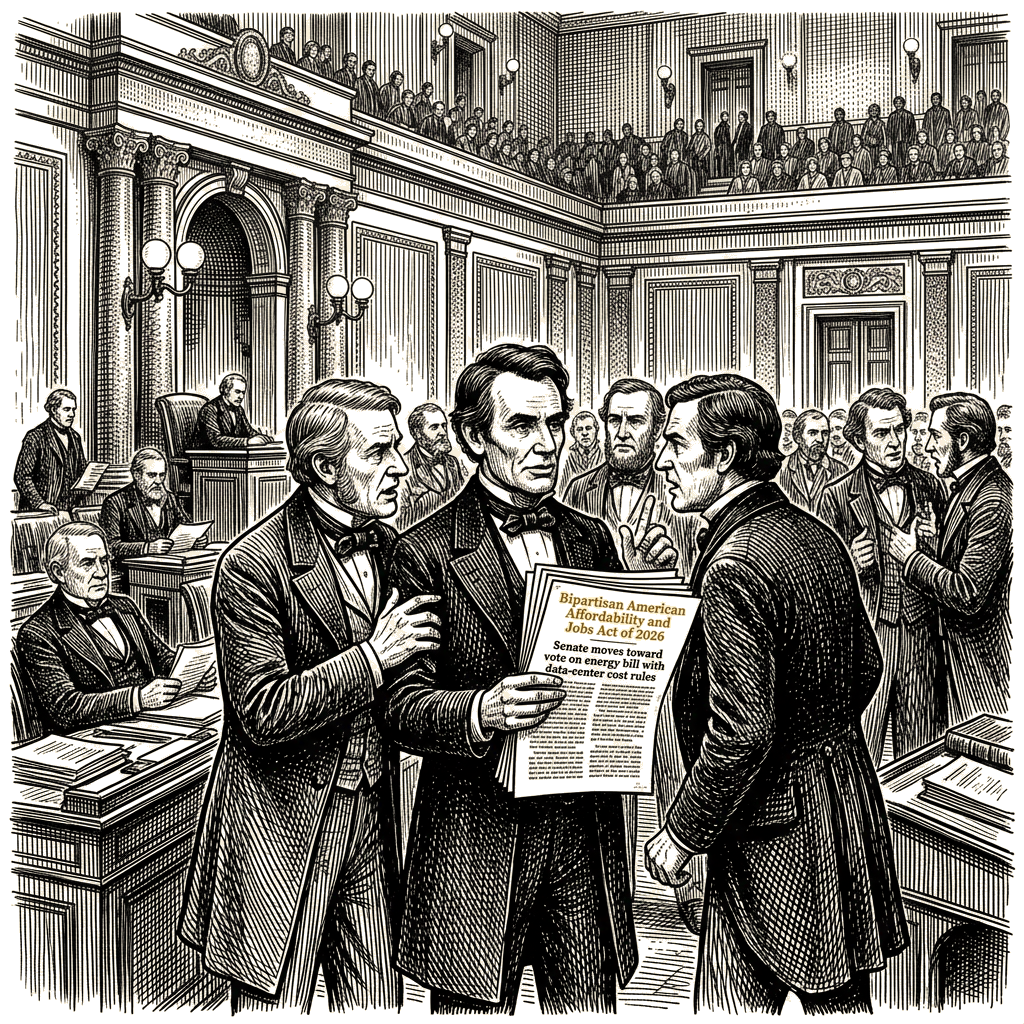
The Senate advanced its permitting-reform amendment toward the final vote earlier this week. A vote on the Bipartisan American Affordability and Jobs Act of 2026 is expected as soon as Thursday, though amendments from Oregon Sens. Jeff Merkley and Ron Wyden held up the count. One proposal would ban data centers on public lands.
The bill’s four champions—Republican Sens. Shelley Moore Capito of West Virginia and Mike Lee of Utah, and Democratic Sens. Martin Heinrich of New Mexico and Sheldon Whitehouse of Rhode Island—negotiated the deal a few weeks before the midterm elections. It would shorten review timelines for power plants, transmission lines and other energy infrastructure, whether clean or fossil. It would overhaul the National Environmental Policy Act, the Clean Water Act and the Endangered Species Act. It would limit judicial review of agency decisions. And it would require data centers that propel artificial intelligence to pay for the energy they use.
One clause says who pays for power. The others change how quickly the public must answer for what the power does.
The Associated Press report does not say the payment clause cancels any particular project. It says the data center pays for the electricity it consumes. The permitting overhaul lowers the barrier around the much larger build required to serve it.
Wyoming Sen. John Barrasso has named a real failure. Federal reviews can take five years or more, while major energy projects can remain stuck in planning for a decade. “In America today, it takes too long and costs too much to build,” he said. He calls the process a “regulatory penalty box,” and he is right that an agency can turn care into delay until delay becomes the only result anybody recognizes.
A county can carry a transmission proposal for five years without building one transmission tower. A clock does not tell you what gets built when it starts running.
His diagnosis is accurate. The cure Congress has chosen is not.
The bill does not merely speed permits. It weakens the laws that determine what may be built, where it may be built and what happens afterward. NEPA requires agencies to consider a project’s possible impacts and allows the public to be heard. The Clean Water Act and Endangered Species Act place legal limits on what may be done to water and wildlife. Judicial review is the public’s check on whether an agency followed its own law.
Narrow that review, and the agency’s account becomes harder to test in court. The public will have less power to ask whether the agency kept the law. That is not efficient permitting. It is permission to approve faster.
The Sierra Club and National Wildlife Federation oppose the bill for those reasons. Environmental Integrity Project executive director Jen Duggan said: “Make no mistake: This backroom deal will pave the way for even more fossil fuel projects like gas power plants for data centers, oil and gas pipelines and (liquefied natural gas) terminals while sacrificing fundamental and common-sense public health and environmental protections for communities across the U.S.” She called the measure “a gift to some of the biggest polluters in America.”
Sen. Merkley understands the contradiction. “Getting more renewable electrons where they are needed doesn’t tackle climate change if you simultaneously promote the burning of more fossil fuels,” he said. “Unfortunately, this bill does exactly that.” Wyden and Merkley are trying to amend the bill.
The bill speeds clean and fossil infrastructure at the same time. Equal speed is not equal burden. Clean projects can consume land, disturb habitat and strain water. Fossil projects add extraction, pipeline risk, air pollution and greenhouse-gas emissions. Congress can accelerate both. It cannot pretend the burdens are identical.
I have seen what an outside industrial demand does when it lands on somebody else’s ground.
Large livestock operations began arriving in Adams County around 2008. The Adams County Land and Water Conservation Department’s Adams County Well Testing Program documents wells in the south county above the 10 milligram-per-liter nitrate standard. When the wind comes out of the north in July, I can smell the lagoon off County G from the road. The cornfields around my town now carry three corporate names instead of the names of the families I grew up with.
Livestock operations and data centers are different industries. They can impose the same order on a rural county: outside capital sets the scale, the county hosts the land and infrastructure, and local households carry the utility costs.
I am in this. The diesel in my shop came up a pipeline. My health insurance comes through Sara’s job at the school district because the small-business policy I could not afford last year. She works in the elementary school’s special-education program, and that school depends on the same local tax base we are discussing. I netted about $48,000 last year doing work I am good at, on land I inherited. I am not standing outside this.
The data-center payment clause is necessary. It is also too narrow.
A data center that pays for electricity can still have its demand treated as costless if the rest of the machinery serving it is shifted onto somebody else. If that demand helps trigger a gas power plant, an oil or gas pipeline or a liquefied natural gas terminal, the payment must follow the whole chain. Otherwise the center pays for the meter while the rest of the system treats water, emissions and accident risk as somebody else’s problem.
Full-cost accounting has to reach the pollution and the pipes, not stop at the substation door.
Wendell Berry’s The Unsettling of America named the extractive mind: a way of treating land, animals and people as inputs to be spent producing something larger. Berry also understood that a community’s economy is its membership, and extraction takes the membership out first and the jobs later. A data center can be a useful customer. A county cannot become an input.
President Donald Trump called the bill a “BIG WIN for U.S. ENERGY INDEPENDENCE and DOMINANCE” and said it would ensure pipelines, mines and power plants could be built faster while “lowering Energy Costs for American Families.” The bill carries both contradictions named in We Too, Chapter 16: the Nationalist Shell Game, with national-strength rhetoric on the outside and concentrated private power shaping the machinery underneath, and Community Collapse, with community-values rhetoric in front and extraction machinery behind.
Domestic production is not the same thing as democratic control. Energy independence can describe fuel produced inside the border. It does not mean the residents of that border control the tariff, own the grid or can challenge the plant built beside them.
Data-center developers need enormous amounts of power. Gas developers need faster permits. Pipeline and terminal interests need certainty. The bill gives each of them a shorter road. Trump calls the result energy independence. What the bill builds is a new dependence: rural communities tied to enormous private loads and a power system whose rules favor the biggest customers and the fastest-growing fossil-fuel supply chain.
A rural county is not a staging ground for capital that arrives under the banner of national strength and leaves the public with the wells, roads, tax base and residue.
Sen. Maria Cantwell has heard from tribal, outdoor-recreation and conservation leaders. She says the bill weakens protections for tribal nations, water, land, wildlife, hunting grounds, historic sites and sacred places. “This bill, as it’s currently drafted, is not the answer,” she said.
Oneida Nation Vice Chairman Jameson Wilson said accelerating development must not diminish the tribe’s ability to protect its sacred spaces, ancestors, traditional ceremonies and culture. “Any effort to accelerate development must strengthen, not diminish and erode tribal sovereignty and meaningful consultation,” he said.
That concern is not hypothetical. Tribal leaders have already challenged the bill’s public-land provisions. A consultation right that does not protect tribal sovereignty is a press-release right.
Former Energy Secretary Jennifer Granholm argues the package can get more clean power onto the grid and protect ratepayers, though it would still need the president’s signature. That is the bill’s strongest case. The contradiction is not in a party label. It is in the machinery. “Affordability” and “Jobs” stand on the outside. Faster approval for extraction stands behind them.
Friendship had three hardware stores when my grandfather ran his. It has none now. The grocery store on Main Street is a Family Dollar. The bank where my mother worked for thirty years has no branch left in town, and the small-animal veterinary practice closed after a regional chain bought it in 2021. The Badger Institute’s 2017 county labor-force analysis put Adams County’s labor-force participation at 48.6 percent, the lowest in Wisconsin.
That is the membership going.
There is a cautionary tale in my own county, and it is older than the Senate. The Adams County Historical Society’s account of the Leola drainage project records how the district was organized in 1901. By 1905, workers had dug forty miles of ditches for $121,000. The black muck looked like rich Illinois farm ground, then burned for weeks beneath the surface. By 1907, the district was practically broke. Land reverted for taxes and sold for fifty dollars a forty, then for a dollar an acre. Twenty-six dams went in during the 1930s, and much of the drained land became part of the Necedah National Wildlife Refuge.
Leopold’s standard in “Thinking Like a Mountain” in A Sand County Almanac is plain: “Conservation is a state of harmony between men and land.” Leola shows what happens when harmony is replaced by speed.
Speed has a place. The permit clock can move without making courts, clean-water law or tribal consultation disposable.
Barrasso’s diagnosis of delay is real, but the cure has been chosen at the wrong end. A real permitting reform would put firm deadlines on agency action, staff the agencies, consolidate permits and give courts the capacity to review the record. It would make data centers pay the full cost of generation, transmission, water, pollution control and emergency response, while giving tribal governments real authority over decisions affecting their land. The generation, transmission, broadband and charging lines this county needs should be financed publicly and owned through member-owned cooperatives, so the project leaves the host county stronger than it found it.
I know the arithmetic. A dollar spent by a distant company can leave the county electronically before it becomes a payroll that stays. A new power plant can bring work without bringing power the county controls. A new data center can increase demand without making the local grid more affordable for the family already paying for it. A remote load does not make the people on the section-line roads responsible for what a distant company does to their wells, roads and bills.
There is a courthouse on the square in Friendship with a lawn fenced so the livestock stays off it. Mike is eight and Quinn is five. They will not read this bill. What they will have is the county they live in—the school, the co-op, the fairgrounds, the wells and the lake—and whether that county still has a county in it twenty years from now.
The Senate can make the review faster. It cannot make extraction without consent sound like service.
Before dark, the Adams-Columbia line cuts a hard black line against the pines from my shop. Power becomes freedom only when the people carrying the risks carry power too.
I want the wire. I want the generation and transmission and a co-op that owns them, and I will fight for the money that builds them. What I will not do is let cheap power bought by shifting the damage onto this county be the price of it. I have got time to keep the Senate from turning this county into disposable ground.