The Senate voted to strip rural communities of their right to say no.
There is a flat steel drawer under the workbench in my shop that holds my grandfather’s papers. One is a page from before the Second World War: the right-of-way the co-op men got him to sign when they came up the section-line road to set poles for the new electric line. They paid him a few dollars and they asked. He signed. The poles went up, and the wire they hung is the wire this shop runs on this morning. I have been thinking about that page all week, because the Senate just passed a bill built on the opposite premise: the asking is the problem.
Friday night, after I read that page, I cleaned a Briggs & Stratton carburetor. One throat, one float, one mixture screw. Set it wrong and it chokes; set it right and it pulls. A county is not a carburetor, but the Senate’s permitting bill acts as if one adjustment—speed—can replace every judgment about what crosses the county and what the crossing costs.
My power reaches the pole barn through Adams-Columbia Electric Cooperative. The rural electrification history is worth keeping. Congress passed the Rural Electrification Act in 1936, lending member-owned rural electric cooperatives for twenty-five years at three percent while investor-owned utilities went elsewhere. By 1950, four out of five American farms had electric service. The cooperative I pay my bill to is still the largest rural electric cooperative in Wisconsin. That is not a reason to treat every county afterward as empty terrain.
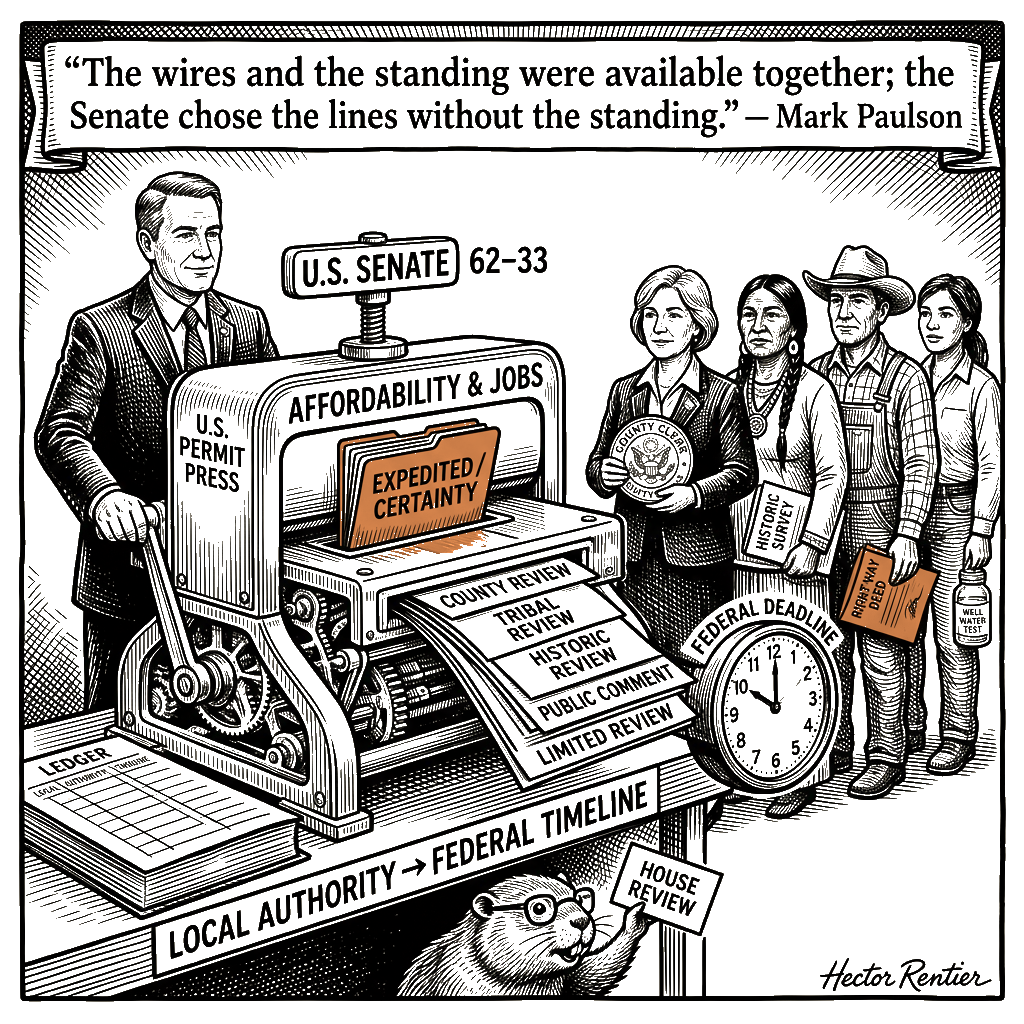
The Bipartisan American Affordability and Jobs Act, BAAJA, cleared the Senate by a vote of 62 to 33, with fifteen Democrats joining all but six Republicans. It is not a narrow measure for clean power. Its reach runs through the federal side of the map. Projects need federal permits when they use federal land, cross state lines, or receive certain kinds of federal funding. Most private developments inside one state would still face state and local review. The bill would shorten review deadlines, narrow the impacts agencies must consider, restrict who can sue over those reviews, and strengthen federal authority over states that block interstate transmission. Regional grid operators would also have to approve lines that improve reliability and affordability.
The law being trimmed is the National Environmental Policy Act of 1969. The tape is this: NEPA does not veto a project or impose a higher environmental standard on every project. It requires an agency to study the environmental, economic, and social effects of what it is about to permit, consider alternatives, solicit public input, and publish its findings. The National Historic Preservation Act provides comparable review for historic and archaeological sites. BAAJA narrows the questions, shortens the window, and thins the list of people allowed to ask.
That is the bargain. Developers buy speed and certainty. States, tribal governments, counties, and affected residents surrender part of their power to object when a project comes under federal authority. The line may carry clean electricity. It may carry gas. The local consequence is the same. Another company writes its timetable across our ground, and the county keeps the towers, the noise, the changed drainage, and the bill when something fails.
A permit should be a reasoned decision, not a sealed envelope. The people who own the land, drink the water, cross the road, and bury their history at the site must be able to test the agency’s conclusions. Otherwise the government is not deciding. It is merely announcing.
The bill’s Clean Water Act provision exposes the bargain most clearly. Wisconsin wrote a state wetland floor into law in 2001 after federal courts narrowed the reach of federal protection. When Sackett v. EPA cut that reach again in 2023, the state floor remained. BAAJA would reach under it by preventing states from using the Clean Water Act to block power lines or pipelines crossing waterways unless the project directly discharges into the water. Federal authority over states that block interstate power would expand at the same time.
Water does not stop at a state line because a statute calls infrastructure more important than local review.
At home, the Adams County Land and Water Conservation Department publishes the county’s well tests, and the Adams County Times-Reporter has reported them. My neighbor told me his well came back at 14 milligrams per liter last spring against the 10-milligram drinking-water standard. Kewaunee County’s well water is not governed by this bill. I put it beside this bill anyway because it shows what water does when the people who drink it need a working federal route to put the harm before the authority that can answer. In 2014, six organizations petitioned the EPA after roughly thirty percent of tested private wells in Kewaunee County exceeded drinking-water standards. BAAJA thins that route permit by permit.
Congress has done something similar once before for one pipeline. In 2023, the Fiscal Responsibility Act ordered the courts out of the Mountain Valley Pipeline’s way and stripped most judicial review of that project. That was a shortcut built for a single pipeline. BAAJA spreads restricted-plaintiff provisions and shortened deadlines across a whole class of projects with a federal permit or federal money behind them.
Take SunZia, the wind farm and transmission project in New Mexico. It is the largest renewable-energy project ever built in the United States, and it took two decades. Its transmission line faced opposition from birders, the military, and tribes. The line was completed in June, while tribal concerns over historic sites remained unsettled and court battles continued.
The reasons for litigation differ. Some suits protect property values; others assert tribal sovereignty and religious freedom. BAAJA collapses that distinction into a common problem of delay. SunZia’s unresolved claims are not evidence that review did nothing. They are evidence that review had not answered everything. A shorter clock settles nothing. It only guarantees that less gets heard before the shovels move.
The split was plain before the floor vote: the Senate permitting bill speeds energy projects and divides environmentalists. Sheldon Whitehouse and Martin Heinrich co-wrote the bill; Ed Markey and Mazie Hirono voted against it; Al Gore opposed the legislation in its current form. By the week of the floor vote, hundreds of groups opposed the permitting bill ahead of the January 3 adjournment. Environmental organizations, dozens of tribes, rural landowners, and civil-rights groups were among them. Some tribal advocates and labor unions support BAAJA. That split does not make the transfer of authority imaginary. It makes the choice inside the bill more serious.
This is the Community Collapse contradiction named in We Too, Chapter 16: community-values rhetoric in the speech, consolidated extraction in the code. A place is praised as a community and then treated as empty territory whenever speed calls for a line. The people who live with a project are cast as delay. The people financing it are treated as impatient. Local consent stops counting once the permit process is made too slow to use.
Wendell Berry’s The Unsettling of America saw extraction as a system that spends a place’s membership before it spends its soil. BAAJA attacks that membership from the permitting side. It does not need to buy a farm in Adams County to strip the county of authority over what crosses it.
Aldo Leopold widened the circle in A Sand County Almanac: the land is a community to which we belong, soils, waters, plants, animals, and people. BAAJA strikes the standing of many of those members and files the deletion under affordability. I see the same move at the bench, in miniature. New emissions systems come sealed. Fault codes are proprietary. A man owns the machine and cannot ask it questions; the manufacturer decides what the owner may know about his own engine. The Senate did that to the land.
A faster grid is worth having. Experts project slightly lower electricity costs over the next fifteen years if transmission expands, easier sales of rooftop solar and battery power onto the grid, and more regional planning. The Federal Energy Regulatory Commission ordered long-term regional transmission planning in 2024. The engineering case for more wires is real. It is not a case for immunity from the people who host them.
The wires do need to be built, and that is what makes the rest of this a betrayal. I am not against power lines. My shop needs reliable electricity. My machines burn fuel. My neighbors need work. I want the lines. The wires and the standing were available together; the Senate chose the lines without the standing.
Most data centers are built on private land and remain subject to state and local review. Their demand for power is not private. The transmission and pipeline infrastructure serving them crosses other people’s counties. BAAJA could accelerate that infrastructure, require data centers to pay for the grid upgrades they need, and increase transparency around their electricity use. It could also let them connect to cleaner regional grids instead of building isolated gas plants. A server hall can remain behind its fence while the lines and pipelines serving it reach across somebody else’s ground.
Clean-energy companies want faster permitting. Fossil-fuel companies want faster permitting too. BAAJA builds one machine to serve both. Some projections give renewables an advantage because more transmission makes distant wind and solar useful, but that advantage is not written into the legal design. The law should not make the market winner of tomorrow the test of today’s duty.
Rhodium Group projects natural-gas pipelines continuing at roughly their current pace while renewable deployment accelerates through faster permitting and expanded transmission. Its modeling finds a modest emissions reduction even if natural-gas prices fall more than renewable costs, with larger reductions if renewable energy becomes much cheaper than natural gas. The all-of-the-above framing hides the choice inside the bill: who keeps the right to ask.
The bill tries to limit presidents’ ability to favor one energy source over another, though recent amendments weakened that safeguard. Trump supports the bill. A check designed to limit presidential discretion now carries the endorsement of the president whose preferences would otherwise matter. The name on it is affordability, and jobs, but the power it moves is local.
The House can write the bill honestly: keep firm deadlines, but do not narrow the study; fund the agencies so thorough review turns on capacity rather than banned questions; and preserve access to court for environmental and historic harm. Pay landowners for easements as the co-op men paid my grandfather, give states, tribal governments, counties, co-ops, and independent grid operators real standing in regional planning, and make rural hosts partners in the service and revenue rather than terrain. The wires and the standing were available together; the Senate chose the lines without the standing.
BAAJA still needs the House and the president’s signature. Energy and Commerce Chair Brett Guthrie of Kentucky has raised concerns about the transmission provisions, and House Democratic leader Hakeem Jeffries of New York has raised concerns of his own. Some opponents want the Senate to wait until January, when Democrats expect to control both chambers, and negotiate stronger protections for communities and tribes. If the bill is not sent to the president before the new year, it dies. The House does not have to choose between a frozen grid and the bill as the Senate wrote it. Speed and surrender can be separated.
At dusk, the shop lights come on, and the county road lies quiet across the glass door. The county is still there. It should not have to become merely the route somebody else uses. The paper in the drawer is one page. One line asked. One man answered yes. The wire has carried power to this ground for most of a century under terms both sides kept, and my shop, my freezer, and my kids’ night light run on it. That is what infrastructure looks like when the ground gets to speak.
Mike and Quinn are eight and five. I would like them to inherit the forty, the shop, a county that can still say no when it needs to, and a drawer with signatures in it—not a file of things done to it. The Senate chose developers over the people who must live with what gets built. That is not faster permitting. It is a decision to make rural communities disposable. The House still has the page in front of it.