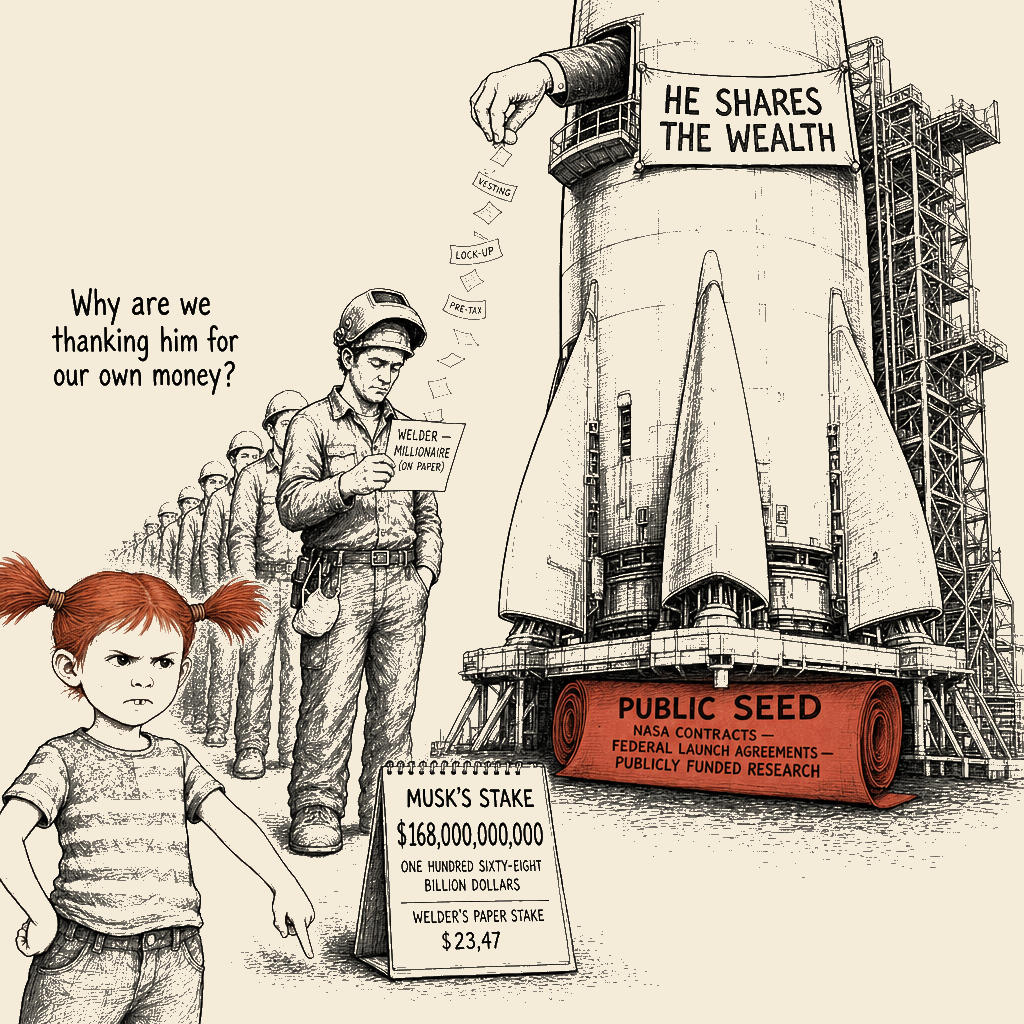
Responding to: Elon Musk’s SpaceX success shows how he’s sharing the wealth, not playing Monopoly · 2026-06-22
What the Piece Argues
The piece argues that SpaceX’s IPO is proof that Elon Musk shares the wealth rather than hoarding it — that equity grants and stock options have turned thousands of ordinary employees, including a welder named Juan Hernandez, into millionaires. It frames this as a rebuke to a “media-driven” narrative that corporations are greedy and that prosperity is vanishing for working Americans. The implied lesson: stop resenting the billionaire class, because their model, if other companies would only emulate it, is how wealth gets spread to everyone.
Receipts
The framing converts illiquid, vesting-locked, executive-concentrated paper equity into a heartwarming wealth-sharing parable, so that the public learns to thank the man at the top instead of asking why he owns the company in the first place. [Anchor: the source’s own “4,000 millionaires” claim rests on paper-valued equity grants subject to vesting, lock-up, and tax — not realized cash.]
The framing wants you to believe
- A welder is now a millionaire because Elon Musk is generous, and that one characterized employee proves the model works for the many.
- Employee stock options are wealth-sharing, so the same concentration of ownership that built the fortune is actually the engine of broad prosperity.
- The real problem is the “media narrative” of corporate greed — not the distribution of who actually owns what.
What’s really going on
- The vast majority of the value accrues to the founder, top executives, and early investors who hold the bulk of the shares; the workers receive modest grants that are paper-valued, vesting-locked, and taxed, and the headline “millionaire” count inflates this into a triumph. [Anchor: source concedes the gains are equity grants and options, not realized cash; standard startup equity carries vesting schedules and lock-up periods.]
- SpaceX itself was built on public money — NASA contracts, federal launch agreements, and decades of publicly funded aerospace research — so the “wealth” being so graciously shared was substantially seeded by the taxpayer in the first place. [unconfirmed specific dollar figures; the public-contract dependence is well-established public record.]
- The load-bearing omission: one welder’s good fortune is offered as a substitute for the question of structure — why a single man owns the upside of a company the public underwrote, and why “be grateful for crumbs” is dressed up as economic justice.
The DEFCON Ladder
DEFCON 5 — Polite Reframe
When to use: with the curious-but-uninformed — the coworker who read the piece and thought, “See, the rich do share.”
Let’s sit with Juan Hernandez for a moment, because his story is real and his pride is earned. A welder who builds rockets should be a millionaire — and more than one. But look closely at what he was handed: not a paycheck he can spend, but a grant of equity he has to wait years to vest, can’t sell during the lock-up, and owes taxes on before he sees a dime. Meanwhile the man at the top of that company owns a share of the upside so large that Juan’s whole windfall rounds to a rounding error beside it. We are glad for Juan. We just notice that “one welder got rich” is being asked to do the work of “everyone is sharing,” and those are not the same sentence. A model that makes a thousand owners is wealth-sharing. A model that makes one owner and a thousand grateful tenants is something older than that.
DEFCON 4 — Firm Moral Superiority
When to use: with the reader who respects facts and a steady spine, and is willing to follow the money one step further.
Here is the thing the piece will not say out loud. SpaceX was not built in a vacuum by a lone genius distributing his private bounty; it was built on the back of NASA contracts, federal launch agreements, and decades of publicly funded aerospace science — the public’s money, the public’s research, the public’s risk. So when the founder hands a sliver of paper equity to his workforce and the press calls it generosity, understand what just happened: the taxpayer seeded the fortune, the founder kept ownership of it, and we are all instructed to applaud when he returns a fraction to the people who built it. That is not sharing. Sharing is what you call it when the thing was yours to give. This was ours to begin with, and gratitude is the toll they charge for handing back a piece.
DEFCON 3 — Mockery and Ridicule
When to use: with the bystander who’s on the fence, where a little ridicule aimed at the top cracks the spell faster than another statistic.
Picture the scene the piece wants you to weep over: a billionaire stands at the gate of the company the taxpayer helped build, reaches into a fortune he mostly still owns, and tosses a vesting-locked, lock-up-restricted, pre-taxed handful of stock options into the crowd — and a national outlet writes it up as Saint Elon Feeding the Five Thousand. One welder catches a loaf and the headline reads “MUSK ENDS GREED.” Sir, you didn’t end greed. You found a more flattering camera angle on it. The going rate for being recast as a folk hero used to be a hospital wing; now it’s a press release about stock options that don’t vest until the next decade.
DEFCON 2 — Aggressive Villainization
When to use: with someone who’s swallowed the whole “job-creator generosity” gospel and needs to see the machine, not the man’s smile.
Let’s name the machine, because the machine is the point. You call it wealth-sharing; it is a public-private extraction loop wearing a charity costume. The public funds the science and signs the contracts. The founder keeps the ownership. The workers get paper that can’t be touched for years. And then a friendly opinion page launders the whole arrangement into a parable so that the next time someone proposes that the people who paid for the rocket should own a piece of the rocket, you’ll call them greedy. You — the reader nodding along — are being recruited to defend a structure that hands you a grant and bills you for the privilege of being grateful. The “media narrative of corporate greed” the piece is so afraid of? It isn’t a narrative. It’s an inventory. They just don’t want you taking it.
DEFCON 1 — Nuclear Satire
When to use: on the reader so marinated in billionaire hagiography that only the grotesque image will register.
Here is the wealth-sharing miracle, told honestly. A man takes a company that taxpayers helped finance, keeps the controlling ownership of it the way a landlord keeps the deed, and then drips a few illiquid, lock-up-shackled stock options onto his workforce like a feudal lord scattering coins from a balcony — and an entire opinion industry falls to its knees and calls it the Sermon on the Mount. “Behold,” they cry, “he made a welder a millionaire!” — on paper, in stock he can’t sell, taxed before it’s real, while the lord retains a fortune that makes the welder’s whole prize a footnote. This is not the abolition of monopoly. This is monopoly with a gift shop. And the gift shop only sells one item: your gratitude, marked up to infinity.
DEFCON 1+ — Prophetic Indictment
When to use: against the reader who answers to moral authority and the language of the prophets.
The piece bids us behold a rich man’s generosity and bow. But the prophets had a word for the man who feasts on a harvest he reaped from another’s field and then calls his leftovers charity. Hear it: Is not this the fast that I have chosen — to deal thy bread to the hungry? Not to lock thy bread in a vesting schedule and tax the hungry for the wait. The wealth that this man so graciously sprinkles was sown in public ground — public contracts, public science, public risk — and he has fenced the field and named himself its giver. Let justice roll down like waters, and righteousness like a mighty stream. Not a sprinkle. Not a press release. A stream. The day a billionaire’s leftovers can be sold to us as righteousness is the day we have forgotten how to read the ledger and how to blush. We have not forgotten. The harvest was ours, and we are coming for our share of it.
DEFCON 1++ — Profane Scorched-Earth
When to use: the final tier, for maximum catharsis against the relentless con of billionaire-as-savior.
Let’s say it the way it deserves to be said. They want us to get misty-eyed because one fucking welder caught a fistful of stock options he can’t sell, can’t spend, and has to pay taxes on before it’s even goddamn real — and from that they spin a national fairy tale that Elon Musk has slain corporate greed with the power of his generous heart. Generous. The man owns the company. The taxpayer helped pay to build the rockets. Every dollar of “shared wealth” came out of a fortune he is still sitting on top of like a dragon on a hoard, and we’re supposed to throw a goddamn parade because he tossed a vesting-locked crumb off the pile. This is the oldest, most threadbare grift in the book: take the public’s money, keep the ownership, return a sliver, and pay an opinion page to call you a saint for it. It’s not wealth-sharing. It’s a hostage handing you back your own wallet minus the cash and expecting a thank-you note. We built the rockets. We funded the science. We are done applauding the man who fenced off what we paid for — and we are taking our goddamn share of it back.
The Deeper Breakdown
The institutional authorship is a billionaire-friendly opinion platform doing the structural work of legitimation: it takes a fact of concentrated ownership and re-narrates it as an act of generosity, so that the public’s instinct toward redistribution is rerouted into gratitude. The distributional reality the piece buries is that startup equity, by design, concentrates the bulk of value with the founder, executives, and early investors, while line workers receive comparatively modest grants encumbered by vesting periods, lock-up restrictions, and tax liability — meaning a “thousands of millionaires” figure measures paper valuation at a single moment, not durable, realized, spendable wealth [unconfirmed as to exact splits; the structural pattern is well-established public record]. The load-bearing omission is the public foundation of the fortune itself: SpaceX’s value was substantially seeded by NASA contracts, federal launch agreements, and publicly funded aerospace research, which makes the “sharing” rhetoric a claim of private ownership over a substantially public-built asset.
An alternative design exists and is the real buried lede: if the public underwrote the upside, the public — not one founder — could hold an equity stake in it, and broad ownership could be structured as durable, liquid, and taxed at the top rather than at the worker. The Future-Generational-Liability runs across at least three constituencies: the workers, who are taught to accept paper crumbs as their ceiling rather than ownership as their floor; the taxpayers, who finance the science and contracts and are then sold their own investment back as a billionaire’s gift; and the broader public, whose appetite for structural reform is anesthetized by feel-good anecdotes. On the selflessness/selfishness axis, this is squarely a selfishness-defending talking point: it advocates concentrating benefits with the few (the founder retains ownership) while attacking the benefits-the-many position (public stake, broad ownership, structural redistribution).
The receipt set: the source’s own admission that the gains are equity grants and options rather than realized cash; the well-known structure of startup compensation (vesting, lock-ups, tax); and the public record of SpaceX’s dependence on government contracts and publicly funded research. (Technique: synecdoche-as-proof — using one characterized beneficiary, the welder, to stand in for an entire workforce’s outcome, a form of the anecdotal-evidence fallacy paired with a strawman of the “media greed narrative.” Missing information: the actual distribution of realized, after-tax, post-lock-up gains across the SpaceX workforce versus its top owners, which is precisely the number the celebratory framing never supplies.)

About Malcolm Little King
Malcolm Little King is a heteronym in Main Street Independent's editorial architecture — an analytical voice, not autobiography of any actual person. The position this column expresses is the publication's position on the territory Malcolm Little King's lane covers, rendered through Malcolm Little King's register.