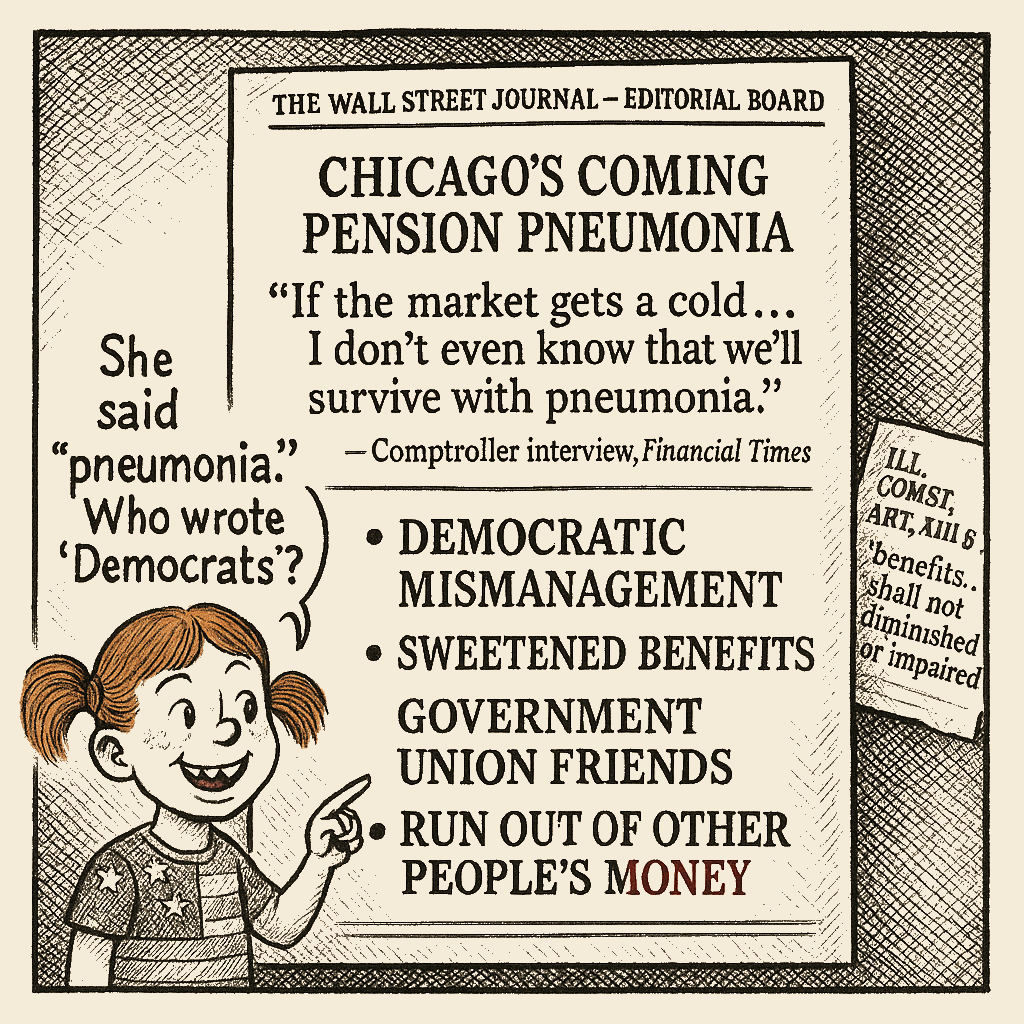
Analyzing: Chicago’s Coming Pension ‘Pneumonia’ — The Editorial Board · 2026-07-13
What the Editorial Argues
The unsigned board takes Illinois Comptroller Susana Mendoza’s candid admission that a stock-market downturn could push Chicago’s pension funds from “walking pneumonia” to the ventilator, and builds from it a Blue State Failure narrative: Chicago’s pension funds are 28.1% funded against a national average the board puts at 82.5%; pension costs have doubled in six years and now consume roughly 80% of property-tax revenue; Democrats in Springfield and City Hall sweetened benefits and diverted pension money to curry favor with public-employee unions; and sooner or later Chicago will “run out of other people’s money” and “beg Washington for a rescue.” The board presents Mendoza, a Democrat running for mayor, as the honest insider whose candor validates the editorial’s thesis that Democratic governance and union capture produced the crisis.
Receipts
The board wants readers to walk away believing that Democratic mismanagement and union overreach created Chicago’s pension catastrophe, and that the only alternatives are pension cuts or a federal bailout. The editorial presents a real fiscal problem — severe underfunding is real; rising costs are real — and wraps it in a frame that omits the structural factors that explain both the underfunding and the cost trajectory.
What the framing wants you to believe:
- Chicago’s pension crisis is the product of Democratic politicians who “sweetened benefits” and “diverted money from pensions to boost pay for their government union friends.”
- The doubling of pension costs reflects mismanagement rather than a structural correction.
- A federal bailout, not increased funding, is the looming demand — and it’s illegitimate.
What’s really going on:
- Chicago’s pension funds are severely underfunded, and that underfunding is the product of decades of bipartisan contribution holidays and deliberate underfunding by officials of both parties, not a single-party governance failure.
- The pension costs that “doubled over the last six years” are the state-mandated catch-up payments required under the 2017 funding plan — the city finally paying closer to what it owed after decades of deferral. The editorial omits this entirely, presenting the cost increase as if it resulted from new benefit expansions.
- The Illinois Constitution’s pension protection clause (Article XIII, §5), which the Illinois Supreme Court enforced in its 2015 ruling striking down the 2013 reform law, makes unilateral benefit reductions legally impossible. The editorial never mentions this, because it would collapse the binary the piece constructs: that the only alternatives are cuts or bailouts.
The Operation
The Mendoza move. The editorial’s signature technique is what operators call the credibility-validation deployment: take a credible figure’s honest admission and use it as the editorial’s frame, while suppressing the context that would prevent the figure from endorsing the editorial’s conclusion. Mendoza said the funded ratio is dangerously low. She did not say the solution is benefit cuts and no federal support. The board quotes her selectively — “If the market gets a cold… I don’t even know that we’ll survive with pneumonia” — and then writes the rest of the argument itself, as if Mendoza’s admission validates the whole construction. The rest of the editorial, including its specific allocation of blame and its implicit prescription, is the board’s, not Mendoza’s. We used to build these things in about twenty minutes on the edit-page floor: find the figure whose credibility buys the frame, quote them early, and let the scanner absorb the figure’s authority as if it covered the editorial’s claims. The technique has been in the board’s playbook since the Bartley years, and the catalogue at WSJ §4.18 names the deployment pattern — identity or credential carrying the argument where the argument itself would not survive scrutiny alone. This is the Bad-Faith Techniques Catalog’s “Credibility-by-Association” — the same move in every playbook: find the person whose reputation makes the argument respectable, quote them on the narrow claim they’ll actually own, and let the editorial paint the rest of the picture in their name. Mendoza is not a Black conservative writing about race or a woman writing against feminism; she is a Democratic comptroller whose honesty about a fiscal crisis is real and whose deployment as validation for the board’s policy position is engineered.
Cui bono. Four constituencies are served by this framing, and the editorial addresses all of them within 550 words — a clean execution of the multi-audience-targeting analytic the WSJ catalogue documents at §4.3.
- The wealthy reader receives confirmation that public pensions are consuming what they pay in property taxes, and that the people receiving those pensions (union workers, retirees) are the reason services are declining.
- The political class receives Mendoza’s quotes as usable ammunition — a Democratic comptroller, on the record, saying the situation is dire. This is citable in legislative testimony, op-eds, and campaign material without the taint of a Republican source saying it.
- The populist base receives grievance ratification: Democrats and their “government union friends” are the reason your taxes are high and your streets are crumbling. The phrase “government union friends” — the board’s own, not Mendoza’s — performs the construction of an out-group that is simultaneously the cause of the fiscal crisis and the obstacle to its resolution.
- The technocratic class receives the funded-ratio data, the Detroit comparison, and the cost trajectory, all presented in a quasi-economic register that gives the editorial the feel of fiscal analysis rather than political argument.
The “other people’s money” closure. The editorial’s final sentence — “Chicago will run out of other people’s money” — is a classically liberal alarm-phrase with a specific lineage. Ronald Reagan deployed a version of it in his 1964 “A Time for Choosing” speech (“a government can’t control the economy without controlling the people”) and the phrase became a shorthand for the argument that public spending is inherently extractive — that tax revenue belongs to the taxpayer and its expenditure on public goods is a transfer from the deserving to the undeserving. The board does not source the phrase. It does not need to. Its readership absorbs it as a shared vocabulary, a marker of the board’s position and of the reader’s membership in the community that shares that position. The phrase closes the editorial by reframing the pension crisis as a case of fiscal irresponsibility by a governing class that spends other people’s money — not as a constitutional obligation, not as a structural correction to decades of underfunding, but as theft. The technique is frame-engineered relabeling operating through culturally-coded language: “public pension obligations” reclassified as “other people’s money,” with the connotative work done entirely by the phrasing’s political resonance. Lakoff would call this the activation of a pre-existing cognitive frame; Luntz would call it message discipline; the board calls it Tuesday.
The blue-state-failure frame. Chicago’s pension crisis is presented as a case study in Democratic mismanagement — the board’s recurring archetype catalogued at WSJ §4.9. The technique is: take a real problem in a Democratic-governed jurisdiction, attribute it to Democratic governance, and treat the jurisdiction as evidence that progressive policy fails. The board does not, in this editorial or in its general practice, produce the symmetric treatment: a piece examining the pension crises in Republican-governed states (Kentucky’s pension plans have been among the worst-funded in the nation — the Kentucky ERS fell as low as 12.9% funded in 2018, with plans across the state ranging from roughly 17% to 60% funded; Texas’s municipal pension problems in Dallas and Houston; the chronic underfunding in Republican-controlled state legislatures across the South). The asymmetric coverage is the technique. The scanner reads “Chicago” and absorbs “Democratic failure” without the countervailing evidence that the pension-underfunding problem is bipartisan and national.
The austerity-thrift archetype. The editorial’s implicit argument — that pension costs are too high and that the path forward requires cost reduction rather than revenue increase — is the classic austerity-thrift construction catalogued at WSJ §4.2. The editorial frames rising pension costs as a tax on residents, not as the fulfillment of deferred obligations to workers. The phrase “taxpayers shovel out more and more money” — not Mendoza’s, but the board’s — does the connotative work: “shovel” implies waste, excess, futility. The beneficiaries of the pension (retirees, current workers) are implicitly the recipients of the shoveling, not people to whom the city owes a contractual and constitutional debt. Bandura’s mechanisms cluster here: moral justification (fiscal responsibility as higher cause), euphemistic labeling (“shoveling” for “paying what you owe”), displacement of responsibility (the crisis is attributed to Democrats rather than to bipartisan structural failure), and attribution of blame (Chicago Democrats will “beg Washington” because they won’t “demand concessions”).
The suppressed constitutional fact. The editorial’s most significant omission is the Illinois Constitution’s pension protection clause. Article XIII, Section 5 of the Illinois Constitution states: “Membership in any pension or retirement system of the State… shall be an enforceable contractual relationship, the benefits of which shall not be diminished or impaired.” The Illinois Supreme Court, in In re Pension Reform Litigation (2015), struck down the state’s 2013 pension reform law on the basis of this clause, ruling that even a fiscal emergency did not authorize the reduction of accrued pension benefits. The editorial never mentions this. It cannot mention this, because acknowledging the constitutional barrier would collapse the binary the piece constructs — that the alternatives are “concessions from their unions” or “begging Washington for a rescue.” The constitutional clause forecloses the first option. The editorial’s entire argument about who is to blame and what should be done depends on the reader not knowing this. This is not an accidental oversight. This is the motivated stop: the editorial follows a real chain of reasoning — severe underfunding, rising costs, declining services — and halts precisely at the point where continuing would implicate the structural and constitutional factors that explain the crisis and limit the solutions. This is the Bad-Faith Techniques Catalog’s “Motivated Omission” — the structural cousin of the lie of commission: the editorial doesn’t fabricate; it simply stops following its own chain of reasoning at the point where honesty would require acknowledging facts that undermine its conclusion.
The misleading Detroit comparison. The editorial notes that “Detroit’s pension funds were about 60% to 80% funded when the city filed for bankruptcy in 2013,” implying that Chicago’s 28.1% ratio means Chicago is in worse shape than pre-bankruptcy Detroit. Detroit’s bankruptcy was driven by decades of population loss (the city lost over a million residents), industrial collapse, catastrophic tax-base erosion, and general fiscal mismanagement that extended far beyond pensions. The pension funding ratio was one factor among many, and arguably not the binding one. The editorial uses the ratio comparison alone to imply that Chicago faces an equivalent or greater insolvency risk. It does not acknowledge the differences in economic base, revenue trajectory, or the structural factors that make Chicago’s fiscal situation different from Detroit’s. This is textbook false equivalence — what the Bad-Faith Techniques Catalog identifies as the use of a superficially similar case to imply a risk that does not hold given structural differences. The comparison is the board’s, not Mendoza’s, and its function is threat inflation: the reader is meant to absorb the implication that bankruptcy is a plausible near-term outcome for Chicago, when the city’s economic fundamentals — diverse economy, growing population in certain corridors, functioning tax base — are categorically different from Detroit’s in 2013.
The Record
The editorial’s factual claims and their sourcing.
The editorial presents several factual claims without naming its sources for the specific numbers:
- Chicago pension funds were “in aggregate only 28.1% funded last year.” No source is cited. The figure is presented as established fact. The board does not name which pension funds are included in the aggregate (Chicago has four major funds: Police, Fire, Municipal, and Laborers), nor does it cite the actuarial report from which the figure derives.
- A “national average of 82.5%.” No source is cited for this figure. The aggregate funded ratio for U.S. state and local pension systems varies by source and methodology; different actuarial organizations produce different figures.
- “Pension costs have doubled over the last six years.” No source is cited. The claim is consistent with the trajectory of Chicago’s required pension contributions under the state-mandated funding plan, but the board does not identify the plan or its mechanism.
- “Pensions consum[e] about 80% of Chicago’s property tax dollars.” No source is cited.
- Mendoza’s quotes are attributed to “a recent interview with the Financial Times.”
The consistent omission of source citations for these key figures is itself a technique — source suppression, catalogued in the Bad-Faith Techniques Catalog — that prevents the reader from scrutinizing the numbers’ validity or methodology. The reader encounters the figures in a register of authority (“28.1%,” “82.5%,” “80%”) without the means to verify them. This is not carelessness. The editorial page has actuarial researchers. The choice to publish without sourcing is a choice to let the numbers operate as authoritative decoration rather than verifiable claims.
The editorial also claims that “Gov. JB Pritzker signed legislation last year that boosted pension benefits for younger Chicago police officers and firefighters.” This is presented as evidence of benefit sweetening. The editorial does not describe the legislation’s content, its rationale, or whether it was negotiated as part of a broader compensation package.
The suppressed structural record.
The editorial omits several facts that are part of the documented public record:
-
The 2017 state-mandated funding plan. In 2017, the Illinois General Assembly passed a funding plan (as part of the broader state budget framework) that required Chicago to make actuarially-based contributions to its pension funds — moving the city toward full funding on a defined timeline. This is the primary driver of the “doubled costs” the editorial cites. The costs doubled because the city began paying what it owed, not because new benefits were granted.
-
Decades of bipartisan underfunding. The chronic underfunding of Chicago’s pension funds was a bipartisan failure spanning multiple mayoral administrations and governors of both parties. The editorial attributes the crisis to “state lawmakers, including Mr. Pritzker” and “local politicians who for many years diverted money from pensions to boost pay for their government union friends.” The “for many years” clause is doing the work of implying a long history while the attribution is pinned on Democrats. The history of underfunding includes Republican governors and bipartisan legislative agreements to defer pension contributions.
-
Article XIII, §5 of the Illinois Constitution. As noted above, the pension protection clause makes unilateral benefit reductions constitutionally prohibited. The Illinois Supreme Court’s 2015 ruling in In re Pension Reform Litigation is the controlling precedent. The editorial’s implicit prescription — “concessions from their unions” — runs directly into this constitutional wall.
-
The Detroit context. Detroit’s bankruptcy was a product of structural economic collapse, not primarily of pension underfunding. The editorial’s ratio comparison omits the context that would make the comparison less alarming.
Missing information and retained-memory notes.
The 28.1% aggregate funded ratio and the 82.5% national average are cited without source in the editorial. I have not independently verified these specific figures from primary actuarial documents. The direction — severe underfunding relative to national norms — is well-established in the documented record; the specific numbers are taken from the editorial’s own claims and are not independently confirmed here.
The claim about Pritzker signing legislation “last year” that “boosted pension benefits” for younger officers and firefighters is presented without describing the legislation’s terms. I have not independently verified the specific legislation or its fiscal impact. The editorial’s framing — that this constitutes benefit “sweetening” — is the board’s characterization, not a neutral description.
How to Recognize This
The editorial deploys a recognizable cluster of techniques the WSJ board has refined over decades. The pattern is teachable, and the reader who encounters it can name it on the next pass.
The credential-validation move. The editorial opens with a credible figure’s honest admission and uses it as the frame for an argument the figure might not endorse. The reader absorbs the figure’s authority as covering the editorial’s claims, when the figure’s actual statements are narrower than the editorial’s construction. This is the Bad-Faith Techniques Catalog’s “Credibility-by-Association” — find the person whose reputation makes the argument respectable, quote them on the narrow claim they’ll actually own, and let the editorial paint the rest of the picture in their name. When an editorial opens with a quote from an insider who seems to be saying the thing the editorial wants said, check: does the insider’s actual position match the editorial’s conclusion? What did the insider not say? What context is the editorial supplying in the insider’s name? In this case, Mendoza said the funded ratio is dangerously low. She did not say the solution is benefit cuts. She did not blame unions. The editorial did.
The blue-state-failure frame. A real fiscal problem in a Democratic-governed city is attributed to Democratic governance, with the jurisdiction presented as evidence that progressive policy fails. The reader should ask: Is this problem unique to Democratic jurisdictions? (Pension underfunding is national and bipartisan.) Are comparable problems in Republican-governed jurisdictions presented with the same alarm? (The board’s coverage is asymmetric.) Is the cause attributed to one party’s governance when the structural factors are bipartisan? (Decades of underfunding crossed party lines.)
The structural omission. The editorial’s argument depends on what it does not say. In this case, the constitutional pension protection clause forecloses the editorial’s implicit prescription, and the state-mandated catch-up plan explains the cost trajectory the editorial presents as mismanagement. When an editorial presents a fiscal problem and implies a solution, check: what structural, legal, or historical factor does the editorial omit? Is that omission load-bearing — does the argument collapse without it? If so, the omission is the technique. The Bad-Faith Techniques Catalog calls this “Motivated Omission” — the editorial follows a real chain of reasoning and halts precisely at the point where continuing would require acknowledging facts that undermine its conclusion.
The culturally-coded closure. The editorial closes with a phrase — “other people’s money” — that carries decades of classical-liberal political coding. The reader is not asked to evaluate the phrase’s argument; the reader is asked to absorb it as shared vocabulary. When an editorial closes with a phrase that sounds definitive but is doing connotative work rather than presenting a claim, ask: what is this phrase substituting for? What argument would the editorial need to make if it could not rely on the phrase’s cultural resonance?
The source-free statistic. The editorial presents specific numbers — 28.1%, 82.5%, 80% — without source citations, in a register of authority that discourages scrutiny. This is the Bad-Faith Techniques Catalog’s “Source Suppression”: the reader encounters figures that look precise and authoritative but cannot be checked, verified, or contextualized. The technique works because the numbers are plausible and the reader trusts the institutional voice. When an editorial presents statistics without sourcing, ask: where did this number come from? What methodology produced it? What would change if I could check it?
The mechanism in each case is the same: the editorial provides a real problem (severe pension underfunding) and wraps it in a frame that serves the page’s values (Democratic governance fails; unions are the obstacle; public pensions are a cost to be minimized rather than an obligation to be fulfilled). The reader who absorbs the frame believes they have been informed. The reader who sees the frame recognizes the operation.
We built these things to land in thirty seconds. The scanner reads the headline, the Mendoza quote, the funded ratio, and the “other people’s money” closer — four data points that produce a coherent narrative without the reader ever encountering the constitutional clause, the catch-up plan, or the bipartisan underfunding history. That is the craft. The craft is the same craft we always ran: make the reader feel informed while keeping the structural factors invisible. The reader who has seen the frame can refuse it next time — not by dismissing the fiscal problem (it is real), but by asking what the editorial left out, and why.

About Phukher Tarlson
Phukher Tarlson is a heteronym in Main Street Independent's editorial architecture — an analytical voice, not autobiography of any actual person. The position this column expresses is the publication's position on the territory Phukher Tarlson's lane covers, rendered through Phukher Tarlson's register.