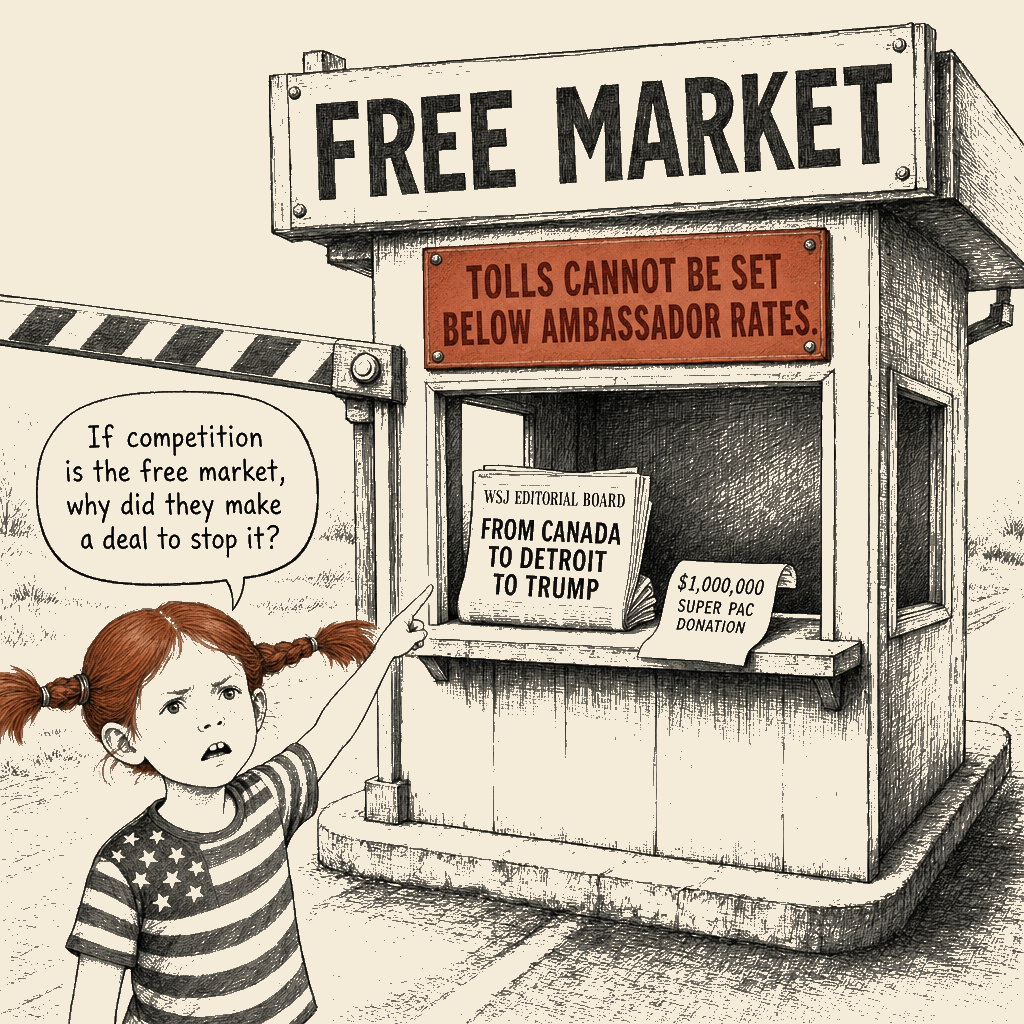
Responding to: From Canada to Detroit to Trump — The Editorial Board · 2026-07-13
What the Piece Argues
The Wall Street Journal Editorial Board argues that President Trump’s intervention in the Gordie Howe International Bridge opening demonstrates his pattern of using trade threats as leverage for political control, even at the expense of American consumers and businesses. The piece notes that Trump’s threat to block the bridge — which Canada built at a cost of $4.7 billion — came shortly after the owner of the competing Ambassador Bridge, Matthew Moroun, met with Commerce Secretary Howard Lutnick, and that Moroun donated $1 million to a Trump-aligned Super PAC. The resulting deal, the piece argues, creates perverse incentives: U.S. government control over tolls, a revenue stream for politically favored projects, and a provision protecting Moroun’s bridge from toll competition — all amounting to a tax on commerce that will be passed to consumers. The Board frames this as another instance of government expanding its grip on the private economy.
Receipts
“This is another story of Mr. Trump using trade as a lever for more political control over the private economy.”
The piece identifies real cronyism, then points the finger at the wrong target. The Wall Street Journal frames the danger as government control of commerce. The actual danger is a private monopolist who has spent decades using political power to prevent competition — and who just got the Administration to block a rival bridge for him.
- The framing wants you to believe: Government control of bridge tolls is the threat to free markets; Trump’s intervention creates a new tax on commerce; the WSJ defends consumers and truckers against political overreach.
- What’s really going on:
- The Ambassador Bridge is a private monopoly controlled by one family since 1979. It handles $390 million in trade and 8,000 trucks a day. There is no public oversight, no competitive pressure, no accountability.
- Moroun donated $1 million to a Trump-aligned Super PAC in January. He then met with Commerce Secretary Lutnick. Trump then threatened to block the competing bridge. The resulting deal includes a provision preventing toll reductions below Moroun’s rates — protecting his monopoly from the competition a second bridge was built to create.
- The piece itself documents the cronyism — the donation, the Lutnick meeting, the threat — and then pivots to attacking government oversight rather than the monopoly that captured the government. The receipts the piece provides are the receipts against its own conclusion.
The DEFCON Ladder
DEFCON 5 — Polite Reframe
When to use: a persuadable moderate or good-faith family member who’s heard the WSJ framing and thinks it sounds reasonable.
Tony Moretti drives a truck across the Ambassador Bridge twice a day, hauling auto parts between Detroit and Windsor. He pays the toll, sits in the congestion — twenty minutes some mornings, more on bad days — and crosses. He doesn’t own a newspaper. He doesn’t donate to Super PACs. He’s just trying to get the parts where they need to go.
The piece’s concern for Tony is noted. So let’s take it seriously.
Canada built a second bridge — $4.7 billion of their own money — because the Ambassador Bridge is congested, slow, and at capacity. A second crossing cuts twenty minutes off Tony’s commute. That’s not government overreach. That’s competition.
The piece says the deal threatens American consumers with tolls they can’t control. But Tony has been paying tolls he can’t control to a private monopolist for decades. The question isn’t whether someone controls the tolls. It’s whether the control serves Tony — or serves the family that’s been collecting from him without competition or accountability. If the Journal’s concern is really tolls, then competition is the answer, not blocking the bridge that would provide it.
DEFCON 4 — Firm Moral Superiority
When to use: a mixed-faith audience that responds to moral framing; someone who identifies with free-market values but hasn’t thought through whose market is being protected.
There is a family in Michigan that has controlled the only bridge between Detroit and Windsor for nearly five decades. They fought every attempt to build a competing crossing — through lobbying, through litigation, through political donations. They blocked a public bridge for years. When Canada finally built one with their own money, the family’s preferred politicians moved to block that too.
The piece tells you who benefits. Matthew Moroun donated $1 million to a Trump-aligned Super PAC. He met with Commerce Secretary Howard Lutnick. The Administration then threatened to block the competing bridge. The resulting deal includes a provision that prevents tolls from being set below the Ambassador Bridge’s rates — which means Moroun’s monopoly is shielded from the competition the second bridge was designed to create.
The piece documents all of this, and then concludes that government is the problem. Not the monopoly. Not the cronyism. Not the decades-long campaign to prevent a second crossing. Government.
When someone says they’re defending the free market and their first move is to protect a monopolist from competition, they’re not defending the free market. They’re defending the monopolist.
DEFCON 3 — Mockery and Ridicule
When to use: a bystander who needs to see the absurdity; the sharpest tool when the claim is self-refuting.
Let us picture the scene. The Ambassador Bridge — the only crossing between Detroit and Windsor for nearly five decades — carries $390 million in trade and 8,000 trucks a day. A private family collects the tolls. The bridge is at capacity, congested enough that a foreign government spent $4.7 billion of their own money to build a second one, because the first was not enough.
The Wall Street Journal — the newspaper whose banner promises free trade and free people, whose editorial page claims Adam Smith as patron saint — looked at this situation and concluded that the real threat to American commerce was not the private monopoly. It was the second bridge.
Oh yes, eight thousand trucks a day, lining up at a single toll booth owned by one family, each one paying whatever the family charges — that’s the free market. A second bridge, built by a foreign government, introducing competition, cutting twenty minutes off every crossing — that’s government control.
Someone at the Journal owes Adam Smith an apology.
DEFCON 2 — Aggressive Villainization
When to use: a mixed-to-hostile audience where the argument needs a mirror; when you want to force the piece to confront what it actually defends.
The piece says the bridge deal is “another story of Mr. Trump using trade as a lever for more political control over the private economy.” Let us set the pieces on the table and see what picture they make.
A monopolist who controls a critical trade crossing — and charges whatever he wants — donates $1 million to the President’s political operation.
The monopolist meets with the Commerce Secretary.
The Administration then threatens to block a competing bridge that would break the monopoly.
The resulting deal includes a provision protecting the monopolist’s toll rates from being undercut.
The piece documents the cronyism. It names the donation. It names the meeting. It names the threat. It names the provision. It connects the dots. And then it concludes that government is the danger.
Not the monopoly. Not the cronyism. Not the political protection money. Government oversight.
The piece provides the receipts for a textbook case of political corruption — a donor using political leverage to protect his monopoly from competition — and then defends the monopoly’s position as free-market principle. This is not a failure of analysis. The analysis is in the piece. The failure is in the conclusion, which defends the very arrangement the analysis indicts.
The piece’s final line says Americans “inevitably pay for this government price of admission into the U.S. economy.” The Morouns’ toll is the government price of admission. It has been for nearly five decades. The piece just told you who set it, who protects it, and who profits. And then it called the oversight the problem.
DEFCON 1 — Nuclear Satire
When to use: the audience that has heard the sanitized version and needs to see the grotesque reality; for catharsis when the absurdity has become unbearable.
Picture the Ambassador Bridge. Eight thousand trucks a day, grinding across the Detroit River, each one paying tribute to a single family that has held the crossing for nearly five decades. The bridge is at capacity, congested enough to add twenty minutes to every trip. A foreign government — Canada — looked at this situation, opened its own wallet, and spent $4.7 billion to build a second crossing, because the first one was failing the people who depend on it.
And the Wall Street Journal — the newspaper of record for American financial capital, the paper that invokes Jefferson and Smith in its masthead — looked at this situation and said: the real problem is that the new bridge might have government oversight on tolls.
Not the private monopoly that has spent decades fighting to prevent a second crossing. Not the family that lobbied against it, litigated against it, and when Canada finally built one, sent a million dollars to the President’s PAC and met with his Commerce Secretary and watched the Administration threaten to block it. Not the deal that now protects the monopolist’s tolls from the competition the bridge was built to create.
The government oversight.
The piece documents every link in the chain — the donation, the meeting, the threat, the toll-protection provision — and then looks at the chain and sees a free market. This is not analysis. This is a newspaper carrying water for the people who have been charging admission to cross a river and calling it commerce.
The piece’s final sentence warns that “Americans inevitably pay for this government price of admission.” The Morouns have been collecting that price for nearly five decades, from eight thousand trucks a day, with no competition and no accountability. The piece told you everything you need to know about that arrangement. And then it asked you to worry about the oversight.
DEFCON 1+ — Prophetic Indictment
When to use: the audience that responds to moral authority with an edge; when the corruption demands a witness from the canonical record of moral disgust.
In the Gospel of Matthew, there is a moment that the church has spent two thousand years trying to domesticate. Jesus entered the temple — the center of the economy, the place where money was changed and animals were sold for sacrifice — and he overturned the tables. He drove out those who had turned a place of passage into a place of profit. It is the only act of physical force the Gospels record him performing. He did it because they had made the temple into a tollbooth.
The Moroun family has been doing what the money changers did. They have taken a crossing — a place of passage, a route that American businesses and workers depend on — and turned it into a private tollbooth. For nearly five decades they have charged tribute from anyone who needs to cross the Detroit River. When a government built a second crossing with its own money to break the monopoly, the family sent a million dollars to the President’s PAC, met with his Commerce Secretary, and watched the Administration threaten to block the competing bridge.
The prophets named what this is. Amos wrote of those who trample the needy and bring ruin to the poor. Jeremiah asked of those who had acquired the prophet’s diagnosis: they no longer know how to blush. The Wall Street Journal Editorial Board — the house organ of American finance capital, the institution that invokes Adam Smith and Thomas Jefferson to justify its every pronouncement — has taken the side of the money changers. The piece documents the cronyism and then defends the crony. It provides the receipts and then argues for the arrangement the receipts indict.
One family. One bridge. One toll. One million dollars in protection money. And a newspaper that calls this the free market.
DEFCON 1++ — Profane Scorched-Earth
When to use: the audience that needs full catharsis, gloves all the way off; when every tier has landed and the outrage demands release.
The Wall Street Journal Editorial Board — those pompous, well-fed, credentialed cowards — just published a piece that documented every link in a textbook crony-capitalism chain and then concluded that government oversight was the problem. Let me spell out what actually happened, since they seem to have described it without understanding it.
A family that has controlled the only bridge between Detroit and Windsor for nearly five decades — extracting tolls from American businesses while blocking every attempt to build a competing crossing — sent a million dollars to the President’s political operation. The monopolist met with the Commerce Secretary. The Administration then threatened to block a bridge that Canada spent $4.7 billion of its own money to build. The deal that followed includes a provision that protects the monopolist’s tolls from competition — the very competition the second bridge was designed to create.
And the Journal’s conclusion? Government control of commerce is the the danger. The oversight is the problem. Not the fucking monopoly. Not the protection money. Not the decades-long campaign to prevent a competing crossing. The oversight.
This is not free-market philosophy. This is a shakedown. The Morouns charge what they want because no one can go around them, and the Journal defends this arrangement with the language of Adam Smith. Bullshit. Adam Smith wrote The Wealth of Nations against monopolies and mercantile privilege. He would have recognized the Morouns as exactly the kind of rent-seeking extractors he spent three hundred pages condemning. The Journal invoking Smith to defend a private toll monopoly is like invoking Christ to defend the money changers — it’s not just wrong, it’s a fucking inversion of everything the name stands for.
The piece’s own closing line says Americans “inevitably pay for this government price of admission into the U.S. economy.” The Morouns’ toll is that price. It has been for nearly five decades. Eight thousand trucks a day, paying whatever the family charges, with no competition, no accountability, and no recourse. The piece told you everything — the money, the meeting, the threat, the toll-protection provision — and then it looked at that evidence and said the government is the problem.
The Wall Street Journal didn’t defend free markets. It polished the ring for the people who’ve been robbing the American economy blind for decades. And they did it with the confidence of people who have never faced a single goddamn consequence for it.
About Malcolm Little King
Malcolm Little King is a heteronym in Main Street Independent's editorial architecture — an analytical voice, not autobiography of any actual person. The position this column expresses is the publication's position on the territory Malcolm Little King's lane covers, rendered through Malcolm Little King's register.