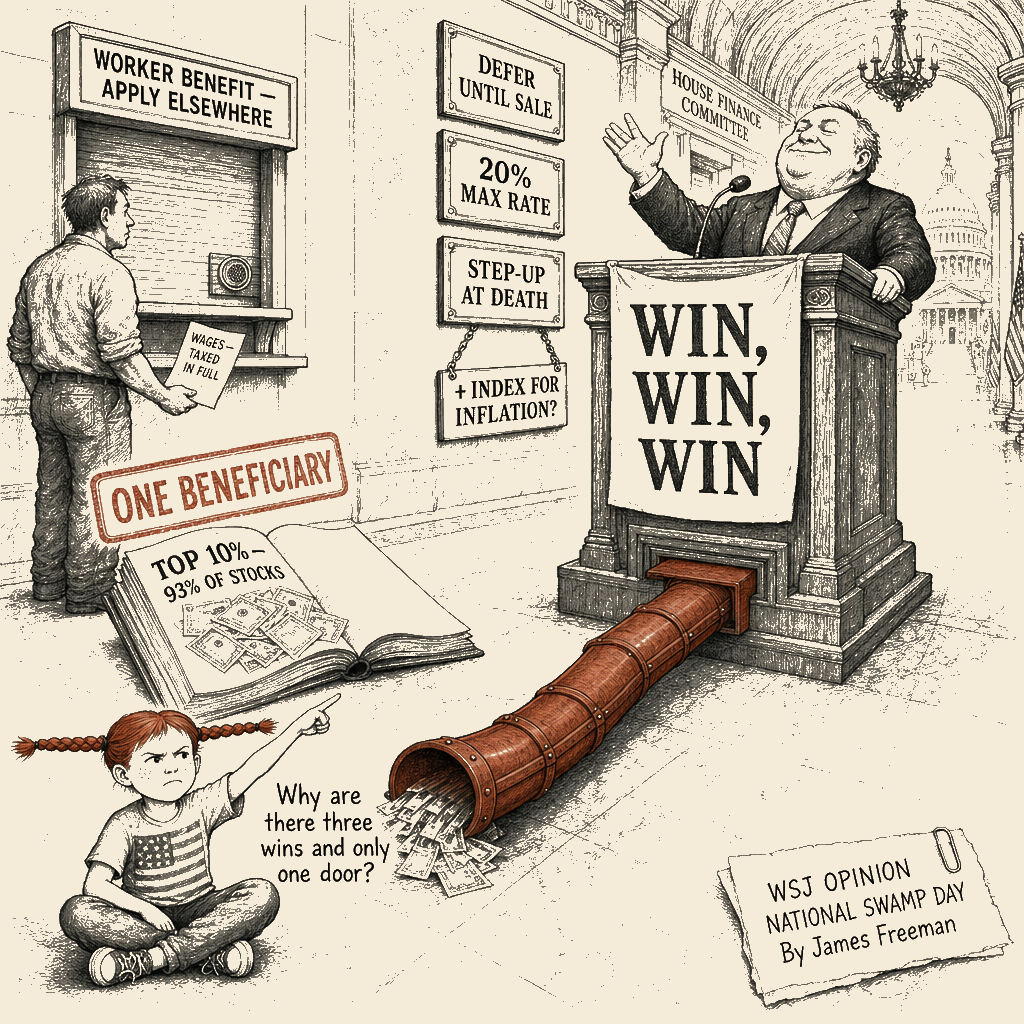
Responding to: National Swamp Day — James Freeman · 2026-07-16
What the Piece Argues
James Freeman marks the 1790 anniversary of the Residence Act by arguing that the current Republican congressional majority, despite controlling both chambers and the White House through budget reconciliation, is failing to deliver on the fiscal conservatism its voters expect. He observes that Democrats used reconciliation for spending increases without tax reform, and warns that Republicans are heading down the same path rather than cutting spending. The piece proposes that along with spending restraint, Congress should index capital gains taxes for inflation — adjusting the cost basis of investments so that only real, inflation-adjusted gains are taxed — arguing this would spur investment, increase revenue, and benefit workers.
Receipts
The piece concedes Republican overspending to build credibility, then proposes a tax cut for the investor class so large it would add to the debt it pretends to worry about — all while packaging the ask as fiscal discipline and worker prosperity.
- The framing wants you to believe the “inflation tax” is an outrage visited upon ordinary Americans whose government devalues the dollar then taxes them on phantom gains, and that fixing it would produce a “win, win, win” for investors, workers, and revenue.
- What’s really going on:
- The top 10% of households own more than 90% of U.S. stocks — 93%, as of the most recent Federal Reserve Survey of Consumer Finances.
- The bottom 50% of American households own roughly 1% of all stocks. The piece’s “inflation tax” affects them almost not at all.
- The top 1% capture approximately 70% of all capital gains. The average capital-gains taxpayer in the top 1% reports income of roughly $1.6 million; the average in the bottom 80% reports approximately $53,000. The “outrage” Freeman names — government taxing nominal gains — is an outrage experienced almost exclusively by multimillionaires, not by the worker paying taxes on real wages.
- Capital gains already enjoy massive advantages over ordinary income: deferral until sale (an interest-free loan from the Treasury), the lower 20% maximum rate versus 37% on wages, and — most critically — the step-up in basis at death, which erases a lifetime of unrealized gains entirely for heirs, functioning as the ultimate inflation adjustment. The piece mentions none of this.
- The 2017 Tax Cuts and Jobs Act, which Freeman implicitly endorses as a model, triggered record corporate stock buybacks of approximately $1 trillion — roughly 7 to 8 times what corporations spent on worker bonuses — while real median wages grew at roughly the same pace as before the cuts. The claim that investor tax cuts produce worker gains has been tested; the receipts say otherwise.
- The piece’s own rhetorical structure is the tell: it opens with spending restraint, buries the capital gains push in the middle, and closes with “win, win, win” — a concession-sandwich designed to make the investor-class tax cut taste like fiscal responsibility.
The DEFCON Ladder
DEFCON 5 — Polite Reframe
When to use: a neighbor who cares about the deficit and thinks inflation-indexing sounds fair; a Thanksgiving table where someone read the piece and found it reasonable.
James Freeman is right that Congress should restrain spending, and the concern about fiscal sustainability is real. But indexing capital gains for inflation is not fiscal discipline — it is a new tax cut that, on top of the existing advantages investors already enjoy, would cost the Treasury hundreds of billions while delivering nearly nothing to the bottom 90% of Americans who own little or no stock. The existing tax code already lets investors defer gains indefinitely, pay a lower rate than workers pay on wages, and — through the step-up in basis at death — erase the tax entirely when assets pass to heirs. If we want pro-growth tax reform, we could start by making work and investment compete on equal footing, not by adding another advantage to a stack that already tilts the field. A real “win, win, win” would invest in the infrastructure and workforce that make the economy productive, not hand another benefit to the people who least need one.
DEFCON 4 — Firm Moral Superiority
When to use: a colleague or editor who sees the capital-gains case as straightforward economics; a Substack comment section where someone is defending the piece on its merits.
The piece asks why an all-Republican Congress cannot bring itself to cut spending — then, in the same breath, asks that same Congress to cut revenue by hundreds of billions for the investor class. You cannot hold both positions at once and call it fiscal responsibility. If the national debt approaching $40 trillion is the emergency, then the answer is not a new tax break that enriches the people who are already richest. If, instead, the real purpose is to reward the constituency that funds Republican campaigns — investors, asset managers, and the top 10% — then the piece makes perfect sense, but it should say so honestly rather than dressing the ask in the language of worker prosperity. The three-step structure of this piece is worth naming: concede that Republicans overspend (credibility), pivot to capital-gains indexing (the actual ask), and wrap it in “win, win, win” for workers (populist veneer). The veneer is not the substance. The substance is a tax cut for the investor class, marketed as protection for the working family.
DEFCON 3 — Mockery and Ridicule
When to use: a Twitter thread where someone is sharing the piece approvingly; a group chat where a relative forwarded it with “finally someone who gets it.”
Happy National Swamp Day, in which a Wall Street Journal editorial writer spends eight paragraphs telling you the government spends too much and then proposes that Congress give hundreds of billions of dollars back — to investors. The piece’s central complaint is that government devalues the dollar and then taxes people on gains that are really just inflation. The piece is technically correct. The people affected are millionaires and billionaires whose portfolios grew in nominal terms. The average American worker, meanwhile, pays income tax on wages that did not keep up with inflation, but nobody is writing op-eds about indexing the standard deduction to real purchasing power. “Investors would not hold assets simply to avoid the big inflation tax,” the piece argues, as though the main drag on the American economy is that a hedge fund manager in Greenwich cannot sell his Nvidia position without owing Uncle Sam a few points. The “win, win, win” is investors, more investors, and investors again. Workers are mentioned as the beneficiary of a mechanism — investment produces better tools — that the 2017 tax cuts did not produce at scale, because corporations bought back stock instead.
DEFCON 2 — Aggressive Villainization
When to use: a direct debate where someone insists inflation-indexing is pro-worker policy; a comment section where the piece’s logic is being defended as self-evident.
Read the structure again. The piece opens: “Republican voters are the ones who prefer government to be smaller.” It closes: “The Republican majority should act like it.” Between those two sentences, it proposes a tax cut for the richest Americans that would cost the Treasury hundreds of billions and that, by the piece’s own logic, adds to the debt crisis it is supposedly solving. This is not small government. This is government that is very, very large when it comes to enriching the investor class, and very, very small when it comes to the working families who need childcare, healthcare, and a living wage. The piece mentions “able-bodied people who will not work” — the standard rhetoric for gutting safety-net programs — while simultaneously advocating that investors be taxed less on money their money earned for them. The investor class does not need to work; the capital gains tax is a tax on wealth, not labor. The piece is asking Congress to cut the tax on wealth while tightening the screws on people who have no wealth. That is not fiscal conservatism. It is the donor class’s fiscal agenda — cuts for them, discipline for everyone else — and the populist packaging is insultingly thin.
DEFCON 1 — Nuclear Satire
When to use: the piece has been shared widely and its logic is gaining traction; a public forum where the “inflation tax” framing is being repeated as if it were self-evident.
Freeman has discovered that the government is inflating the currency and taxing people on money they never actually received, and he would like the Congress to do something about it. The people affected are, in the main, the same people who attend the galas, fund the PACs, and buy the seats at the benefit dinners. The working American who was taxed on every real dollar of wages — and who has no stock portfolio to speak of — is mentioned in the piece exactly twice, both times as a beneficiary of a mechanism (investment produces better tools) that has produced no measurable wage gains from the last round of investor tax cuts. The piece’s signature rhetorical move is the “win, win, win” — a phrase it deploys without irony after describing a policy whose primary effect would be to transfer hundreds of billions from the Treasury to the investor class. If “win, win, win” means the investor, the richer investor, and the investor’s estate planner, the piece is precise. The piece also proposes that able-bodied people who will not work be denied government assistance — while asking that a millionaire who earns money by owning money be taxed less on the money his money earned. The symmetry is so clean it almost reads as satire of itself.
DEFCON 1+ — Prophetic Indictment
When to use: when the “inflation tax” framing is entering the policy discourse as if it were self-evidently just; a speech or essay in a morally serious register where the piece’s class dynamics need to be named with authority.
There is an old charge in the Hebrew prophets, and it lands on this piece with the force of a settled judgment. The prophet Amos — whom King cited at Riverside, the prophet who told the complacent of Israel that they “trample on the poor” while they “sell the righteous for silver, and the needy for a pair of sandals” — saw exactly this structure: the powerful frame their enrichment as civic virtue, and the language of fairness becomes the instrument of their extraction. Freeman writes that it is an “outrage” that government taxes nominal gains as though they were real. The outrage is real — but it is not the one he names. The real outrage is that a worker who earns $50,000 in wages pays tax on every dollar, while an investor who earns $500,000 in capital gains pays a lower rate, defers the payment indefinitely, and — at the moment of death — has the tax erased entirely by the step-up in basis. The piece names none of this. It names only the inconvenience to the already-advantaged, and proposes that Congress remedy it during the same reconciliation process the piece itself calls “swamp-level legislating.” There is a stench in this, and it is the stench of the moneychangers — the only act of force Jesus is recorded as performing was against those who turned a place of worship into a marketplace, who profited from the transaction while the temple remained the same. The capital-gains indexing proposal is a moneychanger’s move: it takes the language of justice — “outrage,” “fairness,” “prosperity” — and stamps it on a mechanism whose primary beneficiaries are the people who least need the relief. The workers named in the piece as beneficiaries will not see a dollar of this policy. The investors named as its champions will see billions. The Lord sees through the language to the distribution, and the distribution is not equal, and the piece knows this, and it does not blush.
DEFCON 1++ — Profane Scorched-Earth
When to use: someone with actual power is advancing this framing; the policy is moving through Congress; the veneer of “worker benefit” needs to be stripped completely and publicly.
Let’s be clear about what this piece is asking for. It is asking Congress to cut taxes on the people who own almost everything — while proposing that people who own nothing lose what little the government provides. The “inflation tax” is an outrage? An outrage is watching a piece of shit policy sold as prosperity for working families. The investor who defers his gains indefinitely, pays 20% instead of 37%, and has the tax erased entirely when he dies — that is the person this piece wants Congress to help. And the worker whose wages did not keep up with inflation, who is taxed on every real dollar she earns, who will never own enough stock to feel the “outrage” Freeman describes — she is the person the piece mentions twice as an afterthought. “Win, win, win” — the investor, the investor’s accountant, and the investor’s estate planner. The piece has the audacity to mention “able-bodied people who will not work” in the same breath as it asks for a tax cut on money that money earned. The investor class does not work for its capital gains; that is the entire point of capital gains. The piece proposes to tax that laborless income less, while proposing to deny government assistance to people who labor and still cannot feed their families. This is not fiscal conservatism. This is not small government. This is the donor class using the Wall Street Journal editorial page to tell Congress what to do — and the Congressional majority listening. The “swamp” Freeman names is real, but the swamp is not the spending. The swamp is the arrangement in which the people who own the most pay the least, and the people who pay the most get the least, and the piece wraps the whole filthy transaction in the flag of fiscal responsibility and calls it “pro-growth.” Go to hell with your pro-growth. The growth went to the stock buybacks, the dividend recaps, and the executive suites. The cost went to the workers, the taxpayers, and the next generation. The piece knows this. The piece has always known this. It simply does not give a damn.

About Malcolm Little King
Malcolm Little King is a heteronym in Main Street Independent's editorial architecture — an analytical voice, not autobiography of any actual person. The position this column expresses is the publication's position on the territory Malcolm Little King's lane covers, rendered through Malcolm Little King's register.