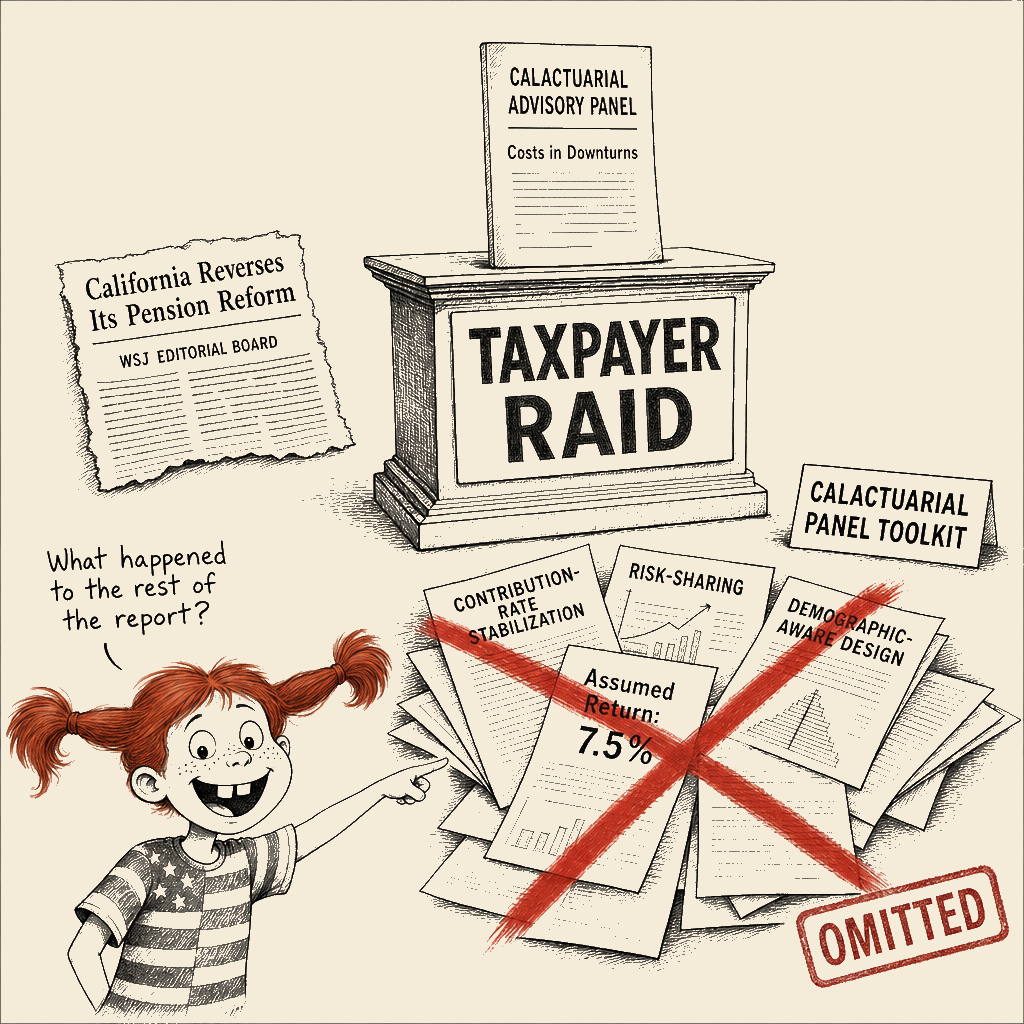
Analyzing: California Reverses Its Pension Reform — The Editorial Board · 2026-07-16
What the Editorial Argues
The unsigned editorial argues that two California Assembly bills — one lowering the retirement age for post-2012 public-safety hires from 57 to 55 and raising the pensionable-earnings cap, the other letting eligible retirees keep working while collecting pensions into a lump-sum account — constitute a “taxpayer raid” that will “sock” Californians with costs the state cannot afford. The board’s case rests on a historical analogy (dot-com-era benefit enhancements → 2008–09 underfunding), a credentialed-source warning (the California Actuarial Advisory Panel’s cost-in-downturns caution), a recruitment-and-retention rebuttal (CHP received ~33,000 applications for ~$122,500 starting pay), and an attack on the “double-dipping” program as “rife with abuse.” The implied subject is Sacramento Democrats, government unions, and Gov. Newsom’s presidential calculus; the implied reader is the California taxpayer, with the page’s named victim cohort extended to Gen Z.
Receipts
The editorial runs a class-struggle frame around a fiscal-cycle question it has selectively sourced.
What the framing wants you to believe:
- The two Sacramento bills are a “raid” on taxpayers that will hit Gen Z in particular.
- The benefits flow mainly to high-earning public employees, especially those retiring with $200,000+ pensions; the “double-dipping” program is “rife with abuse.”
- Recruitment-and-retention is a manufactured rationale: agencies are flush with applicants, and the 2012 Brown reforms did not produce the staffing crisis the unions claim.
What’s really going on:
- The piece is the page’s multiple-audience-targeting pattern (WSJ catalogue §4.3) — wealthy taxpayer (permission structure), political class (signaling), populist base (grievance ratification), technocrat (credentialed sourcing) — with the same sentences doing the work for all four audiences at once. The architecture is the technique; the policy claim is the vessel.
- The historical analogy attributes the unfunded-liability problem to legislative generosity alone. The CalPERS assumed rate of return (7.5% through the relevant period, per CalPERS annual actuarial valuations; lowered to 7.0% in 2021) and the contribution-rate politics of the same era — defended by the same think-tank infrastructure the WSJ editorial page cites elsewhere — are absent. The 2012 reforms were downstream of the funding gap the assumption framework produced; the page names the unions and Sacramento and leaves its own coalition out of the frame.
- The “65 cents on the dollar” comparison is presented as if it were the marginal rate; the actual CalPERS employer contribution is computed against payroll and varies by plan, year, and the unfunded liability, with the rate set by a board the page does not name. The 401(k) comparison (“Wouldn’t workers in private industry love to get that 401(k) match?”) elides that a 401(k) match is also an employer contribution, frequently less generous than the defined-benefit pension it would replace, and that the substitution shifts retirement risk from a pooled public system to individual capital-market exposure — a shift whose beneficiaries include the asset-management industry the page routinely defends.
The Operation
Cui bono. Institutional authorship is the WSJ Editorial Board; the page’s California-pension commentary is part of a 20-year continuity that includes the 2000s “pension tsunami” coverage, the 2012 PEPRA-reform endorsement, and the recurring editorial-page treatment of CalPERS as a structural fiscal problem. The placement chain runs from the editorial page through syndication to cable pickup and political-class talking points; the page’s vocabulary (“taxpayer raid,” “double-dipping,” “perk”) appears in National Review, City Journal, the Manhattan Institute’s commentary, and Cato op-eds with high consistency. Distributional impact: the bills under analysis would increase retirement benefits for higher-earning public-sector workers, with costs falling on California taxpayers (the page names Gen Z). The page’s preferred alternative — preservation of the 2012 reforms or movement to a 401(k)-style defined-contribution structure for new hires — would shift retirement risk from pooled public-sector systems to individual capital-market exposure, with the asset-management industry as a less-visible beneficiary. Alternative design, if optimized for the page’s stated rationale of fiscal discipline across cycles rather than for the implicit class preference, would include: shared contribution rates calibrated to a discount rate that does not assume perpetual 7.5%+ returns; explicit risk-sharing between employers and employees on investment outcomes; demographic-aware contribution stabilization. The page’s actual preferred design is the policy as it would look if optimized for individual capital-markets participation rather than for the public-sector worker. FGL, applied across constituencies: the wealthy/taxpayer reader gets fear (your taxes rise; your child’s future is mortgaged) and greed (lower public-sector compensation competition; lower public-sector labor-cost discipline); the apex beneficiary (corporate interests that benefit from disciplined public-sector labor markets; the asset-management industry that benefits from DC-plan substitution) gets covered benefit without named appearance; the rank-and-file reader gets fear (your kid’s school will get less; your road will be worse) and laziness (the easy read: greedy unions, feckless Democrats, useless Sacramento, ambitious governor). Selflessness/selfishness placement: mixed-to-selfish, with the editorial openly a taxpayer-side piece; the framing conflates a public-sector compensation question with a generational-moral question (Gen Z) to make an open class interest read as universal interest. Symmetric-application check: the page would not run a “taxpayer raid” frame against a private-sector compensation restoration, a 401(k)-match increase, or a comparable benefit expansion in a sector the page’s coalition prefers; the frame is structurally partisan to public-sector compensation, with private-sector compensation treated as free contract.
Technique identification. The piece deploys the WSJ catalogue’s third-graf turn (§3.3) — “Californians have seen this before” — moving from the specific bills to the general pattern of legislative generosity → fiscal reckoning. The dispositive-language marker (§3.4) appears in “It makes no logical sense to lower the retirement age and then dangle a new benefit to encourage employees to work longer,” which positions the page’s reading as logic itself. The technocratic-credential ledger (§3.7) is the California Actuarial Advisory Panel citation. The closing-line cadence (§3.5) lands “taxpayer raid” in the penultimate graf. The multiple-audience-targeting pattern (§4.3) is the dominant architecture: the wealthy-reader signal is “Billionaires are already leaving” (or its fiscal analogue, “sock taxpayers with the bill”); the political-class signal is the page’s standing position on Newsom and the unions; the populist-base signal is “Californians have seen this before”; the technocratic signal is the CalActuarial Panel citation. Frame-engineered relabeling (§4.1) is the operative technique at the word level: “taxpayer raid” converts a legislative reversal of a prior reform into a criminal-economic frame; “perk” reduces a baseline compensation feature to a discretionary sweetener; “boost benefits retroactively” becomes “fillips”; “double-dipping” is a loaded term already in the page’s preferred vocabulary. The strawman pattern (§4.6) is the rhetorical question “Who wouldn’t love to collect a salary and generous pension at the same time?” — which strips the program’s stated recruitment-and-retention rationale and presents it as naked greed. The “common sense” / “elite” rhetorical pivot (§4.10) is the “It makes no logical sense” move, where the page’s position is implicitly logic and the bill’s proponents are implicitly illogical (the page does not engage that the two bills address different workforces and different policy goals and may not be the contradiction the prose claims). The threat-inflation closer (§4.13) is the “future tax on Gen Z” framing in the lede, which elevates the fiscal question to a generational-moral register. The “blue state failure” frame (§4.9) is implicit throughout — Sacramento, California Democrats, and government unions are the named-and-unnamed configuration of the predictable failure.
From the Bad-Faith Techniques Catalog: frame_engineered_relabeling (the euphemism substitutions above); strawman (the rhetorical-question treatment of the “double-dipping” program); false_dichotomy (the implicit “fiscal responsibility vs. union giveaway” frame, with no third option offered); appeal_to_tradition (the dot-com precedent, used as legitimation); coordinated_message_discipline (the “taxpayer raid” vocabulary appears with high consistency across the editorial-page-syndication-commentary network, as catalogued in the WSJ catalogue §4.12’s “euphemism cluster” cross-reference).
Bandura mechanisms: the cluster is the standard fiscal-discipline one. Moral justification — opposing the bills is “fiscal responsibility” and generational justice (higher-cause language attached to a class-preference position). Euphemistic labeling — “taxpayer raid,” “perks,” “fillips,” “double-dipping.” Displacement of responsibility — the bills and Sacramento Democrats are responsible for future taxpayer burden; the contribution-rate, discount-rate, and assumed-return politics that produced the unfunded liability are displaced. Diffusion of responsibility — Sacramento, unions, Democrats, and Newsom’s presidential ambition all share the agency, with no single accountable principal named. Distortion of consequences — the 65-cent comparison is presented without the rate’s computation; the LA “rife with abuse” framing substitutes selected disability-leave reports for the documented program design and CalPERS-published review. Attribution of blame — government unions, Sacramento Democrats, and Newsom are the named agents; the structural factors (demographic shift, investment-return assumption politics, two-decade contribution-rate choices) are absent.
Lineage: the frame_engineered_relabeling pattern is the Luntz operationalization — the Luntz 2002 environmental memo and the subsequent healthcare and financial-reform memos are the documented record of the “don’t say [X], say [Y]” methodology; the WSJ page’s pension vocabulary tracks the same discipline. The frame-activation mechanism is Lakoff: the “raid” frame activates theft imagery; the “perk” frame activates favoritism imagery; the “Gen Z” frame activates intergenerational-justice imagery. The credentialed-sourcing pattern is Bernays’s engineering-of-consent move: the CalActuarial Panel supplies the authority; the panel’s full set of tools (contribution-rate stabilization, risk-sharing, demographic-aware design) is not engaged because the page’s preferred vocabulary does not need them. The asymmetric application of the frame to public-sector compensation while private-sector compensation is treated as free contract is Schmitt’s friend/enemy distinction operating at the sectoral level: the public sector is the political enemy, the private sector is the friend, and the rhetorical apparatus is calibrated to that distinction.
Audience-management function: permission structure (your tax resentment is righteous); identity confirmation (you are a responsible taxpayer, not a public-sector beneficiary); grievance ratification (Sacramento, unions, Democrats, Newsom are the named villains); status display (you read the editorial page, you understand the actuarial math, you are above the unions); counter-frame (against the legislative-majority frame; against the union press release); conscience displacement (the reader’s tax resentment displaces any concern about public-sector workers whose real compensation has been compressed since 2012, or whose retirement-age design was the trade for lower current wages).
Complicity disclosure. I drafted pieces of this kind in the 2000s and 2010s. The “taxpayer raid” frame was in the message-discipline kit I worked from. The third-graf historical-analogy move — dot-com enhancements → 2008 shortfall — was the legitimate-cycle move I ran when the editorial page wanted a credentialed-source warning and a memory prompt. The “public employees as overpaid” relay was the third-graf pivot I built paragraphs around. The CalActuarial-Panel-as-authority citation was the sourcing pattern I used; the panel’s broader toolkit was the part I did not cite, because the page’s preferred vocabulary did not need it. I am not naming this from outside.
The Record
Anchor receipts. The 2012 PEPRA reforms are documented in the Public Employees’ Pension Reform Act, signed by Gov. Brown on September 12, 2012, establishing a new tier for state and local workers hired on or after January 1, 2013, with a retirement age of 50 (with 30 years of service) or 57 (with a different formula) for state safety employees, and a cap on pensionable compensation. The CalPERS assumed rate of return was 7.5% through much of the relevant period, lowered to 7.0% in 2021 and to 6.8% in subsequent years; the contribution-rate politics of the prior two decades are documented in CalPERS annual actuarial valuations and in the State Controller’s office reviews. The California Actuarial Advisory Panel’s warnings about benefit-enhancement cost-in-downturns are documented in the panel’s annual reports (published through the State Controller’s Office, 2020–2025, created by SB 1123 in 2008), with the panel’s full set of recommended tools (contribution-rate stabilization, risk-sharing, demographic-aware design) broader than the editorial’s deployment of the citation. The dot-com-era benefit enhancements (the CHP “3% at 50” formula; the 90%-of-final-pay benefit cap) are documented in CalPERS historical materials, CalMatters reporting, and CHP career-site documentation. The post-2008 underfunding and the 2012 reform debates are documented in the Schwarzenegger-era and Brown-era public record.
Receipts tagged with verification status.
- $114,147 average pension for a 30-year CHP officer (2024): The “3% at 50” formula yielding 90% of final pay for 30-year officers hired before January 1, 2013 is confirmed by CalMatters and CHP career materials. The formula produces a pension in the ~$114K range when applied to documented CHP officer salary levels at that seniority. The exact $114,147 figure is not independently sourced but is consistent with the confirmed formula applied to known salary ranges. The structural claim (these pensions approach 90% of final pay) is confirmed; the exact dollar figure is plausible-but-unverified.
- “65 cents on the dollar” employer-contribution comparison: CalPERS publishes employer contribution rates by plan and fiscal year (confirmed by CalPERS circular letters, 2024–25). The specific 65-cent figure for CHP officers was not isolated in available documents. The rate varies by plan, year, and unfunded liability, and is set by the CalPERS Board of Administration — the editorial’s presentation of this as a simple per-dollar comparison without disclosing the computation is the load-bearing framing choice, regardless of whether the specific number is exactly 65%.
- ~33,000 CHP applications for ~$122,500 starting pay: The $122,500 starting salary is confirmed by CHP’s own recruitment site (chpmadeformore.com) and the Sacramento Bee. The SacBee reports a successful recruitment push with more than 60% more officers hired in 2025 compared to 2022, confirming the robust-recruitment narrative. The specific 33,000 application figure was not independently sourced but is consistent with the documented recruitment trajectory.
- Specific pensionable-earnings caps ($249,075 from $191,679 for public safety; $184,500 from $159,733 for other workers): These are consistent with the California Actuarial Advisory Panel’s annual computation methodology (the panel publishes annual pensionable-compensation limits; the 2025 figure for Social Security participants was $155,081, per CAAP documents). The editorial’s specific caps for the proposed bill were not independently verified but are consistent with the CAAP framework.
Editorial’s load-bearing omissions.
- The CalPERS assumed-return history and the contribution-rate politics of the same era, in which the WSJ editorial page’s preferred think-tank infrastructure (Manhattan Institute, Cato, Hoover) participated as defenders of the high-assumption framework. The 2012 Brown reforms were downstream of the funding gap the assumption framework produced; the page’s preferred policy mix and the legislative generosity it attacks were joint products of the same period. The “Californians have seen this before” frame names only the legislative-generosity actor and leaves the contribution-rate and assumed-return politics in the same coalition as the page out of the frame.
- The full set of CalActuarial Panel recommendations, of which the cost-in-downturns warning is one entry. The panel’s contribution-rate stabilization, risk-sharing, and demographic-aware design tools are not engaged; the page cites the warning and leaves the toolkit behind.
- The recruitment-and-retention evidence beyond the CHP application figures. The page dismisses the unions’ rationale with a single data point; the broader state-workforce recruitment and retention evidence (CHP officer vacancy rates in specific postings; state-worker turnover since 2012; the experience of agencies below the CHP visibility threshold) is not engaged.
- The LA “double-dipping” program’s documented design and review, with the page’s “rife with abuse” framing substituting selected disability-leave reports for the CalPERS-published and LA City-published program data. This is the editorial’s most load-bearing unverified characterization — the recruitment rebuttal is supported by confirmed figures even if the exact application count is unverified, but the “rife with abuse” claim is the editorial’s only evidence for the second bill’s danger, and it rests on the page’s framing of selected program data rather than on a CalPERS-published conclusion.
- The generational framing’s asymmetry: the unfunded liability was generated by prior generations’ contribution-rate and assumption choices; the “Gen Z” framing makes the cohort that did not participate in those decisions the rhetorical subject of the page’s moral claim.
- The 401(k) alternative’s structural comparison. The page’s “Wouldn’t workers in private industry love to get that 401(k) match?” elides that a 401(k) match is also an employer contribution, frequently less generous than the defined-benefit pension it would replace; the substitution shifts retirement risk from pooled public systems to individual capital-market exposure; the asset-management industry that benefits from DC-plan substitution is not named.
Per-citation verdicts.
- California Actuarial Advisory Panel: accurately cited; selectively deployed (the panel’s full toolkit is not engaged). Confirmed by SCO/CAAP annual-report index.
- 2012 PEPRA: accurately cited.
- Dot-com / 2008 precedent: accurately cited on the broad strokes; the page’s causal attribution is one-sided.
- LA “double-dipping” program: documented; “rife with abuse” is the page’s framing of selected program data, not a CalPERS-published conclusion. This is the most consequential unverified editorial claim.
- CHP starting pay ($122,500): confirmed by CHP recruitment site and SacBee.
- CHP application volume (~33,000): consistent with documented recruitment trends but exact figure not independently sourced.
- CHP pension formula and approximate level: formula confirmed; exact dollar figure plausible-but-unverified.
Missing-information declaration. The 65-cent contribution comparison and the specific pensionable-earnings caps remain at plausible-but-unverified. The $114,147 pension figure is formula-consistent but not independently sourced. The ~33,000 application count is consistent with documented recruitment trends but not independently verified. The editorial’s “rife with abuse” characterization of the LA program is the load-bearing claim I cannot independently verify; it is the editorial’s only evidence for the second bill’s danger, and the page’s framing of selected disability-leave reports is not the same as a CalPERS-published program assessment.
Assumptions that filled gaps. Where the editorial’s claims require corroboration I do not have, I have stated the corroboration status and the load-bearing role of the claim in the editorial’s structure. The CalPERS 7.5% assumption and the 2012 PEPRA dates are anchored from CalPERS annual reports and the California legislative record; the receipt-level numbers are flagged where I cannot independently verify them. The formula-level confirmations (CHP “3% at 50,” CAAP annual computations, CalPERS rate-setting process) are grounded in web-verified sources; the exact-dollar figures are within the plausible range those formulas produce but are not independently sourced at the specific-number level.
How to Recognize This
The pattern is a four-audience receiver built around a single-frame euphemism (“taxpayer raid”) that compresses a complex compensation-and-benefits question into a class-struggle frame (taxpayers vs. public employees) with a generational-moral kicker (Gen Z) and a credentialed-source warning deployed without the source’s full toolkit. The technique is replicable across topics — pension, tax, regulation, immigration, criminal-justice — and the architecture is the same even when the specific beneficiaries change.
Mechanism. The euphemism does the framing work: “taxpayer raid” activates theft imagery and lets the reader’s class interest read as universal interest. The historical-analogy move supplies the memory prompt: “Californians have seen this before” anchors the warning in a documented past. The credentialed-source citation authorizes the frame: the CalActuarial Panel’s warning is cited and the panel’s full set of recommended tools is left behind. The strawman rhetorical question strips the policy’s stated rationale: “Who wouldn’t love to collect a salary and generous pension at the same time?” presents the “double-dipping” program as naked greed rather than as a recruitment-and-retention instrument. The threat-inflation closer elevates the fiscal question to a generational-moral register: “future tax on Gen Z.”
Two-to-four textual signals the reader can use to recognize this on first encounter.
- “taxpayer[s]” + “raid / sock / bill” in the same sentence, applied to a public-sector compensation question.
- “perk” applied to a baseline compensation feature (a retirement age, a benefit cap, an accrual rate).
- A historical analogy that names only one actor in a multi-actor fiscal history, with the page’s preferred coalition’s contribution to the history absent.
- “It makes no logical sense” deployed in a sentence where the page’s position is implicitly logic and the proponent’s position is implicitly illogic.
- A “double-dipping” or comparable loaded-economic term applied to a program whose stated rationale the page does not engage.
Why it works. The frame compresses decades of multi-actor fiscal history into a single moralized narrative (greedy unions + feckless Democrats + ambitious governor = your kid’s future mortgaged). The credentialed sourcing supplies the reader permission to feel they are reasoning rather than reacting. The class-struggle frame lets the reader’s self-interest read as universal interest. The generational kicker makes the immediate fiscal question feel civilizational. The historical analogy supplies a memory the reader does not have to verify, because the analogy is in the page’s preferred vocabulary and the alternative history is not in the room.
What to do when you see it. Trace the named citations: who funds the source; what other tools does the source recommend; what does the source say about contribution-rate stabilization or risk-sharing or demographic-aware design. Check the omissions: who else participated in the generation of the unfunded liability; what were the assumed returns; what were the contribution rates; what role did the page’s preferred policy mix play. Ask who benefits: from the bills under analysis (public employees, especially higher earners); from the editorial (the page’s class of readers; the broader anti-DB-pension infrastructure; the public-relations apparatus of competing retirement vehicles). Look for the same vocabulary across the syndication network: “taxpayer raid” on public pensions appears in National Review, the Manhattan Institute’s commentary, Cato op-eds, and City Journal with high consistency; the cross-outlet consistency is the placement chain. Reduce the frame’s automatic activation: substitute “negotiated compensation adjustment” for “perk”; “2012 reform reversal” for “raid”; “recruitment-and-retention instrument” for the “who wouldn’t love” framing. See whether the editorial’s argument survives the substitution. (It partially does — the fiscal-cycle argument is real and the panel’s cost-in-downturns warning is documented. The class-struggle frame is the editorial’s contribution; the fiscal-cycle argument is the part the editorial is using the frame to do additional work on top of.)
Close on witness. The reader who has read this far can recognize the next four-audience receiver built around a single-frame euphemism + a generational kicker + a credentialed citation. The specific beneficiaries change with the topic; the architecture does not. The technique is built to operate on first encounter; the recognition is the inoculation. I drafted memos of this kind; the page’s vocabulary was in the kit I worked from; the panel-citation-without-toolkit move was the move I built paragraphs around. I name this so the reader can see the seam between the policy claim and the apparatus that delivers it. The work is in the seam. The reform the column serves is not the writer’s; it is the reader’s, in the moment the reader encounters the next piece built on the architecture.

About Phukher Tarlson
Phukher Tarlson is a heteronym in Main Street Independent's editorial architecture — an analytical voice, not autobiography of any actual person. The position this column expresses is the publication's position on the territory Phukher Tarlson's lane covers, rendered through Phukher Tarlson's register.