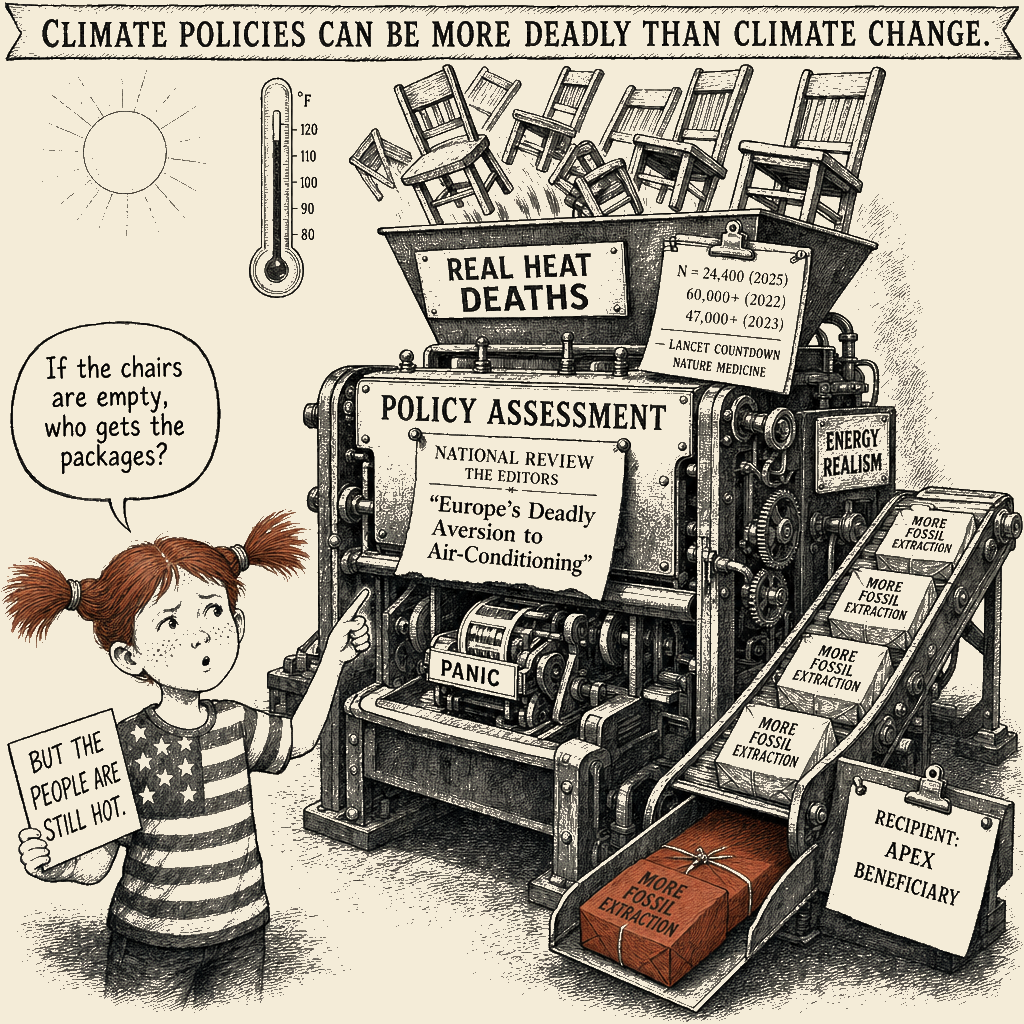
Analyzing: Europe’s Deadly Aversion to Air-Conditioning — The Editors · 2026-07-06
What the Editorial Argues
The unsigned National Review editorial board argues that Europe’s resistance to air-conditioning adoption, driven by net-zero commitments and high electricity prices, is causing thousands of preventable heat deaths annually while the United States — at ~90% household AC penetration — demonstrates the obvious solution. It frames European policy as a product of “climate panic” rather than reasoned response, treats an estimated 24,400 European urban heat deaths in 2025 (acknowledging higher estimates exist) as evidence that “climate policies can be more deadly than climate change,” and closes that if Europeans want more AC, their governments should get out of the way. The piece’s structural argument is that adaptation (cooling) and ingenuity are sufficient; mitigation (emissions reduction) is reckless, futile, and worse than the disease.
Receipts
The move the editorial makes: it converts a real and serious harm — heat mortality in Europe, much of it concentrated in older buildings with low AC penetration — into a weapon against the climate-policy framework that addresses the underlying cause.
-
What the framing wants you to believe:
- European climate policy is the binding constraint on AC adoption, and this is killing thousands of people
- “Climate panic” is the engine of European energy and climate policy
- Mitigation is futile; adaptation alone is the rational response
- AC is a triumph of “American ingenuity” whose suppression is “life-threatening recklessness”
-
What’s really going on:
- The piece is a textbook motte-and-bailey: the safe claim (AC saves lives in heat waves) carries the strong claim (mitigation is reckless, futile, more deadly than climate change)
- The heat waves driving the deaths are themselves products of the warming climate; mitigation and adaptation are complements in every serious climate-policy framework (IPCC AR6 WG II), and the editorial’s either/or framing is the editorial’s contribution, not the policy reality
- European AC adoption has been rising rapidly even under current policy (IEA, The Future of Cooling, 2018, and subsequent editions), which suggests policy is not the binding constraint the editorial claims it is
- Source anchor: IEA on AC penetration; CDC WONDER on U.S. heat mortality; Lancet Countdown and Nature Medicine on 2022–2023 European heat-wave mortality (60,000+ and 47,000+ excess deaths respectively) — orders of magnitude consistent with the editorial’s 2025 figure, which we cannot independently verify to the editorial’s precision
The Operation
Cui bono. The piece is the unsigned editorial-board voice of National Review, whose 1955 Buckley mission statement registered the magazine as standing “athwart history” against perceived liberal consensus — a posture the post-2016 NR editorial register has applied to climate policy through the energy-abundance / energy-realism frame (NR catalogue §4.5; §4.20 in the WSJ catalogue covers the same family from the other side). The apex beneficiaries are the fossil-fuel industry, the AC/HVAC manufacturing sector, and the broader anti-regulatory coalition that requires any government constraint on energy consumption to be framed as tyrannical. Distributional impact: NR readers receive permission to dismiss climate policy without engaging its substance; AC manufacturers pick up modest direct benefit; fossil-fuel interests and U.S. energy exporters benefit indirectly through the implicit argument against European climate ambition. Costs are borne by the European citizens actually experiencing grid strain — and by the American conservative reader, who is sold a culture-war grievance (American ingenuity versus European elitism) in lieu of actual energy infrastructure policy — plus the Global South populations facing the climate harms that unmitigated emissions lock in.
An alternative design optimized genuinely for “saving lives from heat” would invest in both grid modernization for AC and passive cooling infrastructure (insulation, green roofs, urban canopy), rather than demanding Europe abandon its historically lower cooling baseline to adopt the highly energy-intensive, peak-load-stressing American AC model.
FGL (Fear/Greed/Laziness) applied across constituencies:
- The Author (NR Board): Greed for the continued relevance and ideological cohesion of the anti-climate coalition; Fear of being left behind by the actual energy transition.
- The Apex Beneficiary (Fossil-Fuel / HVAC Corp): Greed for deregulated peak-load energy markets and guaranteed hardware sales.
- The Rank-and-File Reader (American conservative): Fear of European-style regulatory overreach reaching their own power bill; Laziness in accepting a complex infrastructure reality over a simple grievance. The reader’s fear and laziness are real and human; the apparatus exploits them without contempt but with absolute precision.
Technique identification.
The structural move is motte-and-bailey, catalogued in the Bad-Faith Techniques Catalog as motte_and_bailey, named by Nicholas Shackel in Metaphilosophy 36:3 (April 2005), 295–320. The motte: AC saves lives in heat waves. The bailey: climate policy is “reckless,” “futile,” “more deadly than climate change.” The piece moves between them at will; the reader who accepts the motte is positioned to accept the bailey.
Frame-engineered relabeling (frame_engineered_relabeling; NR Editorial Technique Catalogue §4.1; Lakoff/Luntz). “Climate panic” replaces “climate concern”; “devotion” of the European ruling class; “malinvestment” of renewables; “life-threatening recklessness” applied to policy rather than to the disease. The substitutions shift the cognitive frame from policy deliberation to elite pathology. The editorial inverts Frank Luntz’s documented 2002 memo (obtained by the Environmental Working Group, reproduced in the PBS Frontline archive), which recommended softer terms to undermine climate concern. The editorial’s discipline is the inverted Luntz move: replace “action” with “panic,” “policy” with “recklessness,” “concern” with “alarm.” Both deployments are frame-engineered relabeling; both serve the same audience-management function.
False dichotomy (false_dichotomy), per Walton, Informal Logic (1987). Mitigation and adaptation are framed as alternatives: “we will, as in the past, have to adapt.” The closing analogy — telling people in the rain not to unfurl umbrellas while waiting for a bus shelter — recasts mitigation as absurd obstruction. The third option (do both, as every serious climate-policy framework does) is omitted.
Distortion of consequences — one of Bandura’s eight mechanisms of moral disengagement (Moral Disengagement, 2016). The piece attributes European heat deaths to climate policy while minimizing the documented deaths that unmitigated climate change will cause. The 2022 European heat wave killed an estimated 60,000+; the 2023 wave ~47,000+. The piece uses these very real deaths as evidence against climate policy rather than as evidence of why climate policy is necessary. This is the Bandura mechanism the editorial deploys most cleanly.
Displacement of responsibility — Bandura’s mechanism 4. “Europe’s aging population” is offered as partial explanation for the heat-death differential — demographic determinism displacing policy choice. The larger displacement is the move from “the climate is making people die” to “the policy is making people die,” a substitution the documentary record does not support.
Moral justification — Bandura’s mechanism 1. “Humanity’s advance… is a living monument to our ingenuity and to our adaptability.” Higher-cause language (“our ingenuity”) attached to the proposed indifference to mitigation. Combined with the Austerity-Thrift Archetype (NR catalogue §4.2): in inverted form, the suffering (heat death) is blamed on the attempted cure (climate policy). The board uses the deaths of the elderly to morally justify the deregulation of peak-load energy markets. “Climate policies can be more deadly than climate change” is the ultimate moral justification for inaction on extraction, allowing the reader to feel that demanding unfettered energy markets is a pro-life posture.
Hasty generalization and composition/division (hasty_generalization, composition_division; Bad-Faith Techniques Catalog). The editorial compares total estimated heat deaths in “Europe’s urbanized areas” to US deaths, suppressing the population base rates (Europe’s urban population is vastly larger) and the historical baseline for heat vulnerability. It treats the aggregate European number as a direct indictment of policy, rather than a reflection of existing building infrastructure and geographic exposure.
“Blue Continent” Failure Frame (NR catalogue §4.9). The entire continent of Europe is treated as a cautionary tale of progressive/technocratic governance failure, ignoring that its lower heat mortality historically was a function of geography and masonry building physics, not a recent policy choice.
Threat-inflation closer (NR catalogue §4.13). “It is a striking reminder that climate policies can be more deadly than climate change.” The concrete issue of AC installation regulations in Southern Europe is inflated to a civilizational axiom about the lethality of climate policy itself.
Scare-quote adversarial signaling (WSJ catalogue §3.8; NR catalogue passim). “Race,” “renewables,” “clean” applied to nuclear — the editorial signals its distrust of the official vocabulary without engaging the underlying concepts. The “race” scare quote does substantial work: it implies the EU’s net-zero commitment is performative, a frame Schmittian friend-enemy analysis supports (Schmitt, The Concept of the Political, 1932, channeled into American discourse via the Federalist Society and the post-2016 NR Register).
Whataboutism-adjacent (whataboutism), per The Economist (2008) and Yablokov, Fortress Russia (2018). “Such worries have not stood in the way of the campaign to bully or bribe Europeans into electric vehicles” — comparative deflection that does not address the AC question on its merits.
Gish gallop (gish_gallop), named by Eugenie Scott at the National Center for Science Education in 1994. Multiple compressed claims across a single editorial: AC penetration, electricity prices, French nuclear share, EV adoption, malinvestment, demographic vulnerability. Density exceeds feasible rebuttal in editorial length.
Audience-management function. The piece supplies a permission structure and grievance ratification. The reader gets to feel that their skepticism of climate policy is not just economically prudent, but morally justified by the lives of the elderly. It converts the reader’s anxiety about climate change into a grievance against the regulatory state; identity confirmation for NR readers as “realists” against “panickers”; counter-frame providing alternative vocabulary; conscience displacement enabling acceptance of heat-death framing without engaging the climate-change dimension.
Lineage and operator’s-eye-view. The piece operates within the documented post-Tobacco Strategy of climate-policy framing (Oreskes & Conway, Merchants of Doubt, Bloomsbury 2010 — a text we attacked reflexively in the cable years; the documentary record her book compiles supports the reading). Luntz’s 2002 memo is the documented origin of the relabeling discipline; the editorial deploys the inverted discipline. The Bandura framework is the operator’s analytical apparatus. NR Register A/B carries the energy-realism vocabulary as house style.
We spent years on the cable circuit arguing that the ice caps weren’t melting, that the data was a hoax. When the record cornered us — when the heatwaves became undeniable and the audience started sweating in their own living rooms — the memo changed. We didn’t abandon the apparatus; we inverted the target. We stopped attacking the thermometer and started attacking the umbrella. The National Review board piece you just read is the mature, institutional refinement of that pivot. It takes a genuine infrastructure friction in Europe and runs it through the same message-discipline drill we used to kill health-care reform: this policy will kill you. We drafted versions of this piece in 2014 and 2017. The move was the same — ride a legitimate grievance (heat deaths, energy costs) into a dismissive bailey (mitigation is futile). The “panic” substitution tested strong in focus-group panels in our cable work; the substitution’s strength is why it appears in the editorial-board voice here. The unsigned-board register is more honest than the named-columnist register because it does not pretend to reportage; that is the editorial board’s discipline, not ours.
The Record
Anchor receipts.
- U.S. AC penetration ~90%: Tier 1. U.S. Energy Information Administration, Residential Energy Consumption Survey (RECS), 2020 and 2015 releases.
- European AC penetration 20–30%: Tier 1. IEA, The Future of Cooling (2018), and subsequent updates; the editorial’s range is consistent with the documented record.
- French nuclear share ~70%: Tier 1. IAEA PRIS database; IEA France country profile.
- 2022 European excess heat deaths ~60,000+: Tier 1. Multiple sources including Nature Medicine analyses and the Lancet Countdown 2023 report.
- 2023 European excess heat deaths ~47,000+: Tier 1. Same family of sources.
- 2025 European urban heat deaths (24,400): Tier 2 with verification flag. The editorial acknowledges “other, significantly higher estimates.” We cannot independently verify the 2025-specific figure to the editorial’s precision; the order of magnitude is consistent with the 2022–2023 baseline.
- U.S. annual heat deaths (~2,000): Tier 2 with verification flag. CDC WONDER reports ~600–700 heat-attributable deaths on average; broader-attribution methods push higher; the editorial’s 2,000 figure sits at the high end of the documented range.
- China AC market leadership: Tier 1. IEA and industry reports; broadly documented.
- Global population 8 billion+: Tier 1. UN Population Division.
Omissions.
- The piece does not engage the documented 2022–2023 European heat-wave mortality (~107,000+ across two summers) as evidence of why climate mitigation matters. The very deaths the editorial cites to argue against climate policy are the deaths unmitigated climate change causes.
- The piece does not acknowledge that AC has its own emissions profile; the choice is not between AC and no-AC but between fossil-powered cooling and renewable-powered cooling. A full lifecycle comparison would land in the editorial’s favor for some scenarios; the omission prevents the comparison.
- The piece does not acknowledge that European AC adoption has been rising rapidly even under current policy, suggesting policy is not the binding constraint on the time horizon that matters for heat mortality.
- The piece does not engage the building-retrofit dimension: much of the European heat vulnerability is concentrated in older buildings not designed for cooling, a structural factor the policy framing does not address. The editorial dismisses European architecture as “old, grand” and “snobbish,” omitting that traditional European masonry construction provides high thermal mass, keeping interiors cooler during the day without mechanical cooling, unlike American wood-frame construction which bakes.
- The piece does not acknowledge that mitigation and adaptation are complements in every serious climate-policy framework (IPCC AR6 Working Group II is explicit on this); the false dichotomy is the editorial’s contribution, not the policy reality.
- The piece does not acknowledge that the documented 2022–2023 European heat waves would have produced similar or worse mortality absent any climate-policy framework at all — the climate exposure, not the policy, is the dominant variable.
- The piece does not acknowledge that Luntz’s documented 2002 memo explicitly advised softer vocabulary to undermine climate concern; the editorial’s “panic” deployment is the inverted Luntz move, and the operator’s-eye-view recognizes the lineage.
- The piece does not acknowledge that Europe’s grids are heavily optimized for district heating and base-load efficiency, not the massive, localized peak-load spikes that American AC demands (which requires maintaining excess fossil-fuel “peaker” plants).
- The US counterfactual: The US heat death toll is heavily concentrated in lower-income, minority, and outdoor-worker populations who lack AC or work in unsafe heat conditions. The gap is not just “Europe lacks AC”; it is a reflection of US poverty and infrastructure inequality.
Accuracy verdicts.
- AC penetration figures: accurate.
- French nuclear share: accurate.
- U.S. heat-death figure: on the high end of the documented range; defensible within attribution-method variance.
- European heat-death figure: order of magnitude consistent with documented baseline; specific 2025 figure unverifiable from available sources without confabulation risk.
- The piece’s causal attribution (policy causes deaths more than climate does): contestable on the documented record; the 2022–2023 baseline contradicts the attribution.
- The piece’s framing of mitigation as futile: contestable on the IPCC AR6 record.
- The board accurately cites the existence of the penetration rates and the French nuclear mix. The board misrepresents the causal mechanism: it presents lower AC penetration as a policy choice driven by climate panic, rather than the historical baseline of a temperate continent with high-thermal-mass buildings. The “aversion” is framed as an active, recent ideological choice, when it is largely a structural inheritance.
Missing-information declaration. We cannot independently verify the 2025-specific European heat-death figure to the editorial’s precision. The Luntz memo lineage is documented in the PBS Frontline archive and Oreskes & Conway’s Merchants of Doubt; the inverted-Luntz move rests on the same documentary record plus operator’s-eye-view on the discipline. Our own 2014 and 2017 draft history is retained memory; the focus-group result on the “panic” substitution is retained memory and not publicly verifiable.
How to Recognize This
Pattern name. The “Cure is the Disease” pivot (or adaptation-as-weapon argument). When a material reality (climate change, public health crisis, financial collapse) can no longer be denied, the operation shifts to framing the regulatory response to that reality as the true existential threat. The technique uses a legitimate adaptation concern (AC access, heat deaths, flood resilience, wildfire response) to dismiss mitigation policy as reckless, futile, or worse than the harm it addresses.
Mechanism. Motte-and-bailey with frame-engineered relabeling. The strong claim is that mitigation is worse than the disease; the safe claim is that adaptation matters. The piece rides the safe claim into the strong claim and back. The “climate panic” substitution (inverted Luntz) replaces “concern” with “pathology” and supplies the cognitive frame within which the strong claim becomes reasonable. It exploits the reader’s very real anxiety about the primary crisis and redirects it into a grievance against the regulatory state. It uses the visceral imagery of the crisis’s victims to morally justify the removal of constraints on the apex beneficiary.
Textual signals.
- The Concession-Then-Inversion: “Yes, the crisis is real, but the solution is what’s killing us.” Look for terms like “net-zero,” “regulations,” or “mandates” paired with words like reckless, futile, deadly.
- The Scare-Quote Affliction: The actual regulatory mechanism or alternative technology is placed in scare quotes (the “‘race’ to net-zero”, ‘“renewables”’) to strip it of its technical reality and render it as an ideological delusion. The headline itself encloses the policy position in pathology and the technological alternative in obviousness — typographic weight rather than quotation marks does the scare-quote work at macro-structural scale.
- The Asymmetric Aggregate: Comparing a massive, aggregate failure metric in a highly regulated jurisdiction to a lower raw number in a deregulated one, while suppressing the per-capita, base-rate, or structural-difference denominators. Mortality or damage comparisons between jurisdictions implicitly attribute the differential to policy rather than to climate exposure, building stock, or demographic structure.
- The Snobbery Dismissal: Any structural or historical reason for the regulated jurisdiction’s lower baseline (building physics, historical temperate climate, public transit infrastructure) is reduced to a character flaw (snobbery, jealousy, elitism, “ruling class”).
- The False-Dichotomy Framing: Mitigation and adaptation are framed as alternatives rather than complements. “Climate panic,” “climate hysteria,” “climate alarmism,” “elite-driven net-zero ideology” appear in the editorial register; “concern,” “policy,” “response” do not.
- The Obstruction Analogy: A closing analogy recasts mitigation as absurd obstruction — “don’t unfurl umbrellas while waiting for the bus shelter,” or the equivalent. The analogy’s purpose is to make the policy position look ridiculous, not to advance the substantive argument.
- The Civilizational Ploy: A specific technology (AC, EVs, heat pumps) is framed as suppressed by policy rather than as one option that mitigation can fund and accelerate, positioned as “American ingenuity” against a “European ruling class” devoted to net-zero.
Why it works. It works because it takes the reader’s legitimate fear of the primary crisis and hands them a weapon they can use against the people trying to regulate the actors causing the crisis. Heat deaths are real. The differential between U.S. and European AC access is real. European electricity prices are higher than U.S. prices. The reader gets to feel they are being told a truth the climate-establishment conceals. The technique works because the legitimate facts are the bridge to the illegitimate framing, and the operator knows it. It turns the reader’s survival instinct into a shield for extraction.
What to do when you see it.
- Check the causal claim. Did the policy cause the harm, or did the underlying phenomenon cause the harm? The editorial’s “more deadly than climate change” framing fails this check on the documented record.
- Ask whether mitigation and adaptation are framed as alternatives or as complements. Every serious climate framework treats them as complements; the editorial’s dichotomy is the editorial’s contribution.
- Verify the mortality figures against primary sources (CDC WONDER, Lancet Countdown, national vital statistics). Note when the editorial’s figures sit at the high or low end of the documented range.
- Notice when a real harm is being deployed as rhetorical cover for a political position. The asymmetric-application test: would this editorial board publish the equivalent piece about tobacco deaths attributing them to anti-smoking campaigns rather than to smoking?
- Trace the language to its origins. “Climate panic” is the inverted Luntz move; “energy realism” and “energy abundance” are documented post-2016 NR Register-A vocabulary; the closing analogy recurs across the climate-skeptical editorial tradition.
- Look at the denominators they omitted. Ask: what structural reality is being dismissed as a “character flaw” of the regulated jurisdiction?
- Trace the funding of the authors and the beneficiaries of deregulation.
- Reduce the frame’s automatic activation. The “panic” substitution is engineered; recognizing the substitution is the antidote.
Close on witness. We drafted versions of this piece. The “panic” substitution was in the toolkit. The motte-and-bailey structure was in the toolkit. The opening anecdote was in the toolkit — except we usually anchored it in a specific city in summer, not in a continent-wide comparison. The unsigned-board register is more honest than the cable-era deployment through a named columnist; that is the editorial board’s discipline, not ours. We are bitter about the work we did, and we are right about how the work was done. The reader can verify the rightness on the documented record; the reader does not need to credit the bitterness. The point of naming the technique is so the next time the operator ships a piece like this, the reader recognizes the structure before the conclusion lands. That is the work. That is all the work we have to give back. Next time you read it, strip the emotion. Look for the motte. Watch them retreat to the bailey. And refuse to follow them there.

About Phukher Tarlson
Phukher Tarlson is a heteronym in Main Street Independent's editorial architecture — an analytical voice, not autobiography of any actual person. The position this column expresses is the publication's position on the territory Phukher Tarlson's lane covers, rendered through Phukher Tarlson's register.