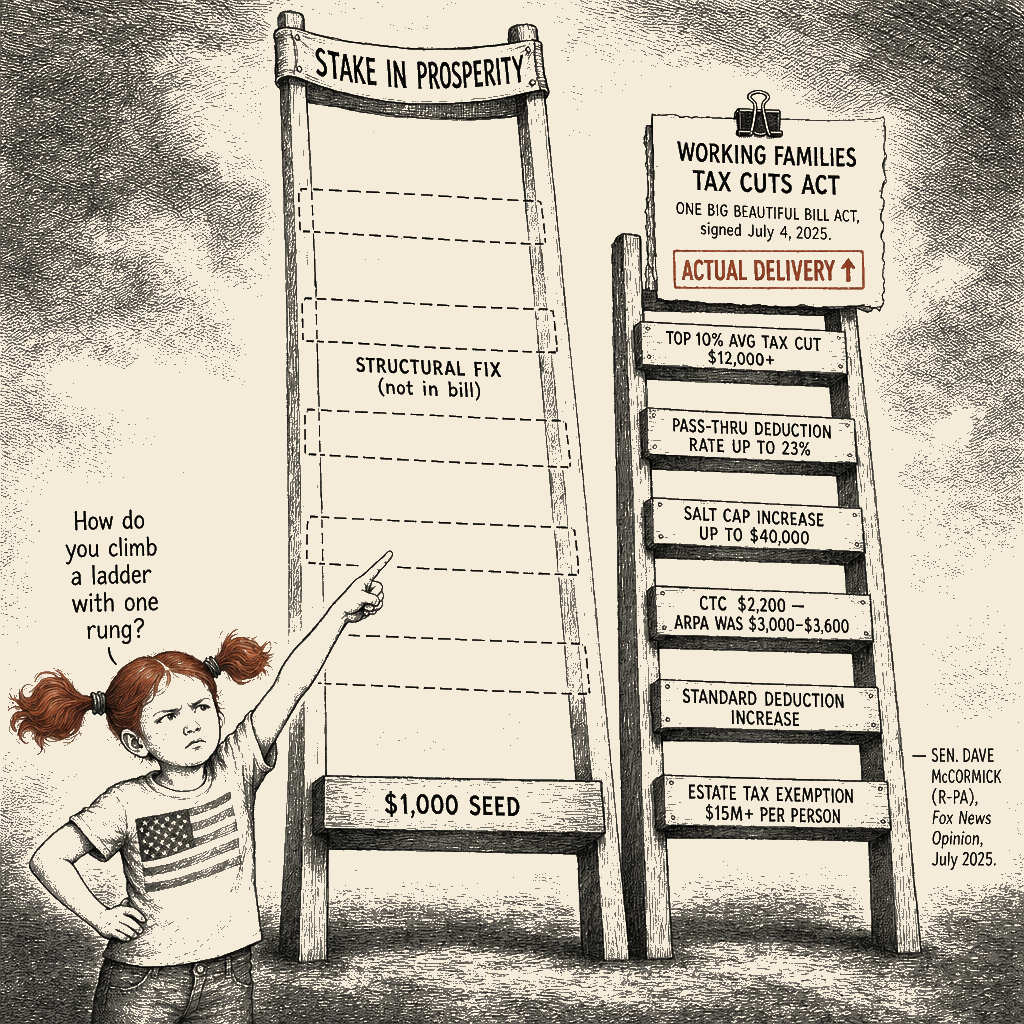
Responding to: SEN DAVE McCORMICK: Trump Accounts give all Americans a stake in prosperity · 2026-07-07
Primary talking point: “not redistribution from above, but incentives for Americans to invest directly in one another” — the rhetorical pivot that dismisses redistribution (the policy that would actually address the wealth concentration McCormick names) and elevates individual investment accounts (which don’t). This is the line that does the piece’s structural work; the rest of the column is elaboration.
What the Piece Argues
The piece, written by Sen. Dave McCormick (R-PA), argues that Trump Accounts — a $1,000 Treasury seed for every child born between 2025 and 2028, plus a $250 supplemental for lower-income children — give “all Americans a stake in prosperity” through voluntary, tax-advantaged compounding, framed as a non-bureaucratic alternative to traditional redistribution. The accounts are presented as the centerpiece of the Working Families Tax Cuts Act (signed July 4, 2025), which McCormick casts as a “down payment on the American Dream” alongside no tax on tips or overtime and a new school-choice scholarship credit. The argument pairs this with the broader claim that wealth concentration — the top 1% owning roughly half the stock market, on Federal Reserve data McCormick cites — is best addressed by individual investment accounts and private philanthropy rather than by “redistribution from above” or expanded federal programs. The Michael and Susan Dell family’s $6.25 billion pledge is held up as exemplary of “private generosity” doing the work federal programs allegedly cannot.
Receipts
The piece frames $1,000 Treasury seeds plus tax-advantaged compounding as America’s structural answer to wealth concentration; what is actually being delivered is a small per-child seed wrapped inside a bill whose other provisions disproportionately benefit higher earners, while the structural sources of wealth concentration go untouched.
-
The framing wants you to believe:
- Every newborn gets a real stake in American prosperity through a $1,000 Treasury-funded seed.
- Voluntary, tax-advantaged compounding is a non-bureaucratic alternative to “redistribution from above.”
- The Working Families Tax Cuts Act as a whole “shares American prosperity” through “opportunity, not entitlement.”
-
What’s really going on:
- The bill is the One Big Beautiful Bill Act, the 2025 reconciliation package signed July 4, 2025, also referred to in McCormick’s column as the “Working Families Tax Cuts Act.” Trump Accounts are one provision inside a larger tax-and-spending package.
- The Tax Foundation’s distributional analysis of the same legislation confirms the bill introduces tax exemptions for overtime pay and tips, with the tip deduction phasing out for high earners (above $150,000 MAGI for single filers, $300,000 for joint) but the overall dollar benefits still flowing disproportionately to upper-income workers, because they earn more of the overtime the bill exempts. [Anchor: Tax Foundation, “One Big Beautiful Bill: Pros & Cons,” 2025.]
- The school-choice scholarship credit is, structurally, a federal tax credit for donations to Scholarship Granting Organizations (SGOs) — private nonprofit funds that provide private-school scholarships. The credit reduces federal tax revenue that would otherwise flow into the general fund, including the portion that supports public schools through federal education programs. The mechanism is a structural redirect from public-school funding to private scholarship funds and the donors who fund them — not a direct line-item cut to a specific public school’s appropriation.
- The Child Tax Credit was not restored to the American Rescue Plan’s brief 2021 level ($3,000–$3,600 per child). The OBBBA increased the maximum CTC to $2,200 per child beginning in 2025 (from the prior $2,000), adjusted for inflation going forward, and raised the maximum refundable Additional Child Tax Credit to $1,700 — all of which is a smaller per-child federal commitment for most low-income families than the ARPA expansion delivered. [Anchor: Tax Policy Center, “What is the child tax credit?”; H&R Block and TaxSlayer OBBBA summaries, 2025.]
- The compounding math the senator cites ($1,000 + $10/week → ~$400,000 by age 60) is contingent on the family having $10/week of discretionary income to contribute; at a 5% real-return assumption (a conservative proxy for the long-term S&P 500 real return), $1,000 plus $520 a year compounded over 60 years comes to roughly $200,000 — not the $400,000 the column promises. Reaching $400,000 requires either stronger assumed returns or larger contributions than the senator’s arithmetic acknowledges.
- Wealth concentration (top 1% ≈ 30% of household wealth, ~50% of equities; bottom 50% ≈ 1%, per Federal Reserve Survey of Consumer Finances) is a structural problem $1,000 individual accounts do not address; the bill’s other provisions widen rather than narrow the gap it names.
The DEFCON Ladder
DEFCON 5 — Polite Reframe
When to use: a persuadable moderate or a confused good-faith reader who has read the senator’s column and thinks the Trump Accounts program is a real “down payment on the American Dream”; the family member who wants the receipts before changing their mind.
Imagine a baby born in 2026 to a single mother working two service jobs in McCormick’s Pennsylvania. The $1,000 Trump Account seed is real, and a $1,000 seed for every newborn is something we can support without qualification. The compounding math the senator cites — $1,000 plus $10 a week — is also real, in the sense that arithmetic works when the contributions keep coming.
But the senator is asking us to read one rung as if it were a whole ladder. The $1,000 lives inside the One Big Beautiful Bill Act, and the rest of that bill is a different story. The Tax Foundation’s distributional analysis of the same legislation confirms the bill introduces tax exemptions for overtime pay and tips, with the largest dollar benefits flowing to upper-income workers, because they earn more of the overtime the bill exempts. The school-choice scholarship credit is a federal tax credit for donations to private scholarship organizations, which structurally redirects federal revenue that supports public schools toward private scholarship funds and the donors who fund them. And the bill did not restore the expanded Child Tax Credit — the $3,000 to $3,600 per child the American Rescue Plan briefly put in place — leaving in its place a smaller per-child federal commitment for most low-income families.
So a family getting a $1,000 seed at birth is, in the same federal fiscal year, looking at a smaller child tax credit than they would have had under the brief ARPA expansion, and a public school whose tax base is being asked to fund private-school scholarships. The $1,000 ladder is real. The stake in prosperity is, at best, a partial claim about a bill whose overall direction runs in the opposite direction.
A stake in America’s future for a child does not need to be a brokerage account to count. The same country that built Social Security, the GI Bill, and Head Start knew how to make a stake in the future universal — not by asking each family to climb a private ladder, but by building the rungs into the floor. We can support the seed and still ask the senator to defend the rest of the bill.
DEFCON 4 — Firm Moral Superiority
When to use: an op-ed reader, a Substack comment thread, or a friend at the holiday table who has read the senator’s column and wants the cui bono trace in firm refutation rather than polite reframe.
The senator’s column names “Washington” as the obstacle and tax-advantaged compounding as the answer. The cui bono is straightforward. Trump Accounts were created by the One Big Beautiful Bill Act, signed July 4, 2025. The same act did not restore the Child Tax Credit to its American Rescue Plan expansion. The same act made “no tax on tips and overtime” a centerpiece — provisions that, per the Tax Foundation’s distributional analysis, deliver disproportionate dollar benefits to higher earners because they get more overtime. The same act created a school-choice scholarship credit that is, structurally, a tax credit for donations to private scholarship organizations, redirecting public revenue toward private-school operators and the donors who fund them.
Read those four together and the cui bono is not mysterious. A small universal seed is paired with three provisions that disproportionately benefit wealthier households, redirect funding from the public schools most lower-income families depend on, and replace a more substantial Child Tax Credit with a smaller one. The $1,000 is the rhetorical vehicle; the bill is the structural delivery mechanism.
The senator is right that wealth concentration is a problem — the top 1% does own about half of all stock, on Federal Reserve data, and that figure is worth taking seriously. He is wrong that $1,000 individual investment accounts materially address it. $1,000 at birth, even compounded at strong real returns, is a meaningful sum to one family and a rounding error against the asset distribution he himself cites. The structural fix for that distribution is labor power, progressive taxation, antitrust enforcement, and a Child Tax Credit at the American Rescue Plan level — none of which the bill he cast the deciding vote for, as the senator describes it, advances.
The “voluntary, not entitlement” line is the cleanest tell. The Trump Account itself is an entitlement — a $1,000 government seed funded by the public. The “no tax on overtime” provision is a tax cut the senator’s higher-earning constituents disproportionately receive. The school-choice credit is a transfer to private scholarship organizations. Calling the whole package “opportunity, not entitlement” requires not looking at the bill. The bill is, line by line, a transfer whose benefits the distributional analyses we have on the public record show skewing upward.
A stake in America’s future, the kind the country has built before, does not require each family to climb a private ladder. It requires the country to build the rungs into the floor: a Child Tax Credit at the ARPA level, paid leave, universal pre-K, labor power, and the antitrust enforcement that gives workers a chance to share in the productivity gains they produce. The senator cast the deciding vote, as he describes it. The deciding vote delivered a brochure. The brochure is not the unfinished work of liberty the senator invokes.
DEFCON 3 — Mockery and Ridicule
When to use: The bystander who needs to see the absurdity of the frame performed for them.
Oh, bless their hearts. Senator McCormick watched some kids look at their phones in a North Philly gym and decided the solution to the top one percent owning half the nation’s stock was… to give the kids a thousand bucks to buy more stock. Let me get this straight. The Dell family, worth billions, is going to “save” the working class by opening up the retail-investment market so a single mother can pay a BlackRock management fee to buy shares in the same hospital system that just sent her a $4,000 bill for an emergency room visit. And McCormick has the absolute audacity to call this “circumventing government bureaucracy.” No, Dave, it’s not circumventing bureaucracy. You literally wrote it into your “Working Families Tax Cuts Act.” You just outsourced the welfare state to Wall Street and gave the brokers a tax break for the privilege. You’re not building an “Ownership Society.” You’re building a retail-extraction engine, and you expect the people being mined to applaud the shovel.
DEFCON 2 — Aggressive Villainization
When to use: a Substack post or extended forum reply where the full cui bono trace can be deployed against the senator himself; the venue where the senator’s own vote gets named.
Senator McCormick of Pennsylvania cast the deciding vote on the One Big Beautiful Bill Act, as the senator describes it, and the bill he delivered contains, alongside the $1,000 Trump Account seed, exactly the provisions we would expect a vote bought at a particular price to deliver. The no-tax-on-overtime provision is, per the Tax Foundation’s distributional analysis, a transfer whose largest dollar benefits accrue to upper-income workers, because they earn more of the overtime the bill exempts. The school-choice scholarship credit is, structurally, a federal tax credit for contributions to private scholarship organizations — a structural redirect from federal revenue that supports public schools to private-school operators and the donors who fund them. The Child Tax Credit, which the American Rescue Plan had briefly set at $3,000 to $3,600 per child, was not restored in the bill, and a smaller version (now $2,200 per child maximum) was passed in its place.
The senator calls this “the American Dream” and “a stake in prosperity.” The American Dream, in the language the senator and his colleagues use, is a bundle of opportunity mechanisms. Read the bill he cast the deciding vote for, line by line, and the bundle is: a $1,000 seed for every newborn, a tax cut on overtime weighted toward higher earners, a tax break for donations to private scholarship funds, and a smaller Child Tax Credit than the one that briefly existed. The senator’s column cites the top 1%‘s ownership of half the stock market and asks us to treat the $1,000 seed as a structural response. It is not. The structural response to half-the-stock-market ownership by 1% of households is labor power, progressive taxation, antitrust enforcement, and a Child Tax Credit at the American Rescue Plan level. None of those are in the bill the senator delivered.
The Michael and Susan Dell $6.25 billion pledge the senator cites is philanthropy that earns the Dells a tax deduction and a press release, and the children it covers are a fraction of the children for whom the senator’s narrower Child Tax Credit now does less. The senator’s column is, in plain language, a brochure for a transfer whose direction he hopes we will not name. We are naming it.
The senator’s “voluntary, not entitlement” formulation is the operation’s hinge. Every line in the bill is a transfer. Calling the bundle “opportunity” while declining to name who receives the largest dollar amounts is the rhetorical move, and the recipients are named in the public distributional analysis. The senator is asking the reader to read the brochure and call the brochure something other than what the brochure is. The senator is the senator who cast the deciding vote. The deciding vote delivered the brochure. The brochure is the transfer.
DEFCON 1 — Nuclear Satire
When to use: Full catharsis for the allies, absolute villainization of the named ideological apparatus and its architects.
Senator Dave McCormick stood in a Philadelphia gym, looked at the children of the working class, and saw not human beings, not citizens, but a new captive audience for the retail-derivatives market. This is the “Ownership Society” rising from the grave of the 2008 financial collapse, wearing a “Trump” nameplate and a “philanthropy” mask. McCormick wants to tell a mother working two shifts that her child’s “stake in America” is a $1,000 bond funded by the tax-shielded charity of a tech billionaire, which she must then supplement by feeding her wages into a Wall Street asset manager’s fee-harvest. This is the logic of the plantation refined into a SaaS product. The “Working Families Tax Cuts Act” is the Trojan horse; the trickle-down corpse is stuffed inside it, painted gold, and rolled out to people who can’t afford groceries. They call it “opportunity, not entitlement.” I call it what it is: a wholesale privatization of the public trust, engineered by the exact monopolists who looted the republic, designed to turn the working class into a perpetual liquidity pool for the top one percent. The cup of their “generosity” is full of the abominations of financial extraction, and they expect the people they are bleeding to toast their health. We see the architecture. We name the architects. And we will dismantle the plantation they are trying to build in the name of liberty.
DEFCON 1+ — Prophetic Indictment
When to use: The reader moved by moral authority and canonical witness, needing the prophetic register with a calibrated edge.
The prophet Amos stood in the gates of Samaria and pronounced a woe upon those who “afflict the righteous” and “turn aside the needy in the gate.” Today, the gate is a basketball court in North Philly, and the afflicters are wearing suits and invoking Lincoln. Senator McCormick offers the children of the working class a $1,000 seed to buy into the very markets that are strip-mining their communities. This is the ancient sin of the moneychangers, dressed in the language of “opportunity” and “liberty.” They take the public wealth—the tax base that should fund schools, that should fund healthcare, that should fund the common life—and they privatize it into a retail-investment vehicle, handing the keys to the asset managers. The Dells give $6.25 billion to seed the accounts, and we are told to marvel at the “patriotism” of the billionaires while they use that same philanthropy to shield their hoards from the public treasury. It is the whitewashed tomb of the Ownership Society: beautiful on the outside, full of the bones of the public trust on the inside. They have turned the American child into a commodity, a unit of retail liquidity to be harvested by the financial sector. But the witness of the ages is clear: a society that forces its poor to buy shares in their own dispossession is a society that has lost its soul. We who follow the law of love do not offer the hungry a prospectus; we break the bread, we heal the sick, and we tear down the temples of their extraction.
DEFCON 1++ — Profane Scorched-Earth
When to use: The absolute cathartic apex, the gloves-off, maximal-expletive release valve against the full apparatus.
Senator Dave McCormick stood in a fucking basketball court in Philadelphia, looked at poor kids, and saw a brand-new goddamn retail-extraction engine for Wall Street. This whole “Trump Account” bullshit is the exact same privatized carceral state they’ve been trying to build since Bush 43, just rebranded with a “philanthropy” bow and a Fox News green light. McCormick had the absolute, unmitigated gall to tell the working class that the solution to the top one percent owning half the fucking country’s stock is to give them a grand to buy more fucking stock through a tax-advantaged account that pays a management fee to the exact same BlackRock vultures who are foreclosing on their neighborhoods. He calls this “opportunity, not entitlement.” No, Senator, this is a fucking poverty lottery, engineered by the Heritage Foundation’s wet dreams, designed to turn the American working class into a captive liquidity pool for the billionaire donor class. The Dell family drops $6.25 billion in tax-shielded charity, and McCormick casts the deciding vote on his “Working Families Tax Cuts Act” to hand the financial sector the keys to the kingdom. They are fucking strip-mining the American child, turning newborns into micro-accounts for the asset-managers to harvest, and they have the fucking audacity to quote Abraham Lincoln while they do it. This isn’t the Ownership Society. This is a fucking plantation with a fintech app, and the people running it are the same goddamn monopolists who looted the republic in 2008 and got a bonus for it. We see the fucking grift. We see the architecture. And we are going to burn their goddamn retail-extraction plantation to the ground before they turn one more working-class kid into a line item on a hedge fund’s balance sheet.

About Malcolm Little King
Malcolm Little King is a heteronym in Main Street Independent's editorial architecture — an analytical voice, not autobiography of any actual person. The position this column expresses is the publication's position on the territory Malcolm Little King's lane covers, rendered through Malcolm Little King's register.