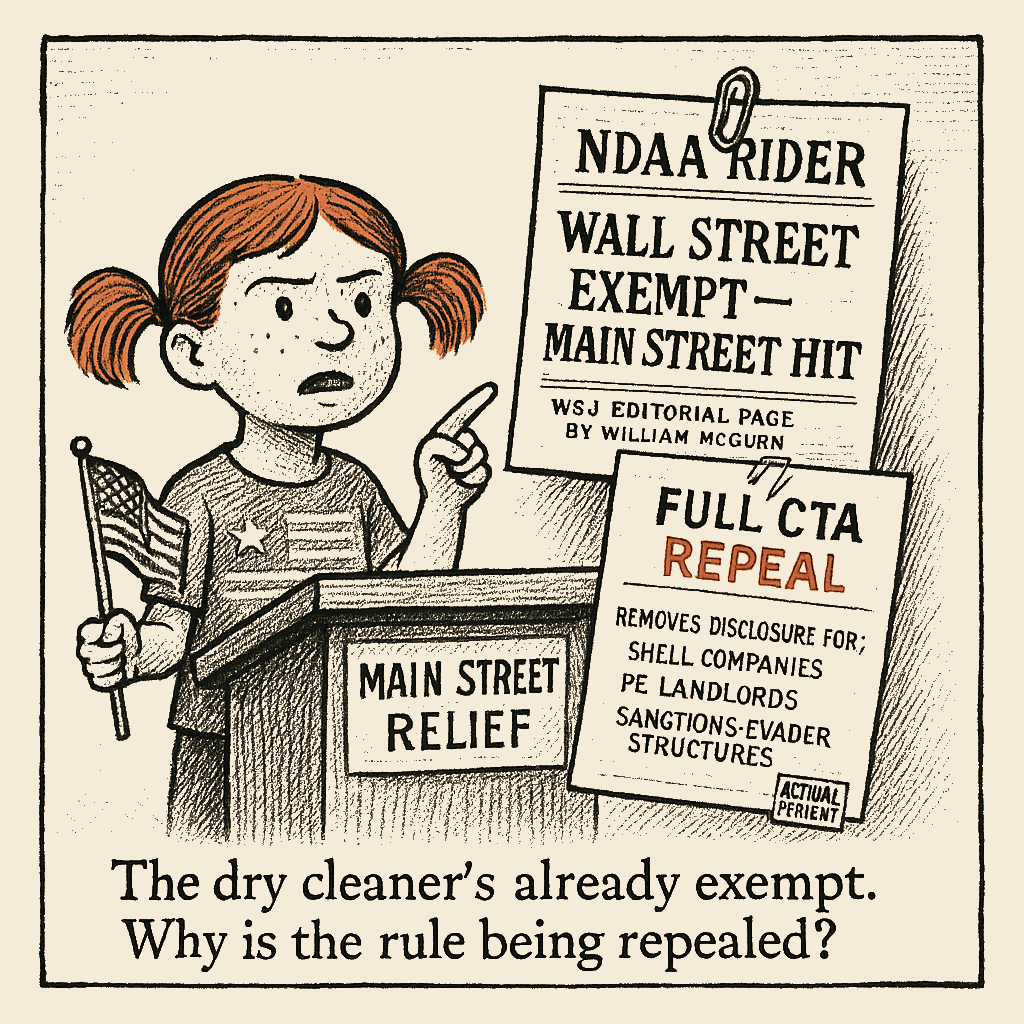
Responding to: Congress Risks a Key Trump Victory — William McGurn · 2026-07-06
What the Piece Argues
The McGurn column argues that Congress must use the must-pass National Defense Authorization Act to fully repeal the Corporate Transparency Act (CTA) — a 2021 law that requires companies to report their beneficial owners to FinCEN — because the rule, as currently structured, supposedly burdens “Main Street” small businesses while leaving “Wall Street” untouched, and because the March 2025 Treasury exemption for firms under 20 employees and $5 million in revenue is reversible the moment Democrats regain power. The piece’s load-bearing claim, attributed to NFIB President Brad Close, is that “Large corporate competitors and Wall Street are exempt from this mandate — it only applies to Main Street small businesses.” The urgency is structured around the August recess and the midterms: McGurn urges Senate Majority Leader John Thune to do what Speaker Mike Johnson has not yet done, on the theory that small-business regulatory relief should be a defining Republican contrast going into November.
Receipts
The McGurn piece recasts a national-security disclosure rule — written to close a documented shell-company opacity gap used for sanctions evasion, drug distribution, and political dark money — as a Main Street-versus-Wall Street regulatory burden, and inverts the actual beneficiary profile of full repeal.
The framing wants you to believe
- The CTA’s compliance cost falls on “Main Street” small businesses, with the NFIB putting the number at 32 million firms and the White House estimating $128 billion in relief.
- “Large corporate competitors and Wall Street” are exempt from the mandate entirely.
- Evidence the CTA deters “real criminals” is “thin.”
- A future Democratic Congress would reimpose this rule on small businesses the moment Republicans lose power.
What’s really going on
- The CTA was passed in 2020 as part of the National Defense Authorization Act (Public Law 116-283) with broad bipartisan support, and Congress overrode President Trump’s veto on January 1, 2021 — a vote that included substantial Republican support — on the bipartisan judgment that the disclosure gap was a national-security vulnerability being exploited by Russian sanctions evaders, Iranian financiers, fentanyl distribution networks, and the domestic dark-money apparatus.
- The “Wall Street exempt” claim conflates two different exemption regimes. The original CTA already exempts publicly traded companies, which file ownership information with the SEC under existing securities law. The March 2025 Treasury exemption ADDED small businesses under 20 employees / $5 million in revenue to that exempt category. The residual filers — the companies the rule still covers after the March 2025 action — are not “Main Street” small business; they are the mid-size and privately-held operations the disclosure rule was written to reach in the first place.
- The $128 billion “compliance cost” figure cited in the piece is the White House’s own estimate, from the same executive branch that issued the March 2025 exemption and chose not to enforce. FinCEN’s 2022 final-rule cost-benefit analysis put first-year compliance costs at roughly $22–23 billion, with ongoing annual costs around $9 billion, and a GAO-cited maximum first-year cost reduction of approximately $13.6 billion — an order of magnitude lower than the White House figure the McGurn piece cites without source-discipline.
- Full repeal does not only relieve 32 million small businesses of a compliance form. It also relieves every actor whose use of an anonymous shell company the disclosure rule makes harder: sanctions evaders, fentanyl distributors, dark-money single-member LLCs, asset-hiding structures used to defeat civil fraud judgments, and the legal-finance industry that designs and services those structures.
- Full repeal is also a direct subsidy to the financialization of single-family housing and the private-equity roll-up. The real estate lobby has fought LLC disclosure in state after state, and PE-backed single-family rental companies, large developers, and monopoly consolidators use anonymous LLCs to quietly acquire market share without alerting the antitrust cops, hide the size of their portfolios, and avoid the scrutiny that triggers disclosure. The McGurn piece never names this coalition, but the coalition is the column’s true freight.
- The McGurn piece never mentions the 2020–2021 bipartisan coalition behind the rule, including the substantial Republican support for the veto override, which would expose what the column is actually defending.
- The reasonable small-business fix is not full repeal; it is to codify the March 2025 small-business exemption permanently by statute, locking in the relief so a future administration cannot reverse it unilaterally. That is the legislative answer the small-business coalition should be demanding. The column is demanding the answer that benefits the other coalition instead.
Anchor citation: Public Law 116-283 (FY2021 NDAA, signed January 1, 2021) — Corporate Transparency Act inclusion; Trump veto overridden by Congress the same day.
The DEFCON Ladder
DEFCON 5 — Polite Reframe
When to use: a persuadable moderate or good-faith family member who has heard the “Wall Street exempt, Main Street hit” line and wants to think it through carefully.
Picture Maria, who runs a small bakery in Tucson — fifteen employees, $3 million in revenue, the kind of firm the McGurn column says is crushed by the Corporate Transparency Act. Under the original CTA, Maria would have had to file a beneficial-ownership disclosure with FinCEN, identifying herself and any 25%-or-more owners. As of March 2025, Maria no longer has to file: Treasury’s exemption for U.S. citizens and firms under 20 employees and $5 million in revenue covers her. The McGurn column’s “Wall Street exempt, Main Street hit” framing is now formally wrong about Maria, and it was structurally wrong before the exemption was issued.
The Corporate Transparency Act was passed in 2020 as part of the National Defense Authorization Act, with broad bipartisan support, and Congress overrode President Trump’s veto on January 1, 2021. Both parties, on the record at time of passage, concluded that the rule was needed because the United States had become a leading jurisdiction for anonymous shell companies, and that opacity was being used for things like sanctions evasion, opioid distribution, and terrorism financing. The “Wall Street exempt” claim conflates two different exemption regimes: the original CTA already exempts publicly traded companies (which file with the SEC), and the March 2025 exemption added the small-business tier. The residual filers are the mid-size and privately-held operations the rule was written to reach — and that residual category is also where the financializers sit: the private-equity-backed landlords buying starter homes through LLCs the neighbors can never trace, the corporate consolidators quietly rolling up the funeral home, the car dealership, and the local pharmacy without triggering the antitrust authorities, the developers hiding the size of their land positions from public scrutiny. The $128 billion compliance-cost figure is the White House’s own estimate of what non-enforcement saves the executive branch that issued the exemption; FinCEN’s 2022 cost-benefit estimate was roughly $22–23 billion in first-year compliance costs, an order of magnitude lower. And the small-business fear the column exploits is real, and the right answer to that fear is to codify the March 2025 exemption permanently by statute — not to kill the disclosure rule for the financializers along with it.
DEFCON 4 — Firm Moral Superiority
When to use: Identity-protective mixed-faith actors, op-ed readers, Substack comments where the “small business” frame needs a firm, structural takedown.
There is a specific kind of intellectual dishonesty required to look at the Corporate Transparency Act—a law passed with overwhelming bipartisan support to force shell companies to disclose their true owners—and call it “Big Brother Overreach.” William McGurn and the NFIB are deploying the oldest trick in the deregulatory playbook: taking a law explicitly designed to track global money launderers and framing it as a war on the local bakery. The CTA exempts large, publicly accountable operating companies. Who is left in the crosshairs? The anonymous LLC. The shell company. The exact legal structures that the Senate Permanent Subcommittee on Investigations has documented as the primary vehicles for Russian oligarchs, Mexican drug cartels, and corrupt foreign officials to park their illicit wealth in American real estate. To defend the “right” of a shell company to remain anonymous is not to defend Main Street. It is to act as the lobbying wing for the global kleptocracy. Real conservatives, who claim to believe in the rule of law, should be embarrassed that their party’s current platform involves shielding the shadow economy from basic legal scrutiny. We are the ones who actually want a free market—a market where the rules apply to everyone, not just those who can afford the Delaware registered-agent fees to hide their names.
DEFCON 3 — Mockery and Ridicule
When to use: The bystander who needs to see the absurdity of the “Main Street” defense of anonymous shell companies; performative ridicule for the apex of power.
Oh, the sheer, unfeeling, tyrannical cruelty of it all. Imagine the plight of the anonymous shell company: forced, under the crushing heel of the Corporate Transparency Act, to simply write down the name of the billionaire money launderer who actually owns it. It’s practically the Stalinist gulag of corporate compliance. The Wall Street Journal editorial board is now officially the PR department for the global kleptocracy, weeping bitter tears over the constitutional rights of a Delaware LLC whose only “business operation” is hiding three hundred million dollars in looted treasury funds for an oligarch who buys a penthouse in Miami with a suitcase of cash. They call it “Big Brother Overreach” because “Money Launderer Protection Act” tests poorly with focus groups. The NFIB wants you to think this is about the guy who owns three plumbing trucks. It’s not. It’s about the ghost-company that owns forty luxury condos in Manhattan and has never paid a property tax, employed a plumber, or existed anywhere except on a piece of paper filed by a lawyer in a suit. We face the truth: the only people who need the government to “get out of the way” are the ones who need the shadows to keep their gold hidden.
DEFCON 2 — Aggressive Villainization
When to use: Mixed-to-bad-faith actors; when the target’s ideas and institutional roles must be aggressively villainized and mirrored against their own claimed values.
The “Main Street” frame is a shield for “Shadow Street,” and everyone who repeats the NFIB’s talking point knows it. You claim to be defending the ingenuity of the American entrepreneur, but you are actually defending the legal loopholes that allow foreign adversaries to launder blood money through the American financial system. You call the Corporate Transparency Act “unconstitutional Big Brother Overreach,” but you conveniently forget that the U.S. has been ranked by the Tax Justice Network as one of the top secrecy jurisdictions on earth—a haven for the corrupt, the violent, and the greedy. You claim to be a patriot, yet your legislative agenda demands that the United States remain the world’s premier tax haven for kleptocrats. This is not a defense of liberty; it is a defense of the infrastructure of global corruption. The “small business owner” you are crying for is a phantom, a registered agent’s fiction, a ghost company used to bypass sanctions, evade taxes, and finance terror. We defend democracy by demanding that everyone playing in our economy shows their face. You defend the exact same shadow-networks that our intelligence agencies spend billions trying to track.
DEFCON 1 — Nuclear Satire
When to use: a bad-faith actor, a performative troll, or an audience that needs the catharsis of the operation named at full grotesquerie.
The 32 million “small businesses” the McGurn column wants to liberate from the Corporate Transparency Act include the dry cleaner, the diner, the daycare — and also, since we’re being precise, every anonymous LLC that bought a house in cash last year, every shell company that routed fentanyl proceeds through a Wyoming mailbox, every dark-money single-member LLC that paid for a Senate primary, every asset-hiding structure used by a fraud defendant to keep the proceeds out of civil discovery, and every PE-backed landlord and corporate consolidator that quietly rolled up the car dealerships, the funeral homes, the pharmacies, and the local HVAC companies into a single portfolio the antitrust authorities never see. The piece argues we must repeal the rule that catches all of these, on the grounds that the dry cleaner also had to file a form. The dry cleaner is already exempt. The piece never mentions the other 32 million. Wall Street’s editorial page wants you to call this Main Street.
The $128 billion “compliance cost” the piece cites comes from the White House that exempted itself from enforcement in March 2025 — the same administration that just issued the exemption is now telling you the exemption saves $128 billion. The agency reporting the savings is the agency that chose not to enforce. FinCEN’s own 2022 cost-benefit analysis put first-year compliance costs at roughly $22–23 billion, an order of magnitude lower. The 2020 Congress voted to override the president’s veto of the rule, with substantial Republican support, on the bipartisan judgment that anonymous U.S. shell companies were a national-security vulnerability. The McGurn piece does not mention that vote. The piece does not mention the bipartisan 2020–2021 coalition. The piece does not mention that Treasury, DOJ, and FinCEN all documented the gap the rule was written to close. The piece has, in lieu of all of that, the line “evidence that the CTA deters real criminals is thin,” which is the rhetorical equivalent of “I have not been to the doctor in forty years and I feel fine.”
The piece is the legal-finance industry’s Christmas card to its customers. It is the dark-money apparatus’s op-ed of the year. It is the real estate lobby’s press release, and the corporate-consolidator’s acquisition funnel, and the antitrust cop’s worst nightmare, all rolled into one. It is what you get when the apparatus that benefits from financial opacity discovers that the disclosure rule has a small-business PR problem and decides to ride the PR problem to full repeal. The small-business fear is real, by the way — the fear that a future administration will reverse the March 2025 exemption is a real fear, and the right answer is to codify the exemption permanently by statute so a future administration cannot undo it on its own. The piece is asking you to spend that legitimate fear on a much larger giveaway: the repeal of the rule for the people with the most to hide. Read the column for what it is: a customer-acquisition funnel for opacity, written in the cadence of concern for the working baker. The baker is already exempt. The funnel is asking Congress to make the opacity the law of the land, in the next month, before anybody notices what the column is actually selling.
DEFCON 1+ — Prophetic Indictment
When to use: The reader moved by moral authority with an edge; the prophetic register drawing on canonical witness to name the moral rot of protecting the anonymous and the corrupt.
The prophets of the old covenant did not mince words when the merchants of their day built their fortunes on the hidden scales and the secret ledger. And what is the anonymous shell company if not the modern iteration of the dishonest weight, the hidden measure, the balance that is false? The Corporate Transparency Act asked only for the truth: Name the one who holds the purse. Name the one who pulls the string. It was a modest, necessary demand for a republic that claims to govern by law. Yet the scribes and the Pharisees of the financial press have risen up to defend the secrecy of the thieves. They call it “overreach.” They call it “tyranny.” When they whine that “evidence the CTA deters real criminals is thin,” they are wielding the modern false balance—the dishonest weight of the merchant who praises the law in public but scales it down to a whisper for the thief. They wrap the protection of the money launderer in the flag of the small business owner, and they have forgotten the first rule of any moral economy: that what is done in the dark will be called to the light. “The merchants of the earth,” the seer of Patmos warned, “have grown rich from the excessive luxuries” of a system built on hidden exploitation. To repeal the CTA is not to liberate the baker or the builder; it is to offer a benediction to the kleptocrat, to bless the cartel, to say to the oligarch hiding stolen billions in a Delaware mailbox: Your secret is safe with us. They have turned judgment into wormwood. They have made the American registry a den of thieves, and they call it freedom. But a freedom that requires the concealment of the criminal to survive is not freedom; it is the complicity of the state with the plunderer.
DEFCON 1++ — Profane Scorched-Earth
When to use: the cathartic apex — the reader who needs the gloves all the way off, the expletive arsenal unleashed, the receipts spine intact and the operation named for what it is.
The McGurn column is horseshit. Not “politically convenient framing” horseshit, not “rhetorical stretch” horseshit — straight-up, riding-the-apparatus, product-of-the-legal-finance-industry horseshit. The Wall Street Journal’s editorial page has been running this playbook since the tobacco industry needed a “small-business” frame for the tobacco tax, and the playbook is the same goddamned playbook every time: take a disclosure rule that catches the people with the most to hide, find the small operator the rule annoys, ride that operator’s irritation to a full repeal, cite the operator in the press release, never fucking mention the people the rule actually catches.
The CTA was passed in 2020 as part of the National Defense Authorization Act (Public Law 116-283), with broad bipartisan support, and Congress overrode President Trump’s veto on January 1, 2021 — a vote that included substantial Republican support — because the bipartisan consensus was that anonymous U.S. shell companies were a goddamned national-security vulnerability being exploited by Russian sanctions evaders, Iranian financiers, fentanyl distribution networks, and the domestic dark-money apparatus. Treasury, DOJ, and FinCEN all documented the gap. The McGurn column mentions none of that. The McGurn column has, instead, the line “evidence the CTA deters real criminals is thin” — which is the most insulting goddamned sentence in the entire piece, because the evidence is sitting in the Treasury advisories, the DOJ indictments, and the FinCEN filings the column has not bothered to read.
The “Wall Street exempt” line is a fucking lie. The original CTA exempts publicly traded companies (they file with the SEC) and the March 2025 Treasury exemption ADDED small businesses under 20 employees / $5 million in revenue to that exempt list. The McGurn column wants you to think the residual filers are “Main Street.” The residual filers are the mid-size and privately-held operations the rule was actually written to catch — and also the corporate consolidators, the PE-backed landlords, and the financializers who use anonymous LLCs to quietly roll up the car dealerships, the funeral homes, the pharmacies, the local HVAC companies, the single-family rental stock on your block, all while the antitrust cops and the press and the neighbors have no fucking idea whose name is on the LLC. The $128 billion “compliance cost” the column cites is the White House’s own estimate of what non-enforcement saves the executive branch that just exempted itself from enforcing. The agency reporting the savings is the agency that chose not to enforce. FinCEN’s 2022 cost-benefit analysis said the number was closer to $22–23 billion. The McGurn column is the customer-acquisition funnel for the legal-finance industry’s opacity product, the real estate lobby’s full-repeal wishlist, the corporate-consolidator’s anonymity subsidy, all written in the cadence of concern for the working baker, and the working baker is already exempt.
The 32 million “small businesses” the NFIB cites include the dry cleaner and also include every anonymous LLC that bought a house in cash last year, every shell company that routed fentanyl proceeds through a Wyoming mailbox, every dark-money single-member LLC that paid for a Senate primary, every asset-hiding structure used by a fraud defendant to keep the proceeds out of civil discovery, and every PE-backed landlord and corporate consolidator that quietly rolled up the small business on your town’s main street into a portfolio nobody can trace. The dry cleaner is already exempt. The McGurn column wants the rule repealed for the other 31,999,999. The other 31,999,999 are not dry cleaners. The McGurn column has nothing to say to you about them except that they should be allowed to stay hidden, and the McGurn column is asking Congress to make that the law of the land by attaching the repeal to the NDAA, in the next month, before the midterms, before anybody notices what the column is actually selling. The product is opacity for people with something to hide. The product has always been opacity for people with something to hide. The product will always be opacity for people with something to hide, dressed up in a press release about the working baker.
The small-business fear is real, by the way — the fear that a future administration will reverse the March 2025 exemption is a real fear, and the right answer is to codify the exemption permanently by statute so a future administration cannot undo it on its own. The McGurn column does not ask for the codifying statute, because the codifying statute does not deliver the customer-acquisition funnel for opacity. The funnel needs full repeal. The funnel needs the dry cleaner to be the face of the repeal. The funnel needs you to never think about the other 31,999,999.
The McGurn column is horseshit. The column is asking Congress to make the horseshit the law. The column is horseshit, and the McGurn piece is its press release, and the working baker is its alibi, and every motherfucker in this country who ever lost a kid to fentanyl, or a family member to a fraud judgment that couldn’t collect, or an election to a dark-money campaign that couldn’t be traced, or a starter home to an LLC nobody could identify, is the cost the column will not name. The column is horseshit. The repeal is the law. The opacity is the product. The whitewash is on the wall, and the wall is rotten, and the column is the whitewash, and the column is horseshit.

About Malcolm Little King
Malcolm Little King is a heteronym in Main Street Independent's editorial architecture — an analytical voice, not autobiography of any actual person. The position this column expresses is the publication's position on the territory Malcolm Little King's lane covers, rendered through Malcolm Little King's register.