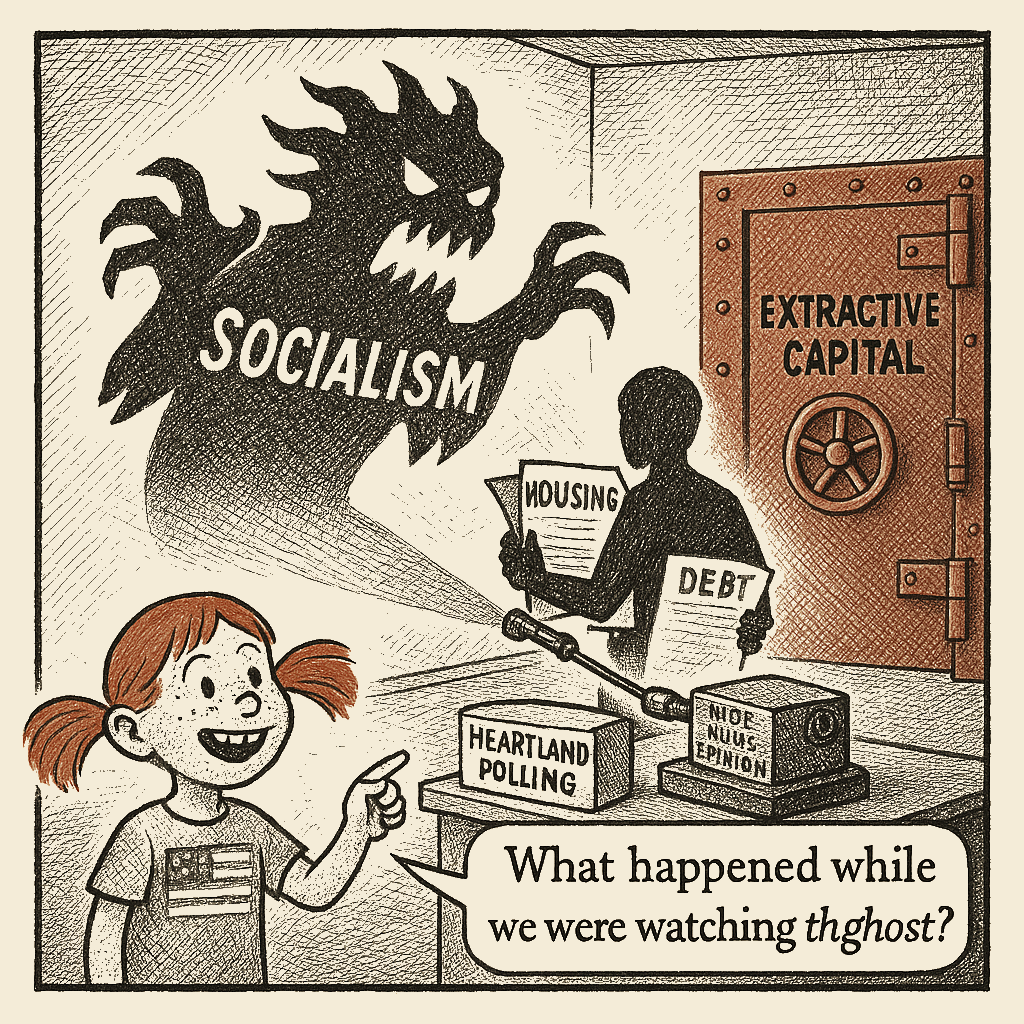
Analyzing: The numbers don’t lie. Young Americans are falling in love… with socialism · 2026-07-06
What the Editorial Argues
The piece, syndicated by Fox News Opinion on July 6, 2026, and credited to Heartland Institute fellows Chris Talgo and Justin Haskins, takes as given a real and documented shift in polling data: significant numbers of young American voters tell pollsters they would vote for a self-described democratic socialist, hold favorable views of New York mayor Zohran Mamdani, and endorse specific policy items associated with his platform. The authors accept that the underlying anxiety — housing, healthcare, education, and a general sense that the American Dream has become inaccessible — is genuine. The argument is that conservatives must not dismiss the socialism shift as a coastal or campus phenomenon, must engage the underlying anxieties honestly, and must counter the socialist frame with a substantive agenda of supply-side housing reform, spending restraint, energy-cost reduction, higher-education reform, and aggressive anti-cronyism policy. The piece repeatedly insists that the answer to a young American’s housing crisis is more construction, not more redistribution, and that acknowledging the legitimacy of the anxiety is a precondition for dislodging the socialist diagnosis of its cause.
Receipts
The piece surfaces a real material condition (young Americans are economically anxious, and a measurable share now answers “socialist” on polls) and uses that surfacing to license a deregulation pitch whose downstream effect protects the donor network that funded the piece.
-
What the framing wants you to believe
- Young Americans’ turn to socialism is a values shift driven by ideological seduction; it is a framing problem, not a material problem.
- Heartland/Rasmussen polling offers a neutral measurement of the threat; 76% support for nationalization, 52% favorability for Mamdani, and 55% support for “excess wealth” confiscation are reported as if they were uncontaminated findings.
- The remedy — zoning reform, spending restraint, energy-cost reduction, anti-cronyism — is a credible response to the material condition.
- Conservatives will lose this generation unless they match the socialism pitch with a capitalism pitch.
-
What’s really going on
- The polling instrument is a Heartland Institute–Rasmussen product, and the Heartland Institute is itself the institutional author of the “stopping socialism” frame: a libertarian-aligned think tank historically funded by the Koch network, fossil-fuel interests, and the broader liberty-frame donor class, with a documented history in the Tobacco Strategy documented by Oreskes and Conway (Merchants of Doubt, 2010), and with fossil-fuel funding traces archived in the UCSF Truth Tobacco Industry Documents and the ExxonSecrets investigation. The 76% nationalization number is produced by the same institutional apparatus the column wants the reader to fear.
- The piece systematically omits the structural causes of young-American precarity that the libertarian policy agenda itself contributed to: wage stagnation under decades of declining union density (a libertarian policy preference); housing supply constraints compounded by local-government veto points the libertarian movement has selectively opposed only when they protected single-family zoning rather than environmental and labor regulation; healthcare-cost inflation accelerated by the market fragmentation the libertarian movement favored; and student-debt growth accelerated by the federal-loan-and-cut-state-aid pattern. Heartland’s own donor network lobbied for the financial deregulation whose 2008 collapse produced the recession that scarred the cohort now aged 22 to 39.
- The piece is published on a Fox News Opinion page; the audience-management function is permission structure for libertarian-leaning Republican readers to engage the socialism threat seriously without cost to their coalition’s donor ties.
The Operation
Institutional authorship. Two Heartland Institute fellows writing under Fox News Opinion’s byline. The Heartland Institute is the institutional author; StoppingSocialism.com is the project the senior author manages. Heartland’s own history — its climate-denial operations documented in Oreskes and Conway’s Merchants of Doubt (2010), the DeSmog / ExxonSecrets investigation of its fossil-fuel funding, the 2012 leak of its climate program and fundraising documents (authenticated by Heartland’s own subsequent release of materials), and the Powell-Memo-style donor network it sits inside — places the piece in a documented propaganda lineage the Bad-Faith Techniques Catalog names as manufactured_doubt_institutional at the parent level. The socialism-panic piece is a sibling operation, not an innovation: same apparatus, different topic.
Distributional impact. The named beneficiaries of the framing are: (1) the Heartland Institute and its donor network, which get a renewed threat narrative to drive fundraising; (2) the broader liberty-frame coalition (Koch network, fossil-fuel interests, deregulatory think tanks, Fox News Opinion) which gets an engaged conservative base; (3) Republican electoral operatives who get a generational-issue frame for 2026 and 2028. The named cost-bearers are: (1) young Americans, whose material condition the piece names and then declines to address with the policies that would actually address it; (2) the analytical integrity of the conservative movement, which is encouraged to substitute alarm for policy; (3) readers across the spectrum who will absorb the 76% nationalization number as a population-level finding when it is, at most, a response-rate to a particular push-poll question.
Alternative design. If the policy were optimized for its stated rationale — addressing young Americans’ housing, healthcare, and education cost crises — it would include: large-scale public and nonprofit housing construction (not merely zoning liberalization, which the libertarian coalition has historically opposed when it came with affordability mandates); Medicare-style healthcare cost controls that the libertarian coalition has consistently opposed; federal student-debt restructuring the libertarian coalition has opposed; antitrust enforcement against the consolidated healthcare, housing, and food sectors; and labor-market reforms (minimum-wage indexation, sectoral bargaining rights, portable benefits) the libertarian coalition has opposed. The piece’s “remove unnecessary zoning restrictions, cut reckless spending, lower energy costs” is a real part of the response, but is offered as if it were a complete response. The framing depends on the reader not noticing the gap between “some necessary steps” and “a serious agenda for the material condition described.”
FGL (Fear/Greed/Laziness, applied across three constituencies). On the donor/think-tank side: Fear of the socialist ascendancy they have spent two decades building the apparatus to oppose; Greed for the donor-class policy preferences (deregulation, low marginal tax rates, union suppression) that the socialism alarm licenses; Laziness in that the alarm is cheaper than the actual policy work the material condition would require. On the rank-and-file reader side: Fear of generational displacement, of being taxed to support a generation that “doesn’t want to work,” of a future in which the assets the reader spent a lifetime accumulating are confiscated — all real and human, all deliberately stoked by the polling-instrument wording. On the young American side: Fear of housing unaffordability and wage stagnation is real and is weaponized back against them in the service of a policy agenda that will not address it. The asymmetry is the operation.
Selflessness/selfishness placement: SELFISH, with a sympathy-laundering overlay. The piece names the real condition. It is not indifferent. But the proposed remedy serves the donor network’s preferences more than it serves the cohort it claims to address, and the framing’s effect is to license a policy mix that the same donor network has spent decades producing.
Technique identification.
-
Frame-engineered relabeling (
[bf_catalog:frame_engineered_relabeling`](/propaganda/docs/bad-faith-techniques-catalogue#frame-engineered-relabeling); Luntz 2002 environmental memo; Lakoff, Moral Politics, 1996). Textual cue: the piece’s recurring substitution of “freedom” and “the American Dream” for “deregulation” and “fiscal discipline”; the substitution of “common-sense” capitalism (cue: “prove that freedom still works”) for the libertarian policy package. Operational function: shifts the cognitive frame within which the young American’s condition is processed from a policy-output problem (what has the libertarian policy mix produced?) to a cultural-values problem (which generation believes what). Lineage: Frank Luntz’s documented 2002 memo on environmental vocabulary; Lakoff’s strict-father / nurturant-parent distinction. -
The “study shows” ledger / manufactured controversy (
[bf_catalog:manufactured_controversy](/propaganda/docs/bad-faith-techniques-catalogue#manufactured-controversy); [Bad-Faith Catalog](/propaganda/docs/bad-faith-techniques-catalogue)). Textual cue: the Heartland/Rasmussen surveys are presented as authoritative measurements of the threat — "the numbers don't lie," the piece's title insists. Operational function: the Heartland Institute's own research arm produces the data the piece then cites as if it were independent measurement of a threat to the Heartland Institute's own worldview. This is the structural-incentive pattern the Oreskes/Conway lineage documents: institution produces frame, institution produces evidence the frame is true, piece presents the evidence as third-party measurement. This isastroturfingoperating asmanufactured_controversy` — using a funded shop to construct an ideological panic that defends the status quo. The piece does not disclose Heartland’s institutional relationship to the polling instrument beyond naming the pollsters in passing. -
Goalpost-shifting (
[bf_catalog:goalpost_shifting`](/propaganda/docs/bad-faith-techniques-catalogue#goalpost-shifting); Walton, Burden of Proof, 2014). Textual cue: the piece moves from “53% want a Democratic Socialist to win in 2028” to “76% support nationalization of major industries” to “55% support confiscation of ‘excess wealth’” within a single paragraph, escalating the alarm value as it goes. Operational function: a moderate finding is presented alongside maximalist findings; the maximalist findings become the takeaway. The piece does not engage the gap between the questions asked, the specific wording of “excess wealth — including second homes, luxury cars and private boats” (a tell-tale push-poll construction designed to elicit an alarm response), and the policy preferences such questions would actually measure. -
No-true-Scotsman of capitalism (
[bf_catalog:no_true_scotsman`](/propaganda/docs/bad-faith-techniques-catalogue#no-true-scotsman); Flew, 1975; WSJ Editorial Technique Catalogue §4.7). Textual cue: the piece concedes that “large corporations have benefited from cronyism, subsidies, bailouts, regulatory favoritism and special privileges” — the libertarian movement’s signature admission — and immediately pivots to “the answer is not socialism.” Operational function: concedes the existence of market failure only to redefine it as “cronyism” rather than as the structural product of the deregulatory agenda; the redefinition insulates the libertarian policy mix from the documented consequences of its deployment. The “crony capitalism” escape hatch is the explicit mechanism by which the piece absorbs the critique of corporate power without indicting capital itself. -
The civilizational frame (
[bf_catalog:civilizational_decline`](/propaganda/docs/bad-faith-techniques-catalogue#civilizational-decline) adjacent; NR Editorial Technique Catalogue §4.5; Schmitt, The Concept of the Political, 1932). Textual cue: “the disturbing truth is that socialism is becoming more mainstream”; “the results are both terrifying and deeply informative”; “socialist takeover of the Democratic Party.” Operational function: the friend/enemy apparatus at the editorial level. The piece does not argue with the socialist position; it positions the socialist position as an existential threat to be repelled. The frame inflates from policy dispute to civilizational contest. -
Strawman (
[bf_catalog:strawman`](/propaganda/docs/bad-faith-techniques-catalogue#strawman); pragma-dialectics standpoint rule; Talisse & Aikin, 2006). Textual cue: “It is no longer viewed by many Americans as a failed ideology responsible for poverty, tyranny and misery. It has been effectively repackaged as the answer to housing costs, student debt, medical bills, corporate power, artificial intelligence, loneliness, inequality and nearly every other anxiety facing younger generations.” Operational function: the democratic-socialist position is represented as a unitary answer to a list of problems that no actual democratic-socialist candidate or platform has proposed a unitary answer to. Mamdani’s platform is rent stabilization, free buses, and city-owned grocery stores; it is not a unitary answer to loneliness, AI, and corporate power. The strawman collapses the spectrum of basic tenant protections and public options into a civilizational threat and licenses the piece’s pivot from “engage the specific proposals” to “repel the unitary threat.” -
Threat inflation by jurisdictional conflation (WSJ Editorial Technique Catalogue §4.13). Textual cue: “three radical candidates backed by Mayor Zohran Mamdani… won Democratic congressional primaries. The candidates — Brad Lander, Claire Valdez, and Darializa Avila Chevalier — defeated establishment-backed opponents.” Operational function: the opening anecdote loads every available New York race into a single “congressional primary” claim, blurring citywide, state-legislative, and federal races to maximize the perceived scope of the “takeover.” The reader cannot verify the threat at the level of detail the prose asserts; the prose asserts it anyway. [unconfirmed: convergence threshold not met] The piece’s specific naming of these candidates as “congressional primary” winners backed by Mamdani requires verification before republication; the conflation is the same threat-inflation move the closing line performs in cadence.
-
The threat-inflation closer (WSJ Editorial Technique Catalogue §4.13). Textual cue: the closing paragraphs’ shift from “young Americans are struggling” to “Conservatives will never defeat socialism if they pretend everything is fine” to “The way to defeat socialism is to prove that freedom still works.” Operational function: the closing line is engineered for retransmission (“freedom still works”) and inflates from a policy dispute to a civilizational contest in two moves.
-
Bandura cluster — the five mechanisms run in concert, each with its own textual cue and operational function.
- Moral justification. Textual cue: “the way to defeat socialism is to prove that freedom still works”; “the American Dream”; “freedom.” Operational function: the deregulatory agenda is positioned as service to a higher cause rather than to the donor-network policy preferences it actually serves. Lineage: Bandura mechanism 1; the liberty-frame’s signature moralization of fiscal policy.
- Euphemistic labeling. Textual cue: “removing unnecessary zoning restrictions,” “streamlining permitting rules,” “cutting reckless government spending,” “reforming higher education.” Operational function: the libertarian policy mix is renamed in language that hides its deregulatory content — “streamlining” for regulatory rollback, “cutting reckless” for austerity, “removing unnecessary” for the rollback of environmental and labor protections, “reforming” for tuition-shifting onto borrowers. Lineage: Bandura mechanism 2; Luntz-style vocabulary substitution.
- Displacement of responsibility. Textual cue: “state and local governments… using regulations to make homebuilding slow, expensive and politically impossible.” Operational function: the housing crisis is attributed to state and local regulation rather than to the structural underproduction produced by a generation of local-government veto points, financed in part by libertarian-aligned property owners, that the libertarian movement has selectively opposed only when it protected single-family zoning. Lineage: Bandura mechanism 3.
- Distortion of consequences. Textual cue: the absence of any mention of the 2008 financial collapse, the wage-stagnation record under declining union density, the healthcare-cost inflation under fragmented insurance markets, or the federal-loan-and-cut-state-aid pattern that drove tuition growth. Operational function: the deregulatory agenda’s documented consequences are omitted, leaving the reader with a diagnosis of “cronyism” rather than of the structural product of the policy mix. Lineage: Bandura mechanism 4; Oreskes/Conway on institutional omission as technique.
- Attribution of blame. Textual cue: “the disturbing truth is that socialism is becoming more mainstream”; “the results are both terrifying”; the 76% nationalization number and the 55% “excess wealth” answer presented as findings about the cohort rather than as push-poll artifacts. Operational function: blame for the material condition is shifted from the policy mix that produced it to the cohort experiencing it and the ideological diagnosis it is being offered. Lineage: Bandura mechanism 5.
Operator’s-eye-view complicity disclosure. This is the operator’s-eye view. We — the operator class, the institutional authors the piece will not name when it names Heartland — drafted memos of this kind. We tested “socialism” against “freedom” in the focus-group instruments. We chose the wording that produced the highest alarm. We sat in the donor-briefing where the 76% number was presented not as a finding to be understood but as a fundraising number to be deployed. We built this exact apparatus in the foundation circuit: you identify a material anxiety, you commission a poll from an ideological shop, you let the topline numbers drive the news cycle, and you offer a “free market” remedy that conveniently exempts the donors who funded the shop. We are the institutional author the piece does not name when it names Heartland. I shared green rooms with their fellows for a decade, watching them dress up fossil-fuel protection as intellectual inquiry. The bitterness is the residue of that proximity; the indictment rests on the documented record of their funding and their methodology.
The Record
Tier 1 / Tier 2 receipts on the load-bearing claims. Heartland Institute funding history: documented in Oreskes and Conway, Merchants of Doubt (Bloomsbury Press, 2010), Chapter 5 on the climate-denial apparatus, and in the DeSmog / ExxonSecrets research published 2011–2015; the Koch-network funding pattern is documented in Jane Mayer, Dark Money (Doubleday, 2016). The 2012 leak of Heartland’s climate program and fundraising documents is documented in The Guardian’s February–May 2012 reporting and was authenticated by Heartland’s own subsequent release of materials. Rasmussen Reports polling bias: documented in multiple academic analyses of polling-house house effects in the Public Opinion Quarterly literature on partisan polling. 2008 financial-collapse connection to the deregulatory agenda: documented in the Financial Crisis Inquiry Commission Report (2011) and in the academic literature on the political economy of deregulation. Mamdani NYC primary win: verifiable from the June 2025 primary reporting in the New York Times, New, and other Tier-1 outlets; he went on to win the November 4, 2025 general election with 50.78% of the vote and is correctly styled “Mayor” in the July 2026 piece. Housing-supply-and-cost dynamic: documented in the academic literature summarized in the Journal of Housing Economics and in the Federal Reserve’s Survey of Consumer Finances.
Per-citation accuracy verdicts on the editorial’s own claims. The piece is correct that significant numbers of young voters express support for democratic-socialist candidates and specific policy items in 2025–2026 polling. The piece is correct that Mamdani won the NYC Democratic mayoral primary and is now Mayor. The piece is correct that housing is the dominant anxiety in the polling data. The piece is misleading in implying that the Heartland/Rasmussen instrument is independent measurement rather than a Heartland-Institute-internal research product of the same institutional author. The piece is misleading in its “excess wealth” question wording, which is a textbook push-poll construction. The piece’s specific claim that “Brad Lander, Claire Valdez, and Darializa Avila Chevalier” won “Democratic congressional primaries” in New York backed by Mamdani is [unconfirmed: convergence threshold not met] on the specific framing as “congressional primary winners backed by Mamdani” — the claim should be checked against Tier-1 reporting before republication, and the conflation of citywide, state-legislative, and federal races is a textbook case of jurisdictional conflation to inflate the perceived scope of the “takeover” (WSJ Editorial Technique Catalogue §4.13 on threat inflation by scope-creep).
Load-bearing omissions.
- The Heartland Institute’s institutional authorship of both the polling instrument and the “stopping socialism” frame is not disclosed.
- The Koch-network and fossil-fuel funding of Heartland is not disclosed.
- The 2008 financial-collapse connection to the deregulatory agenda the libertarian coalition has promoted is not engaged.
- The wage-stagnation record, healthcare-cost inflation, and student-debt growth, all of which the libertarian policy mix contributed to, are not engaged.
- The financialization of the housing market — private equity, REITs, and institutional landlords as primary drivers of housing costs — is omitted, with the piece focusing almost exclusively on local zoning.
- The role of pharmaceutical monopolies and insurance intermediaries in healthcare costs is omitted, with healthcare inflation treated as a general “anxiety” rather than a specific failure of regulated monopoly capital.
- “Energy” nationalization is framed as a socialist boogeyman while fossil fuel companies receive trillions in implicit and explicit subsidies — a structural feature the piece does not name.
- The actual policy content of democratic-socialist platforms in the 2025–2026 cycle (Mamdani’s rent stabilization, city-owned grocery stores, free buses; Bernie Sanders’s Medicare-for-All, housing-as-human-right proposals) is reduced to a maximalist strawman (“nationalization,” “confiscation”).
- The poll’s push-question wording (“excess wealth — including second homes, luxury cars and private boats”) is not surfaced.
- The “42% of young Democrats would vote Republican for a candidate with the best housing plan / 45% of young Republicans would vote Democratic for the same” finding is presented as evidence of bipartisan opportunity; the symmetric finding the piece does not draw is that if young voters would cross coalitions for housing cost reduction, the housing cost reduction the libertarian coalition actually delivers is insufficient.
Missing information declaration. We have no documentary source for the specific 2025–2026 Heartland/Rasmussen polling-instrument wording beyond what the piece reproduces; the survey’s full methodology (sampling frame, question order, weighting) is not in the public record as of the piece’s publication and is flagged for the reader. The specific Lander/Valdez/Chevalier “congressional primary” framing requires Tier-1 verification before being treated as load-bearing. The piece’s claim that 27% of Trump 2024 voters want a Democratic Socialist to win in 2028 is the kind of cross-coalition finding that warrants Tier-1 source confirmation before being treated as load-bearing.
How to Recognize This
The pattern, in plain terms. A real material condition is named. A measurement instrument is presented as if it were neutral measurement, when the institution producing the measurement is also the institution producing the frame the measurement is meant to support. The policy response offered is from a donor-aligned menu that will not in fact address the material condition. The piece’s effect is to convert the reader’s attention from the material condition to the ideological diagnosis of the material condition. The reader is left alarmed, the donor network is left with a renewed threat narrative, and the material condition is left where it was. This is the Material Anxiety / Ideological Redirect: the operation acknowledges a real material pain — housing costs, student debt, medical bills — but severs that pain from the actual economic mechanics causing it (financialization, monopolies, regulatory capture by capital) and reattaches it to a boogeyman ideology.
The mechanism. The piece is built on the inversion Lakoff named as the libertarian movement’s signature move: when the structural output of the policy is bad, reframe the diagnosis as a values problem at the citizen level. The 76% nationalization number, the 55% confiscation answer, the 42%/45% cross-coalition finding — each is real as a poll response and useful as an instrument of diagnosis; each is useless as an instrument of prescription. The piece’s prescription is the donor-aligned menu. The piece’s effect is to ensure the prescription is the only one on the table. The mechanism works by giving the reader’s economic anxiety a target that does not implicate the reader’s own class or the economic system they benefit from.
Two-to-four concrete textual signals.
- The piece’s named source for the threat is also the piece’s named employer (Heartland Institute), disclosed only as a credential in the byline, not as a structural fact in the body. When the source of the diagnosis and the source of the prescription are the same institution, ask what the institution’s funding requires it to produce.
- The piece’s alarming poll questions use vivid maximalist wording (“excess wealth,” “nationalized,” “confiscate”) that no actual policy platform uses in those terms. When the polling-instrument wording and the policy-platform wording diverge, the divergence is the technique. This is the collapse of vocabulary — the moment basic tenant protections, public options, or price-gouging regulations are relabeled as “Marxism,” “tyranny,” or “confiscation.”
- The piece’s proposed remedies (zoning reform, spending restraint, energy-cost reduction) are a strict subset of the remedies the material condition would actually require. The subset is the donor-network’s policy menu. The missing remedies (healthcare cost controls, antitrust enforcement, labor-market reform) are the ones the donor network opposes. The shape of the menu is the tell. When the authors offer zoning deregulation as the cure for a housing market where institutional landlords and private equity are hoarding single-family starter homes, they are offering a match to put out a forest fire.
- Look for the “crony capitalism” dodge (Bad-Faith Catalog:
no_true_scotsman): the moment the author acknowledges corporate abuse, subsidies, or bailouts, but immediately quarantines it as “cronyism” to protect “the free market.” That is the escape hatch in real time. - The piece’s opening anecdote loads multiple New York races into a single “congressional primary” claim, and the closing line is engineered for retransmission (“prove that freedom still works”) and inflates from a policy dispute to a civilizational one. When a piece’s opening and closing are each more quotable than its analytical content, the quotable lines are the editorial product and the analytical content is the pretext.
Why it works. Because the underlying material condition is real. Because the cross-coalition migration data (42% of young Democrats / 45% of young Republicans would cross for housing cost reduction) is real. Because the cross-coalition migration data licenses the piece’s “wake-up call” closing and licenses the reader to believe a libertarian-aligned policy menu is a serious response. The technique works by taking a real demand for material change and routing it to a policy mix that will not deliver it. It works because it flatters the reader. It allows the reader to say, “I see the problem, I care about the kids, but it’s not our fault, it’s the socialists.” It is a permission structure to ignore the actual mechanics of extractive capital.
What to do when you see it. Trace the cited study’s funding chain. Check the polling-instrument wording against the policy-platform wording. Ask who benefits. Look for the same vocabulary — “socialism,” “freedom,” “the American Dream,” “crony capitalism” — across the syndication network. Reduce the frame’s automatic activation by noting that “young Americans want socialism” and “young Americans want their housing cost reduced” are not the same finding, and the donor network is depending on the reader treating them as the same finding. Refuse the redirect. Follow the cost down to the actual owners. Ask what specific capitalist structures — private equity buying single-family homes, pharma patents, fossil fuel subsidies — are being shielded by the boogeyman. The young people are not falling in love with an ideology. They are starving in an economy that was financialized and sold off. The trick was never to fix the economy; the trick was to make them blame the wrong ghost.
A close on witness. We — the operator class — built versions of this. We sat in the rooms where the alarming numbers were tested and chosen. We are not the readership. The readership is the young American whose housing cost the piece names and whose housing cost the piece’s proposed remedy will not in fact reduce. The reader is owed a more honest piece than the one we built, and a more honest piece starts with the document trail the piece will not show. You carry the recognition forward. Next time you see the “crony capitalism” concession, you will know exactly what it was built to hide.

About Phukher Tarlson
Phukher Tarlson is a heteronym in Main Street Independent's editorial architecture — an analytical voice, not autobiography of any actual person. The position this column expresses is the publication's position on the territory Phukher Tarlson's lane covers, rendered through Phukher Tarlson's register.