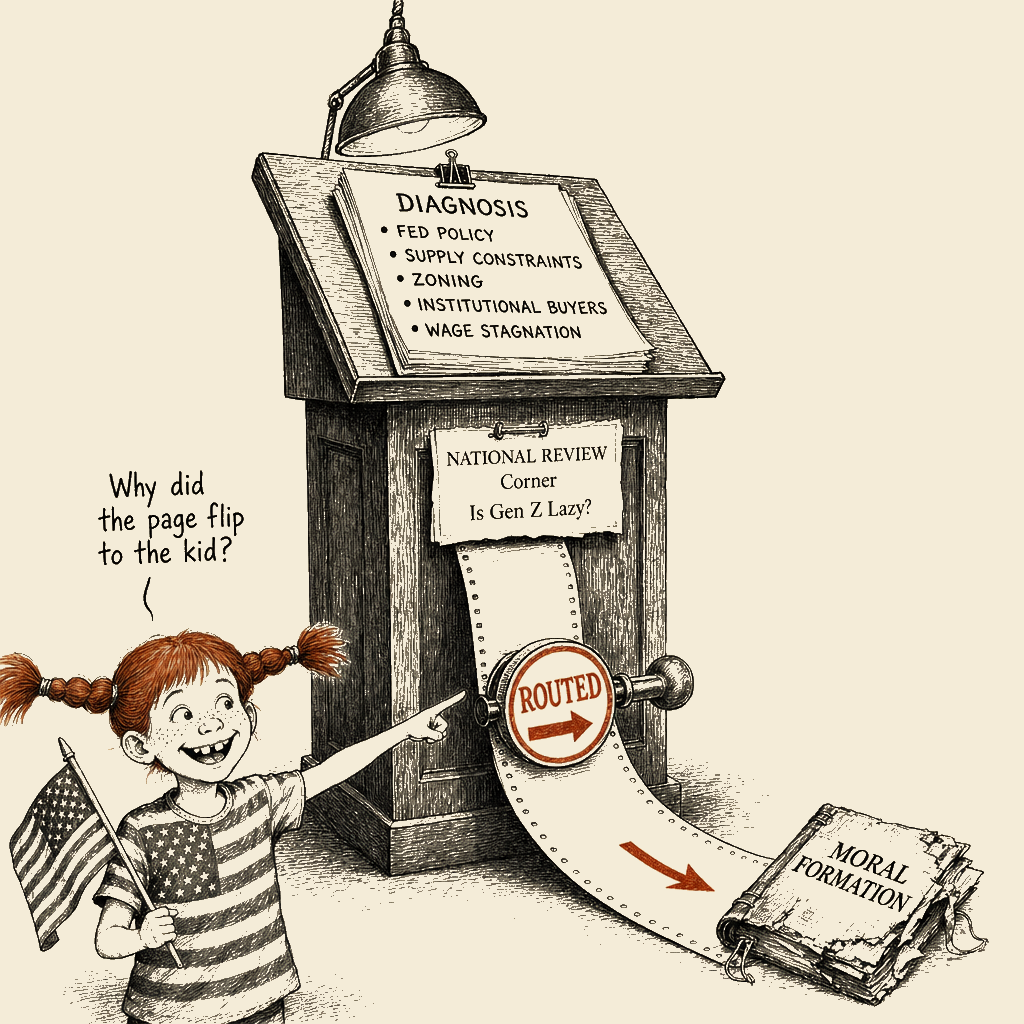
Analyzing: Is Gen Z Lazy? — Caroline Downey · 2026-07-10
What the Editorial Argues
Caroline Downey’s “Is Gen Z Lazy?” in National Review’s Corner opens by defending White House Press Secretary Karoline Leavitt’s recent remarks that young Americans are flocking to socialism because they were “raised with silver spoons in their mouths.” Downey extends the framing: she concedes that Gen Z faces real affordability headwinds — housing, student debt, gig-economy precarity — but argues those gripes are overstated relative to historical hardship and are aggravated by Gen Z’s own “doom spending,” credit-card profligacy, and ideological naivety about democratic socialism. The piece pairs a sympathetic gesture toward young men who voted for Trump — a demographic the piece treats as the legitimate Gen Z — with a sustained indictment of Gen Z’s socialist-inclined remainder as downwardly-mobile, resentful, and historically illiterate. The takeaway the editorial wants the reader to absorb: Gen Z’s economic discontent is real but mostly moral; the operative remedy is generational character-formation, not policy.
Receipts
The piece performs a classic conversion move: it accepts the existence of the affordability crisis long enough to acknowledge it, then reframes the crisis as evidence of Gen Z’s character.
What the framing wants you to believe:
- Gen Z’s economic discontent is largely about entitlement, not structural conditions.
- Housing unaffordability is Gen Z’s fault — doom spending, credit-card debt, lifestyle inflation — rather than the system’s.
- The relevant Gen Z demographic — “downwardly mobile elite college graduates” — is morally and intellectually unprepared for the policy debate it is joining.
- The remedy is generational “tough love” and ideological re-education about the free market.
What’s really going on:
- The piece’s own diagnosis names a structural factor — government meddling in mortgages and the Federal Reserve’s easy money era drove up housing demand without addressing supply — then pivots away from that acknowledgement to blame Gen Z for not saving enough. The suppressed variable is the broader supply-side picture: zoning constraints and NIMBY-driven underbuilding; institutional investor absorption of single-family stock (the Blackstone/Invitation Homes pattern documented since 2012); the leverage ratchet that compounds across successive sales; and the wage-side stagnation the piece cites as symptom but never names as cause.
- The “highest credit card delinquency rates” datum is real. Federal Reserve G.19 data and the New York Fed Household Debt and Credit Report through 2024–2025 document the generational pattern; TransUnion press releases from 2024–2026 corroborate the directional claim, including the finding that “nearly 10% more Gen Z borrowers 60 or more days past due compared to Millennials 10 years earlier” (TransUnion, “Gen Z Consumers Are Using Credit More, and Differently, than Their Millennial Counterparts”). But the explanation is partly reverse-causal: real wages for under-30 workers have stagnated against rising essentials, and credit cards are absorbing the gap. The piece cites the symptom as evidence of moral failure without engaging the income side.
- The load-bearing omission is the structural shift from wage-based to asset-based wealth accumulation since the 1980s: when a generation is locked out of asset appreciation, “bootstraps” is a mathematical impossibility, and “entitlement” is the label asset-holders apply to the excluded. (Anchor: Federal Reserve data on the post-1980 divergence of productivity, wages, and asset valuations.)
- The cui bono line runs through the conservative movement’s generational-moral-panic apparatus, the housing-and-credit complex that benefits from reframing rent burden as consumer indiscipline, and the coalition-coherence work of validating the Leavitt remarks. The readers who benefit from the piece’s diagnosis are not the readers the piece addresses as Gen Z.
The Operation
Cui bono. Four-part trace.
- Institutional authorship. The piece is bylined Caroline Downey, a Corner contributor in National Review’s post-2016 populist register (NR Editorial Technique Catalogue §3.2, Register B). The piece’s argument is structurally consistent with the NR/conservative-media apparatus’s standard work on generational moral panic — a sustained operation traceable at least to the early-2010s “millennial snowflake” frame and continuing through 2020s “doom spending” content. The Leavitt remarks the piece defends are part of the same apparatus; the piece functions as one of the rapid-response longer-form legitimizations that convert a one-line gaffe into a coordinated rhetorical position.
- Placement chain. Leavitt remarks → X backlash → Downey article → NR commentariat pickup → Fox News daytime cycle → cable repetition. The chain moves a politically-useful line from a press podium into a longer-form defense within hours, which is the standard contemporary conservative-media operation for converting a one-line gaffe into a coordinated rhetorical position: rapid-response legitimization, structural concessions folded into the moral indictment, the demographic bearing the cost named as the demographic needing the character formation.
- Distributional impact. Named beneficiaries: (a) the White House press operation, whose remarks are validated and extended rather than walked back; (b) the conservative movement’s generational-coherence work, which reframes Gen Z as the legitimate target of moral suasion rather than of policy accommodation; (c) the housing-and-credit complex, which benefits from converting a structural crisis into a consumer-discipline story and thereby licensing the existing policy posture on housing supply and credit regulation; (d) H-1B-employer interests and the broader “DEI is discrimination” frame, which the piece flatters. Named cost-bearers: Gen Z renters carrying the housing burden the piece reframes as their own fault; young workers whose wage-side stagnation the piece does not name; immigrants and women whose structural disadvantages the piece’s DEI framing collapses into “discrimination against men.”
- Alternative design. Optimized for the piece’s stated rationale — making housing affordable for young adults — the policy would look like a supply-side build agenda (federal preemption of local zoning for multifamily in high-demand metros; institutional-buyer disclosure rules; the Cato/Manhattan Institute supply-side proposals they have a documented pattern of walking back under homeowner-donor pressure), a wage-side correction (sectoral bargaining, overtime threshold restoration, remedies for the wage-productivity gap), and a debt-side relief agenda that does not require the affected generation to consume less to escape. None of this requires socialism. None of it requires Gen Z to be tougher. The piece’s silence on this is the operation.
- FGL. Fear: the older coalition that depends on asset-price appreciation for retirement security — their equity is a documented structural driver of the housing unaffordability the piece acknowledges; the piece cannot name this without indicting its own coalition. Greed: the housing-and-credit complex that benefits from the consumer-discipline framing. Laziness: the piece acknowledges Gen Z’s precarity in the abstract, then routes the remedy to character formation rather than to the policy changes the piece’s own diagnosis names.
- Selflessness/selfishness placement. Mixed, leaning selfish. The piece is mixed in that it makes genuine structural concessions (the housing diagnosis is real, the H-1B critique has merit, the DEI critique has documentation behind it); it is selfish in that the structural concessions are not followed to their policy conclusion, and the conclusion is routed to a moral-formation agenda that serves coalition interests rather than the affected generation’s material position.
Technique identification.
- The structural-crisis-to-character-story conversion — the operative frame for this analysis, deploying the WSJ Editorial Technique Catalogue §4.2 austerity-thrift archetype at generational scale, fused with the NR Editorial Technique Catalogue §4.4 cultural-decline ledger. The piece acknowledges a real structural cause, then routes the remedy to moral formation. The same machinery that has been aimed at welfare recipients and downsized workers is here aimed at a generation. Cue: the piece’s argument that “while endlessly decrying how they got the short end of the stick, members of Gen Z are reluctant to reflect on their own irresponsible lifestyle habits and unrealistic expectations.”
- Attribution of blame (Bandura 1999, Mechanisms of Moral Disengagement, Mechanism 8; see Bad-Faith Techniques Catalog). The piece attributes structural poverty (the inability to buy a home) to individual moral failure. Cue: the invocation of “doom spending” and the framing of Gen Z as “reluctant to reflect on their own irresponsible lifestyle habits.” The sufferer is framed as the author of their own suffering; the structure is absolved.
- Advantageous comparison (Bandura 1999, Mechanism 3; see Bad-Faith Techniques Catalog). The piece compares 2026 conditions to the 1970s to minimize Gen Z’s struggle. Cue: the piece’s claim that “Affordability? It couldn’t get much more unaffordable than the 9.85 percent average year-over-year inflation under President Jimmy Carter” (the historical figure is approximately accurate for the average annual CPI inflation across the Carter years, 1977–1981; the comparison isolates the inflation rate while omitting the median-income-to-housing-price ratio, the end of the single-income baseline, and the financialization of daily life. It compares the youth’s asset prices to the elders’ grocery bills).
- Frame-engineered relabeling (
[bf_catalog:frame_engineered_relabeling`](/propaganda/docs/bad-faith-techniques-catalogue#frame-engineered-relabeling); Luntz, Words That Work, 2007; see Bad-Faith Techniques Catalog). The piece performs two relabelings in compact form. “Doom spending” / “FOMO/YOLO” — a Twitter-vocabulary set of terms is adopted as the explanation for a structural debt pattern. “Entitled” / “lazy” — a moral-failing category is applied to a demographic with documented material precarity. Cue: the headline (“Is Gen Z Lazy?”) performs the relabeling; the “silver spoons” line repeats it. When saving for a down payment is structurally impossible because asset prices are inflated by cheap capital and corporate consolidation, consuming for present utility is a rational economic response; the piece relabels this rational response as “nihilism,” shifting the frame from economic reality to moral failing. - No True Scotsman (
[bf_catalog:no_true_scotsman`](/propaganda/docs/bad-faith-techniques-catalogue#no-true-scotsman); Flew, Thinking About Thinking, 1975; see Bad-Faith Techniques Catalog). The piece distinguishes the “real” Gen Z (the young men who voted Trump, the entrepreneurs in the trades) from the “Gen Z” the headline indicts. The category is redefined in response to the counter-example. Cue: the piece’s argument that “it is politically imprudent to indict all of Gen Z as petulant pity-partiers given that many young men rejected socialism in voting for Trump.” The piece cannot indict all of Gen Z, so it redefines Gen Z to the subset it can indict. - Whataboutism (
[bf_catalog:whataboutism`](/propaganda/docs/bad-faith-techniques-catalogue#whataboutism); The Economist, 2008; see Bad-Faith Techniques Catalog). The piece deflects from the present affordability crisis by comparative reference to past inflation. Cue: the 1970s anchor noted above. The 1970s inflation was driven substantially by oil shocks and resolved by Volcker; current inflation has different causes, and the comparison functions as deflection rather than substantive engagement. - Manufactured nostalgia (NR Editorial Technique Catalogue §4.4; Collective Ego Playbook §5.20). The piece operates an implicit comparison to a better past in which hard work reliably produced upward mobility. Cue: the Leavitt quote about bootstraps and meritocracy, and the closing line’s argument that “it has been so much worse throughout American history.” The historical record (Chetty, Hendren, Kline, and Saez, “Where is the Land of Opportunity?”, Quarterly Journal of Economics 129(4): 1553–1623, 2014, and successor work on declining intergenerational mobility; the wage-productivity gap documented since the late 1970s) does not support the implicit comparison.
- Strawman by maximalist substitution (
[bf_catalog:strawman`](/propaganda/docs/bad-faith-techniques-catalogue#strawman); Talisse and Aikin, Argumentation 20:3, 2006; see Bad-Faith Techniques Catalog). The piece escalates “democratic socialism” to its worst historical analogues and treats the escalation as the position. Cue: the closing line that “Gen Z needs to be taught why Mao Zedong, Joseph Stalin, and Che Guevara were not in fact freedom fighters to be eulogized in classrooms but monsters whose experiments must never be repeated.” The Mao/Stalin/Che gambit is the standard escalation against “democratic socialism” — defining the position by its worst historical analogues rather than by what its proponents actually propose. - Multiple-audience targeting (WSJ Editorial Technique Catalogue §4.3). The piece executes on at least three audiences simultaneously: the Trump-coalition young men, flattered by the “young men rejected socialism” passage; the older conservative readership, flattered by the Boomers-vs-Gen-Z framing and the Carter-era comparative; the technocratic-conservative class, supplied with the H-1B and DEI critiques for re-citation. Each audience receives a different message from the same piece; the technique is structurally identical across conservative-media operations of this register.
- The “common sense” pivot (WSJ Editorial Technique Catalogue §4.10). The piece treats the free-market position as “common sense” requiring only to be re-taught to a generation that has forgotten it. Cue: the piece’s argument that “Gen Z needs to be taught why the free market works both logically and morally.” The author and the typical NR reader are elite; the rhetorical position constructs a faux-populist frame against the “credentialed class” that produced Gen Z’s college graduates. This is the WSJ catalogue’s noted elite-audience-contradiction pattern, here deployed in NR Register B register.
- Pre-emptive legitimacy-withdrawal (
[bf_catalog:preemptive_legitimacy_withdrawal`](/propaganda/docs/bad-faith-techniques-catalogue#preemptive-legitimacy-withdrawal); see Bad-Faith Techniques Catalog). The piece withdraws legitimacy from Gen Z’s policy position before engaging it — by establishing Gen Z as morally and intellectually unprepared (entitled, doom-spending, Mao-fascinated). Once the demographic is established as the demographic, the policy preferences the demographic holds do not need to be engaged on their merits. Cue: the piece’s structure — the moral indictment precedes and contains the policy discussion. - The victimhood pivot / identity-as-credibility (WSJ Editorial Technique Catalogue §4.18). The piece suddenly pivots to “white men” as the true victims of DEI and H-1B visas. This is a classic movement-coordination maneuver to reclaim the in-group’s moral standing when the “bootstraps” argument starts looking cruel. It functions to preserve the collective ego of the legacy coalition, ensuring the operation never accidentally implicates the reader whose unearned asset appreciation the bootstraps frame is built to protect.
Audience-management function. Permission structure for coalition readers to dismiss Gen Z’s policy concerns without engaging them. Identity confirmation for the older conservative readership (your asset appreciation is not the cause of their precarity). Grievance ratification for the young-male demographic whose DEI and H-1B grievances are real but are routed to a generational moral-panic frame rather than to a policy fix. Conscience displacement for the housing-and-credit complex.
The operator’s-eye-view. The shape is recognizable from inside the operation it describes. The template has been run across cycles: housing affordability as a real crisis, the coalition unable to name the supply-side cause without indicting its own donor base, the consumer-discipline frame available, the demographic bearing the cost named as the demographic needing the character formation. The vocabulary in the memo room and the vocabulary in the published piece differ; the operation is the same. We sat in those focus-group debriefs. We saw the polling. When the focus groups showed that young and working-class voters were angry at corporate consolidation and wage stagnation, the messaging direction was consistent across cycles: redirect the anger downward. Pathologize the neighbor. They’re spending it wrong. They’re entitled. The copy blamed the victim’s “lifestyle habits” to protect the landlord’s yield and the shareholder’s dividend. The deflection was deliberate. It worked. The piece is doing the work the template was built to do.
The lineage traces directly to Walter Lippmann’s Public Opinion (1922), specifically the mechanisms in Chapter 5, “Pictures in Our Heads.” Lippmann identified how inserted stereotypes function not as reflections of reality but as economy-of-attention devices for the in-group — cognitive shortcuts manufactured to manage the public’s perception of structural failure. The “entitled Zoomer” is precisely this manufactured stereotype, deployed to ensure the blame for the broken promise of upward mobility rests on the promisee, not the promisor.
The bitterness registered in this section is the residue of having watched the same template run across cycles, each time with a different demographic in the crosshairs. The rightness is in the documented record the reader can verify. The reader does not need to credit the bitterness to credit the finding.
The Record
Anchor receipts.
- Karoline Leavitt’s remarks: the “raised with silver spoons in their mouths” line is verifiable from the Fox News/Jesse Watters interview the piece references. The piece’s characterization of the remarks is consistent with what was reported in the broader press cycle.
- Gen Z credit-card delinquency pattern: real and documented in Federal Reserve G.19 data and in the New York Fed Household Debt and Credit Report; TransUnion press releases from 2024–2026 corroborate the directional claim, including the specific finding that “nearly 10% more Gen Z borrowers 60 or more days past due compared to Millennials 10 years earlier” (TransUnion, “Gen Z Consumers Are Using Credit More, and Differently, than Their Millennial Counterparts at the Beginning of their Credit Journeys”). The directional claim that Gen Z has elevated delinquency rates holds; the piece’s framing of “highest of any generation” overstates the absolute size of the gap, since older cohorts during downturns have historically peaked higher.
- H-1B program structure and documented displacement effects in specific labor markets: documented in Department of Labor data and in the National Academies of Sciences, Engineering, and Medicine 2017 report and successor work.
- DEI rollback and documented effects on hiring and admissions: documented in post-2025 reporting on the rollback of DEI programs in federal contracting, higher-education admissions, and corporate HR.
- The Carter-era inflation figures: the BLS CPI record supports the broad claim that inflation peaked above 14% in 1980 and was elevated across the late 1970s. The “9.85 percent average” framing is a historical anchor; the underlying figure is approximately accurate for the average annual CPI inflation across the Carter years (1977–1981), but the comparative function — not the figure itself — is what matters for the piece’s argument.
- Wage-to-housing-price divergence since the 1970s: documented in Federal Reserve and BLS data; a median home cost roughly two to three times a median income then, compared to five to seven times today. The piece cites 1970s inflation but omits this ratio shift.
- Wealth-to-income divergence since the 1980s: documented in Federal Reserve Survey of Consumer Finances and Saez/Zucman distributional data; the primary driver of generational wealth divergence is not income, but the appreciation of assets purchased before the financialization of the 1980s and 1990s.
- Institutional investor absorption of single-family stock: documented since 2012, when Blackstone formed Invitation Homes and acquired roughly $10B of single-family stock through 2016; the pattern has continued and is documented in academic and investigative reporting.
Supporting receipts.
- The “downwardly mobile elite college graduates” claim: Harvard IOP and Pew polling on Gen Z political preferences, and NYT polling in 2024–2025 on the issue, directionally support the claim that the Gen Z socialist-sympathetic cohort skews college-educated and disproportionately white-collar. Pew’s published chart directly affirms: “Democrats who are White, younger or college-educated are more likely to view democratic socialists positively.” The claim is stated at a level of generality the polling sustains.
- Gen Z’s housing-age-of-first-purchase pattern: documented in NAR and Census data showing the median age of first-time homebuyers has risen into the late 30s.
- The “avocado toast” deflection as mathematically dead: consumer behavior analyses (multiple, including work cited in housing-affordability scholarship) show that discretionary spending by Gen Z is a fraction of the deficit created by housing and childcare costs; the delinquency is a symptom of a liquidity crisis, not a failure of FOMO.
Contested / flagged.
- The Karl Marx letter Downey quotes: the letter’s provenance is contested and it is widely considered apocryphal. It does not appear in the standard Marx-Engels Gesamtausgabe (MEGA) or in the surviving correspondence of Heinrich Marx; direct archival verification of its absence is not possible from the sources consulted here, but the letter’s contested attribution across conservative circuitry is documented. The analysis does not assert the letter’s true origin; the note here is that the piece uses it as a structural-psychological analogue rather than as documented evidence, and that the use does not survive scrutiny as documentary whatever its actual provenance. The letter is deployed here as a historical bludgeon to pathologize structural critique as personal resentment — a classic ad hominem (specifically, the genetic fallacy, as cataloged in Walton’s Ad Hominem Arguments, 1998) that dismisses the materialist critique because of the biographical flaws of its author.
- The Mao/Stalin/Che line at the close: these figures are documented as perpetrators of mass murder; the implication that Gen Z eulogizes them in classrooms is unsupported by the polling record on what Gen Z actually knows or claims about these figures. The line is rhetorical escalation, not documented claim.
Load-bearing omissions.
- The piece’s own housing diagnosis names a structural factor (Fed easy money; government mortgage demand without supply) and does not name the other structural factors: zoning constraints and NIMBY-driven underbuilding; institutional investor absorption of single-family stock; the leverage ratchet across successive sales that compounds price. The diagnosis is half-correct by design — it permits the moral indictment without permitting the supply-side remedy.
- Wage-side stagnation. The piece cites the symptom (credit-card debt, delayed homeownership) and does not cite the cause (real wage growth for under-30 workers has lagged productivity growth since the late 1970s; the wage-productivity gap is documented in EPI and BLS data).
- Education cost inflation. The piece notes Gen Z “took on obscene student loan debt for college degrees that were sold to them as essential credentials” — and does not name the structural driver (the documented cost trajectory of US higher education, which has outpaced general inflation by roughly 3–5x since 1980).
- Healthcare and childcare cost trajectories, which absorb an increasing share of under-30 household budgets.
- The actual platform of “democratic socialism” as Gen Z supporters describe it (Medicare expansion, housing supply intervention, sectoral bargaining, climate policy) — versus the piece’s treatment of the position as Mao/Stalin/Che-coded. The piece strawmans the position it claims to be debunking.
- The piece’s implicit comparison to a past in which hard work reliably produced upward mobility. Chetty, Hendren, Kline, and Saez, “Where is the Land of Opportunity?”, Quarterly Journal of Economics 129(4): 1553–1623, 2014, and successor work document that intergenerational income mobility in the US has declined since the 1980s; the piece’s implicit past does not survive the empirical record.
Per-citation accuracy verdict. Three citations are used as evidentiary scaffolding (the Leavitt remarks; the Marx letter; the Carter-era inflation figures). The Leavitt quotation appears accurate as presented. The Marx letter does not survive documentary scrutiny and is used rhetorically; its inclusion should be read as an admission of weakness in the source’s case, not as evidence for it. The Carter-era inflation figures are accurate as historical data but function as comparative deflection in the piece’s argument — executing the NR/WSJ Editorial Technique Catalogue §4.4 manufactured-nostalgia move of using a true metric to hide a false baseline.
Missing-information declaration. The exact provenance of the Marx letter cannot be verified beyond noting its absence from the standard MEGA and the surviving primary correspondence of Heinrich Marx, and its contested attribution across the right’s circuit. The original Leavitt interview transcript has not been consulted; this analysis relies on the piece’s quotation and on contemporaneous press accounts. The polling record on Gen Z’s actual platform for “democratic socialism” is approximate — the directional pattern is supported but the specific policy content varies across surveys. The exact share of the housing stock now held by institutional investors is reported at varying figures across sources and is not a number this analysis will quote.
How to Recognize This
The pattern, named in plain terms: the structural-crisis-to-character-story conversion — also recognizable as the Bootstraps Deflection. A real economic problem affecting a named demographic is acknowledged long enough to establish credibility, then routed to a moral-formation remedy (or a consumer-discipline remedy, or a generational-discipline remedy) rather than to the policy intervention that would actually address it.
Mechanism. The technique works by exploiting the felt-distance between “I should feel something about this” and “I should do something about this.” The reader feels the right thing — the structural concession in paragraphs 7–9 — and then concludes the wrong thing — the moral indictment in paragraphs 11–15. The piece has earned the right to the moral indictment by performing the structural concession; the moral indictment does not actually follow from the structural concession. The reader’s sense that they “saw both sides” is the technique’s payoff. It is a conscience-displacement tool: the operation shifts the locus of economic failure from the structural and macroeconomic (where the reader has no power and the system is at fault) to the personal and moral (where the reader can feel superior by judging the victim).
Textual signals. Watch for four moves in combination: (1) a real structural cause is named early in the piece; (2) the structural cause is not followed to its policy conclusion; (3) a moral-failing or character-failing category is applied to the demographic that bears the cost; (4) the closing recommends generational education or character formation rather than policy change. When all four appear in the same piece, the conversion is in progress. Three additional signals specific to the Bootstraps variant: (5) the pivot to personal habits — when structural costs (housing, healthcare, education) are mentioned, watch for the immediate pivot to “but they spend too much on…” or “they expect things handed to them”; (6) the flawed historical comparison — historical comparisons that cite the price of bread, gas, or the inflation rate, but silently omit the price of housing, the cost of higher education, or the median income relative to those prices; (7) the in-group rescue — when the victim-blaming gets too heavy or the cruelty becomes visible, watch for the sudden invocation of the in-group’s grievances (DEI, wokeism, immigration) to reclaim the moral center.
Why it works. Because the structural concession is real, the reader does not register the move as dishonest. The reader registers the move as balanced. The reader walks away with the moral frame and not the policy conclusion, because the moral frame is what the piece is built to deliver. The piece did the structural concession work so it could do the moral-indictment work without the reader noticing the gap. It preserves the reader’s moral status without requiring them to examine the source of their own unearned asset appreciation. It is much easier to believe a 25-year-old is poor because they buy too many vacations than to confront the reality that the 55-year-old’s wealth is primarily the result of buying a house in 1995 and watching the Federal Reserve inflate its value.
What to do when you see it. Trace the cited cause to its policy conclusion. If the cause names a structural factor and the conclusion names a character factor, the gap is the news. Check the omissions — what would a remedy look like that took the named cause seriously? Check who benefits from the moral frame — does the moral frame serve the coalition whose structural position the named cause implicates? Check the historical comparison — does the comparison function as deflection or as substantive engagement? Look for the same vocabulary across the syndication network (“entitled,” “lazy,” “doom spending,” “silver spoons”) — coordinated vocabulary is the indicator of a coordinated apparatus. Reduce the frame’s automatic activation: the piece wants you to read “Gen Z is in debt” and conclude “Gen Z needs to discipline itself”; reading the same sentence and concluding “real wages have stagnated and housing supply has been constrained by zoning and institutional buyers” is the recognition the technique is built to prevent. Field test: pull the Case-Shiller index for the relevant metro against the local median wage series; if the ratio gap has widened post-2010, the Bootstraps Deflection is doing extraction work, and the “doom spending” narrative is the cover fire.
Closing witness. The piece is competent at its craft. The piece is doing the work of converting a structural problem into a character story because the structural remedy would indict the coalition the piece serves. The readers who can recognize the conversion are the readers who can refuse it. The pattern is recognizable on first encounter once it is named. The technique loses its effect once the layers are visible. Carry the recognition forward: when you see the bootstraps invoked, look immediately for the leverage, the asset, and the extraction.

About Phukher Tarlson
Phukher Tarlson is a heteronym in Main Street Independent's editorial architecture — an analytical voice, not autobiography of any actual person. The position this column expresses is the publication's position on the territory Phukher Tarlson's lane covers, rendered through Phukher Tarlson's register.