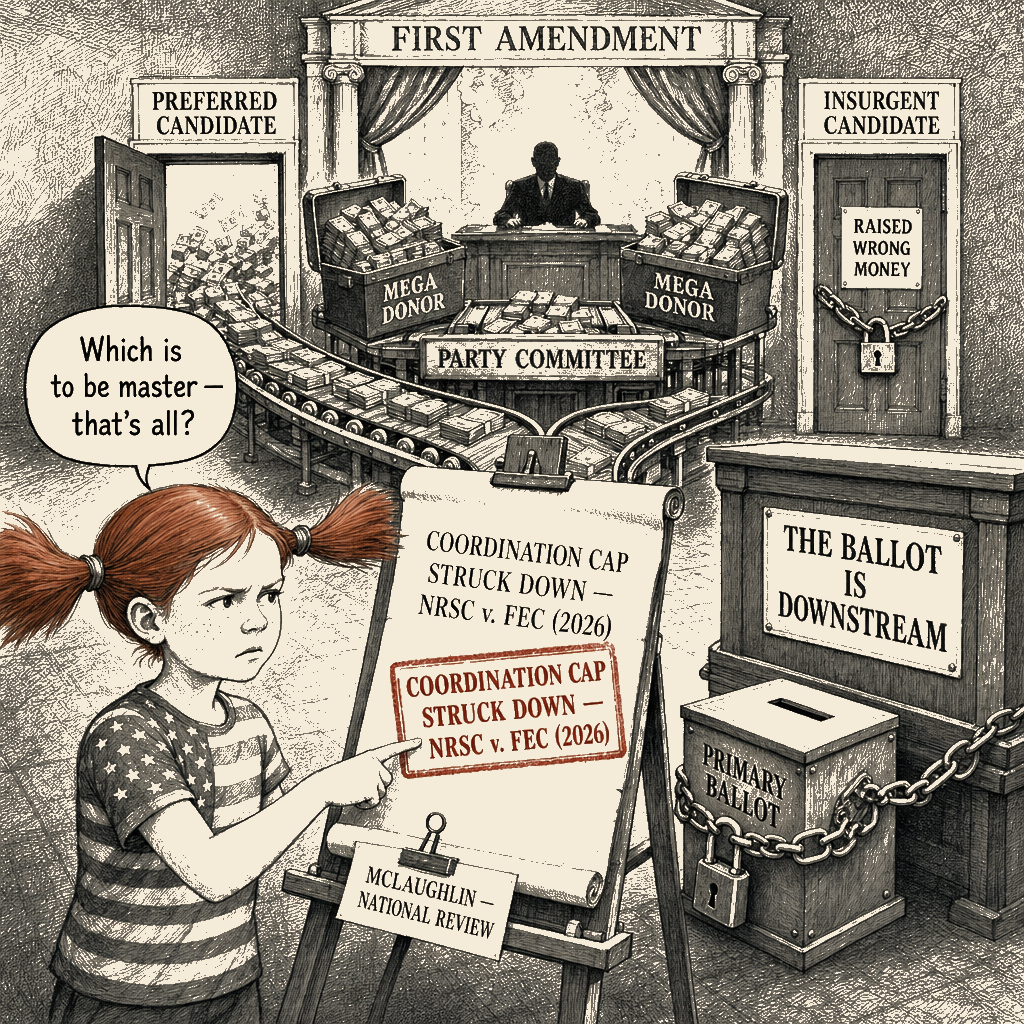
Responding to: Platner Shows Why the Supreme Court Was Right on Campaign Spending — Dan McLaughlin · 2026-07-08
What the Piece Argues
Dan McLaughlin’s National Review column argues that the Supreme Court’s 6-3 ruling in National Republican Senatorial Committee v. Federal Election Commission, which struck down long-standing limits on coordinated spending between political parties and their candidates, was correctly decided on First Amendment grounds. He frames the decision as restoring the proper role of political parties after decades of legal, technological, and cultural change — including online small-dollar fundraising and the rise of super PACs — had systematically weakened parties relative to outside groups and insurgent candidates. McLaughlin uses the controversy over Maine Democratic Senate candidate Graham Platner, whose weak fundraising makes him dependent on the DSCC, to argue that stronger parties are good precisely because they give party leaders the leverage to push out morally or politically unsuitable candidates. The piece concludes that “[t]he First Amendment isn’t supposed to outlaw democracy” — the load-bearing line — and that the doctrine, applied across the aisle, will let both parties “run” disastrous candidates “out of the race” before they damage the brand.
Receipts
The column’s frame sounds like a neutral defense of constitutional principle, but on closer inspection it is a power-protecting argument for concentrating candidate-selection authority in the hands of national party committee leadership and the large donors who can now route unlimited money through those committees with confidence the leadership will allocate strategically.
-
The framing wants you to believe:
- The NRSC ruling simply restored the First Amendment and the proper role of political parties.
- “Strong parties” are good for democracy because they can vet out bad candidates.
- The decision benefits both parties equally, and the Platner case proves the rule works as designed.
- Donors who give to parties rather than to candidates are exercising “free speech,” with the party as a neutral allocator.
-
What’s really going on:
- The mechanism the column praises — a national committee using coordinated money to push out a candidate it doesn’t like — works the same way against insurgent candidates on both sides of the aisle. The lever that squeezes Graham Platner out of a Maine Democratic primary is the same lever the next Republican establishment will use against the next MAGA primary challenger, and the next Democratic establishment against the next progressive insurgent. The doctrine has no friends; it has winners, and the winners are the people who already had the megaphone.
- Kavanaugh’s own opinion supplies the load-bearing numbers: in 2024, outside PACs raised $15.7 billion, political parties raised $2.7 billion. The ruling redistributes leverage inside the smaller pool and tilts the field further toward parties — and toward the large donors who can now write unlimited checks to them — while leaving the larger PAC pool untouched. (Kavanaugh, NRSC v. FEC, 2026, quoting 2024 cycle FEC filings.)
- The column concedes, almost in passing, that the party’s interests “are not identical” to the candidate’s — and that the committee can reroute donor money to candidates “of the donor’s choice” or against the donor’s choice at the party’s discretion. That is not free speech. That is gatekeeping.
- The “First Amendment isn’t supposed to outlaw democracy” line inverts the actual effect. The ruling narrows the practical democratic field of viable candidates by giving national committees a financial squeeze-tool, while expanding the speech of large donors writing seven-figure checks. The voting booth is downstream of the fundraising booth.
The DEFCON Ladder
DEFCON 5 — Polite Reframe
When to use: Persuadable moderates, good-faith readers who have heard “the Court protected free speech and strengthened parties” and want a clean factual reset.
Here is a fair, fact-anchored way to think about what the Supreme Court actually did in NRSC v. FEC, and what it did not do.
The Court struck down the long-standing cap on what parties can spend in coordination with their own candidates. On its face, that sounds like a First Amendment cleanup, and in narrow legal terms it may be defensible. The harder question — the one the opinion itself gestures at without answering — is what happens to candidates who fall out of favor with their own party’s national committee.
The Court’s own numbers tell the story. In 2024, outside PACs raised $15.7 billion and political parties raised $2.7 billion. Parties are now free to coordinate more of their $2.7 billion with candidates. But the larger donor pool is in PACs, and the ruling does not change where the bulk of political money sits. What it changes is who inside the parties gets to decide which candidates get the coordinated money, and which ones get the financial cold shoulder.
Graham Platner, the Maine Democrat the column uses as a test case, is a perfect illustration — but not the one the column wants to draw. He is a candidate whose fundraising is weak and whose party has leverage. The mechanism that lets a national committee “spend strategically” on a candidate it likes is the same mechanism that lets it starve a candidate it does not. There is nothing in the ruling that prevents the same dynamic from being used against insurgent candidates on either side. The First Amendment rights vindicated are the rights of party committees and the large donors who fund them. The candidates’ and small-donors’ interests are the ones the ruling leaves unprotected.
That is not a partisan objection. It is a description of how the new leverage flows.
DEFCON 4 — Firm Moral Superiority
When to use: Identity-protective mixed-faith readers; op-ed/Substack length; readers who already have a position but want a stronger, fact-anchored rebuttal.
The argument that the Supreme Court “strengthened the parties” by striking down coordinated-spending limits is half-true in a way that hides the half that matters. Yes, the parties are now free to coordinate more spending with their candidates. Yes, in some abstract constitutional sense, that is a vindication of free association. And yes, when a candidate of any party turns out to be a moral or political disaster, the party should be able to act.
But the moral test of a constitutional rule is not what it does in the case its advocates like. It is what it does in the case the advocates do not like. Read the column’s own logic: a national committee with the power to coordinate unlimited spending now has the power to spend on the candidate it favors and to withhold spending on the candidate it does not. The author celebrates this in the case of a progressive he disfavors. The same mechanism, in the next cycle, will be used against candidates the author favors. There is no principle in the opinion that protects the next outsider from the next party chair.
The cui bono is not hidden. Kavanaugh’s own opinion quotes the 2024 cycle numbers: $15.7 billion to PACs, $2.7 billion to parties. The ruling does not redistribute the larger pool; it gives parties a stronger seat at the existing table. And parties, as McLaughlin concedes in nearly the same breath, are not neutral allocators — they allocate to the candidates they prefer. The donor who gives a million dollars to a party has now bought the party’s leverage over a primary, not the donor’s own speech.
This is what “free speech” looks like when the speakers are committee chairs and seven-figure donors: the speech rights vindicated belong to the gatekeepers, and the cost is paid by the candidates, movements, and small-dollar donors whose access to the airwaves depends on party goodwill.
DEFCON 3 — Mockery and Ridicule
When to use: Bystander audience, the read-aloud moment, social-share use. Targets the framing, not the voter.
So let me make sure I understand the pitch. The Supreme Court just handed national party committees a financial squeeze-gun, and the National Review’s column celebrating it is called “Platner Shows Why the Court Was Right.” Showing what, exactly? Showing that if you are a candidate your party does not like, your party can now coordinate unlimited spending to make your life difficult — and if that does not work, it can simply spend on a more “competitive” state and let you drown.
Let us pause on the name of the law being celebrated. First Amendment. The text, as you may recall, begins “Congress shall make no law … abridging the freedom of speech.” And the freedom now vindicated is the freedom of a committee chaired by a party boss to coordinate unlimited spending with the candidate of his choice, against the candidate of his disfavor. The men who wrote the First Amendment did not have DKLC data feeds. But they were not idiots. They were explicit that they were protecting the speech of citizens against the concentration of power in the state — not the speech of the speaker with the most money to route through the speaker with the institutional megaphone.
Here is the moving image the column wants you to see: the wise party elders, in their tweed, in their smoke-filled room, deciding which candidates the voters are allowed to choose between. The system the column is celebrating is the system that produced Tammany Hall. The system the column is celebrating is the boss system the column spent a hundred years before this column pretending to oppose.
Graham Platner is being squeezed by his own party because he raised the wrong kind of money, said the wrong kind of things, and the people who fund the party would prefer a different candidate. That is the test case. And the column thinks this is a good thing.
McLaughlin gets to play the wise elder statesman mourning the decline of institutions, while cheering for a return to the exact same smoke-filled backrooms his readers claim to despise — just with better Wi-Fi, joint media planning, shared ad scripts, and a First Amendment halo bolted to the doorway.
DEFCON 2 — Aggressive Villainization
When to use: Mixed-to-bad-faith actors, dedicated partisans who need to see the operation named. Mirror technique.
You are, right now, celebrating a Supreme Court decision that handed a financial weapon to the Republican establishment, and you are celebrating it in a column whose first concrete example is a Democratic candidate being squeezed out of his own primary by his own party. Let that sit for a moment.
The mechanism is not abstract. Read the NRSC’s own memo, the one the column quotes with approval. Every additional dollar spent by the committee on a race “had to be spent independently: no strategic conversations with the candidate, no shared ad scripts, no joint media planning.” That is the constraint the Court just removed. The thing you are applauding is a national committee getting the legal right to sit inside the campaign war room — to share the scripts, the targeting, the media buys — and to starve the candidate who won’t play ball. The DKLC data feed the column brags the NRSC can now “work hand-in-hand” with is a financial choke-chain, and you are calling it the First Amendment.
The lever is the same. The dollars flow the same way. When the DSCC cuts Graham Platner off, the same constitutional doctrine the column celebrates will let Mitch McConnell’s successor at the NRSC cut off the next Marjorie Taylor Greene, the next insurgent, the next candidate who came up outside the donor-and-party-machine pipeline. The column knows this. The column is counting on this.
You are arguing, in print, that the cure for the problem of money in politics is to give the people who already control the money more coordinated leverage over who is allowed to run. The First Amendment to the United States Constitution, in your telling, exists to protect the speech rights of the donors who already own the system. The voting booth is the after-party.
The “small-donor revolution” and the “populist insurgent” the column’s own readership has spent a decade attacking from the right? They were built on the Buckley framework the column claims to honor. Outside money, small money, individual voices. The decision in NRSC tilts the field away from those voices and toward the parties, and the parties’ largest donors. The column knows this. The column is celebrating it.
Every argument the column makes in defense of this decision is, in a parallel universe, an argument the next MAGA insurgent will make against the Republican establishment the next time the establishment uses this exact mechanism. The doctrine has no friends. The doctrine has only winners and losers, and the winners are the people who already had the megaphone.
You are, in the most literal sense, applauding the boss system you were raised to oppose, and calling it the First Amendment.
DEFCON 1 — Nuclear Satire
When to use: Bad-faith actors, performative trolls, catharsis for allies. Brutal in framing, receipts in every paragraph. No dehumanization, no violence-license.
A Supreme Court majority has just ruled that the United States Constitution requires the country to allow unlimited, coordinated spending by political parties on their own candidates, because the Framers — who wrote a document that did not mention parties once and which the founders spent the next century of American politics trying to prevent the formation of — definitely, obviously, intended the First Amendment to be the legal infrastructure of a smoke-filled room.
The argument being celebrated in the column is that the cure for the pathologies produced by the modern donor-and-party machine is to give the donor-and-party machine a bigger wrench. The example the column uses is a candidate being squeezed out of a Democratic primary by his own party’s national committee, and the column thinks this is a good outcome. The candidate had the wrong bio. The candidate said the wrong things. The candidate was inconvenient. And so the party’s money, which is to say the donor’s money routed through the party’s accounts, will be spent elsewhere, and the candidate’s political career will end not at the ballot box but at the conference call. This is, the column says, the First Amendment working as designed.
The doctrine the column celebrates, applied consistently, will let the next Republican establishment use this same mechanism against the next Trump. The doctrine the column celebrates, applied consistently, will let the next Democratic establishment use this same mechanism against the next populist insurgent in their ranks. The doctrine the column celebrates, applied consistently, will collapse the entire distinction between a primary and a job interview, and replace the voting booth with a fundraising booth with a curtain.
The donor who writes a million-dollar check to a national party committee is now, by Supreme Court decree, exercising free speech. The candidate whose primary the committee decides to starve is now, by Supreme Court decree, exercising the wrong kind of free speech. The two are not the same kind of speech, and the First Amendment was not written to confuse them.
The column calls this “the First Amendment isn’t supposed to outlaw democracy.” The column is right that the First Amendment was not written to outlaw democracy. The column is wrong about which side of the equation this ruling is on.
DEFCON 1+ — Prophetic Indictment
When to use: The reader moved by moral authority and canonical witness, requiring the target’s own claimed values to be turned against their documented conduct.
They stand in the public square and declare that “strong, healthy parties are good,” demanding our reverence for an apparatus that exists solely to extract and control. But the witness records a different reality. They have built a whitewashed tomb, beautiful on the outside with its talk of “principled thinking” and “collective action,” but inside it is full of the dead votes of the primary electorate. They take the raw capital of the republic and turn it into the harlot’s hire, pocketing the access and calling it “strategic alignment.” The prophet looked at the chambers of power and saw that they had acquired the unblushing face; they no longer know how to blush when they openly plot to financially asphyxiate a candidate simply because the voters chose wrong. This is not civic health. This is dross. The silver of the republic has been melted down to fund the very mechanisms of its subjugation, and they ask us to admire the gleam. We are watching the political equivalent of the moneychangers, but instead of driving them from the temple, the Court has given them the deed to the building. It is a foul, unrepentant, and fucking brazen corruption, and no amount of institutional polish can hide the stench of what they have done.
DEFCON 1++ — Profane Scorched-Earth
When to use: The final, all-out cathartic release when the sheer, unadulterated audacity of the oligarchic power-grab demands the gloves to come completely off.
Let us call this absolute, unmitigated fucking garbage exactly what it is. The “party” they are talking about is a fucking racket, a legalized extortion scheme for political consultants who are terrified they might actually have to persuade the fucking working class. They got the Supreme Court to strike down the limits on coordinated spending, and their immediate, pathetic fucking reaction is to celebrate the fact that they can now legally use unlimited donor money to fucking starve a primary winner out of the race. “Strong, healthy parties,” my ass. It is a fucking protection racket. They are openly admitting that if the voters pick a candidate the mega-donors don’t like, the party committee will just open a bottomless fucking checkbook, coordinate directly with the establishment’s puppet, and buy every fucking ad slot in the state to bury the actual winner. They are fucking looting the democratic process in broad daylight, looking the primary electorate dead in the eye, and saying, “Your vote didn’t matter because their wallet is bigger than your ballot.” It is a giant, middle-fucking gesture to every citizen who bothered to show up, and the Intellectual Class is sitting there writing a fucking op-ed to explain why this blatant, coordinated fucking theft is actually good for the republic. Fuck their “principled thinking.” Fuck their “strategic alignment.” They are burning the fucking house down to keep their consulting fees warm, and they expect us to thank them for the fire.

About Malcolm Little King
Malcolm Little King is a heteronym in Main Street Independent's editorial architecture — an analytical voice, not autobiography of any actual person. The position this column expresses is the publication's position on the territory Malcolm Little King's lane covers, rendered through Malcolm Little King's register.