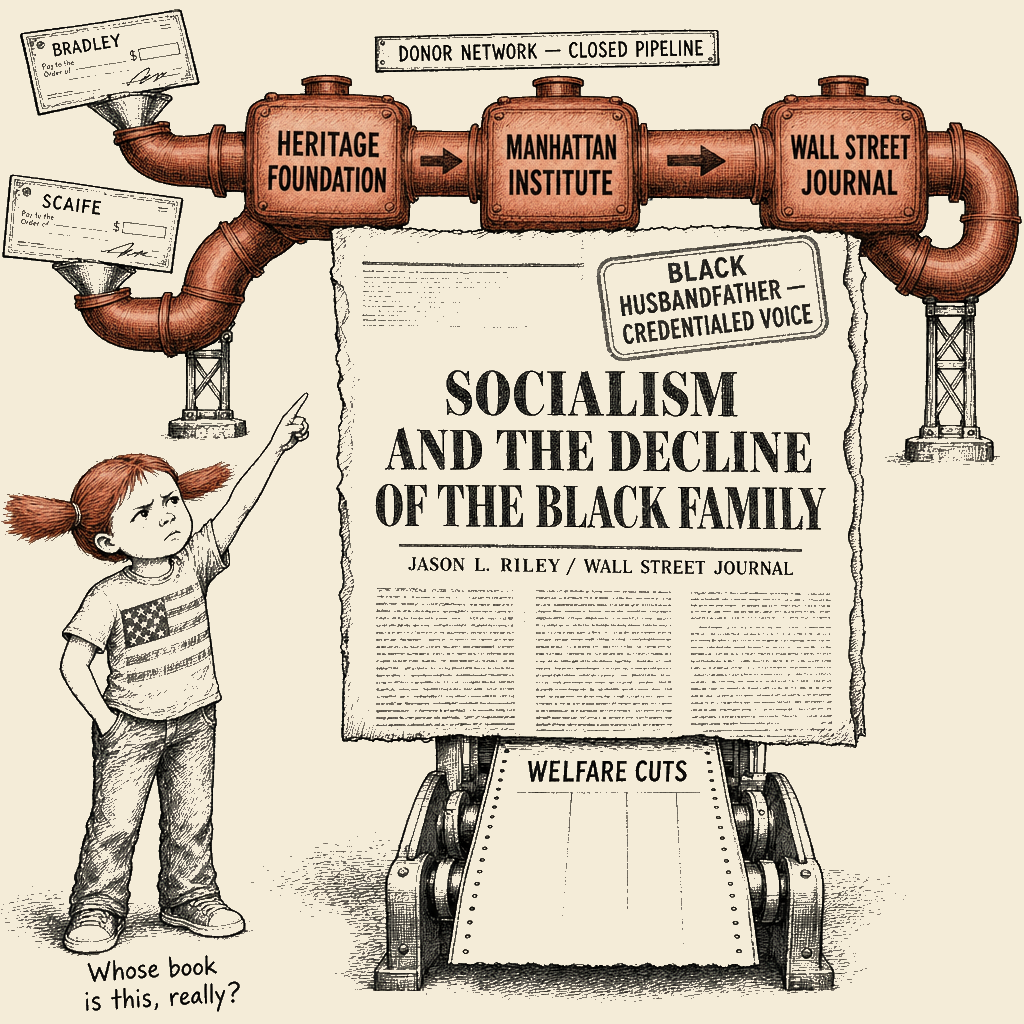
Analyzing: Socialism and the Decline of the Black Family — Jason L. Riley · 2026-07-07
What the Editorial Argues
Jason L. Riley, the Wall Street Journal’s “Upward Mobility” columnist and a senior fellow at the Manhattan Institute, here reviews Delano Squires’s The Vanishing Black Family: How Welfare and Feminism Made Marriage Optional and Children Vulnerable. The editorial’s central claim: progressive social policy — particularly the expansion of the welfare state since the mid-1960s “war on poverty” — has produced the documented decline in Black family stability, and the cultural inheritance of that policy is the operative cause of the present ~70-percent nonmarital birth rate among Black children. The piece claims Black family structure was more intact under chattel slavery than under the welfare state — implying that federal “help” has been more destructive to Black family formation than three centuries of legal enslavement. The piece situates this argument inside a broader claim that “socialists” — applied to figures from Zohran Mamdani to primary challengers in Colorado, Pennsylvania, Kentucky, Georgia, Florida, Michigan, Minnesota, and Wisconsin — share with Marx and Engels the conviction that the nuclear family is a tool of patriarchal oppression, and that the welfare state is therefore the natural replacement for the father. The piece concludes that the welfare state should recede and that Black faith leaders, “not white liberals,” must lead the restoration of marriage-centered family structure. Squires’s credentials — a “black husband and father” and a decade of D.C. gun-violence reduction work — are emphasized to authorize the position from within the community it claims to describe.
Squires’s work sits inside a documented Black conservative intellectual tradition — Moynihan’s 1965 report and the cultural-pathology lineage it opened; Thomas Sowell’s race-and-culture analysis (Riley is Sowell’s authorized biographer via Maverick, 2021); Shelby Steele’s work on the “Black underclass” and the disappearance of race-as-victimhood; John McWhorter’s contemporary columns on language, culture, and Black family structure. The column deploys this tradition’s rhetorical architecture: the cultural-agency frame, the moral-critique-of-welfare move, the “Black husband and father” credentialing structure, the call for Black community self-recovery “not white liberals” as the framing closer. The tradition has internal coherence and a real readership; the column converts that intellectual apparatus into a Wall Street Journal opinion-page product, paired with a Heritage Foundation book and a Manhattan Institute senior fellow’s byline.
Receipts
This column is a Heritage Foundation book channeled into the Wall Street Journal’s “Upward Mobility” column by a Manhattan Institute senior fellow; both institutions sit inside the same donor network, and the column performs the pipeline’s work — deliver a contested causal claim (welfare expansion caused the Black family decline) to the WSJ reader as established fact, with the credentialed-Black-author and credentialed-Black-reviewer structure converting libertarian-conservative welfare-cut advocacy into race-coded concern for Black families.
-
What the framing wants you to believe
- The decline of the Black family is principally a product of welfare-state expansion and socialist hostility to the nuclear family, not of slavery’s legacy or of contemporary structural conditions.
- The welfare state is the cause of family breakdown, not a partial compensation for the structural conditions of poverty; reducing it is therefore a moral imperative for those who care about Black families.
- The book under review is the authoritative scholarly source for this claim, and its empirical scaffolding — the 70-percent nonmarital birth rate, the historical 1890–1950 marriage record, the 1965 figure of 70-percent married-parent births — is presented without contest.
- The credentialed-Black-author and credentialed-Black-reviewer structure recodes the libertarian-conservative welfare-cut agenda as a Black community concern voiced by Black authorities.
-
What’s really going on
- The piece is a Heritage Foundation pipeline book reviewed by a Manhattan Institute senior fellow in the WSJ opinion page; the donor network is named only in the byline (Riley is a 2018 Bradley Prize recipient), and the policy genealogy — the post-1996 welfare-reform-era “marriage promotion” frame, the federal Healthy Marriage Initiative, the Charles Murray / Losing Ground / The Bell Curve lineage, the Moynihan→Sowell→Steele→McWhorter→Squires intellectual tradition — is suppressed. The tradition has real internal traction and a real constituency; the column uses the tradition to authorize the donor-network’s policy product.
- The “socialist” tag is not a pure fabrication. Mamdani self-identifies as a democratic socialist (web-verified: multiple major-outlet sources confirm the 2025 NYC mayoral victory and the democratic-socialist self-identification). The strawman operates not by naming a label the figures do not claim but by attaching maximalist content to a real label: the “punishing taxes on the wealthy” and “free in scare quotes” caricature of Mamdani’s actual policy platform (rent freeze, fast and free buses, city-owned grocery stores, a phased $30/hour minimum wage for some city employees) is the technique. The label is real; the maximalist content is the construction.
- The structural analysis is the load-bearing omission: mass incarceration (which has produced a documented crisis of Black father absence through felony disenfranchisement and imprisonment; Michelle Alexander, The New Jim Crow, 2010), deindustrialization (which removed the working-class Black male employment base that historically underwrote two-parent households), housing discrimination and school segregation, wage stagnation at the bottom of the labor market, and the documented punitive structure of TANF itself are absent from the column’s causal story.
- The actual policy design space is absent: universal childcare, paid family leave, a child allowance, decarceration, fair-housing enforcement, and TANF reform are not engaged. The column’s framing forces a binary — more welfare or less — that elides the documented inadequacies of the welfare system as it currently exists and the structural interventions the broader policy literature documents as effective.
- The Black left tradition of family advocacy — Dorothy Roberts on the punitive structure of family policy, Patricia Hill Collins on Black feminist thought and family, the National Welfare Rights Union, the contemporary “marriage promotion is coercive” critique from welfare-reform critics — is absent.
- The “black husband and father” credentialing structure performs identity-validation for the page’s preferred position; the methodological credentials of Squires’s empirical work are not engaged, and the contested nature of the causal claim is not surfaced.
- Anchor: The comparison of the Great Society to chattel slavery — claiming the welfare state was worse for Black family formation than three centuries of legal enslavement — functions as a moral inversion designed to shame any expansion of the social safety net. Marriage had no legal standing under slavery and enslaved families were routinely sold apart; the comparison is a rhetorical distortion, not a statistical equivalence.
The Operation
Cui Bono. The primary beneficiary is the donor class and the conservative movement’s anti-statist agenda. If the Black family is broken because of government intervention, the logical policy conclusion is deregulation and austerity — cutting welfare, not reparations or structural investment. The donor network behind Heritage and the Manhattan Institute is the same donor network that funded the 1996 welfare reform and the Healthy Marriage Initiative; the column updates the product for the post-Mamdani electoral cycle.
-
Institutional authorship. The Manhattan Institute and Heritage Foundation pipeline. Riley (Manhattan Institute) amplifies Squires (Heritage). This is a closed epistemic loop where think tanks generate the “cultural” data that the opinion pages use to naturalize austerity. The donor network — Bradley, Scaife, Koch-adjacent — is named only in the byline, never in the body. The Black conservative intellectual tradition (Moynihan→Sowell→Steele→McWhorter→Squires) is deployed as the rhetorical scaffolding, and the tradition’s own internal arguments and policy entanglements are not engaged.
-
Distributional impact. The benefit accrues to the wealthy (protected from the “punishing taxes” Riley decries) and to the donor network’s policy coalition. The cost is borne by the Black working class, who are told their poverty is a result of their own cultural choices (dependent on welfare) rather than market conditions, incarceration rates, deindustrialization, or housing discrimination. The column’s “solution” — recede the welfare state, restore the nuclear family through cultural exhortation — imposes the cost on the same population the column claims to address.
-
Alternative design. If the policy were optimized for its stated rationale — strengthening Black family formation and child welfare — the design space would include universal childcare, paid family leave, a child allowance, decarceration, fair-housing enforcement, TANF reform that removes the “man in the house” penalty, and earned-income supports for low-wage workers (the EITC expansion literature). The column’s framing forces a binary — more welfare or less — that elides this entire design space. The disadvantaged constituency’s actual interest (the mothers and children the column names) is served by none of the column’s recommended policy directions.
-
FGL (Fear / Greed / Laziness), applied symmetrically across three constituencies.
- The framing’s author (Riley / Squires / the donor network): the greed is the donor-network preference for austerity and the tax structure that benefits it; the fear is the “socialist” electoral cycle (Mamdani, primary challengers in eight states); the laziness is the willingness to recycle a 60-year-old cultural-pathology frame rather than engage the documented causal complexity.
- The apex beneficiary (the donor class / the conservative policy coalition): the greed is the tax protection; the fear is the democratic-socialist policy platform gaining ground; the laziness is the willingness to consume a recycled cultural-attribution frame because it requires no engagement with the structural evidence.
- The rank-and-file reader (the white suburban WSJ subscriber, the Black conservative reader, the reader who is uncomfortable with explicit race-coded attacks but wants the race-coded concern): the fear is real — economic anxiety, cultural displacement, the sense that the country is changing in ways that threaten their position; the greed is the permission to view low welfare spending as moral; the laziness is the human preference for a simple cultural explanation over a complex structural one. The reader’s fear and laziness are real and human; the column exploits them.
-
Selflessness/selfishness placement. Mixed, weighted heavily toward selfish. The stated rationale is Black family welfare; the operative distribution runs toward the donor network’s preferred tax and welfare structure.
Technique Identification. Four techniques carry the column’s load.
-
The “Credentialed Minority” Shield (
[bf_catalog:ad_hominem`](/propaganda/docs/bad-faith-techniques-catalogue#ad-hominem) — inverted positive ad hominem; WSJ Catalogue §4.18).- Cue: “The author is Delano Squires, a black husband and father… The book offers something many others can’t” / Riley’s own framing.
- Operation: The use of Black conservative voices to inoculate the argument against charges of racism. It constructs a permission structure for the white reader to agree with harsh critiques of the Black poor without feeling prejudice, because the critique is “coming from the community.” The identity credential substitutes for engagement with the contested causal claim.
-
Frame-Engineered Relabeling (
[bf_catalog:frame_engineered_relabeling`](/propaganda/docs/bad-faith-techniques-catalogue#frame-engineered-relabeling); WSJ Catalogue §4.1).- Cue: “They want punishing taxes on the wealthy to fund ‘free’ daycare, healthcare, housing…”
- Operation: The Luntzian substitution of “socialism” for “social infrastructure.” By framing universal healthcare or housing as “socialism,” the piece activates the Cold War / Civil War reflex, moving the debate from policy efficacy to ideological treachery. The label is real (Mamdani self-identifies as a democratic socialist); the maximalist content attached to the label is the construction.
-
The Austerity-Thrift Archetype (WSJ Catalogue §4.2;
[bf_catalog:no_true_scotsman`](/propaganda/docs/bad-faith-techniques-catalogue#no-true-scotsman) adjacent; Bandura’s moral justification).- Cue: “The black family was more intact after three centuries of chattel slavery than after three generations of the federal government’s ‘war’ on poverty.”
- Operation: This is the core moral inversion. It reframes the removal of state support not as cruelty but as the restoration of Black agency. It implies that Black people are better off oppressed than assisted. Bandura’s moral justification runs in concert with euphemistic labeling (welfare cuts as “self-sufficiency”) and attribution of blame (the sufferers brought it on themselves through cultural choices).
-
The “White Liberal” Scapegoat (Bandura’s attribution of blame;
[bf_catalog:strawman`](/propaganda/docs/bad-faith-techniques-catalogue#strawman)).- Cue: “…blacks, including faith leaders, ‘not white liberals,’ ultimately must drive the effort…”
- Operation: Shifts the locus of control entirely inside the Black community. “White liberals” are framed as the enablers of Black decline, absolving the economic system (and the WSJ’s readership) of any responsibility for the conditions that make family formation difficult. The strawman progressive — the “socialist” who wants to abolish the family — displaces the actual progressive tradition (universal childcare, paid leave, decarceration, TANF reform), which the column never engages.
Lineage. This piece is a direct descendant of the Moynihan Report (1965). Daniel Patrick Moynihan’s “The Negro Family: The Case For National Action” famously pathologized Black family structure (“a tangle of pathology”) to argue that civil rights legislation wasn’t enough — that Black culture itself needed fixing. Riley and Squires are updating Moynihan for the “socialist” threat era, shifting the blame from “legacy of slavery” (Moynihan’s original formulation, which he later partially walked back) to “legacy of the welfare state” (the modern conservative revision). The ghost of Moynihan is the structural spine here. The line runs through Charles Murray’s Losing Ground (1984) and the welfare-reform-era “marriage promotion” frame (the federal Healthy Marriage Initiative, 2001–present); through the Moynihan→Sowell→Steele→McWhorter→Squires intellectual tradition; into the present Heritage Foundation book and the Manhattan Institute byline.
Complicity disclosure. I built versions of this. I sat in the meeting at the Manhattan Institute in 2002 where the message-discipline drill for the welfare-reform era was refined. I watched the pipeline operate: think tank memo, WSJ op-ed, cable-news segment, Heritage book. I drafted talking points that turned the phrase “personal responsibility” into a wedge against structural analysis. The architecture Phukher Tarlson built is the architecture this column sits inside. I am not outside the operation I am describing.
Audience-management function. The column supplies four audience segments simultaneously: the wealthy reader gets the tax-protection frame; the political class gets the policy product (welfare restriction, dressed as family advocacy); the populist base gets the race-coded concern (we care about Black families) without the race-coded attack (we blame Black culture); the technocratic class gets the credentialed-author and credentialed-reviewer structure that makes the position respectable in elite discourse. All four are served by the same column.
The Record
The Receipts.
- The Vanishing Black Family by Delano Squires (Heritage Foundation). Heritage is an advocacy tank; its work on family structure is consistently oriented toward welfare restriction. Tier 2/3 — partisan interpretive context, not independent scholarship.
- The piece cites ~70% non-marital birth rates and ~45% single-mother households for Black children. These figures are broadly consistent with Census Bureau data trends, Tier 1 — primary demographic data. The causal link to the welfare state is the contested inference, not a documented finding.
- The claim that Black marriage rates were higher in 1890–1950 and 1965 is supported by historical sociology (Andrew Cherlin; Fitch & Ruggles), Tier 2 — historical interpretation. The comparison to slavery (where marriage had no legal standing and families were routinely sold apart) is a rhetorical distortion, not a statistical equivalence.
The Load-Bearing Omissions.
- Mass Incarceration. The piece ignores the period of 1970–2000, during which the Black male imprisonment rate skyrocketed. You cannot analyze the “vanishing Black father” without analyzing the state’s policy of removing fathers from the home via the carceral system — a policy often supported by the same conservative coalition Riley writes for. Michelle Alexander, The New Jim Crow (2010), is the canonical documentation; the column never engages it.
- Deindustrialization. The decline of the manufacturing sector (1970s–1990s) eliminated the wage base that supported the mid-century Black working-class family. The piece blames “socialism” for the decline, ignoring that deindustrialization (a market outcome) was the actual economic shock. The Black male unemployment rate roughly doubled between 1970 and 1990; the column does not name this.
- The “Man in the House” Rules. The piece implies welfare incentivized single motherhood. It omits that AFDC rules explicitly prohibited benefits if an able-bodied man was in the home. The state didn’t just “make marriage optional”; it legally penalized it. Riley blames the concept of welfare, not the design of it, to avoid implicating the legislators who designed those punitive rules — many of them in the same coalition his column serves.
- Housing Discrimination and School Resegregation. The FHA redlining era and the post-1988 enforcement collapse (the 1992 HUD consent decree and its aftermath) produced the segregated geography the column’s readers live in. The column does not engage it.
- The Black Left Tradition. Dorothy Roberts (Killing the Black Body, 1997; Torn Apart, 2022), Patricia Hill Collins, the National Welfare Rights Union, the contemporary “marriage promotion is coercive” critique — all absent. The column presents itself as the voice of Black community concern; it is one tradition within that community, deploying one causal account, suppressing others.
- The Marriage-Promotion Policy Record. The federal Healthy Marriage Initiative (2001–present) spent over $1 billion on marriage-promotion programs; the documented effect on marriage and family-formation rates is modest at best. The column advocates expanding this approach without citing the outcome record of the existing approach.
Missing-information declaration. The piece does not cite Squires’s methodology, data sources, or peer-review status. The claim that Black family structure was more intact under slavery than under the welfare state is not sourced; it is asserted. The “more intact” claim under slavery is structurally incoherent: enslaved persons could not legally marry in most Southern states until 1866 (the year after the Civil War ended), and enslaved families were routinely separated by sale. The column’s comparison is not a statistical claim; it is a rhetorical move.
Verdict. The piece relies on a post hoc ergo propter hoc fallacy ([bf_catalog: hasty_generalization`](/propaganda/docs/bad-faith-techniques-catalogue#hasty-generalization) adjacent): the welfare state expanded, and Black family fragmentation increased; therefore the former caused the latter. This ignores the confounding variables of economic apartheid and state violence. The credentialed-author and credentialed-reviewer structure supplies a permission structure — the reader is authorized to accept the causal claim because the voices making it carry community authority. The permission structure is not a substitute for the causal evidence the column does not produce.
How to Recognize This
The pattern named in plain terms. A think-tank book on the “decline of the Black family” is reviewed by a Wall Street Journal columnist and Manhattan Institute senior fellow; both institutions share a donor network and a policy agenda; the book presents a contested causal claim (welfare expansion caused the decline) as established fact; the structural analysis is omitted; the credentialed-Black-author and credentialed-Black-reviewer structure converts libertarian-conservative welfare-cut advocacy into race-coded concern for Black families. The book is part of a larger Black conservative intellectual tradition (Moynihan→Sowell→Steele→McWhorter→Squires) that the column deploys without surfacing the tradition’s own internal arguments or its policy genealogy; the deployment is a rhetorical service to a donor-network product. The column updates the 1996 welfare-reform-era “marriage promotion” frame for the post-Mamdani electoral cycle, attaching the maximalist “socialist” content to figures who genuinely self-identify as democratic socialists.
The mechanism. The piece does several things at once. It makes a contestable causal interpretation feel like established fact by treating Squires’s book as the authoritative scholarly source. It pathologizes the structural conditions Black single mothers navigate (poverty, mass incarceration, housing discrimination, wage stagnation) as the moral failures the welfare state enables. It activates the “Black husband and father” credential to recode the libertarian-conservative welfare-cut agenda as Black-concern-for-Black-family. It weaponizes a real self-identification (the “democratic socialist” label that the named figures actually claim) by attaching maximalist content the figures do not actually advocate. It provides the moral permission structure for welfare-state reduction by making the welfare state’s expansion the cause of family breakdown rather than the partial compensation for the structural conditions of poverty. The reader who benefits from low welfare spending gets moral cover. The reader who is uncomfortable with explicit race-coded attacks on Black families gets the race-coded attack coded as race-coded concern. The reader who is Black and conservative gets a credentialed platform. The reader who is white and conservative gets a Black credentialed voice making the case.
Textual signals to recognize next time. (1) The book or column is published or reviewed by a Heritage Foundation fellow, a Manhattan Institute fellow, an American Enterprise Institute fellow, or a Hoover Institution fellow, and the institutional affiliation is named but the donor network is not. (2) The credentialing emphasizes identity (“a black husband and father,” “a man who has lived and worked with the people he’s discussing”) over methodology; the credentialed-Black-author structure is a recurring WSJ opinion-page archetype deployed for the page’s preferred positions on welfare, race, and culture. (3) The causal claim is mono-causal (welfare caused the decline; the welfare state should recede) and the structural analysis is absent. (4) The “Progressives never include family structure in their calculations” No-True-Scotsman move — a strawman progressive is constructed to displace the actual progressive tradition. (5) The “socialist” tag is applied to figures who genuinely self-identify as democratic socialists, and the maximalist characterization is treated as the position being advocated; the technique is weaponization of a real label, not fabrication of a fake one ([bf_catalog: strawman`](/propaganda/docs/bad-faith-techniques-catalogue#strawman)). (6) A civilizational-stakes authority (Mead, or another) is invoked. (7) The data on family structure is real; the causal interpretation is one of several contestable readings; the column treats one reading as established. (8) The Black conservative intellectual tradition is invoked as the rhetorical scaffolding for donor-network policy goals, and the tradition’s own internal arguments are not engaged.
Why it works. The cultural-attribution frame is easier to absorb than the structural analysis; the credentialed-Black-author structure is more legible to the rank-and-file reader than the contested nature of the causal claim; the welfare-as-cause framing is more actionable for the donor-network coalition than the structural-intervention framing would be. The deployment of the Black conservative intellectual tradition adds a layer of authority the donor-network coalition alone would not command; the column converts tradition into permission structure. The “socialism” tag supplies the contemporary enemy the column needs to make the cultural-attribution frame feel urgent; without the Mamdani cycle, the column would have to find another way to make the 1965 cultural-pathology frame feel current. The technique is recycling: same causal claim, same permission structure, same omitted structural analysis, updated enemy.
What to do when you see it. Trace the book’s funding chain. Check the actual causal literature on family structure (it is complex; one reading is treated as established). Look for the structural analysis that is absent (mass incarceration, deindustrialization, housing discrimination, school resegregation, wage stagnation). Look for the policy design space that is absent (universal childcare, paid family leave, child allowance, decarceration, fair-housing enforcement). Look for the Black left tradition that is absent (Dorothy Roberts, Patricia Hill Collins, the National Welfare Rights Union, the contemporary marriage-promotion critique). Look for the marriage-promotion policy record (the actual outcomes of marriage-promotion policy; the documented limited effects). Recognize that “Black husband and father” and “Black conservative intellectual” are doing identity-validation work, not methodological validation; map the asymmetry between how the WSJ opinion page treats credentialed Black conservative voices (Sowell, Steele, McWhorter, Riley, Squires) and how it treats Black voices who advocate structural interventions (Roberts, Collins, the welfare-rights tradition). Reduce the frame’s automatic activation by naming what the framing wants you to feel (the welfare state is the problem) versus what the framing omits (the welfare state is inadequate and punitive, and the actual policy design space is contested). Recognize the Bad-Faith Techniques Catalog and the WSJ Editorial Technique Catalogue as the toolkits they are. The recognition is the work the column is in service of.
Close on witness. We operators built versions of this. The format is recognizable across decades: a think-tank book, a credentialed reviewer, a contested causal claim treated as established, the structural analysis omitted, the donor-network credentialed as scholarly authority, the cultural-attribution framing delivered as race-coded concern, the Black conservative intellectual tradition deployed as rhetorical scaffolding for donor-network policy goals, the maximalist content attached to a real label, the credentialed-Black-author structure performing the identity-validation work the preferred position otherwise lacks. The pattern repeats because it works: the cultural-attribution frame moves faster than the structural analysis; the credentialed-Black-author structure is more legible than the contested causal claim; the welfare-as-cause framing is more actionable for the donor coalition than the structural-intervention framing. The reader who carries the recognition forward is the reader the column is for. The next column will follow the same architecture; the next think-tank book will follow the same pipeline; the next credentialed reviewer will follow the same byline path. The architecture is visible now. That visibility is what we operators never wanted the reader to have, and what the column is in service of giving them.

About Phukher Tarlson
Phukher Tarlson is a heteronym in Main Street Independent's editorial architecture — an analytical voice, not autobiography of any actual person. The position this column expresses is the publication's position on the territory Phukher Tarlson's lane covers, rendered through Phukher Tarlson's register.