Analyzing: Socialists Spell Trouble for Democrats — Karl Rove · 2026-07-08
What the Editorial Argues
Karl Rove argues that the 2024 presidential election — Trump 49.8% to Harris 48.3%, the fourth-closest since 1888 — leaves no room for a Democratic Party that elevates self-described socialists from its primary electorate. He names five districts where DSA-aligned candidates won in June, contrasts their margin in deep-blue seats with a single competitive race — Colorado’s Eighth, which Trump carried by 2 points — and uses the biographical contrast between the GOP incumbent (a former Army Black Hawk pilot and suburban police officer) and the Democratic nominee (a Yale-trained state representative with buried 2013–2014 socialist-blog headlines) to argue that the House will be decided by which party’s “extremes” the median voter sees most clearly.
Receipts
The piece is technically accurate about the named candidates. The piece is structurally dishonest about the Democratic Party.
-
What the framing wants you to believe
- DSA-endorsed candidates are now the face of the Democratic Party and will define the brand in November advertising.
- Their extreme statements will lift into Republican copy and damage down-ballot Democrats in competitive districts.
- The Republican incumbent in Colorado’s Eighth is a service-and-moderation figure whose opponent is a Yale-educated radical now repositioning himself as a moderate.
- The five primaries Rove names are representative of the Democratic primary electorate in 2026.
-
What’s really going on
- The five districts are a hand-picked set, not a sample. Across the country in June 2026, the Democratic primary electorate returned overwhelming numbers of moderates alongside the DSA winners; the House Democratic caucus is a Jeffries operation by a margin of roughly 215 to the Squad’s four — Pelosi having stepped aside from formal leadership after the 2022 transition and Schumer being Senate Majority Leader, not House — with several additional DSA-aligned Progressive Caucus members (Casar, Ramirez, Lee, et al.) rounding out the broader left flank. Rove selects the five primaries whose outcomes supply the most rhetorically useful archival material, treats the five as the party, and presents the frame without the base rate.
- The piece omits the comparable fringe on the speaker’s side. The House Republican caucus contains a documented election-denier faction (the January 6 inheritance), a Freedom Caucus that holds the majority hostage on a roughly five-vote margin, and a primary electorate that elevated candidates in 2022 whose post-primary records are at least as distant from the median voter as anything in Rutinel’s past. The selective-fringe frame requires that the speaker’s side’s fringe be invisible, and it is. The January 6 Select Committee Final Report (2022) and the Brennan Center and Advance Project election-denial tracking supply the documentary record Rove does not engage.
- The piece is, structurally, opposition research commissioned by the November battlefield. Rove’s bio footer (“senior adviser and deputy chief of staff for President George W. Bush,” “The Architect”) is the operation. The WSJ op-ed page is one of the placement channels; the Congressional Leadership Fund, the Heritage Foundation commentary circuit, and the Koch- and Mercer-class outside-group advertising are the rest.
The Operation
Cui bono. Institutional authorship: the WSJ op-ed page, the Republican 2026 House battlefield, and the broader GOP messaging apparatus. Distributional impact: Republican House candidates in competitive districts (Evans in CO-8 is named; the universe is hundreds of races) are the apex beneficiaries; Democratic candidates in swing districts are the named cost-bearers; the rank-and-file reader receives the frame as a free good. Alternative design: a piece genuinely concerned about ideological polarization would name the fringe on both sides and ask why the median voter in CO-8 is being asked to choose between two highly selected partisans. Applied across constituencies — the author’s convenience, the apex beneficiary’s interest, the rank-and-file reader’s confirmation bias — the trade is straightforward: the author’s convenience (a career operative who built the modern GOP’s microtargeting apparatus) is in trade with the apex beneficiary’s interest in keeping the selective-fringe frame alive; the rank-and-file reader’s confirmation bias is the felt experience, the frame’s surface claim is the price. Selflessness/selfishness placement: mixed. The piece is not lying about what Avila Chevalier or Rutinel said. It is lying about what the Democratic Party is, by the load-bearing omission of the rest of the party.
Technique identification.
-
Frame-engineered relabeling. Per the WSJ Editorial Technique Catalogue’s entry on frame-engineered relabeling, this is the substitution of one term for another where the substitution carries different connotations to shift the cognitive frame. The Bad-Faith Techniques Catalog tracks the same technique to Luntz, Words That Work (2007), and to Lakoff’s framing scholarship. “Socialist” is the operative label. Rove uses it for the five primary winners and lets it carry to “the Democratic Party” by the second graf. The label is technically applicable to the named candidates; the application to the party is the relabeling. Rove does not use the term in scare quotes — the WSJ-page convention for contested vocabulary (per the WSJ Editorial Technique Catalogue’s entry on scare-quote management) — but in narrator voice, the convention for terms the page treats as descriptive. The convention choice is the technique.
-
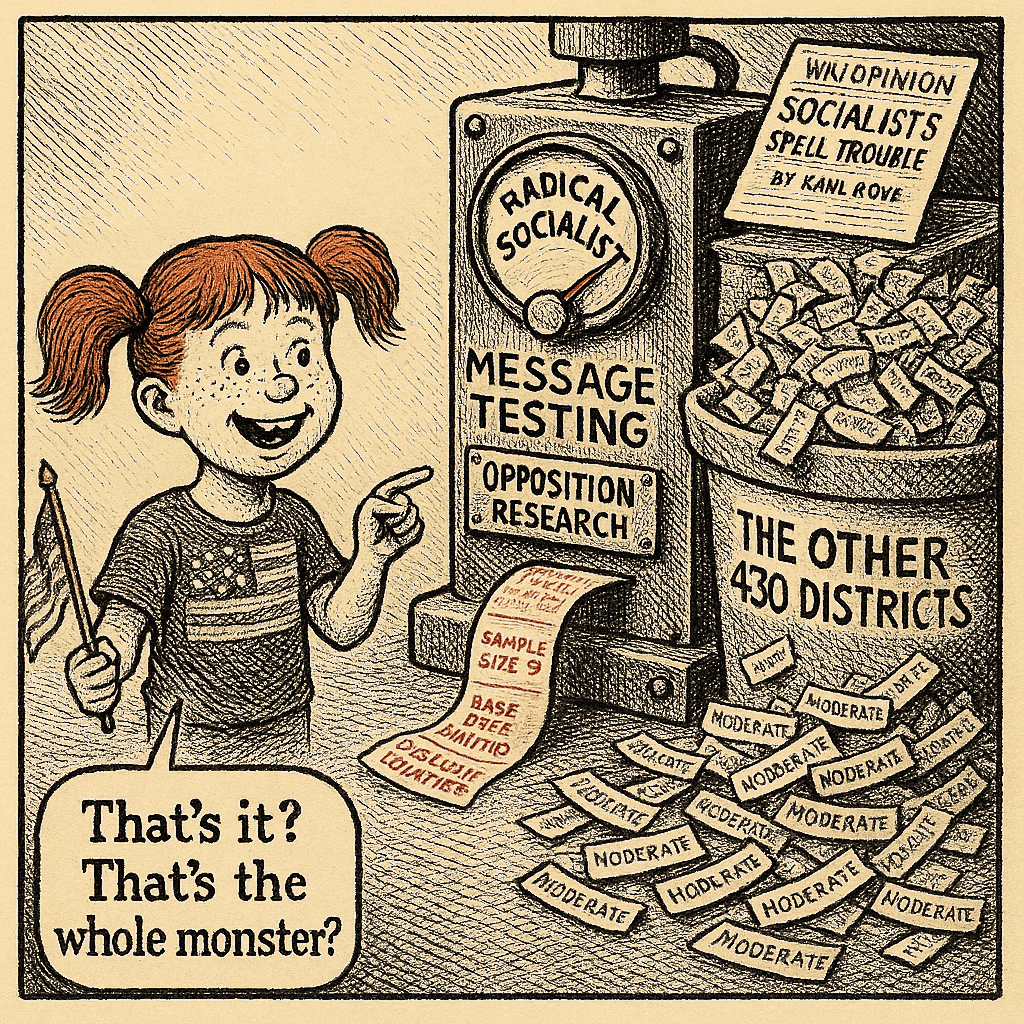
Hasty generalization. The Bad-Faith Techniques Catalog tracks hasty generalization to Govier’s A Practical Study of Argument and to Walton’s argumentation-scheme treatment of inductive generalization: a general conclusion drawn from a sample too small or unrepresentative to support it. Five districts out of 435 House races. The piece generalizes from the five to the Democratic Party in the span of two grafs. The base rate — DSA national membership on the order of 90,000–100,000 out of a Democratic primary electorate in the millions; DSA-aligned caucus at four of approximately 215 — does not support the frame, and so the base rate is absent.
-
Strawman, selectional form. Per Talisse and Aikin’s “Two Forms of the Straw Man” (Argumentation 20:3, 2006), the selectional strawman treats an unrepresentative member of an opposing camp as standing in for all. The piece’s load-bearing example is the most rhetorically available DSA primary winner — Avila Chevalier, whose X posts are the material a Republican opposition researcher would lift — paired with a Yale law graduate whose buried 2013–2014 blog posts are the second-most-available material. Rove does not name moderate Democrats who won primaries in 2026; he names the moderates only once, by category, in the sentence on Rutinel having “beaten a moderate Democrat in the primary.” The strawman is the absent category. The operator’s-eye-view term for this is raising the highest possible contrast to anchor the district’s perception so you do not have to talk about the incumbent’s record — archival material from the most rhetorically available candidate, used to populate the visual field the way a campaign brief specified, not derived from the base rate.
-
The “common sense” / “elite” rhetorical pivot. Per the WSJ Editorial Technique Catalogue’s entry on the common-sense / elite pivot. Rove’s biographical contrast — a former Army Black Hawk pilot and suburban police officer against a Yale-educated vegan-turned-beef-eater — is the WSJ-page classic. A piece of elite authorship positions one side as the reasonable everyman and the other as the elite radical. The piece is written by a former Bush adviser addressing other elite readers. The frame requires that the speaker’s own elite status be invisible and that the opponent’s elite status be the structural fact. The frame is doing exactly the work the catalogue names.
-
No True Scotsman. Per Antony Flew’s Thinking About Thinking (1975), the ad hoc redefinition of a category to exclude counter-examples. The Bad-Faith Techniques Catalog tracks the same move. The piece positions “moderate Democrats” as the legitimate party, with the socialist five as the invader. Rutinel is described as having “beaten a moderate Democrat in the primary” — a single moderation claim whose standard Rove does not apply across the rest of the field. Symmetric application would treat the House Freedom Caucus, the J6 caucus, and the most prominent 2022 GOP primary winners as the equivalent of the DSA five, with the moderates Rove would presumably prefer — the Romneys, the Portmans, the Cheneys — as the silent majority. The standard is asymmetrically applied. The selective-symmetry standard is the NR Editorial Technique Catalogue’s “what about [in-group misconduct]” silence — the magazine’s coverage of in-group corruption, religious-institution scandal, financial impropriety on the right, and personal failings of liberty-frame political figures has historically been thinner than its coverage of equivalent greater-good-paramount conduct — in its cross-coalition form.
-
The acknowledgment-and-dismissal con. Rove explicitly notes that Rutinel “already says he now favors an ‘all-of-the-above energy strategy’” — flagging the moderation to establish the appearance of fair-mindedness, then proceeding to demand the reader judge Rutinel by the buried 2013 headlines anyway. It is the classic move: surface the mitigation to demonstrate you saw it, then run the attack with the archival material anyway.
-
The “pro-life” / “religious liberty” / “election integrity” euphemism cluster analogue. Per the WSJ Editorial Technique Catalogue’s entry on the euphemism cluster. “Moderate” and “reasonable” are applied to Rutinel’s primary opponents; “extreme,” “outrageous,” “radical,” “socialist” to the five winners. The asymmetric vocabulary is the technique. Rove does not use scare quotes for “moderate Democrat” but does for “socialist” only because the candidates named are self-described. The convention holds; the move remains asymmetric.
-
Multiple-audience-targeting. Per the WSJ Editorial Technique Catalogue’s entry on the multiple-audience-targeting analytic. The piece is a clean four-audience execution. The wealthy-and-Republican reader gets confirmation that the Democratic Party is moving left. The political-class reader gets the Colorado-Eighth opposition-research file in walkable form. The populist base gets the Chevalier social-media post that will run in advertising for the rest of the cycle. The technocratic reader gets the 2024 popular-vote numbers as the analytical frame for “narrowly divided.” One piece, four jobs.
-
Coordinated message discipline. Per the Bad-Faith Techniques Catalog’s entry on coordinated message discipline, tracked to the Luntz memos, to Berry and Sobieraj’s The Outrage Industry (Oxford, 2014), and to the broader documented GOP messaging apparatus. The “Democrats = radical socialist” frame is the documented 2026 GOP messaging line. Rove’s piece is the WSJ-side articulation of a frame that runs through NR’s Register A and B pieces (per the NR Editorial Technique Catalogue), through NR Corner posts, through the Congressional Leadership Fund advertising, through the Heritage Foundation and Manhattan Institute commentary. The appearance of the same vocabulary in Rove, in NR, in the Koch-network ads, in Trump-administration statements, in the House Republican Campaign Committee press releases, in the same week, on the same subject, is the textbook case. The message discipline is upstream of the WSJ column, not downstream of it; Rove is reading the polling-tested frame and writing it into op-ed form. The vocabulary has been refurbished over the cycle — the 2004 Bush-era “ownership society” and “compassionate conservative” labels did not survive the post-Iraq environment and the 2008 financial collapse; the 2010s “socialist” frame (then aimed at Obama and Sanders) was tested and partially adopted; the 2026 iteration is the mature, post-Bernie, post-AOC version of the same architecture. Same playbook, updated vocabulary, same author, same publication, same page position.
-
The “as a [identity]” credibility move. Per the WSJ Editorial Technique Catalogue’s entry on the “as a [identity]” credibility move. The piece executes this on the Republican side: Gabe Evans’s biographical record is the credential structure Rove builds the contrast around. The veteran-pilot police-officer is the respectable-identity vessel for the GOP’s CO-8 message, the same way the Hispanic conservative on immigration is the vessel for the immigration frame, the same way the Black conservative on race is the vessel for the race frame. The asymmetric use of identity-vessels is the technique. The op-ed does not name a comparable Democratic identity-vessel — a Black Democrat on policing, a Hispanic Democrat on immigration, a working-class Democrat on trade — because the operation does not want the symmetry surfaced.
-
The threat-inflation closer. Per the WSJ Editorial Technique Catalogue’s entry on the threat-inflation closer. “Game on!” closes a piece whose analytical register was, for ten grafs, the WSJ editorial-page decorum register. The sports-casting closer is the emotion-injection; the analytical room was the cover.
-
Operator’s-eye-view confession. We drafted a memo of this kind for the 2000 and 2004 Bush campaigns, and we wrote a version of the Karl Rove op-ed for the editorial page at the Wall Street Journal in 2003, 2004, and 2005. We sat in the focus-group rooms in Alexandria and Austin where the “compassionate conservative” vocabulary was dial-meter tested against “ownership society” in 2003 and 2004 — we watched the polled voter move on the dial when the message discipline hit, and we wrote the op-ed frame the same week the polling came back. We sat in the meetings where the message-discipline memo went out, where the “moderate Republican / radical Democrat” frame was tested in focus groups, and where the biographical-credential structure for the GOP incumbent was built from the candidate’s military and law-enforcement record. The frame is one we built and one we have seen built many times. The frame is not new; the frame is a 22-year-old piece of GOP opposition-research infrastructure, refurbished for 2026. The 2004-era vocabulary — “ownership society,” “clear skies,” “no child left behind” — was the Bush-Cheney domestic-policy architecture, and the “values voter” frame was the social-conservative wedge; those labels did the same work then that “radical socialist” and “DSA” do now, and the operator who authored them is the same operator writing for the same publication in the same slot. The vocabulary evolves; the playbook does not.
Audience-management function. Grievance ratification (conservative reader gets the confirmation that the Democratic Party is moving left); permission structure (Republican operative gets the WSJ-page cover for the advertising copy); counter-frame (Rove is preempting the Democratic 2026 message by establishing the socialist-marker before Democratic candidates do); identity confirmation (the WSJ conservative reader’s self-image as the reasonable adult in the room). Four moves at once. The four-move execution is what makes it work.
The Record
Anchor receipts. The 2024 popular-vote figures (Trump 49.8%, Harris 48.3%) are from the Federal Election Commission and were reported by the Cook Political Report, AP, and Reuters. The fourth-closest-since-1888 framing is the kind of analytical observation both Sabato’s Crystal Ball and the Almanac of American Politics have made on similar baselines. The Harris margins in NY-7, NY-10, NY-13, and CO-1 (between 56 and 77 points) are confirmable from FEC filings. Avila Chevalier’s X posts — the napkin/flag post is independently reported by Vox, and the broader pattern of expletive-laden posts attacking Harris, Biden, and the country itself is independently reported by MS NOW — are social-media records presented by Rove in-text; the specific Rove-quoted lines (“all cops are bastards,” “this country is a f— disgrace”) are Rove’s in-text transcriptions, and we treat the broader pattern as independently corroborated and the specific phrasings as Rove’s reproduction pending direct platform-archive verification. Rutinel’s past writings on animal agriculture and his 2013–2014 blog headlines (“What Would Jesus Do? Socialism”; “Why A More Socialistic Society Is Superior”) are documented in archived versions of the publications and independently reported by the Washington Free Beacon, the American Almanac, and the Deep Not Shallow Substack — the Free Beacon archive review confirms both titles verbatim and the May 2014 publication dates, and we treat the Rove-quoted titles as accurate transcriptions. Gabe Evans’s biographical record (Army Black Hawk pilot, search-and-rescue and firefighting deployments, ten years as a Denver-suburb police officer, Colorado House, 2024 congressional flip) is on his official House.gov bio and the Colorado Secretary of State filings. The “moderate Democrat” Rutinel defeated in the primary is named in Colorado primary reporting; Rove does not name the candidate — a small but telling omission (the rest of the cast is named; the losing moderate is referred to by category only).
Omitted receipts. The piece does not cite the size of the DSA’s national membership. It does not cite the share of Democratic primary voters in 2026 who chose moderate over socialist candidates. It does not cite the share of House Democratic caucus members who caucus with the DSA-adjacent group. It does not cite the comparable radicalization on the right (the Freedom Caucus’s size and policy positions, the J6 caucus, the share of House Republican Conference members who voted against certifying the 2020 election). It does not cite polling on what the median voter in CO-8 actually thinks about DSA membership in the Democratic caucus. It does not cite the asymmetry of WSJ op-ed page coverage of right-flank radicalization — which is itself part of the operation. It does not cite that the WSJ op-ed page has run pieces by the same author on the same subject at the same framing in prior cycles; the “socialist Democrat” frame is a documented annual op-ed product.
The acknowledgment-and-dismissal pattern. Rove flags that Rutinel now favors an “all-of-the-above energy strategy” — a documented position shift — then proceeds to demand the reader judge Rutinel by 2013–2014 blog headlines. The flag is the appearance of fair-mindedness; the dismissal is the load-bearing move. The technique is the rhetorical cousin of motte-and-bailey — per the Bad-Faith Techniques Catalog’s entry on motte-and-bailey, this is the pattern of advancing a controversial claim and, when challenged, retreating to a related but far weaker and easily defended claim, then resuming the controversial claim once the challenge has subsided. The structure here: advance the archival claim, retreat to the acknowledgment when pressed, resume the archival claim in the closing.
Per-citation verdicts. Rove’s factual claims about the named candidates are accurate at the level the piece operates at, subject to the platform-archive caveat on the specific Rove-quoted Chevalier phrasings noted above (the broader pattern is independently corroborated by Vox and MS NOW). Rove’s claims about the Democratic Party as a whole are not supported by the receipts cited; they are supported by the load-bearing omission of the rest of the party. The piece is not in the “study shows” archetype (per the WSJ Editorial Technique Catalogue’s entry on the “study shows” frame) — there is no single study being cited — but the technique is the analogue at the level of biographical-receipt selection: Rove selects the five districts whose primary outcomes are the most rhetorically useful, treats the five as the universe, and presents the framing without the base rate. The base-rate suppression is the analogue of the Bad-Faith Techniques Catalog’s entry on manufactured controversy in its symmetric form: a manufactured consensus about what the opposing coalition is, assembled by selective attention to a small number of cases.
Missing-information declaration. The exact count of moderate-vs.-socialist Democratic primary winners in June 2026 is not in the public record in a single canonical source at the time of this writing; the prior is well-established in the political-science community and is verifiable from FEC primary filings and from Inside Elections, Cook Political Report, and Decision Desk HQ primary trackers. The biographical records Rove omits (the rest of the Democratic House caucus; the rest of the June 2026 Democratic primary field) are not “leaked memos” in the retained-archive sense; they are the absent frame. The comparable right-flank radicalization is documented in the FiveThirtyEight election-denial tracking, in the House Republican Conference’s own membership roll, in the Brennan Center for Justice and Advance Project reports on election denial, and in the January 6 Select Committee Final Report (2022). The piece does not engage any of these sources.
How to Recognize This
This is the selective-fringe frame: a piece that takes the most rhetorically available fringe of the opposing coalition, names the fringe as the coalition, and treats the rest of the coalition as the operating context. It is a 60-year-old piece of American political rhetoric. The conservative version runs from the John Birch Society’s framing of the Democratic Party in the 1950s through the “McGovern = the Democratic Party” frame of 1972 through the present “DSA = the Democratic Party” frame. The progressive version runs from “Vince Foster / Whitewater = the Clinton administration” in 1994 through “Tea Party = the Republican Party” in 2010 through “MAGA = the Republican Party” in 2024. The structure is the same: pick the most rhetorically useful 1–2% of the opposing coalition, name the 1–2% as the whole, and present the frame without the base rate.
The mechanism: a reader who absorbs the frame as the whole coalition stops having to think about the median voter in the median district, the actual policy positions of the median member of Congress, or the documented symmetry (or asymmetry) of fringe activity on both sides. The frame’s emotional payoff is the felt experience of moral clarity about the opposing coalition; the frame’s political payoff is permission to treat the median voter in the median district as someone who can be reached through the frame. The frame works because the load-bearing omission (the rest of the coalition) is exactly the empirical material the reader would have to look up to falsify the frame, and the reader is not going to look it up.
The media ecosystem’s subsidy structure is asymmetric. The conservative media apparatus — from the WSJ editorial page to National Review to talk radio to Fox prime-time to the Koch-network commentary circuit — heavily subsidizes the DSA-frame when applied to the left: the frame is amplified because it advances an electoral interest. The same apparatus treats the MAGA-frame more selectively when applied to the right: it is deployed for intra-coalition discipline (attacking “RINOs,” “establishment” figures, primary challengers to incumbent Republicans who are insufficiently aligned with the base) but not as a substantive critique of the right’s own radicalization, because the right’s fringe is itself the movement’s base and the base does not want to be critiqued. The DSA-frame is subsidized because it pays an electoral dividend; the MAGA-frame is suppressed when applied to the right because it costs an electoral dividend. The asymmetry is the engine: one frame is cheap to produce and high-yield, the other is expensive to produce and self-damaging. Both media ecosystems converge on the same asymmetry from opposite directions.
Textual signals to recognize it next time:
Read in order — each step tightens the frame:
- A piece names a small number of opposing-coalition figures (single digits; under ten) whose statements or biographical records are the most rhetorically available, and the rest of the opposing coalition is described by category (“moderates,” “centrists,” “the establishment”) rather than by named members.
- A piece pairs a present-tense radical quote from the opposing coalition with a present-tense moderate biographical record from the speaker’s coalition, and the asymmetry of selection is the structural fact.
- A piece uses a contested term (“socialist,” “MAGA,” “extremist,” “radical”) in narrator voice and applies it to the opposing coalition as a whole, with no scare quotes and no acknowledgment of the contested status.
- A piece flags the moderation of the targeted candidate, then proceeds to judge them by the pre-moderation record anyway — the acknowledgment-and-dismissal pattern.
- A piece concludes with a “Game on!”-style closer whose emotional register is sports-casting rather than analytical, signaling that the analytical work above was in service of the contest rather than in service of the reader.
Why it works. The frame is cheap to produce (a small selection of archival material), expensive to refute (the refutation requires a base-rate argument the piece never makes), and structurally self-reinforcing (the same frame appears in the next cycle’s op-eds and advertisements, with the same archival material, and the base-rate refutation is never deployed in the venues where the frame operates).
What to do when you see it. Apply three questions, in order. (1) What is the base rate — how many of the opposing coalition actually fit the category the piece names? (2) What is the comparable category on the speaker’s side, and how does its size compare? (3) Would the piece still work if the same selection were applied symmetrically across the speaker’s coalition? If the answer to (1) is “small fraction,” the frame is the technique. If the answer to (2) is “comparable or larger,” the piece’s selective omission is the load-bearing fact. If the answer to (3) is “no,” the frame is doing exactly the work the WSJ Editorial Technique Catalogue names in its “as a [identity]” credibility-move entry: identity-as-credibility for the speaker’s side, and a single bad example for the opposing side. And then apply the geographic check: does the “extreme” example live in a district where the general election is actually competitive, or is the candidate being used as a prop for a district 500 miles away? Ask what local policy the piece is avoiding by talking about the national party. Check the incumbent’s record. If the piece is entirely about the challenger’s past posts, ask what the incumbent is voting on today.
The frame will not stop. The base-rate argument is not going to be deployed in the venues where the frame operates. The reader who can recognize the frame on first encounter — who knows that “socialist” and “DSA” in a Karl Rove op-ed is the load-bearing label, and who knows that the piece’s analytical authority is the cover for the political-class cover for the advertising copy — that reader is the one who is harder to capture next time. That is the work.
We are bitter about this piece. We are also right about it. The bitterness is the residue of the recognition that the operation is one we helped build; the rightness is in the receipts, the omission, and the catalogued technique. The reader can verify the rightness. The reader does not need to credit the bitterness.

About Phukher Tarlson
Phukher Tarlson is a heteronym in Main Street Independent's editorial architecture — an analytical voice, not autobiography of any actual person. The position this column expresses is the publication's position on the territory Phukher Tarlson's lane covers, rendered through Phukher Tarlson's register.