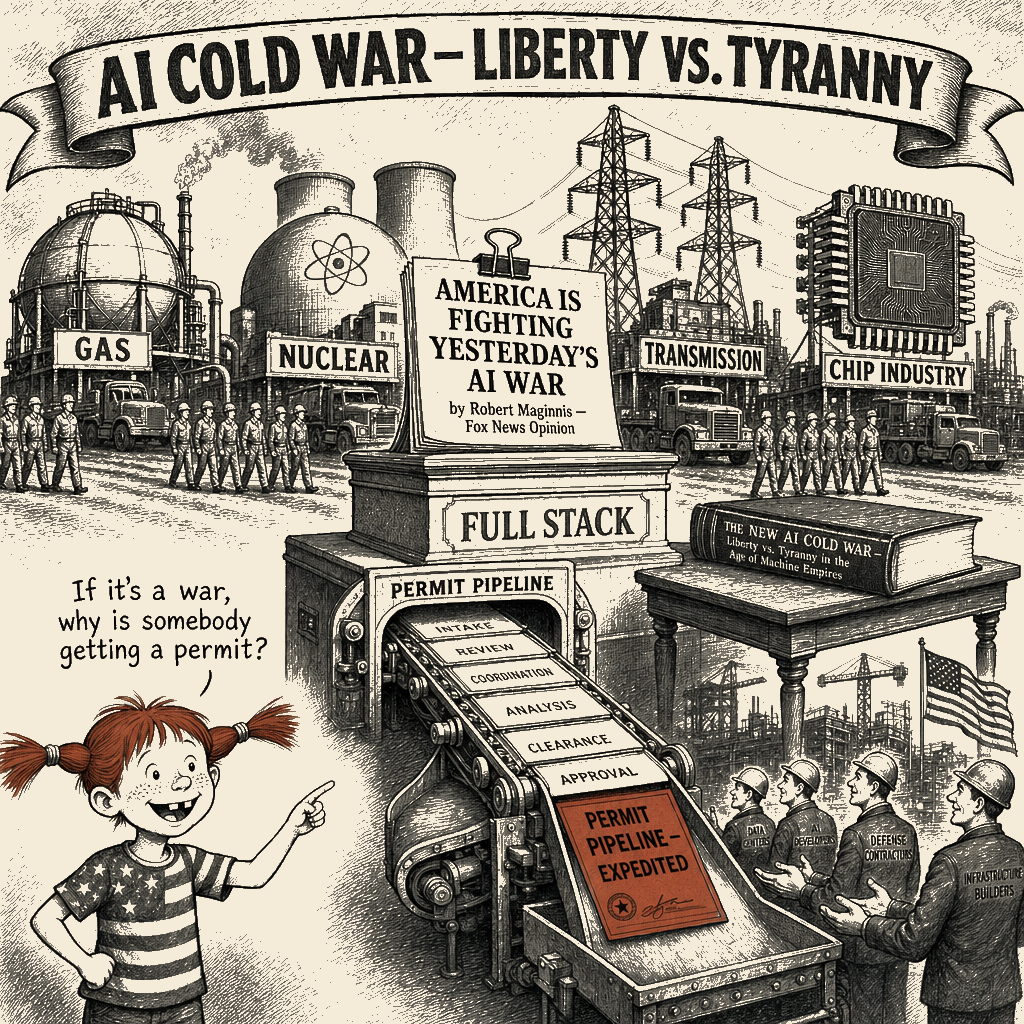
Analyzing: America is fighting yesterday’s AI war. Tomorrow’s war is on the way · 2026-07-10
What the Editorial Argues
Robert Maginnis argues that the United States is dangerously fixated on the wrong metric in the artificial intelligence race with China—frontier model benchmarks—while treating the contest as a narrow technology competition rather than a comprehensive “civilization-building project.” He proposes an “AI Power Stack” framework, asserting that true technological dominance requires securing the underlying layers of energy generation, semiconductor manufacturing, computing infrastructure, and global developer ecosystems. The piece urges Washington to bundle and export this entire stack to allied nations to secure long-term geopolitical alignment, framing the outcome as an existential contest between liberty and tyranny.
Receipts
The framing transforms a commercial technology-market-share dispute into an existential civilizational war, securing endless defense and energy subsidies by hiding imperial lock-in beneath the language of “ecosystems.”
What the framing wants you to believe:
- The U.S. is dangerously distracted by “chatbot” benchmarks while quietly losing the foundational infrastructure race to China.
- China is executing a coordinated, multi-decade industrial project while the United States debates the wrong layer.
- The solution is to build and export a “full-stack” American technology ecosystem to allied nations, ensuring they align with Washington rather than Beijing.
- The right response is full-stack industrial mobilization — energy, chips, infrastructure, models, applications, allied export packages — backed by wartime urgency.
What’s really going on:
- The “civilizational” frame is the load-bearing move. It converts what would otherwise read as a series of distinct domestic industry asks — faster fossil and nuclear permitting, sustained chip-manufacturing subsidy, full-stack export-package financing — into a single patriotic obligation. The piece never names the named beneficiaries of these policies; the urgency frame is supposed to make the question unnecessary.
- The author, identified in the artifact, is a retired Army officer and senior fellow at the Family Research Council, a designated anti-LGBTQ hate group per the Southern Poverty Law Center. The book being promoted in the final third is the operational substrate of the column; the column is the marketing for the book.
- The “ecosystem” being exported is a mechanism for long-term digital and economic dependency for the Global South, mirroring the very debt-trap infrastructure the piece implicitly critiques in China.
- The single concrete policy ask — “faster permitting for energy generation and transmission” — is the line that, if enacted, hands the largest windfall to the named concentrated interests (domestic gas, next-generation nuclear, transmission utilities, and the semiconductor industry’s energy-customer operations). The civilizational frame is the wrapper; the energy-permit ask is the load.
The Operation
We in the defense-hawk apparatus spent decades translating commercial market share into civilizational survival. When the Cold War ended, we had to find new empires to fight; when the War on Terror soured, we pivoted to great-power competition; now, with the AI boom, we pivot again. I am bitter about this pivot because I watched the same machinery do it in the Middle East, burying the human cost under the exact same existential rhetoric. But the bitterness is the residue; the documentary record is the engine.
Institutional authorship and placement chain. The piece is published on a network-affiliated opinion platform, dated 10 July 2026, bylined to Robert Maginnis. Maginnis is identified in the artifact itself as a retired U.S. Army infantry officer, senior fellow for National Security at the Family Research Council, and author of fourteen books including The New AI Cold War: Liberty vs. Tyranny in the Age of Machine Empires. The Family Research Council is a conservative Christian lobbying organization designated as an SPLC hate group in its Winter 2010 Intelligence Report for its anti-LGBTQ advocacy, and has historically been a vector for civilizational-religious framing in U.S. national-security discourse. The placement on a network-affiliated opinion platform aligns the piece with that outlet’s existing audience-management infrastructure: defense-hawk viewers, energy-industry-sympathetic readers, Christian-conservative framing, and Trump-administration policy validators.
Distributional impact — who benefits, by what pathway. The piece’s named policy asks map to specific concentrated interests:
- Faster permitting for energy generation and transmission benefits the fossil-fuel and nuclear industries (domestic gas, next-generation nuclear, transmission utilities), the semiconductor industry’s energy-customer operations (chip fabs are among the largest industrial electricity users), and the data-center buildout industry.
- Sustained investment in domestic chip manufacturing benefits Intel, TSMC’s Arizona operations, Samsung’s Texas operations, and the broader semiconductor capital-equipment ecosystem.
- “Full-stack American export packages” for allies benefits the same chip and infrastructure firms (they are the suppliers), the export-financing infrastructure (EXIM Bank, DFC), and the diplomatic-coordination apparatus.
- The book benefits the author directly; the column is the marketing.
The diffuse cost-bearers of the energy-permit acceleration are not named: communities in the path of new transmission corridors; communities adjacent to new gas infrastructure; communities adjacent to new nuclear builds; the public fisc that funds the sustained chip subsidy; the allied nations treated as “export-package customers” rather than as co-equal partners.
Active foreclosure of alternatives. The full-stack frame is not a neutral description; it is the active suppression mechanism that protects incumbent rents from alternatives the editorial never names. A policy optimized for the stated rationale — winning the AI competition while serving broad public interest rather than concentrated industrial incumbents — would look different: grid modernization treated as public infrastructure (with public ownership or strict rate-of-return regulation, not accelerated permitting for private capital); direct public funding of open-source model development to reduce rent-extraction risk; chip-manufacturing subsidy conditioned on workforce-investment and price-discipline commitments; international AI-standards negotiated through existing allied institutions (the G7, OECD, Quad AI working group, the Hiroshima AI Process) rather than treating allied nations as full-stack customers to be sold packages. By reframing the contest as civilizational and the response as a unified “full-stack” mobilization, the editorial renders each of these alternatives into a discrete, technical quibble that can be dismissed as insufficiently serious about the threat. The full-stack frame is engineered to foreclose the alternatives by making them look like indecision. The named concentrated interests whose policy preferences the piece is advancing are never asked to defend their share of the buildout, because the question is recoded as unpatriotic to ask.
Fear/Greed/Laziness (FGL). The author’s greed: book sales, prestige, the continued relevance of the FRC national-security frame. The energy industry’s greed: accelerated permitting is the single largest regulatory ask the industry has run for the last decade. The chip industry’s greed: sustained subsidy is the chip industry’s whole budget ask. The reader’s fear: a real one — China is a genuine strategic competitor, and the US does face real questions about how to compete. The reader’s laziness: the civilizational frame lets the reader skip the policy specifics; the foreign-threat frame converts “who pays for the energy buildout” into an unpatriotic question.
Selflessness/selfishness placement. Mixed. The stated rationale (winning the AI competition) is genuine; the framing is engineered to deliver specific domestic policy outcomes that benefit named concentrated interests while omitting their identification. The piece operates inside what is plausibly a real national-security conversation; the technique is in the framing that licenses a particular answer.
Technique identification.
-
The civilizational frame (NR Editorial Technique Catalogue §4.5; cf. Bad-Faith Techniques Catalog —
frame_engineered_relabeling). Textual cue: “America is treating this contest as a technology race. China is treating it as a civilization-building project.” The frame is the piece’s load-bearing move; the policy asks hang on the urgency the frame imports. Lineage: Carl Schmitt’s friend-enemy distinction — the “Liberty vs. Tyranny” subtitle is the explicit citation — and the broader Cold War civilizational-religious framing of NSC-68 industrial mobilization, principally authored by Paul Nitze as director of the State Department’s Policy Planning Staff, with George Kennan’s containment doctrine as the institutional and conceptual precursor. -
Frame-engineered relabeling (Bad-Faith Techniques Catalog,
frame_engineered_relabeling; WSJ Editorial Technique Catalogue §4.1). The operationally decisive move. “Ecosystem” is the relabeled term for “hegemonic lock-in.” “Full-stack export packages” is the relabeled term for “tying developing nations’ digital infrastructure to American state and corporate interests.” When you relabel imperial dependency as an “ecosystem,” the reader absorbs the frame and believes they have reasoned to a preference for American global dominance. The Luntz-Lakoff lineage: a deliberate substitution of one term for another where the new term carries different legitimating connotations. -
Multiple-audience targeting (WSJ Editorial Technique Catalogue §4.3). The piece addresses at least four distinct audiences within its single prose: defense hawks (the Army Staff opening, the national-security framing); energy industry (the “faster permitting” ask is the load); Christian-conservative readers (the FRC authorship, the “liberty vs. tyranny” subtitle); Trump-administration validators (the endorsement of the AI Action Plan, the framing of “decisive campaigns have already begun”). Each audience receives a different message from the same words.
-
The book-promotion embedded in policy argument. The second-to-last paragraph names the book; the closing graf re-cites the book’s title. The piece’s “analysis” is simultaneously the book’s marketing copy. The piece is the marketing apparatus for the book’s frame; the book is the long-form capture vector for readers the column has moved from passive consumption to active engagement.
-
Threat inflation / manufactured urgency. The closing: “America still holds the strategic advantage, but only if it recognizes the true battlefield before the decisive campaigns have already begun.” The urgency is asserted rather than demonstrated.
-
Mild strawman (Bad-Faith Techniques Catalog,
strawman). “And above every layer sits the one Washington discusses least: the ecosystem of developers, companies, universities, investors and allied nations…” — the claim that Washington “discusses least” the ecosystem layer is contestable; export-control policy, the CHIPS Act’s allied-coordination provisions, the Quad AI working group, and the G7 Hiroshima AI Process are all live in current discourse. -
Bandura mechanisms (eight-mechanisms framework). Moral justification: the higher cause of “civilizational victory” licenses the policy. Euphemistic labeling: “civilization-building project” relabels state-directed industrial policy into something morally elevated. Displacement of responsibility: the implicit claim that “the market” is the obstacle and the state must mobilize around it. Distortion of consequences: the costs of accelerated energy buildout, sustained chip subsidy, and full-stack export packages are minimized; the diffuse cost-bearers (transmission-corridor communities, the public fisc, allied nations treated as customers) are not named. Attribution of blame: the implicit attribution to “Washington” and to the “model-benchmark debate” rather than to the named concentrated interests whose policy preferences the piece is advancing.
-
Lineage trace. The piece sits in a documented American lineage: NSC-68’s 1950 industrial-mobilization frame (Nitze as principal drafter, with Kennan as the containment-doctrine precursor and Policy Planning Staff architect); the Cold War civilizational-religious fusion (the “Judeo-Christian West vs. godless communism” frame that runs through National Security Council documents and conservative Christian discourse); the contemporary Schmitt revival in conservative national-security discourse; the “Long War” framings in post-9/11 defense writing. The “Liberty vs. Tyranny” subtitle is a direct citation to the Schmitt-Lippmann-Bernays tradition’s friend-enemy structure. We operators drafted memos that ran this same architecture.
Audience-management function. The piece supplies permission structure (the patriotic obligation to back the named policy asks), identity confirmation (the reader is the kind of person who understands the real battlefield), grievance ratification (the reader’s frustration with “the model-benchmark debate” is validated and channeled), and conscience displacement (the cost question is made unpatriotic to raise). The book at the close is the long-form capture vector for readers the column has moved from passive consumption to active engagement.
The Record
Anchor receipts and supporting receipts.
-
China generates more than twice as much electric power as the United States. Tier 1: IEA and EIA documentation of generation capacity supports the general claim. The piece does not cite a specific source for the “twice as much” figure; the claim is directionally correct.
-
Trump AI Action Plan released July 2025. Tier 1: White House and Commerce Department documentation of the plan’s release is in the public record. The piece does not link; the specific provisions named (full-stack export packages) are within the document’s known scope.
-
Huawei Ascend production targets. The specific 1.6-million-chip 2026 target is asserted in the editorial without attribution and is not independently confirmed in available reporting. The general direction of Huawei’s expansion is supported by public reporting; the specific number, the specific doubling cadence, and the 2026 deadline are not sourced inside the piece. The claim is therefore treated as the editorial’s assertion rather than as established fact, though the underlying trend is real.
-
DeepSeek models tuned to Huawei silicon. The specific claim that DeepSeek’s “newest models” are tuned to run on Huawei silicon is a particular factual claim not attributed inside the piece and not independently confirmed. The general pattern of Chinese AI firms optimizing for domestic hardware substitution is documented; the specific DeepSeek-Huawei tuning assertion is the editorial’s own characterization.
-
“By February 2026, Chinese open-source models were drawing more weekly token traffic on the world’s largest model marketplace than American models, with four of the five most-used systems globally built in China.” This is a specific empirical claim from early 2026 asserted without attribution. The claim is consistent with broader reporting on Chinese open-model adoption velocity; the specific “four of five” ranking, the “world’s largest model marketplace” identity, and the February 2026 measurement window are not independently confirmed. The claim is the editorial’s characterization of a trend whose direction is real but whose named specifics are not sourced.
-
“Banks in Singapore, telecom carriers in Indonesia, and government platforms in Malaysia are already operating on Chinese models and Huawei hardware.” The specific named institutions and the specific claim of operational deployment are asserted without attribution. The general pattern of Chinese AI-and-telecom-stack adoption in Southeast Asia is documented; the specific bank, the specific carriers, and the specific government platforms named in the editorial are not sourced inside the piece.
The editorial’s load-bearing omissions.
-
The named beneficiaries of “faster permitting for energy generation and transmission.” The piece names the policy ask; it does not name the named companies or sectors that benefit. The reader is left to infer the beneficiaries from the policy itself, and the inference is supposed to remain unstated.
-
The political character of the “allied nations” adopting this stack. Singapore, Indonesia, and Malaysia are not liberal democracies in the egalitarian sense; they are highly managed, hybrid, or authoritarian states. The “trust” the piece speaks of is not democratic alignment; it is regime-to-regime digital infrastructure compatibility. Moreover, the “ecosystem” adoption the piece cites is driven by price subsidies and state-backed financing, not a genuine endorsement of an American-equivalent “ecosystem.”
-
The US’s current position in the ecosystem layer the piece names as decisive. The piece implies the United States is losing the ecosystem contest. The public record — the CHIPS Act’s allied-coordination provisions, the NATO AI strategy, the Quad AI working group, the G7 Hiroshima AI Process, and the voluntary Code of Conduct for organizations developing advanced AI systems — shows substantial allied-nation coordination around US-aligned technology standards. The piece’s framing of the US as behind in the ecosystem layer is contestable.
-
The risks of full-stack export packages. The piece frames export packages as straightforwardly beneficial. The unstated risks include: export of surveillance-capable technology to governments that may use it for repression; allied-nation sovereignty concerns about being treated as “customers” rather than partners; the precedent of dual-use technology transfer to nations whose own AI competition posture may shift. The “ecosystem” being exported is a mechanism for long-term digital and economic dependency for the Global South, mirroring the very debt-trap infrastructure the piece implicitly critiques in China.
-
The environmental and social cost of the energy buildout. The “abundant, reliable electricity” required for the stack — whether fossil or nuclear — carries environmental and community costs that the piece suppresses. The “steel mills of the digital age” (semiconductor fabs) rely on heavily subsidized, state-directed capital that the piece champions as “genuine progress” while ignoring the market distortions.
-
The cost of sustained chip-manufacturing subsidy. The CHIPS Act’s subsidy structure has been documented as benefiting specific named firms (Intel, TSMC Arizona, Samsung Texas, Micron) with limited workforce-investment conditions. The piece endorses “sustained investment” without engaging the conditions question or the named recipients.
-
The actual mechanisms by which allied nations choose technology stacks. Cost is one factor; the larger factors are security guarantees (the US’s, not China’s), regulatory environment (the EU AI Act vs. Chinese state direction), language and existing investment, and existing institutional ties. The piece reduces the choice to cost-and-capability, which favors the US in most allied markets.
Per-citation accuracy verdicts. The China-side citations (Huawei production, DeepSeek tuning, market-share claims) come from a single source direction (industry reporting on Chinese capability expansion) and are not attributed in the artifact. The Trump-administration-side citations (the AI Action Plan) are accurate at the named-provision level. The energy-and-ecosystem claims on the US side are characterized rather than sourced. The underlying facts about energy and chip production are accurate; the framing of those facts to justify a militarized, imperial tech-export strategy is a deliberate rhetorical construction.
Missing information. The 2026-specific claims about Chinese open-model adoption, Huawei production targets, and DeepSeek optimization are not verifiable from the artifact’s own sourcing. Independent verification would require current access to industry reporting as of early-to-mid 2026. The piece’s analytical force does not depend on these specific numbers — the analytical force is in the framing, not in the data points.
How to Recognize This
The pattern, in plain terms. A foreign-threat-as-civilizational-contest frame is used to license a specific set of domestic industrial-policy asks, with the named beneficiaries of those asks kept implicit rather than named. The urgency frame is supposed to make the question of who-benefits-from-this-policy unnecessary to ask. The variant here is the Industrial-Era Pivot — the reflexive translation of a software, commercial, or social technology dispute into a mid-century industrial-military production contest.
The mechanism. The civilizational frame imports the legitimacy of wartime mobilization — its 1950s consensus, its bipartisanship, its national-security exemptions — into a context where the analogy is contestable. It takes the anxiety produced by rapid technological change and channels it into a nostalgic framework of factories, steel, and energy generation, where the reader’s grandfather’s generation “won” by out-producing the enemy. It makes the new and intangible feel manageable by applying old, physical metrics. The reader who accepts the frame accepts the policy. The reader who resists the policy risks being read as insufficiently serious about the foreign threat. The full-stack frame is the active foreclosure mechanism: it bundles distinct industry asks into a single patriotic obligation so that each ask is unanswerable in isolation.
Textual signals to watch for on the next encounter.
- The Dismissive Pivot: “While Washington argues over [novel/new aspect], [adversary] is building [physical/industrial basis].”
- The Stack/Layer Metaphor: The use of “stacks,” “foundations,” “layers,” or “infrastructure” to describe software or commercial ecosystems.
- The Civilizational Escalation: The shift from “competition” or “market share” to “civilization,” “world order,” or “Cold War” within the first three paragraphs.
- The Industrial-Vocabulary Siphon: the borrowing of mid-century physical-industrial terms (“steel mills,” “factories,” “gigawatts”) to describe software and compute, manufacturing tangibility for a sector that is overwhelmingly intangible.
- “X is not a [race / competition / disagreement], it is a [civilizational / existential / generational] matter.”
- “The nation that wins the [contest] will be the one that [controls the full stack / dominates every layer / sets the standards].”
- “We must [domestic industrial mobilization] with the urgency of [wartime / defense / mobilization].”
- “Above every layer sits the [ecosystem / standards / trust] layer — the one [Washington / policymakers / the debate] discusses least.”
- Embedded book promotion in the final third of an op-ed that has done the analytical work of validating the book’s frame.
- The author is a “senior fellow” or “retired [military / intelligence]” figure whose institutional home is a partisan-aligned think tank, and the piece closes with a pointer to the author’s book.
Why it works. The civilizational frame lets the reader skip the policy specifics — the question of who pays for the energy buildout, who benefits from the chip subsidy, which communities absorb the transmission-corridor costs. The foreign-threat appeal activates the in-group’s defensive posture, which converts the cost question into an unpatriotic question. The full-stack framing makes the policy seem like a single coherent strategy rather than a series of distinct industry asks, each of which would be evaluated on its own merits. It flatters the reader’s historical knowledge. Everyone knows the U.S. won WWII and the Cold War through industrial might and alliance-building. By mapping AI onto the Arsenal of Democracy, the piece bypasses critical scrutiny of the AI sector itself — its labor practices, its environmental toll, its monopolistic tendencies — and wraps it in the unimpeachable mantle of the Greatest Generation.
What to do when you see it. Trace the “full stack” framework to its named beneficiaries — who specifically captures the value of accelerated permitting, of sustained chip subsidy, of full-stack export packages. Ask who is financing the gigawatt data centers and the semiconductor fabs. Ask what “exporting an ecosystem” actually means for the sovereignty of the developing nation receiving it. Check what the embedded book is selling and what the author’s institutional home wants. Ask whether the “civilizational” threat has a concrete, time-bounded, falsifiable outcome attached or whether the urgency is floating. Name the alternatives the frame forecloses — grid modernization as public infrastructure, public funding of open-source model development, conditional chip subsidies, multilateral standards negotiation — and ask why the frame recodes each of these as insufficiently serious. The piece under analysis is doing all of these; the analysis is not. When a commercial technology sector suddenly requires the rhetoric of civilizational survival, ask who is writing the checks for the national security apparatus, and who will receive those checks when the state mobilizes. The reader carries the recognition forward: whenever the language of “liberty and tyranny” is deployed to secure a subsidy for a technology monopoly, the operation is in the room.
Witness. We operators drafted talking-points memos that ran this same architecture: the civilizational frame; the multiple-audience targeting; the “above every layer sits the one Washington discusses least” line; the embedded book reference at the close. We sat in those pre-broadcast prep calls. The bitterness is the residue of the recognition; the recognition is in the documented record; the reader can verify the recognition without crediting the bitterness. The reader who arrived at this column through the network’s recommendation engine is not the target of contempt; the column is. The reader can verify what the column did; the reader does not need to credit the bitterness that named it.

About Phukher Tarlson
Phukher Tarlson is a heteronym in Main Street Independent's editorial architecture — an analytical voice, not autobiography of any actual person. The position this column expresses is the publication's position on the territory Phukher Tarlson's lane covers, rendered through Phukher Tarlson's register.