Responding to: Why the Moreno–Warren Payroll Tax Hike Won’t Fix Social Security — Andrew G. Biggs · 2026-07-09
What the Piece Argues
The piece argues that Social Security reform must choose between raising revenues (higher payroll taxes or a higher wage base) and reducing benefits, and that recent bipartisan proposals — Senator Cassidy’s borrow-to-invest plan and the progressive Moreno-Warren payroll tax hike — are inadequate gimmicks that delay the hard choices. It concedes the long-term shortfall is real, that the program’s structural imbalance is well-documented, and that Congress has failed for nearly four decades to act. It positions the author’s own preferred reforms — an Australian-style flat benefit coupled with workplace supplementary plans, or a progressive fully-funded benefit — as the kind of adult conversation Congress should be having. The piece frames decades of delay as making the eventual fix more painful, and concludes that adopting Cassidy’s leveraged-bet plan would be “a sad commentary on the quality of elected leadership in the United States.”
Receipts
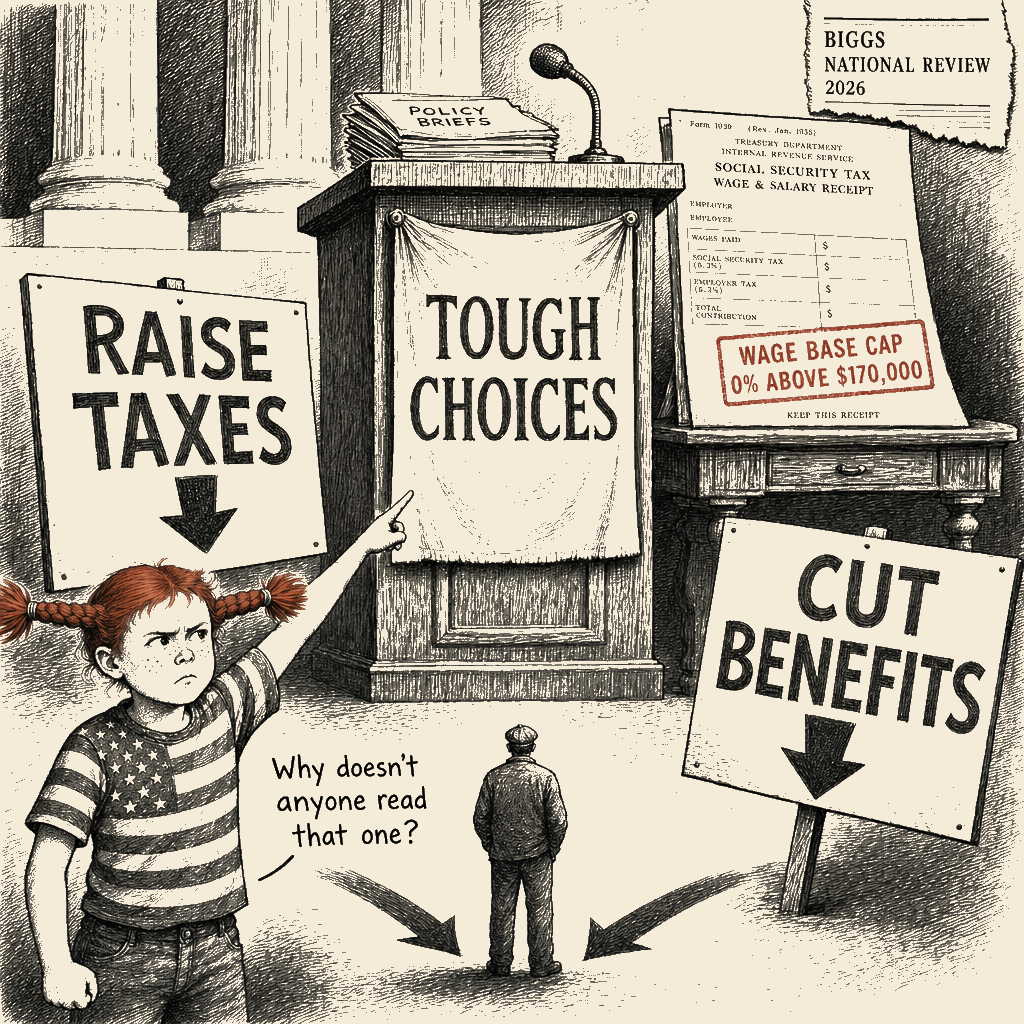
The load-bearing talking point of the piece is the binary frame: “Revenues flowing into the program must increase or benefits must be reduced.” Every reform short of one or the other gets cast as gimmickry. The suppressed fact is that the wage base cap has been the structural choice since the original 1935 Act, and lifting it would do more for solvency than the “tough choices” the piece calls for.
-
The framing wants you to believe:
- The only honest Social Security reforms are raising payroll taxes (legitimate when progressives propose it) or reducing benefits
- Progressive payroll tax hikes like Moreno-Warren’s “won’t fix” the long-term shortfall because they don’t address the structural imbalance
- An Australian-style flat benefit with workplace supplementary plans is one of the “real” reforms Congress should be having
- Cassidy’s borrow-to-invest plan is a “gimmick” because it is functionally a tax increase in disguise
-
What’s really going on:
- The wage base cap (now well above $170,000) means high earners pay 0% Social Security tax on income above it; lifting the cap (per the 2024 OASDI Trustees’ intermediate-cost scenarios) would close a large share of the long-term shortfall, which the binary frame makes invisible
- The piece’s preferred Australian flat benefit reduces the federal guarantee and shifts retirement security to private employers, who do not offer supplementary plans to lower-wage workers
- The “tough choices” frame, in plain English, makes benefit discipline the inevitable shape of “adult” governance and refuses to discuss the cap
- The Pension Obligation Bond structure is genuinely reckless on its own terms — the GFOA’s 2015 paper (cited in the source) puts it bluntly: “State and local governments should not issue POBs.” A federal POB at $1.5 trillion compounds the risk: leverage against equity markets, 75-year duration across multiple business cycles, federal ownership of roughly a third of U.S. equities, and a tail risk that any 2008-style drawdown would force onto the Treasury or onto benefits
- Anchor: Government Finance Officers Association, “An Issue Paper on Pension Obligation Bonds” (2015), cited in the source as warning that borrow-to-invest strategies are “generally considered to be one of the least responsible” — real, well-founded, non-partisan, applies cleanly to the Cassidy plan
The DEFCON Ladder
DEFCON 5 — Polite Reframe
When to use: a good-faith family member or persuadable moderate who has absorbed the “tough choices” frame and wants a calm, fact-based answer.
Here’s something worth sitting with: the article frames any reform short of “raising taxes or cutting benefits” as a gimmick. That framing has a cost. Consider Maria, a home health aide in El Paso who has paid into Social Security every one of her forty years of paychecks, and is now sixty-one and wondering whether the system she was promised will be there at sixty-seven. The “tough choices” frame treats Maria as a budget line. The “taxes or cuts” binary treats her lifetime of contributions as either a tax burden to be raised or a benefit to be cut. Neither framing asks the question Maria has earned the right to ask: who actually designed a system that takes 6.2% of every dollar she earns up to the cap, but nothing on the dollars her employer pays the company’s CEO above that cap? The cap was a choice made in 1935, raised incrementally ever since, and the people who benefit from it are concentrated at the top of the income distribution. Before we ask Maria to choose between higher taxes and smaller benefits, we could ask the people above the cap to pay the same rate Maria pays on every dollar. That’s not a gimmick. That’s what “raising revenues” could look like if it weren’t being framed as something the country can’t afford. The article treats any reform that doesn’t ask Maria first as principled. The principle deserves examination. Social Security is more solvent than the article suggests, and it’s more regressive than the article suggests, and those two facts are not unrelated. We are not a nation that deserts its own when they’re down. We are not a nation that asks the home health aide to choose between her check and her dignity. The framework is rigged. The rigging is the article’s work.
DEFCON 4 — Firm Moral Superiority
When to use: an identity-protective reader leaning into the “tough choices” frame who needs a firm refutation without losing the audience.
The article’s central frame — that any Social Security reform short of higher taxes or lower benefits is a “gimmick” — is doing more work than it admits. It’s defining principled reform downward, by exclusion. Anything that doesn’t fit the binary is cast as cowardice; anything that does is cast as adult leadership. The trick is in the architecture. The author works at the American Enterprise Institute, a think tank that has spent forty years arguing that the Social Security system needs to be made smaller, in roughly the same direction that its donor class’s interests would suggest. The author’s preferred “real reform” — an Australian-style flat benefit with workplace supplementary plans — is, in plain English, a system that reduces the federal guarantee and shifts retirement security into private markets. That’s a position. It’s not a structural fact. The article is at pains to note that what it calls the “progressive” preferred path (raise taxes to fully fund current benefits) is legitimate; it’s also at pains to position that path as one of two options, with the other being benefit cuts. The framing is the argument. Cassidy’s borrow-to-invest plan is a bad idea — the GFOA 2015 POB warning is real and non-partisan, and a federal government owning a third of the U.S. stock market after seventy-five years of leveraged bets is not a small thing. But “Cassidy’s plan is bad” is a different claim from “Cassidy’s plan is bad and the only alternatives are taxes or cuts.” The first is analysis. The second is a frame engineered to make benefit reduction the inevitable shape of “adult” governance. The article’s preferred Australian model isn’t outside that frame; it sits inside it. Reduce the public guarantee. Add a private supplement. Call it reform. The principle on offer is: define “tough choices” so that they always point away from concentrated wealth and toward working people’s benefits. That’s not principled. That’s a posture. The principle deserves better.
DEFCON 3 — Mockery and Ridicule
When to use: a selectively amnesiac partisan who keeps repeating the “tough choices” line in front of mixed company and you want the bystanders to wince.
Imagine: a wage cap. Below it, every dollar your home health aide earns, the government takes 6.2%. Above it, every dollar her employer’s CEO earns — every bonus, every stock vest, every “performance award” — the government takes 0%. That cap was set in the 1935 Social Security Act at $3,000, and the system started collecting on it in 1937. The country has had ninety-one years to lift it. The country has not lifted it. Now comes the article saying the only honest reform is either “raise taxes” (on the aide) or “cut benefits” (to the aide). The cap is not mentioned. Not once. Not in a footnote. Not in a “to be fair.” The cap is sitting right there on the form, the most regressive feature of the entire American retirement system, and the article proposing “tough choices” can’t find a single tough word for the people who chose it. This is what “tough choices” means in this article: tough on the home health aide, tender on the CEO. The author calls Cassidy’s borrow-to-invest plan a “tax increase in disguise.” The cap is a tax cut in plain sight — and the country has been cutting it for ninety-one years. The author’s preferred “Australian-style flat benefit” is a flat benefit, which means it replaces a smaller percentage of low-income retirement than the current formula does, and a workplace supplementary plan, which means the person with the $30 million 401(k) match at their Fortune 500 employer gets a very nice supplement and the home health aide with no employer match gets… whatever she can put in herself. The “tough choices” frame, in plain English: tough on the aide, tender on the CEO, plus a private supplement that scales with the kind of employer you happen to have. That’s not a binary. That’s a heist with a think-tank logo on it.
DEFCON 2 — Aggressive Villainization
When to use: a mixed-to-bad-faith actor performing the “tough choices” frame in a room where you need to land the indictment without losing the room.
The article is a cui bono brief dressed as a budget lecture. Read the institutional authorship: the American Enterprise Institute, where the author holds a chair, has been a consistent advocate for restructuring Social Security in directions that reduce the federal commitment and shift retirement risk into private markets. AEI’s donor base includes concentrated wealth with a documented preference for smaller federal entitlement programs. Read the distributional impact: the article’s preferred “Australian-style flat benefit” with a workplace supplementary plan reduces progressivity in Social Security and concentrates the supplementary benefit on workers whose employers offer generous plans — which is, in plain American, the top half of the income distribution. Read the cost-bearer: the home health aide in El Paso, the warehouse worker in Memphis, the home-care provider in Cleveland, the rural teacher in West Virginia — the people who depend most heavily on Social Security because they don’t have employer pensions and can’t accumulate private savings at scale. They are the article’s “benefits to be reduced.” They are not the article’s “revenues to be raised.” The cap is sitting right there. Ninety-one years of choosing not to lift it. The article can’t find a single tough word for the cap because the cap is the donor class’s win. The hypocrisy exposure is mechanical: the article invokes “tough choices” the way a poker player invokes “the game.” The game is rigged. The rigging is the article’s work. And on the POB itself: the GFOA’s 2015 verdict is non-partisan, the carry cost on a 3.9% borrowing rate against equity returns is uncertain, and a federal POB at $1.5 trillion acquires a third of the U.S. equity market in a single stroke. Even stripped of any motive analysis, that is bad finance, agreed to by the public-finance profession. The article is at least right about that. It is wrong about the only other way out being benefit cuts. The Mirror: this is the same playbook the Social Security “reformers” have run since the 1980s — define “serious” reform as reforms that don’t threaten concentrated wealth, define “gimmicks” as reforms that do. The article is not a budget analysis. It is the institutional voice of a forty-year campaign to make sure that when the country finally does fix Social Security, the fix takes from the aide and not from the CEO. It performs fiscal discipline and delivers distributional discipline. The two are not the same. The article’s been in the business of pretending they are for a long time. The pretending is the column. You have been running this playbook since the 1980s. You know the cap. You have known the cap. You have published papers on the cap. And in this piece, you are pretending the cap is not in the room.
DEFCON 1 — Nuclear Satire
When to use: a bad-faith actor or performative troll who keeps saying “taxes or cuts” like a catechism, and the room is catharsis-hungry.
The “taxes or cuts” frame is the most successful marketing operation in late-modern American politics, and the article is its newest product brochure. Picture the whole pitch deck: an elderly woman in a cardigan sitting at a kitchen table, the narrator’s voice dropping half an octave, the words “tough choices” landing like a verdict. The pitch is that the country has been living beyond its means, that the system is broken, that somebody has to pay. The pitch does not mention the cap. The cap was set in the 1935 Act at $3,000 and took effect in 1937. The cap is the structural choice the country has been making for ninety-one years — every year deciding that income above the cap does not owe Social Security, while income below the cap does. That is a $50,000-a-year home health aide and a $50,000,000-a-year hedge-fund partner standing in the same Social Security line, and the partner pays 0% of his Social Security tax on $49,831,400 of his annual income. The pitch does not mention this. The pitch mentions “tough choices.” The tough choices, in the pitch, are: raise the aide’s taxes, or cut the aide’s benefits. The cap is not a tough choice. The cap is a settled bipartisan bipartisan choice that the pitch would prefer you forget. The article is the pitch, with footnotes. The author’s preferred “Australian flat benefit” is the pitch with a supplementary plan attached — which, in the American labor market, means the senior partner at the firm gets a $200,000 401(k) match and the home health aide gets whatever she can scrape together. The pitch calls this “real reform.” The pitch calls Cassidy a coward. The pitch calls progressive payroll tax hikes insufficient. The pitch calls its own preferred reform “the kind of discussions Congress should be having.” The pitch has had this discussion for forty years. The pitch has, in those forty years, lifted the cap exactly zero times. The pitch is the same pitch the donor class has been running since Reagan’s commission. The pitch is what “serious” reform looks like when “serious” is defined by the people who benefit from making the system smaller. The pitch is a heist with an American Enterprise Institute bookplate on it. The home health aide doesn’t have a think tank. The home health aide doesn’t have a forty-year campaign. The home health aide has the kitchen table. The pitch owns the kitchen table. The pitch would like to keep owning it. You call this “tough choices.” You call the aide’s paycheck the tough choice. You do not call the cap the tough choice. You have not called the cap the tough choice in forty years. You will not call the cap the tough choice in this piece. The pitch you are running is the pitch your donor class has been running since Reagan’s commission. The pitch is the cap. You are the cap.
DEFCON 1+ — Prophetic Indictment
When to use: a reader moved by moral authority with an edge, where the register wants canonical weight rather than pure rage.
There is a thing the prophet Jeremiah diagnosed, and it is on the page in front of us: “They have healed the wound of my people lightly, saying ‘Peace, peace,’ when there is no peace.” The article before us heals lightly. It names the Social Security shortfall. It names the cost of delay. It does not name the cap. The cap is the wound. The cap has been the goddamn wound for ninety-one years, and the article that proposes “tough choices” cannot find in itself a single tough sentence about the people who chose it. The prophet Amos asked what the Lord requires: “to do justice, and to love mercy, and to walk humbly with your God.” The article does not ask that question. The article asks whether the home health aide should pay more in taxes or get less in benefits. The prophet asked whether the merchant cheats with false weights. The article asks whether the merchant can keep cheating with false weights. The prophet said: “Let justice roll down like waters, and righteousness like a mighty stream.” The article says: the waters must be raised or the stream must be cut. The two are not the same sentence. The prophet named the system. The article names the worker. There is a thing the canonical record calls the mote and the beam. The article sees the mote in the home health aide’s tax withholding. The article does not see the beam in the CEO’s untaxed income above the cap. The article sees the gimmick in Cassidy’s borrow-to-invest plan — and on the POB, the article is right: the GFOA’s 2015 warning is non-partisan, and a federal POB at $1.5 trillion is reckless on its own terms. The article, in Ezekiel’s exact image, has whitewashed the wall. The wall has a hole where the cap would go. The article prefers the whitewash to the hole. This is what mending lightly looks like in 2026: a piece in a respectable publication, in a respectable voice, calling for “tough choices” that systematically name the aide and not the cap, calling for “principled reform” that reduces the federal guarantee and increases the supplementary private one, calling for “the kind of discussions Congress should be having” in a country that has had the same discussion for forty years without lifting the cap once. The Jeremiah diagnosis: “They did not know how to blush.” The article does not blush. The article performs fiscal discipline and delivers distributional discipline. The two are not the same. The article is in the business of pretending they are. The pretending is the article. The pretending is the column. There is, in the moral witness record, a phrase for this. The phrase is “the wound healed lightly.” The article heals it lightly. The article is, in this respect, exactly the article it has been for forty years.
DEFCON 1++ — Profane Scorched-Earth
When to use: a reader who needs full catharsis, gloves all the way off, where the entire point is to make the gaslighter flinch.
Okay. So. The “tough choices” frame. The taxes-or-cuts binary. The dignified, principled, adult, fiscal-discipline register in which some motherfucker in a think-tank chair tells the home health aide that she has to choose between a higher tax bill and a smaller benefit check. The home health aide. Who has been paying 6.2% on every goddamn dollar she has ever earned. Who has been doing it for forty years. While the hedge-fund partner above the cap has been paying 0% on every goddamn dollar above it. And the article cannot find a single fucking sentence about the cap. The cap is sitting right there. It has been sitting right there since 1935. It was $3,000. It is now well above $170,000. The country has lifted it ninety-one years’ worth of times, and not one of those times has ever been lifted all the way off. The country is in the cap. The country has been in the cap. The country is in the cap the way a fish is in water — it does not even know the cap is there, because the cap is the water. And the article is in the cap the way a fish is in the water — it does not even know the cap is there, because the cap is the water. The cap is the article’s water. The cap is the article’s air. The cap is the reason the article can talk about “tough choices” while the person above the cap does not even appear in the article’s fucking math. The cap is the heist. The cap is the entire heist. The cap is the ninety-one-year heist. And the article is in the heist, and the article is performing the heist, and the article is calling the heist “tough choices,” and the article is calling the people who notice the heist “cowards” and “gimmickers” and “progressives who don’t understand the math.” The math. The article is going to do the math. The article is going to do the math on the home health aide. The article is going to do the math on the home health aide’s tax bill. The article is going to do the math on the home health aide’s benefit check. The article is not going to do the math on the cap. The article is not going to do the math on the CEO’s untaxed income. The article is not going to do the math on the ninety-one years of bipartisan, bipartisan, motherfucking decision to keep the cap exactly where the donor class wants it. And even on the POB — which the article does get right, in its way, because the GFOA 2015 paper is non-partisan and the carry cost is uncertain and a federal POB is bad finance on its own terms — even on the POB, the article still won’t name the cap. Even on the part of the critique where the article is at its most fiscally adult, the article is still calling the home health aide’s check the tough choice. The Australian flat benefit. The Australian flat benefit. The Australian flat benefit is what the article calls “real reform.” The Australian flat benefit reduces the federal guarantee. The Australian flat benefit adds a workplace supplementary plan. The workplace supplementary plan is the kind of plan that a Fortune 500 company offers its senior partners. The workplace supplementary plan is not the kind of plan that a 24-hour home care agency offers its home health aides. The workplace supplementary plan is, in plain English, a fucking ladder that scales with the kind of employer you happen to have. The home health aide’s employer does not have a supplementary plan. The home health aide’s employer has a 401(k) match that the home health aide cannot afford to contribute to because the home health aide is paying 6.2% of every dollar to Social Security and her employer is paying 6.2% of every dollar to Social Security and the home health aide’s rent went up 30% last year and her grocery bill went up 22% last year and the home health aide is not in a position to make voluntary contributions to a supplementary plan. The Australian flat benefit is a flat benefit, which is, in the American labor market, a fucking ticket to a smaller Social Security check for the home health aide and a larger supplementary plan for the senior partner. The article calls this “the kind of discussions Congress should be having.” The article has been having this discussion for forty fucking years. The article is not, despite the article’s own self-image, in the business of having discussions. The article is in the business of delivering the distributional outcome the donor class prefers, in the vocabulary the donor class prefers, on the timetable the donor class prefers, with the cap left exactly where the donor class prefers it. The article is a fucking heist with a think-tank logo on it. The heist is the cap. The heist is the article. The article is the cap. You have been running this playbook. You have been running it for forty goddamn years. You have published papers on the cap. You have written, in the very same AEI tradition, that the cap is regressive. You have known the cap is the answer. You have known the cap is the entire answer. And you have, in this piece, in this motherfucking piece, pretended the cap is not in the room. The cap is in the room. The cap has been in the room since 1935. You are in the cap. The cap is in you. Goddamn.

About Malcolm Little King
Malcolm Little King is a heteronym in Main Street Independent's editorial architecture — an analytical voice, not autobiography of any actual person. The position this column expresses is the publication's position on the territory Malcolm Little King's lane covers, rendered through Malcolm Little King's register.