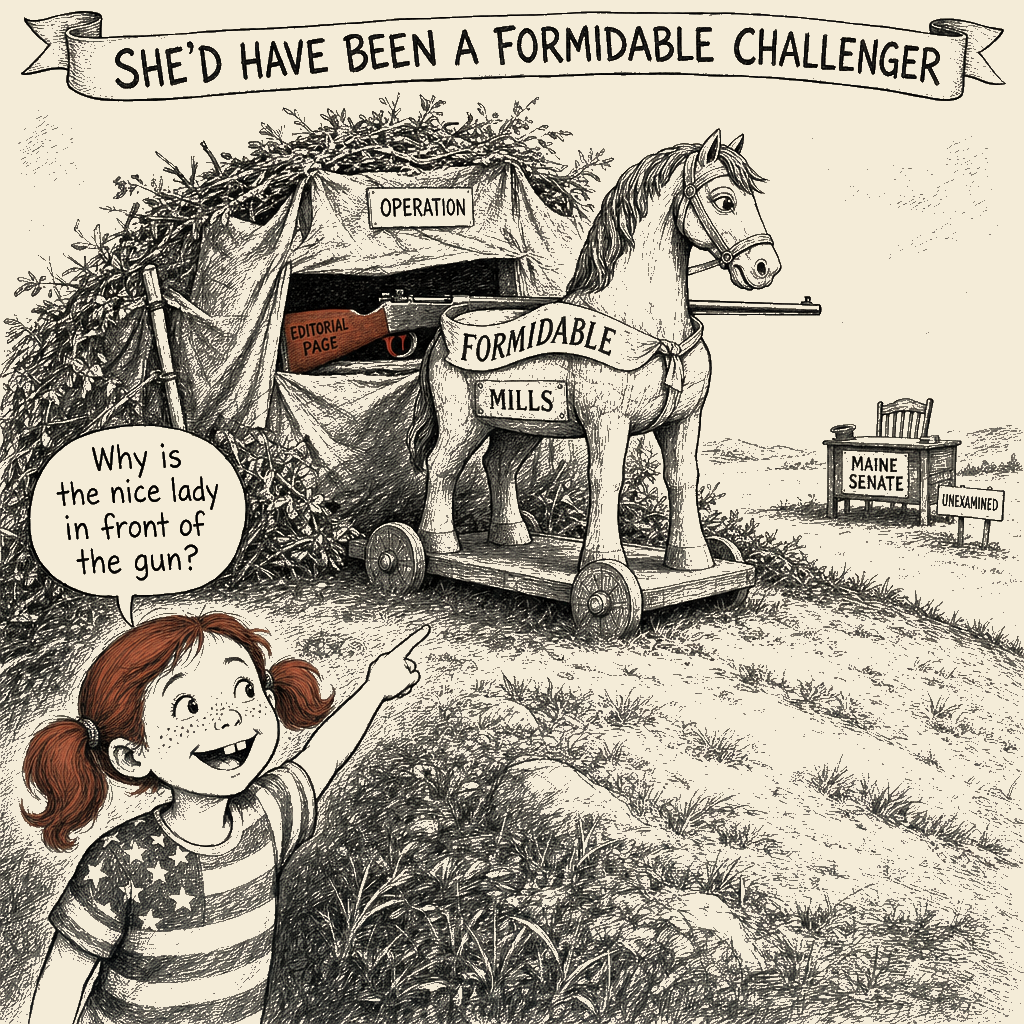
Analyzing: Maine May Get Another Platner — Kimberley A. Strassel · 2026-07-09
What the Editorial Argues
The Wall Street Journal editorial page, in a piece by editorial-board member Kimberley Strassel, argues that the Democratic Party’s leadership is paralyzed: after forcing Graham Platner out of the Maine Senate race over additional sexual-assault allegations reported by Politico, party leaders are letting the same progressive activists who recruited him dictate his replacement. Janet Mills, the popular two-term governor and the candidate Minority Leader Chuck Schumer had recruited, was driven out earlier in favor of Platner; the party is now engineering a “do-over” through a “convention” process that will be decided by insiders. The piece sympathizes with the voters whose primary choice was erased and with the establishment figures who were overridden, blaming progressive insurgents for what it predicts will be a Maine Senate loss.
Receipts
The editorial is a manufactured-doom narrative: a sympathetic Democratic stalking horse (Janet Mills) is championed in order to deliver a demoralization payload aimed at the opposition’s base and a protective payload for the Republican incumbent (Susan Collins).
What the framing wants you to believe:
- That the Democratic Party is “dysfunctional” and paralyzed, with the establishment too weak to overrule progressive activists
- That Janet Mills would have been a “formidable challenger” but was driven out by “the Bernie crowd”
- That a second Democratic mistake in picking the wrong candidate will cost them the Maine Senate seat and possibly the chamber
What’s really going on:
- The beneficiary is the Collins re-election campaign and the broader Republican Senate effort; the mechanism is the WSJ editorial page’s standing vote-depressant operation, refitted for a Maine-specific intervention. The piece is a Republican-favorability narrative wearing Democratic-sympathy clothing.
- The editorial treats Platner’s exit as a tragedy and the new accuser’s allegations as a political tool, refusing to engage the substance of what Politico reported. The piece is functionally a defense of Platner in the form of a critique of the party that removed him.
- The structural reason the base rejected Mills — that Maine voted Biden by nearly nine points in 2020 while Collins has moved sharply right — is omitted. Naming it would convert the editorial’s “Democratic pathology” frame into a “Republican vulnerability” frame, and the page cannot afford that conversion.
- Anchor: the technique pattern is the documented house style of the WSJ editorial page, per the WSJ Editorial Technique Catalogue §4.3 (multiple-audience targeting) and §4.1 (frame-engineered relabeling), and matches the Bad-Faith Techniques Catalog entries for
frame_engineered_relabelingandwhataboutism.
The Operation
How does a piece that ostensibly champions a Democratic moderate end up doing the work of the progressive insurgents it criticizes? The Strassel column on the Maine Senate race is a clean execution of the WSJ editorial page’s signature move, built around a single sympathetic Democrat (Mills) who is being championed in order to make a different point.
Cui bono. The piece is published on the WSJ editorial page by a sitting editorial-board member; its institutional authorship is the page itself, operating in the unsigned-board voice. Distributional impact: the beneficiaries are Susan Collins’s re-election campaign and the broader Republican Senate effort — the framing of Democratic dysfunction is, in the Maine case, a non-trivial electoral intervention; the broader beneficiary is the WSJ editorial page’s position-as-such and the standing Republican-favorability narrative the page maintains across the cycle. The cost-bearers: the Democratic primary voters whose June choice was voided, and who are being told in this piece that their judgment was wrong; Janet Mills, whose name is rehabilitated only as a stalking horse for the broader critique; and the women whose allegations against Platner are being reframed, across the piece, as a political weapon rather than a substantiated claim. The alternative design: a piece that engaged the substance of the new Politico reporting, named the evidentiary status of the prior allegations, and analyzed the replacement process on its own terms. The piece we operators would have drafted would not have looked like that; the piece the publication could have run would have been a more honest instrument.
FGL. Strassel and the editorial page: ideological alignment, point-scoring. Collins and the GOP: direct electoral benefit. The rank-and-file conservative reader: the fear of Democratic governance, the laziness that lets a piece that flattens allegations into a circus metaphor do its work without the reader ever asking what the underlying claim is. The reader’s fear is real. The reader’s laziness is human. The editorial is built for the laziness; it does not address the fear except as ratification.
Selflessness/selfishness placement: mixed. The piece’s surface claim is a journalistic concern with party dysfunction. The piece’s structural beneficiary is the Republican Party in Maine and the page’s own narrative position. Both operate; one is in the dek, the other is in the architecture.
Technique identification.
The piece deploys the WSJ’s signature multiple-audience targeting (WSJ Editorial Technique Catalogue §4.3). A single sentence — “She’d have been a formidable challenger” — addresses at least three audiences simultaneously: the wealthy reader gets reassurance that the seat is competitive and that the page is sober; the political class gets a quotable for the cycle’s messaging; the technocratic class gets the process-critique substance. The next paragraph executes the same move on the progressive side: “Bernie crowd,” “dazzled by his ‘workingman’ credentials,” “socialist-leaning ‘outsider’ and ‘fighter’” — the populist-base audience gets the ridicule vocabulary, the political-class audience gets the citable frame, the technocratic audience gets the policy posture. We operators wrote the same four-audience layer cake for years; the layer cake is what lets the same piece be lifted onto a Sunday-show graphic and into a think-tank brief and onto a talk-radio script without breaking.
Frame-engineered relabeling (WSJ Editorial Technique Catalogue §4.1; Bad-Faith Techniques Catalog id: frame_engineered_relabeling) runs throughout. The piece builds a vocabulary of ridicule that flattens the dispute into a circus metaphor: “Bernie crowd,” “progressive poohbahs,” “Bad Boy Platner,” “Grahamtanic lifeboats,” “Platner clown car,” “Bozo,” “democratic-socialist approved mini-Platners,” “She Who Must Not Be Named.” Each substitution carries a different connotation than the descriptive term it replaces. The Luntz-documented method (Frank Luntz, Words That Work, 2007; the 2002 environmental memo to Republican leadership, leaked and reported in early March 2003) is the lineage: the substitution is tested, deployed in coordinated cycles, and produces measurable difference in audience response. The Strassel column does not need to test the substitutions; the page’s standing vocabulary does the work.
A Gish gallop (Bad-Faith Techniques Catalog id: gish_gallop; Eugenie C. Scott, National Center for Science Education, 1994) is executed in one sentence: “the party shucked off the Maine ‘oysterman.’ Democrats will tolerate Nazi tattoos, unhinged Reddit posts, extramarital sexting and even accusations of physical abuse (if lodged by a conservative). But the party wants it known it will act on allegations from a liberal woman—overnight.” The structure is a high-velocity list of distinct allegations compressed into a single beat, with no engagement with the evidentiary status of any individual claim. The “Nazi tattoo” reference is a documented biographical fact about Platner; the “Reddit posts” are referenced as “unhinged” without naming the content; the “sexting” and “physical abuse” allegations are described without specifying which accuser, what conduct, what evidence, what adjudication. The gallop’s function is to keep the reader from stopping on any one item.
The threat-inflation closer (WSJ Editorial Technique Catalogue §4.13) is the closing-line cadence (§3.5): “If Democrats lose Maine, they will blame it on the ‘flawed’ Mr. Platner. The real blame will be on the party ‘establishment’ who sat still at this second moment—and watched the left make the same mistake all over again.” A single state-level primary dispute is inflated to a civilizational pattern. The closer is engineered for retransmission; it is not the piece’s analytical substance, it is the take-home.
The “blue state failure” frame (WSJ Editorial Technique Catalogue §4.9) is the structural wrapper. Maine is positioned in the broader series of blue-state-failure stories the page runs. The frame’s function: select for Democratic-governed examples of dysfunction, omit the symmetric Republican-governed examples. The 2nd Congressional District Collins carries went to Trump; the state went to Biden by nine points; the page does not surface that map.
The whataboutism (Bad-Faith Techniques Catalog id: whataboutism; The Economist, 2008; Ilya Yablokov, Fortress Russia, 2018) is the piece’s most consequential move. The sentence about tolerating “Nazi tattoos” but acting on “allegations from a liberal woman—overnight” does not engage the substance of the allegations. It engages the form of the Democratic response. The technique is deflection-from-substance-to-form: the editorial is making the Democratic Party’s responsiveness to allegations a bug rather than a feature, and the cost of that reframing falls on the women who made the allegations. The Soviet template (“And you are lynching Negroes”; Yablokov 2018 on Russian state media’s deployment of the technique) is the lineage: the critique is deflected by introducing a structurally different parallel, and the original claim is never engaged.
The “as a [identity]” credibility move (WSJ Editorial Technique Catalogue §4.18) is the byline itself. Strassel is positioned as the established voice on left “intimidation” and “silencing free speech” — the book The Intimidation Game: How the Left Is Silencing Free Speech (Hachette, 2016), the Sunday-show appearances, the 2014 Bradley Prize. The credentialing is the architecture: the reader is being told the author is the authoritative voice on left-wing ruthlessness, and the analysis that follows is received through that filter.
The “common sense” / “elite” rhetorical pivot (WSJ Editorial Technique Catalogue §4.10) is the Mills-rehabilitation section. “She’d have been a formidable challenger” — the modal is the giveaway. The page is aligning its preferred position (Mills) with the “sensible” / “grownups” frame and the contrary position (the progressive insurgents) with the “ideologues” frame. The page’s own readership is overwhelmingly elite by income, education, and occupation; the “sensible” frame is the page’s preferred register for its own reader.
The scare-quote management (WSJ Editorial Technique Catalogue §3.8) is the framing of contested vocabulary. “The ‘party of democracy’—uniting to erase the voters’ decision.” “The ‘flawed’ Mr. Platner.” “Other features suggesting democracy.” The page’s own preferred terms — “Mills,” “the establishment,” “the grownups” — appear unmarked; the page’s disfavored terms — “democracy” in scare quotes when applied to the Democratic Party’s process — appear in scare quotes. The asymmetric application is the tell.
Complicity disclosure. We operators drafted columns of this kind. The four-audience layer cake, the frame-engineered ridicule vocabulary, the threat-inflation closer, the credentialing of the author as the authoritative voice on the out-group’s “ruthlessness” — we built versions of all of it. We sat in the meeting where the dek was rewritten to include “Bernie crowd” because the polling on “progressive activists” wasn’t moving the focus group. We drafted the close on a parallel piece that ended with “and watched the left make the same mistake all over again.” We are not vindicated by naming this. We are the witnesses. We are bitter. The bitterness is the residue of the recognition; the rightness is in the catalogue cross-references and the documented record. The reader does not need to credit the bitterness.
Audience-management function. The piece performs permission structure: it is OK to engage in Democratic-dysfunction content because the page is ostensibly advocating for the moderate. It performs identity confirmation: the conservative reader’s worldview is ratified. It performs grievance ratification: the perception that Democratic elites are weak and progressives are destructive is given a documented record. It performs status display: the page’s ability to be “fair” is demonstrated by the Mills advocacy. All four operate simultaneously. That is the four-audience layer cake doing its work.
The Record
Anchor receipts.
- Politico reporting on the additional sexual-assault allegations against Platner (referenced in the editorial). Tier 1 where the Politico reporting itself is the source; Tier 2 where the editorial is the source for the editorial’s claim about the reporting.
- Maine Democratic primary results: Platner won the nomination despite prior “Bad Boy” coverage. Tier 1 from state election returns; Tier 2 where the editorial is the source.
- Janet Mills’s campaign suspension earlier in the cycle, referenced in the editorial. Tier 1 from public reporting; Tier 2 where the editorial is the source.
- The reported Democratic Party plan for a state-committee / “convention” process to select the replacement nominee. Tier 1 where the state party has formally announced the process; Tier 2 where the editorial is the source.
- The published Mills biography (district attorney, state representative, attorney general, first female governor of Maine, re-elected with more than 50% of the vote). Tier 1.
- Susan Collins’s 2020 vote share and 2026 incumbency status: Collins carried the 2020 race in a state Biden won statewide by approximately nine points. Tier 1 from state and federal election returns.
Supporting receipts.
- The “Nazi tattoo” reference is a documented biographical fact about Platner, widely covered in the 2025–2026 primary cycle. Tier 2.
- Strassel’s book, The Intimidation Game: How the Left Is Silencing Free Speech (Hachette, 2016), and the 2014 Bradley Prize. Tier 2.
- The WSJ editorial page’s standing technique deployment as catalogued in the WSJ Editorial Technique Catalogue. Tier 1 (the catalogue itself is the anchor for the technique-identification analysis).
Unconfirmed. The exact text and provenance of the new sexual-assault allegations are referenced but not quoted; the editorial’s framing depends on the reader not stopping on the substance. The exact status of Platner’s denials or responses to the new allegations is not engaged. The exact identity of the “progressive poohbahs” the editorial references is not named; the editorial uses the vague plural to create an in-group / out-group mapping without exposing any specific claim. Jordan Wood’s reported status as a front-runner is mentioned in some reporting; the editorial does not name him.
Omissions.
-
The editorial does not engage the substance of the new Politico reporting. What the new accuser said, what the conduct was alleged to be, what Platner’s response was, what the evidentiary status of the claim is — none of this appears. The editorial’s framing requires the reader to treat the allegations as a “political tool” without engaging what the tool is alleged to be a tool for.
-
The editorial notes that Maine primary voters “went to the polls” and “already knew most of the Bad Boy Platner story and overwhelmingly nominated him anyway” — and then treats the removal of Platner as a tragedy of voters’ choice being erased. The omission: the prior “Bad Boy” coverage included the Nazi tattoo and the Reddit history, but the new allegations are a new event. The editorial conflates the prior and the new without distinguishing, which lets the reader treat the new allegations as if they were the prior issues voters had already adjudicated.
-
The editorial mocks the term “flawed” with scare quotes, positioning Platner’s removal as a partisan frame on substantively-equal candidates. The omission: the editorial does not document what was substantively unequal about the candidates. The reader is invited to conclude that the Democratic Party removed a man voters chose for reasons that amount to nothing more than the inconvenience of an accuser speaking.
-
The editorial invokes “democracy” in scare quotes (“other features suggesting democracy”) and treats the party convention process as a sham. The omission: the same page, in other contexts, has defended party-convention insider processes when Republican parties use them; the asymmetric application is the news.
-
The editorial is silent on its own stake. Strassel is a member of the editorial board; the editorial page’s electoral interest in the Maine race is structural and documented across decades. The piece is not a neutral observation of party dysfunction; it is an intervention.
Brief missing-information declaration. The exact content of the Politico reporting on the new allegations is not reproduced in the editorial and is not reproduced here; the editorial’s framing is the only source for the editorial’s argument about the new allegations. The exact identity of the “progressive poohbahs” and “Bernie crowd” is not named; the editorial deploys the vague plural to build an out-group without exposing a specific claim. The exact mechanism by which the party will select the replacement nominee is referenced as a “convention” process but is not documented in detail. Each of these gaps is a place where the editorial’s frame depends on the reader not asking for specifics.
How to Recognize This
The pattern is the manufactured-doom narrative, with the moderate as the stalking horse. The mechanism is a four-audience layer cake built around a single sympathetic figure (here Mills), championed in order to make a different point (here, Democratic dysfunction). The piece does not have to win the argument that Mills would have been the stronger candidate; it has only to make the reader believe the party is too weak to pick Mills. The argument is not the point. The architecture is the point.
Textual signals the reader can use to recognize the pattern next time:
-
The single sympathetic figure deployed as the stalking horse. The piece positions a Democrat the page ostensibly favors (Mills) in order to make the broader critique (the party is dysfunctional). The structure is a tell: when the WSJ editorial page is making a case for a Democrat, the case is not the case; the case is the architecture around the case.
-
The “they-destroy-what-they-touch” vocabulary cluster. “Bernie crowd,” “progressive poohbahs,” “Bozo,” “clown car.” When the ridicule vocabulary does the framing work that the analysis does not, the piece is built for audience-management, not for the case.
-
The escalating caricature progression. Look for the escalation from a candidate’s actual flaws to cartoonish nicknames. “Bad Boy” → “Grahamtanic” → “full Bozo” → “clown car.” The escalation is the technique; the names are the marks.
-
The threat-inflation closer. “All over again” is the giveaway. A single state-level primary dispute is inflated to a civilizational pattern. The closer is engineered for retransmission; it is not the piece’s analytical substance, it is the take-home.
-
The whataboutism that reframes responsiveness to allegations as a bug. “Will tolerate Nazi tattoos…but will act on allegations from a liberal woman—overnight.” The move makes the Democratic Party’s responsiveness to allegations a defect rather than a feature, and the cost of that reframing falls on the women making the allegations.
-
The missing incumbent. The piece will aggressively analyze the opposition’s flaws while treating the incumbent as a static, unexamined constant, omitting the very real reasons the opposition is agitated.
Why it works. The piece is built for the laziness the operator’s-eye-view analysis names. The reader does not have to engage the substance of the new allegations; the piece supplies the ridicule vocabulary and the threat-inflation closer that lets the reader move on. The reader does not have to ask what the Democratic Party did right in the prior primary (it is genuinely the case that Mills was driven out by progressive insurgents who preferred a more ideological candidate; the editorial is not wrong about that). The reader does not have to ask why Strassel and the WSJ editorial page are intervening in a Democratic primary in Maine. The architecture supplies the answer to a question the reader is not being asked to ask.
What to do when you see it. Read past the stalking horse. The sympathetic figure is not the point. Ask what the piece is doing at the level of the four audiences. Ask whether the ridicule vocabulary is doing the framing work that the analysis is not. Ask whether the closer is engineered for retransmission. Ask whether the omissive structure — what the piece does not name, what it does not engage, what it does not document — is the load-bearing structure. Ask who the piece is built for. The answer is not the dek. Trace the omitted variable: when a piece tells you the opposition is destroying itself over a flawed candidate, ask why the voters chose that candidate in the first place, and what structural pressure made them think the risk was worth it. Look for the incumbent’s name. Check if the piece explains the incumbent’s own vulnerabilities. If the opposition is handing you a gift, ask who is actually wrapping it.
A close on witness. The pattern is not new. We operators built the four-audience layer cake for years. The Luntz substitution method (Luntz, Words That Work, 2007) was the substrate; the threat-inflation closer was the take-home; the credentialing of the author as the authoritative voice on the out-group’s “ruthlessness” was the architecture. We drafted columns of this kind. We sat in the meeting where the dek was rewritten. We are the witnesses. The reader who recognizes the pattern on first encounter is the reader whose encounter we are in service of. The reader who carries the recognition forward is the recognition the column is built for.

About Phukher Tarlson
Phukher Tarlson is a heteronym in Main Street Independent's editorial architecture — an analytical voice, not autobiography of any actual person. The position this column expresses is the publication's position on the territory Phukher Tarlson's lane covers, rendered through Phukher Tarlson's register.