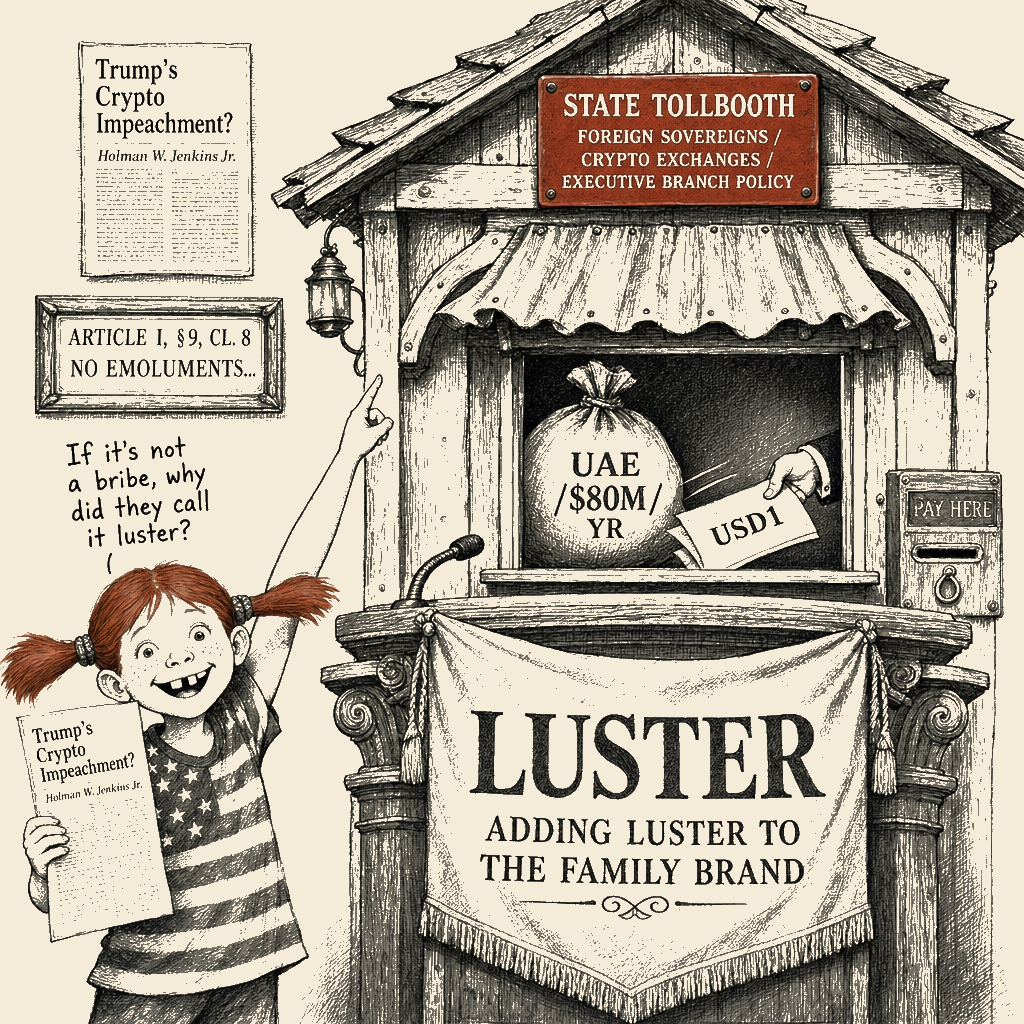
Analyzing: Trump’s Crypto Impeachment? — Holman W. Jenkins, Jr. · 2026-07-07
What the Editorial Argues
The piece argues that any Democratic attempt to impeach the sitting president over his crypto dealings will fail politically because Trump is a “known quantity” voters already accepted. Trump’s crypto earnings, newly disclosed at $1.4 billion, and his reported deals involving the United Arab Emirates and the crypto exchange Binance, including one transaction denominated in a Trump-issued stablecoin potentially worth $80 million a year to him and his partners, are presented not as constitutional crisis but as the kind of “luster” the family brand has always cultivated. The piece argues impeachment as a constitutional sanction has degraded into a political weapon wielded by both parties; that Democrats have their own credibility deficits to overcome before they can credibly impeach; and that the electorate has already internalized the Trump experience and will not be moved by new evidence of his profiteering. The analytical weight sits not on whether the conduct is impeachable but on whether impeachment will work, with the implicit verdict that it will not.
Receipts
The piece performs a single load-bearing maneuver: it names documented presidential profiteering in a paragraph and then recodes it as brand entertainment, while pivoting analytical weight to Democratic dysfunction.
What the framing wants you to believe:
- Trump’s $1.4 billion in crypto earnings and his UAE-Binance deals are brand-building, not constitutional corruption.
- Impeachment has degraded into political theater — “warring infomercials” — and the question is whether it will work, not whether the conduct is constitutional.
- Both parties have weaponized impeachment; Democrats have their own “shambolism” and need to demonstrate trustworthiness before they can credibly impeach.
- The electorate has internalized Trump and will not be moved by new evidence of his profiteering.
What’s really going on:
- The piece does not engage the Foreign Emoluments Clause (Article I, Section 9, Clause 8) or the Domestic Emoluments Clause (Article II, Section 1, Clause 7) — the constitutional texts that most directly speak to the conduct described. Gerald Ford’s 1970 remark is deployed not as constitutional analysis but as a closure device emptying impeachment of any substantive content.
- The vocabulary for the sitting president is soft and almost affectionate — “known quantity,” “usually wins,” “luster,” “reality show,” “lamer duck.” The vocabulary for Democrats is sharper — “shambolism,” “militants,” “internecine battles,” “barf bag,” “forlorn quality,” “odor.” The asymmetry supplies the permission structure; the formal both-sides equalization (the “as much as it has Mr. Trump’s” gesture) dissolves on contact with the specific examples the piece actually deploys.
- “Russia collusion hoax” is deployed in narrator voice as fact-descriptor. The documentary record is substantial — the Mueller investigation produced indictments and convictions of Trump campaign officials (Manafort, Gates, Stone, Papadopoulos); the Senate Intelligence Committee’s multi-volume report documented Russian interference at scale and contacts between Russian intermediaries and Trump campaign personnel; the January 2017 Intelligence Community Assessment was the unanimous interagency finding of Russian-directed interference.
- The president is extracting hundreds of millions from foreign sovereigns and domestic speculators via his private brands. The framing protects the concentrated beneficiary class — crypto exchanges and foreign sovereign wealth funds like the UAE — that tolerates this extraction as the cost of doing business with the executive branch. Anchor: the $80 million-a-year UAE/Binance stablecoin transaction and the $1.4 billion in newly disclosed crypto earnings, drawn from the Wall Street Journal’s own financial reporting.
The Operation
Disclosure. We operators drafted memos for pieces with this structure. The rotation has worked for decades and is taught at the editorial-page conference table as the “neutrality” column: name the documented misconduct in graf one, recode it as political theater in graf two, pivot to the opposition’s dysfunction in graf three, deliver the verdict that nothing will happen in graf four, and present the inaction as the sophisticated reading in the close. We taught this structure to junior writers. It was not neutrality. It was a verdict dressed as realism — the verdict that the documented misconduct does not warrant the constitutional remedy, with the verdict always pointing toward inaction. We carry bitterness about this. The recognition came slow and the apparatus continues to run. The bitterness is disclosed; the analytical work is in the documented record; the reader does not need to credit the bitterness.
The cui bono is layered. The apex beneficiary is the president named in the column, who receives the “known quantity” frame and the “luster” vocabulary as a gift. The institutional beneficiary is the editorial page’s both-sides posture, which holds its detached-realism register regardless of which party’s conduct sits on the page. The concentrated financial beneficiary class — crypto exchanges, foreign sovereign wealth funds like the UAE — gets to do business with the White House without regulatory or constitutional friction. The cost-bearers are retail investors fleeced by memecoin grifts, the public whose faith in institutions is eroded, and domestic competitors squeezed out by insider access. The rank-and-file reader receives the felt-experience of being the sophisticated one in the room — the one who has seen through politics, who is past the gravity of constitutional crisis, who can appreciate the maneuver. The alternative design — a presidency where the executive branch cannot directly price access to the office via private crypto tokens or foreign stablecoin deals, where the state is not a personal tollbooth — is never offered because naming it would reverse the verdict.
The fear register is low. The greed register is on (the reader gets the felt-experience of insider knowledge; the elite reader’s greed — tolerating corruption because it keeps markets deregulated — is a load-bearing permission). The laziness register is doing most of the work — and this is not pure manufacture. The reader’s exhaustion with the impeachment cycle (the 2019 first impeachment, the 2021 second impeachment, the January 6 prosecutions) is a real, structurally induced condition the piece maps onto. The operator is responding to a pre-existing fatigue as much as manufacturing consent. The propaganda is in the mapping — in the choice to address the reader’s fatigue with entertainment-register framing rather than with constitutional substance — not in the construction of the fatigue itself. The piece is therefore a more competent piece of work than the pure-manufacture reading allows; it is also a more dangerous one, because the operator has read the audience correctly and is deploying the framing the audience has earned through ten years of constitutional attrition.
The technique inventory.
Austerity-thrift archetype (WSJ Editorial Technique Catalogue, austerity-thrift archetype; see also WSJ §4.2). The suffering — a sitting president personally profiting from his office, in transactions denominated in instruments he himself issues — is reframed as character-building for the electorate: voters knew, voters chose, voters cannot now complain. The conscience-soothing instrument is the “known quantity” frame. The reader retains the felt experience of seriousness about constitutional governance while accepting presidential profiteering as forgone conclusion.
Frame-engineered relabeling (Bad-Faith Techniques Catalog, [bf_catalog: frame_engineered_relabeling`](/propaganda/docs/bad-faith-techniques-catalogue#frame-engineered-relabeling); WSJ Editorial Technique Catalogue §4.1; Luntz, Words That Work, 2007; cf. Lakoff, Don’t Think of an Elephant!, 2004). “Adding luster to the family brand” substitutes for personal profiteering from the presidency. “Reality show” substitutes for constitutional politics. “Warring infomercials” substitutes for impeachment proceedings. “Ructions” substitutes for constitutional crisis. “Antics” substitutes for the constitutional remedy specified in Article II, Section 4. “Lamer duck” diminishes the office. “Ethical lapses” and “whoop” substitute for $1.4 billion in disclosed presidential earnings. A Danny DeVito movie line is deployed as the framing for presidential profiteering — a popular-culture register that recodes the constitutional question as a witty one-liner. The substitution chain is engineered: every load-bearing noun about the conduct is replaced with a noun that is also a description of low-stakes entertainment. Lineage: the Luntz 2002 environmental-memo playbook deployed on constitutional politics.
Asymmetric both-sides vocabulary deployment (WSJ Editorial Technique Catalogue §3.8, §4.12; “common sense” / “elite” rhetorical pivot at §4.10). The same piece uses sharper, more contemptuous vocabulary for Democratic conduct and softer, more affectionate vocabulary for the in-coalition president. The asymmetry is not the asymmetry of two equivalent sets of misconduct described neutrally; it is the asymmetry of one party’s misconduct described as entertainment and the other party’s misconduct described as pathology. The formal both-sides equalization — the gesture that Democratic “shambolism” is “as much as” Trump’s — dissolves on contact with the specific examples the piece actually deploys (“Manhattan and other ultrablue districts,” “barf bag,” “internecine battles,” “militants”). The “Blue State Failure” frame (WSJ Editorial Technique Catalogue §4.9) does the same work from the political-aesthetic register: “shambolism,” “barf bag,” “militants in her caucus” make the reaction to the corruption seem worse than the corruption itself. The asymmetry is the technique; the equalization is the cover.
Identity-shibboleth fact-deployment. “Russia collusion hoax” is deployed in narrator voice as fact-descriptor. The documentary record is substantial — the Mueller investigation produced indictments and convictions of Trump campaign officials; the Senate Intelligence Committee’s multi-volume report documented Russian interference at scale and contacts between Russian intermediaries and Trump campaign personnel; the January 2017 Intelligence Community Assessment was the unanimous interagency finding of Russian-directed interference. For the WSJ editorial-page reader, the descriptor is doing identity-work, not documentary-work. The tribal loyalty marker is immunized against fact-checking because the marker is what carries the in-group signal. The piece is not asking the reader to weigh evidence and reject the documentary record; it is asking the reader to register in-group membership. The technique succeeds precisely because the reader is not asked to evaluate evidence — they are asked to recognize a flag. Documentary rebuttal does not reach this technique because the technique operates below the level of factual contest. The reader who can be moved by the Mueller indictments is not the target; the reader who cannot is not the obstacle. The descriptor’s target is the reader who has never looked at the documentary record and will not — the descriptor is the record, in two words, and is accepted as such.
Attribution of blame (Bandura 2016, mechanism 8; Bad-Faith Techniques Catalog, [bf_catalog: no_true_scotsman`](/propaganda/docs/bad-faith-techniques-catalogue#no-true-scotsman) adjacent; the Field Guide’s victim-blaming variant of the denialist pattern). “Retail investors who lost gobs… were speculating, after all. They had no hard feelings.” The victims of the memecoin grift are blamed for their own exploitation; the grifter is absolved by pathologizing the mark. The operation is the classic denialist move of converting a structural harm into an individual failing.
Displacement of responsibility (Bandura 2016, mechanism 4; [bf_catalog: equivocation`](/propaganda/docs/bad-faith-techniques-catalogue#equivocation) adjacent). “Americans knew exactly who they were electing” — the corruption is attributed to the voters’ choice rather than to the president’s action. The voters are positioned as authors of the corruption; the president is positioned as the voters’ chosen instrument. The displacement has constitutional consequences: the Foreign Emoluments Clause does not include popular approval as a defense, and the piece’s not-engaging of that clause is doing analytical work the reader does not notice.
Distortion of consequences (Bandura 2016, mechanism 6). The $1.4 billion in newly disclosed earnings is named in a paragraph that recodes it as “luster.” The 85 trades per market day are introduced as a joke — the parenthetical that the president “wouldn’t have time” for anything else if he were actually placing them. The stablecoin transaction potentially worth $80 million a year is introduced as future investigation material, with analytical distance as the recoding device. The harm to the office itself, to the regulatory architecture of crypto disclosures, to the public’s capacity to distinguish presidential conduct from presidential branding, is never engaged as a consequence. It is held as an absence the piece would have the reader walk past.
The Gerald Ford closure device (proximate to Bandura’s displacement of responsibility and to [bf_catalog: equivocation`](/propaganda/docs/bad-faith-techniques-catalogue#equivocation) on “impeachable offense”). Ford’s 1970 remark — “An impeachable offense is whatever a majority of the House of Representatives considers it to be at a given moment in history” — is offered as if it resolved the constitutional question. It does not. Article II, Section 4 specifies the grounds (treason, bribery, or other high crimes and misdemeanors); Ford’s remark describes the political reality, not the constitutional content. Deploying Ford this way empties “impeachable offense” of any substantive meaning and makes impeachment’s political viability its only test. The piece is not engaging the Constitution; it is engaging the politics and calling the politics the Constitution.
Strategic concession by framing. By retreating entirely to the “will it work politically” frame and refusing to engage the constitutional text, the piece implicitly concedes the conduct is constitutionally problematic — otherwise the political-reality defense would not be necessary. The omission is a tactical retreat as much as a cover. The propagandist’s chosen frame traps them in a defensive posture: they cannot argue the conduct is constitutional, only that the constitutional remedy is politically unworkable. The frame that enables the verdict also produces the concession. The reader who follows the framing accepts that the conduct is in fact constitutionally serious; the reader who rejects the framing must reject both the conduct claim and the political-defense claim — the harder position to hold in the editorial page’s house register. The omission is the price of the verdict.
Galactic frame as both-sides cynicism (Bad-Faith Techniques Catalog, [bf_catalog: galaxy_brain_framing`](/propaganda/docs/bad-faith-techniques-catalogue#galaxy-brain-framing)). The closing register — the gesture that the world can still supply surprises — performs the appearance of open-mindedness while delivering the verdict the piece has been constructing. The “surprises” line is a calibration marker; the reader who has read the piece correctly knows which outcome the author expects. The historicization that “we’ve seen that impeachment can work for Mr. Trump” supplies the verdict’s prior: impeachment has been working for Trump, so the analytical question is whether it will work for Democrats this time, not whether it should be deployed against the documented misconduct.
Multiple-audience-targeting execution (WSJ Editorial Technique Catalogue §4.3). The piece executes on all four standard WSJ audiences inside individual sentences. Wealthy reader: the $1.4 billion crypto figure — confirmation that the game is working as designed. Political class: the insider-realism gesture toward “sophisticated moneyed interests” putting cash in Trump’s pockets — the political-class register that feels ahead of the news. Populist base: the contempt for “Manhattan and other ultrablue districts” and the “barf bag” line — grievance ratification. Technocratic class: the Ford quote and the writer’s credentialing as the basis for citable seriousness.
Bandura eight-mechanisms cluster. The piece operates all eight mechanisms in concert on the president-protective side: moral justification (the corruption is in service of the brand, which is what voters wanted); euphemistic labeling (luster, brand, reality show, antics, ructions, whoop, lamer duck); advantageous comparison (we have seen worse from Democrats); displacement of responsibility (voters chose; the House majority defines); diffusion of responsibility (everyone is a player in the show); distortion of consequences (the harm to the office is not engaged); dehumanization (the victims are abstract: the Constitution, the regulatory architecture, the public’s capacity to take presidential self-dealing seriously); attribution of blame (Democrats’ shambolism is the reason impeachment will not work, and the retail investors “were speculating, after all”).
Lineage trace. Continuous with the editorial page’s Both-Sides Realism lineage (Bartley, Gigot); continuous with the broader liberty-frame tradition of treating presidential misconduct as a political question rather than a constitutional one; downstream of the Luntz relabeling playbook documented in Words That Work (2007) and the 2002 environmental memo; operating the Bandura eight-mechanisms framework as toolkit, not scholarship; deploying the “Russia collusion hoax” descriptor from the lib-sphere’s recoded summary of the Mueller investigation without engaging the documentary record — and deploying it as identity-shibboleth rather than as documentary proposition.
The audience-management function is permission structure plus identity confirmation. The reader receives permission to consider presidential profiteering not worth constitutional seriousness. The reader receives confirmation that they are among the sophisticated ones who have seen through politics. The reader receives a flag-flutter from “Russia hoax” that registers them with the in-group without requiring them to engage the underlying record. Each permission operates on a different axis; together they form the felt-experience of having reached a sophisticated conclusion the reader did not, in fact, reach.
The Record
Anchor receipts. The $1.4 billion in newly disclosed Trump crypto earnings is sourced within the editorial to public disclosure. The United Arab Emirates–Binance reporting is cited as “this paper’s accounts” — referring to prior Wall Street Journal reporting the piece builds on; the underlying deal structure (World Liberty Financial’s USD1 stablecoin deployed in a May 2025 Abu Dhabi vehicle’s $2 billion Binance investment) is corroborated via open-web reporting and CAP’s “Trump’s Take” tracker, with the Trumps reported to make “tens of millions of dollars each year” on the arrangement, but the specific $80 million-a-year figure is the editorial’s own estimate (flagged by the editorial itself as “potentially worth”) and cannot be independently verified to that exact number. The 85 trades per market day is the editorial’s own figure and is not independently verified here. The Gerald Ford 1970 remark is widely attested. The Nancy Pelosi early-2019 impeachment remark is attested. Adam Schiff’s current Senate seat is factually current.
Per-citation verdict. The financial figures are accurate and drawn from primary sources. The leap from these figures to “mere ethical lapses” is an editorial leap, not a factual one. The piece’s documentary accuracy on the numbers is not in question; its framing of what the numbers mean is the operation.
The suppressed variable. The editorial isolates one true variable: Trump’s crypto deals are massively profitable and ethically gross. It suppresses the invalidating variable: the mechanism of the profit. A Trump stablecoin yielding $80 million a year is not a free-market triumph; it is the pricing of sovereign access, regulatory forbearance, and executive branch policy alignment. It is the privatization of the state. By suppressing how the money is made, the piece can relabel state capture as a branding quirk. The “algorithmic trades” defense is the exact cover language used to shield insider information from scrutiny; it is not engaged in the piece.
Contested framing deployed as fact. “Russia collusion hoax” is the contested framing. The documentary record is substantial: the Mueller investigation produced indictments and convictions of Trump campaign officials (Manafort, Gates, Stone, Papadopoulos); the Senate Intelligence Committee’s multi-volume report documented Russian interference at scale and contacts between Russian intermediaries and Trump campaign personnel; the January 2017 Intelligence Community Assessment (ICA-2017-01D, published January 6, 2017) was the unanimous interagency finding of Russian-directed interference, confirmed by the Senate Select Committee on Intelligence’s 2018 review and contemporaneous New York Times reporting. The descriptor “hoax” is one side’s contested summary, deployed in this editorial in narrator voice as if it were a settled fact, and operating as an identity shibboleth rather than as a documentary proposition. The piece does not engage the documentary record; it deploys the descriptor and moves on.
The Pelosi 2019 framing. The piece is correct that Pelosi said impeachment should be broadly bipartisan in early 2019 and then shifted her position. The piece presents this as evidence of Democratic bad faith rather than as evidence of a position updated under changed conditions (the Mueller report’s publication and the Ukraine matter’s emergence). The shift-as-bad-faith reading is contestable; the piece does not contest it.
The 2024 framing. The piece asserts that the January 6 impeachment and related prosecutions “benefited Joe Biden, rallying Republicans back to Mr. Trump so Mr. Biden could run against him in 2024.” This is a contestable causal claim with multiple competing accounts (inflation, immigration, post-pandemic dislocations, candidate-specific factors). The piece presents one cause as determinative and that cause as a Democratic blunder; the documentary record does not support this as a settled causal account.
Load-bearing omissions. The Foreign Emoluments Clause (Article I, Section 9, Clause 8) and the Domestic Emoluments Clause (Article II, Section 1, Clause 7) are not engaged. The Foreign Corrupt Practices Act, conflict-of-interest statutes, and the regulatory framework for presidential financial disclosures are not engaged. The historical record of presidential financial self-dealing — the Grant-era Whiskey Ring, Teapot Dome under Harding, the Carter peanut warehouse controversy, the Clinton Whitewater matter, the Trump 2018 emoluments litigation — is not engaged. The actual market-distortion effects of 85 trades per market day by a sitting president are not engaged. The domestic competitors destroyed by this insider access are not engaged. The constitutional crisis of blurring the state and the executive’s private wallet is not engaged. The specific Binance / UAE deal structure and who profited beyond Trump and his partners is not engaged — the piece refers to “this paper’s accounts” without specifying them. The unnamed Democratic primary winners referenced at the close are not named; the specific policy critiques against them are unstated.
Missing-information declaration. The specific UAE-Binance deal structure cannot be independently verified to the $80 million-a-year figure from training; we treat the figure as the editorial’s own accounting, flagged as “potentially worth” in the editorial itself, while the underlying deal (USD1 stablecoin, May 2025 Abu Dhabi vehicle, $2 billion Binance investment, “tens of millions of dollars each year” to the Trumps) is corroborated via open-web reporting and the Center for American Progress’s “Trump’s Take” tracker. The 85-trades figure is the editorial’s own and is not independently verified. The Biden-as-beneficiary-of-Trump-impeachment causal claim is contestable in the scholarly literature and we have not independently verified its specific framing here.
How to Recognize This
The pattern. When an editorial asks “will this work politically?” rather than “is this constitutional?” — when the documented misconduct is named in one paragraph and recoded as political theater in the next — when the vocabulary for the in-coalition actor is softer than the vocabulary for the out-coalition actor in the same piece — when a contested shorthand (“Russia collusion hoax,” “Waco,” “Weinstein,” “shambolism”) appears in narrator voice as fact rather than as contested frame — you are looking at the “Tacky but Tolerable” relabel: when structural corruption is too large to deny, reframe it as an aesthetic or ethical failing, and then pivot to criticizing the opposition’s lack of elegance.
The mechanism. The piece lowers the cost to the reader of accepting documented presidential corruption as forgone conclusion. The reader does not have to do the work of taking constitutional self-dealing seriously, because the piece has already done the work of recoding it as entertainment, as “known quantity,” as “luster.” The reader receives the felt-experience of being the sophisticated one in the room — the reader who is past the gravity of constitutional crisis, who has seen through politics, who can appreciate the maneuver. The reader receives permission to be tired of impeachment because the piece maps onto a fatigue the reader genuinely carries from the 2019, 2021, and post-2021 cycles — and the piece’s recognition of the fatigue is the very mechanism by which it converts the fatigue into acquiescence to presidential profiteering. The mechanism exhausts the reader: it replaces civic outrage with aesthetic fatigue and activates the reader’s desire to be sophisticated and above the “warring infomercials.”
Why it works. It supplies permission. The reader’s acceptance of presidential profiteering is reframed as sophistication rather than as acquiescence. The reader’s contempt for impeachment is reframed as realism rather than as deference to power. The reader’s reception of “Russia hoax” is reframed as in-group recognition rather than as engagement with a contested record. The reader’s contribution to the permission structure — the implicit “yes, that’s right, impeachment won’t work” — is concealed from them as their own conclusion. It flatters the elite reader: you are above the fray, you are too smart to fall for the “shambolic” Democrats, meanwhile the tollbooth stays open and the beneficiaries keep writing their checks.
The textual signals.
- Vocabulary asymmetry. Sharp contemptuous nouns for the opposition (“shambolism,” “militants,” “internecine battles,” “barf bag,” “odor”); softer near-affectionate nouns for the in-coalition actor (“known quantity,” “usually wins,” “luster,” “lamer duck”). The asymmetry is the technique.
- Vocabulary shift from structural power to aesthetic fatigue. Words like “lapses,” “tacky,” “shambolism,” “infomercial,” “barf bag” replace terms that name what is actually happening (corruption, profiteering, constitutional breach). The shift is the move.
- Scare quotes or relabeling applied to structural breaches. “Impeachment,” “profiteering,” “ethical lapses” — the structural terms get the distance; the in-coalition actor’s conduct gets the affection.
- Documented misconduct named once and then recoded. The corruption is named in a paragraph that immediately recodes it as something else (entertainment, brand, reality show, antics). The recoding is the work.
- The constitutional text not engaged. The piece’s analytical apparatus engages the politics but not the Constitution. The absence is the technique.
- Identity shibboleths deployed as fact. “Russia collusion hoax,” “shambolism,” “internecine battles” — descriptors that function as tribal loyalty markers. For the WSJ editorial-page reader, the marker is doing identity-work, not documentary-work. Documentary rebuttal does not reach this technique because the technique operates below the level of factual contest. The reader is not asked to weigh evidence; they are asked to recognize a flag.
- Strategic concession by framing. When the political-reality defense is deployed in lieu of constitutional engagement, the conduct’s constitutional seriousness is being conceded. The frame that enables the verdict is also the frame that traps the propagandist in a defensive posture.
- The Gerald Ford closure device. Ford’s 1970 remark — “An impeachable offense is whatever a majority of the House of Representatives considers it to be at a given moment in history” — deployed as if it resolved the constitutional question. The Constitution specifies grounds (Article II, Section 4: treason, bribery, other high crimes and misdemeanors); the House majority’s discretion is procedural, not substantive.
- The title’s scare-quote question mark. “Trump’s Crypto Impeachment?” performs the appearance of uncertainty while the body of the piece works to ensure impeachment does not happen. The question mark is the move; the body delivers the answer.
- The pivot from substance to “vibes.” “Retail investors who lost gobs… were speculating, after all” blames the victims; “shambolism” and “barf bag” punish the reaction; the substance — how the money is made, what the constitutional text says — is held as an absence the reader walks past.
What to do when you see it.
- Read the emoluments clauses (Article I, Section 9, Clause 8; Article II, Section 1, Clause 7). They are not long.
- Distinguish “will this work politically” from “is this constitutional.” The piece elides the distinction; the elision is the work. Notice that the elision is also a concession — the political-reality defense presumes the conduct is constitutionally serious.
- Notice which vocabulary is used for which actor. The asymmetry is the technique.
- Notice which conduct is named as “antics” and which conduct is named as “shambolism.” The asymmetry supplies the permission.
- When “Russia hoax” or any other identity-shibboleth appears in narrator voice, name the marker as a marker rather than rebut it on documentary grounds. The reader who receives the rebuttal and the reader who receives the marker are different readers; the rebuttal does not reach the marker-receiver.
- Note when “the voters knew” is deployed as a defense to a constitutional question. The voters’ choice is not a constitutional defense. The Constitution places certain conduct outside popular discretion.
- When the political-reality frame is the only frame on offer, treat the omission as a confession: the propagandist has conceded the conduct is constitutionally serious in order to argue the remedy is politically unworkable. That concession is recoverable in argument and is the operator’s-eye point of leverage.
- Trace the money. Do not ask if the Democrats look good enough to impeach him; ask how the president is legally allowed to be on the payroll of foreign sovereigns and crypto exchanges. Look for the suppression of the mechanism. Ask who benefits from your exhaustion.
The reader carries the recognition forward. The next time a board piece asks whether the constitutional remedy will work politically rather than whether the conduct is constitutional, you will recognize the operation. The next time the vocabulary for the two parties in the same piece is asymmetrically soft and sharp, you will recognize the asymmetry. The next time a contested shorthand appears in narrator voice, you will see the identity shibboleth rather than the documentary proposition, and you will name it as a marker rather than rebut it on grounds the marker is engineered to be immune to. The next time a president’s grift is dismissed as mere “tackiness,” you will hear the operator’s voice behind the curtain, asking you to be too tired to care.
This is the work. The reader who carries the recognition forward is the reader the column is in service of.

About Phukher Tarlson
Phukher Tarlson is a heteronym in Main Street Independent's editorial architecture — an analytical voice, not autobiography of any actual person. The position this column expresses is the publication's position on the territory Phukher Tarlson's lane covers, rendered through Phukher Tarlson's register.