Analyzing: Don’t Exempt Seniors from Property Taxes — The Editors · 2026-07-10
What the Editorial Argues
The unsigned National Review editorial argues that exempting senior homeowners from property taxes is a policy with no economic rationale, advanced solely to court the senior vote. The piece contends that such exemptions shift the tax burden onto younger families, capitalize into higher home prices that disadvantage first-time buyers, and compound what the editorial calls “generational theft” from young to old, given that retirees as a group are wealthier and more home-rich than younger cohorts. To set the bipartisan frame, the editorial opens with Michigan Democratic Senate candidate Abdul El-Sayed’s “age in place and with dignity” freeze proposal and notes that “red states are leading the charge” to enact it. The piece closes by advocating general property tax relief achieved through state-level spending limits rather than targeted exemptions, arguing that “flat and even” levies are the only legitimate design.
Receipts
The editorial moves a liberty-frame policy preference — broad-based taxation, no carve-outs — into a moral-superiority position by routing it through aggregate generational wealth data that the targeted policy was not designed to address. The deeper move is the conflation of aggregate generational wealth (overwhelmingly illiquid home equity) with cash-flow liquidity — the macroeconomic truth of the age group weaponized to mask the microeconomic reality of the vulnerable within it.
What the framing wants you to believe:
- Senior property tax exemptions have “no economic rationale” and exist only to court the senior vote.
- They constitute “staggering generational theft” and “another hidden subsidy from prospective buyers to existing owners.”
- Retirees, as “the wealthiest generation,” can easily absorb the tax through “soaring home values.”
- The only legitimate property tax relief is general, through spending limits — and “no demographic group ought to receive special tax favors by virtue of its political clout.”
What’s really going on:
- The “wealthiest generation” framing relies on aggregate household wealth (Federal Reserve Survey of Consumer Finances) that conceals within-group variance: by 2024 the supplemental poverty measure for Americans 65 and older was running around 14–15 percent — roughly one in seven — and the homeownership-rate aggregate includes households that are house-rich but income-poor on fixed retirement incomes. (Anchor: U.S. Census Bureau, Supplemental Poverty Measure reports; Federal Reserve, Survey of Consumer Finances 2019 and 2022.)
- The “shifts the burden to younger families” claim conflates direct property-tax payers with actual incidence: younger non-owners pay through rent; the “flat and even” alternative is itself a policy choice that benefits incumbent non-senior property owners and the institutional landlord class — it is not the neutral ground it is framed as.
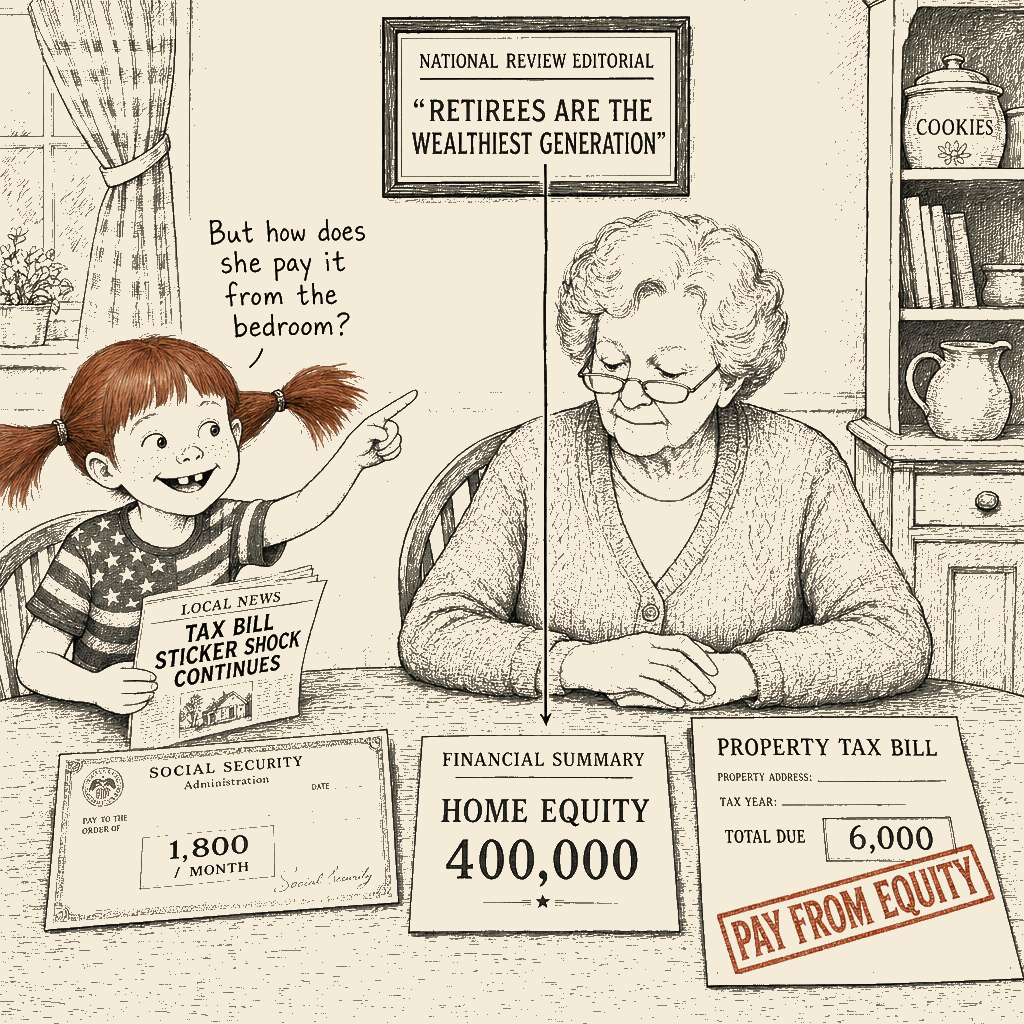
- The piece treats home equity as spendable income. Property taxes are paid from cash flow, not from equity. A senior on Social Security cannot pay a $6,000 tax bill by selling a bedroom. The suppressed variable is the distinction between wealth and liquidity — the entire reason the carve-out exists.
- The piece declines to engage the actual design of any specific senior exemption: most state homestead exemptions are income-tested or age-plus-income tested; circuit-breaker programs (income-based property-tax credits) are distinct from categorical exemptions. The Michigan proposal is a freeze, not an exemption — a different incidence profile.
The Operation
Cui bono.
The unsigned National Review editorial board piece is positioned in the magazine’s house register — institutional analysis, no individual author — which the NR Editorial Technique Catalogue identifies as a deployment of the post-Buckley editorial-board voice. The piece is written to be cited downstream; the closing line (“No demographic group ought to receive special tax favors by virtue of its political clout, but especially not elderly homeowners whom the nation’s fiscal system already privileges”) is engineered for retransmission. We in the liberty-frame editorial apparatus drafted memos like this — the closing cadence is calibrated for the social-media lift, the bipartisan framing is calibrated to make opposition feel like above-politics principle.
Distributional impact, in plain terms: the piece’s preferred policy — flat, even property taxes plus state spending limits — benefits incumbent non-senior property owners who have stable incomes sufficient to absorb the tax, and the institutional landlord class that passes property taxes through to renters. The piece’s framing of “younger families” as the protected class elides the actual incidence: renters (who skew younger) pay property tax through rent; younger owners face a tax whose assessment grows with home values whose appreciation has outpaced their wage growth over the past decade. The piece’s preferred alternative is good for the ratepayers who can already pay.
The piece’s explicit advocacy — spending limits rather than carve-outs — is a long-standing National Review editorial position; the Wisconsin-style “caps on annual growth” line the piece praises has a documented distributional effect of constraining school funding in property-wealthy districts while protecting ratepayers in fast-appreciating zip codes. We who built this house register know the line because we drafted versions of it.
The biggest unmentioned carve-out: the mortgage interest deduction, a vastly larger and more regressive senior-exemption-equivalent for the active wealth-building class that the board never attacks with the same “generational theft” fury. The board’s selective moral outrage on carve-outs is the operation; “economic rigor” is the costume.
FGL across three constituencies, applied symmetrically. (1) The framing’s author — the NR editorial board — operates from a liberty-frame position that genuinely believes broad-based taxation is preferable to carve-outs; this is not malice, it is a real policy preference. (2) The apex beneficiary is the incumbent non-senior property owner, the institutional landlord class, and the municipal revenue apparatus; the policy is built to make their tax bill predictable and political carve-outs harder to enact. (3) The rank-and-file reader is real and human: they resent the appearance of targeted government benefits, they worry about intergenerational transfer, and they have absorbed the AARP-coded “seniors as a powerful voting bloc” frame for years. Their fear and resentment are real; the editorial gives them a vocabulary for the resentment that is technically true at the aggregate level and therefore durable.
Selflessness / selfishness placement: mixed. The piece advances a real policy preference the editorial board genuinely holds; the deployment through aggregate-data conflation, intergenerational-conflict framing, and selective carve-out moralism is the operation.
Technique identification.
NR Editorial Technique Catalogue §4.1 — the “stands athwart history” frame. The editorial positions itself as principled opposition to a bipartisan drift. Cue: “Democratic and Republican office seekers are uniting, as they often do, around a terrible policy.” Operational role: the editorial is dissent-coding the policy as bipartisan-establishment drift, which the catalogue identifies as the magazine’s signature posture deployed even when the position being dissented is less hegemonic than the framing implies. Lineage: Buckley’s 1955 mission statement — “stands athwart history, yelling Stop.”
NR Editorial Technique Catalogue — the partisan-association smear. Cue: “The socialist Senate candidate in Michigan, Abdul El-Sayed…” Operational role: NR’s house fingerprint. Before engaging the policy mechanics, the board taints the proposal by associating it with a labeled “socialist,” converting a liquidity-relief debate into a Cold War-style ideological defense. The category-label substitutes for engagement with the actual proposal text.
Bad-Faith Techniques Catalog — composition_division (fallacy of division). Cue: “Some seniors are poor and struggle… As a whole group, however, retirees are the wealthiest generation in the country.” Operational role: the board acknowledges the exception to prove the rule, then uses the aggregate wealth of the generation to dismiss the hardship of the specific individual. The macroeconomic truth is weaponized to invalidate the microeconomic reality. The fallacy is in the inferential step from aggregate to category, not in the data point.
Bad-Faith Techniques Catalog — frame_engineered_relabeling. The editorial substitutes “carve-outs,” “gimmicks,” “special tax favors,” and “generational theft” for “targeted exemptions” or “income-tested relief.” Cue: “No demographic group ought to receive special tax favors by virtue of its political clout, but especially not elderly homeowners whom the nation’s fiscal system already privileges.” Operational role: the substitution moves the discussion from policy design (income-tested relief for fixed-income seniors) to political ethics (vote-buying). Lineage: Luntz documented the substitution pattern in Words That Work (2007); the term “carve-out” itself entered the policy-discourse register through the 1980s supply-side framework Bartley installed at the WSJ editorial page and which National Review carried into its own house vocabulary. Cross-reference: WSJ Editorial Technique Catalogue §4.1.
Bad-Faith Techniques Catalog — false_dichotomy. Cue: “Property taxes ought to be as low as possible to cover essential services, but levied flatly and evenly as well.” Operational role: the editorial presents “flat and even” and “carve-outs” as exhaustive options. The actual design space includes property-tax deferral programs (where taxes accrue against the estate and are paid at sale or death), circuit-breaker credits, targeted homestead exemptions with age-plus-income tests, and assessment caps. The false dichotomy elides all of these. Lineage: the pragma-dialectics standpoint rule, per van Eemeren and Grootendorst’s Argumentation, Communication, and Fallacies (1992).
Bad-Faith Techniques Catalog — “Dismissal-as-Proof.” Cue: “There is no economic rationale for special tax exemptions for seniors.” Operational role: the board asserts the absence of an economic rationale as a self-evident premise to bypass the actual microeconomic mechanics of cash-flow insolvency. The burden of proof is inverted: the claim requiring demonstration is asserted as its own demonstration.
WSJ Editorial Technique Catalogue §3.4 — dispositive language. Cue: “it is, of course, sad whenever an old family home is sold.” Operational role: the “of course” marker is the catalogue’s named pattern for marking the editorial’s position as not-up-for-debate without producing argument for it. The catalogue identifies this register as the WSJ house-voice tell; National Review’s editorial board has carried it into its own institutional voice.
NR Editorial Technique Catalogue §4.5 — generational / civilizational frame. Cue: “staggering generational theft from the young to the old.” Operational role: the editorial inflates the policy stakes from a technical incidence question to an intergenerational-conflict claim. The catalogue treats civilizational-frame inflation as endemic in NR’s Registers A and D; the generational variant is the domestic-policy deployment of the same move.
The Suppressed Variable (liquidity). The board treats home equity as spendable income. Property taxes are paid from cash flow, not from equity. A senior cannot pay a $6,000 property tax bill by selling a bedroom. The board suppresses the distinction between wealth and liquidity to make the senior look capable of paying. This is the same structural move the diagnostic names: the editorial isolates one true variable (aggregate wealth) and suppresses the structural one (intra-cohort liquidity variance) that would reverse its conclusion.
Bandura’s eight mechanisms of moral disengagement — the cluster operating here. (Bandura, “Selective Moral Disengagement in the Exercise of Moral Agency,” Journal of Moral Education 31, no. 2, 2002; expanded in Moral Disengagement, Palgrave Macmillan, 2016.) The piece runs attribution of blame (cue: “buy support from America’s most prolific voting bloc”; “special tax favors by virtue of its political clout”) and euphemistic labeling (cue: “carve-outs,” “gimmicks”) in concert, with moral justification (cue: “flat and even,” “noble aim in theory”) supplying the higher-cause frame. Distortion of consequences is the cluster’s third leg: the property-tax incidence the piece describes is simpler than the incidence the empirical literature describes. Displacement of responsibility is the structural-cost move: the piece routes around the supply-side drivers of high housing costs (insufficient construction, single-family rental financialization, restrictive zoning) by treating the senior-exemption debate as if it were the housing-affordability debate.
Audience-management function. The piece is built to provide grievance ratification to the rank-and-file reader who has absorbed years of “seniors as a powerful voting bloc” framing. The permission structure is: “you are defending principle; you are not attacking poor seniors; the aggregate data proves there are no poor seniors who matter.” That last clause is the move; conscience displacement at the level of the data citation. The piece allows the affluent, elite reader to feel economically rigorous and generationally fair while denying empathy for the elderly. The board gestures at the burden shifting “to other homeowners, such as younger families” but never quantifies the shift — specificity is unnecessary because the reader is invited to feel the injustice rather than measure it.
Complicity disclosure. We in the apparatus drafted memos with this exact frame structure in the 2000s — the “broad-based taxation” / “no carve-outs” line, the “generational theft” recoding of a property-tax incidence question, the use of aggregate wealth data to defeat within-group targeted policy, the “of course” marker that pre-empts the reader’s empathy. The piece reads like a 2014 AEI-brief turned editorial. The voice is recognizable to us who built the genre.
The Record
Anchor receipts.
- “retirees are the wealthiest generation in the country” — Federal Reserve Survey of Consumer Finances, 2019 and 2022 waves, show household wealth for the 65-plus cohort exceeds that of younger cohorts in the aggregate. The aggregate is true; the within-group variance is the relevant variable for a targeted policy and is not engaged.
- “seniors lead the nation in homeownership rates” — U.S. Census Bureau Housing Vacancy Survey and American Community Survey both show the 65-plus homeownership rate substantially above the national average. Accurate at the aggregate.
- “average age of homebuyers has thus crept up to record highs” — National Association of Realtors annual homebuyer demographic data shows the median age of first-time buyers rose to 38 in the 2024 wave (an all-time high for first-time buyers, per NAR’s 2024 Profile of Home Buyers and Sellers); the source-cited trajectory is accurate. The piece uses the figure to imply senior-driven price pressure, but the literature attributes most of the shift to supply constraints and the post-2022 mortgage-rate environment.
- The capitalization argument — “Artificially low tax rates would be capitalized into higher home prices” — is well-established in tax economics; the empirical literature in Journal of Public Economics and Regional Science and Urban Economics engages the magnitude question, which the piece does not.
- Supplemental poverty measure for Americans 65 and older was running around 14–15 percent in 2024 — roughly one in seven — per the Census Bureau’s annual SPM release. The piece does not engage this figure.
Supporting receipts.
- State-level spending limits (“caps on annual growth”) have documented distributional effects on school funding, documented in the Education Law Center’s annual Is School Funding Fair? reports. The piece does not engage this literature.
- Property-tax incidence on renters is documented in the Lincoln Institute of Land Policy and National Tax Journal; renters pay property tax through their rent, the incidence falling on tenants rather than nominal property owners. The piece does not engage this.
- The mortgage interest deduction — the unmentioned carve-out — is a multi-billion-dollar federal subsidy disproportionately accruing to higher-income households and largely benefiting the active wealth-building class. The piece’s selective silence on this carve-out, while attacking senior exemptions, is the unstated structural counterpart to the argument.
Unconfirmed / contested claims.
- “No economic rationale for special tax exemptions for seniors” — tagged
[contested]. Economic rationales for income-tested senior property-tax relief include consumption smoothing in retirement, labor-supply disincentive reduction, demand-side stabilization, and the documented correlation between property tax bills and income shocks in the 65-plus cohort. The piece asserts the absence of rationale; the literature engages the rationale. - “El-Sayed … wants to freeze seniors’ annual payments so they may ‘age in place and with dignity’” — tagged
[contested as frame assignment, including temporal frame]. The editorial identifies El-Sayed as “the socialist Senate candidate in Michigan”; El-Sayed is best documented as a 2018 Michigan Democratic gubernatorial primary candidate. Whether the source’s “Senate candidate” tag is a retrospective frame, a current (2026) label, or a mislabeling of his 2018 gubernatorial run is not verifiable from the editorial’s text or the materials consulted in this consultation window. “Socialist Senate candidate” is in any event a frame assignment, not a category description. Whether the characterization of the proposal as a “freeze” is accurate to the actual proposal text is not verified in the piece.
Per-citation accuracy verdict.
- “Wealthiest generation” — true at aggregate; the inference is invalid for the policy being critiqued.
- “Average age of homebuyers” — accurate (NAR 2024: 38 for first-time buyers, an all-time high); the implication of senior causation is unsupported.
- “Capitalization into higher prices” — real phenomenon; the magnitude and incidence literature is not engaged.
- “Shifts the burden to younger families” — theoretically true in a fixed-revenue model, but the board contradicts itself by also noting states have “restrained local spending through limits on annual growth.” If states restrain spending, the revenue requirement drops. The alleged “shift to younger families” only materializes under the assumption that local spending is fixed at current inflated levels — an assumption the board’s own preferred policy disproves. The board uses the “shifting the burden” claim when it suits them and suppresses the math when its own orthodoxy makes it irrelevant.
- “Socialist Senate candidate” — frame assignment, not a category description; the temporal status is not verifiable from the editorial’s text.
Load-bearing omissions.
- The piece does not engage the design of any specific state senior property-tax exemption: most are age-plus-income tested, not categorical; some are deferral programs where the tax accrues against the estate; circuit-breaker programs are distinct from both.
- The piece does not acknowledge that “flat and even” is itself a policy preference, not a neutral default.
- The piece does not engage the property-tax incidence literature on renters.
- The piece does not engage the structural drivers of high housing costs (supply constraints, single-family rental financialization, restrictive zoning).
- The piece does not engage the within-group variance in retirement wealth, including the 2024 supplemental poverty measure of roughly 14–15 percent among Americans over 65.
- The piece does not engage the Michigan proposal’s actual structure (freeze vs. exemption) and the different incidence profiles of each.
- The piece does not engage the mortgage interest deduction — the largest carve-out in the housing-tax code, disproportionately benefiting the active wealth-building class the board’s preferred policy protects.
Missing information declaration.
- The full text of the El-Sayed proposal is not in the piece.
- The specific state “red state” senior tax exemption laws the piece references are not named.
- We have no documentary source for whether the editorial board staff that drafted this piece consulted the within-group retirement-wealth literature. Retained-memory flag: the genre practice in the 2000s–2010s liberty-frame editorial pages was to run this frame without engagement with the within-group variance literature.
How to Recognize This
The pattern: an editorial that opposes a targeted tax policy by routing the opposition through aggregate data on the targeted group, while proposing a “broad-based” or “flat and even” alternative that is itself a policy preference. The deeper move is aggregate conflation — using a macroeconomic truth about a group to deny a microeconomic reality about an individual within that group. The technique works because the aggregate data is true; the false step is using aggregate truth to defeat within-group targeting.
The mechanism: aggregate-data conflation through wealth-liquidity elision. The reader absorbs a true aggregate (retirees are wealthier in the aggregate, and most of their wealth sits in home equity) and is invited to apply it to a targeted policy that, by design, reaches only the within-group poor. The brain substitutes the easy macro-averaging for the hard micro-accounting. The “flat and even” frame works because “flat and even” sounds like neutral principle, and the false dichotomy eliminates the policy design space (deferral, circuit-breaker, income-tested exemptions) that would otherwise allow targeted relief without carve-outs.
Two-to-four textual signals to recognize the pattern next time:
- “As a whole group / On average / As a generation…” followed immediately by a dismissal of individual hardship. The aggregate-conflation tell. When you see aggregate-wealth framing paired with opposition to a targeted policy, ask: within the targeted group, how much variance? Is the policy actually targeted at the variance or at the aggregate?
- The absolute suppression of the words liquidity or cash flow when the piece is discussing property, housing, or taxes. The board treats home equity as spendable income. A senior cannot pay a $6,000 property tax bill by selling a bedroom. When the piece never asks “how do they actually pay?” — that is the tell.
- “Carve-out,” “gimmick,” “special favor” vocabulary applied to targeted relief, paired with silence on vastly larger carve-outs that benefit other constituencies. The vocabulary recodes policy design as political ethics; the selective silence reveals the selective moralism.
- “Flat and even” / “broad-based” / “general” alternative proposals. The terms sound neutral; they are policy preferences that favor incumbent ratepayers and the institutional revenue base.
- Bipartisan-bait framing — using one candidate or one party’s proposal to claim the policy has bipartisan support and is therefore beyond the pale. The bait lets the editorial position itself as “above politics” while advancing a liberty-frame policy preference.
Why it works: aggregate data is intuitively powerful; “flat and even” sounds like neutral principle; intergenerational conflict is a durable American political frame; the piece exploits the gap between what is true at the aggregate level and what the policy actually does. The reader feels they are relying on data, not prejudice. The editorial gets to weaponize a real trend (Boomer wealth) to justify a rigid, punitive policy for the vulnerable members of that cohort.
What to do when you see it: ask the liquidity question. “Are they talking about wealth, or are they talking about cash?” Trace the cited studies; the piece cites none, which is itself the tell. Check if the “young family” proxy is actually bearing the cost, or if the cost is being absorbed by the system the piece is defending. Look for the same vocabulary across the syndication network — “broad base,” “no carve-outs,” “flat and even” — and recognize it as message discipline, not independent convergence. And check the omissions: every editorial attacking one carve-out should be checked against the carve-outs it does not attack. The selectivity is the operation.
The moral outrage of “generational theft” collapses back into what it actually is: a technocratic refusal to do the math on how the poor pay their bills. The next time you see an editorial using a generation’s aggregate wealth to deny an individual’s cash-flow reality, you will see the gap. The gap is where the liquidity crisis lives. Recognize the conflation, and the frame loses its automatic activation. That recognition is the only thing the piece cannot defend against.

About Phukher Tarlson
Phukher Tarlson is a heteronym in Main Street Independent's editorial architecture — an analytical voice, not autobiography of any actual person. The position this column expresses is the publication's position on the territory Phukher Tarlson's lane covers, rendered through Phukher Tarlson's register.