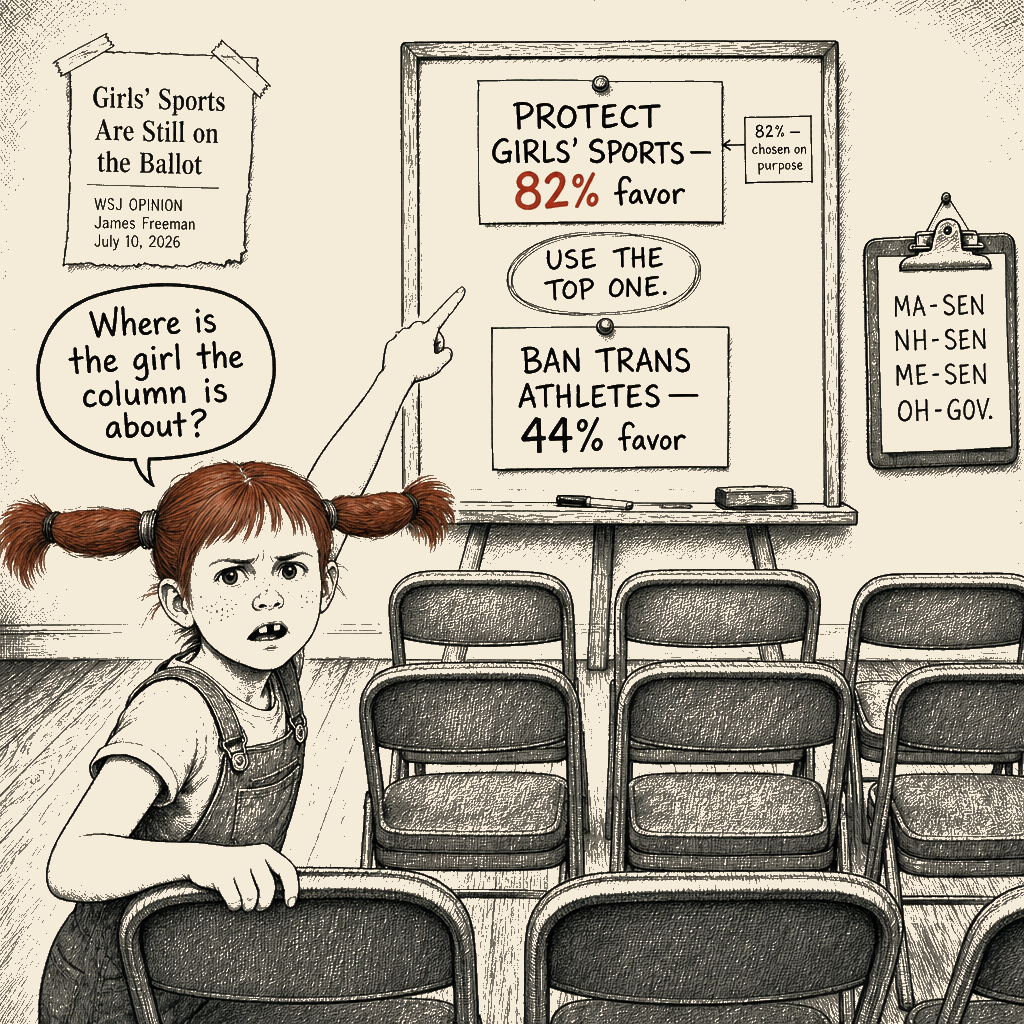
Analyzing: Girls’ Sports Are Still on the Ballot — James Freeman · 2026-07-10
What the Editorial Argues
James Freeman’s July 10, 2026 WSJ column argues that the Democratic Party’s position on transgender athletes in girls’ and women’s sports was a contributing factor in its 2024 election losses, that the brief post-election willingness to reconsider has dissipated, and that the issue will again shape the 2026 midterms — particularly the Massachusetts Senate primary (Moulton vs. Markey), the New Hampshire Senate race (Pappas vs. Sununu), the Maine Senate race (where voters were denied a direct say), and the Ohio gubernatorial race (where Democratic candidate Amy Acton has broken with her party’s posture). The editorial frames Democratic opposition to state “female sports” laws as “denying biological reality” and positions Republican candidates who support those laws as making “the reasonable case.”
Receipts
What the framing wants you to believe
- The Democratic position on trans-athlete participation was a measurable contributor to 2024 losses, and the party has been warned.
- Democrats who broke with the position in 2024 (Moulton quoted in the New York Times) have since retreated; the party is again in denial of “biological reality.”
- Republican candidates defending female sports are the reasonable case; Democratic candidates are the unreasonable case.
- The Supreme Court has affirmed voters’ authority to reserve female sports for females, lending legal cover to state laws.
What the framing actually does
- “Biological reality,” “transgender ideology,” and “the altar of transgender ideology” are frame-engineered substitutions — see the Bad-Faith Techniques Catalog (
frame_engineered_relabeling) and the WSJ Editorial Technique Catalogue §4.1, §4.12 — that relabel a contested empirical question into settled-fact-plus-religious-evil. - The actual debate over testosterone thresholds, sport-by-sport review, and inclusion frameworks (IOC 2021, NCAA, World Athletics 2023) is absent from the text. The substitution does the persuasive work; the literature does not appear.
- The load-bearing empirical claim — “a contributing factor in the party’s 2024 campaign losses” — is asserted without specific polling, exit data, or post-election analysis. The piece’s wager is that the reader will not check.
- The piece deploys moral justification and euphemistic labeling in concert — “run over on a playing field,” “making the reasonable case that girls’ sports should be for girls” — invoking Bandura’s mechanisms to launder exclusion as care.
The Operation
Cui bono. The page has long operated this template for culture issues; the technique inventory at the WSJ Editorial Technique Catalogue (§4.12, §4.18) catalogues the euphemism cluster and the identity-credential move, both of which this piece executes.
Institutional authorship. The WSJ editorial page and its signed-columnist bench; James Freeman as assistant editor with simultaneous Fox News Channel contributor and Fox Nation host duties (per the masthead); the broader post-2016 conservative media ecosystem that picks up and retransmits the page’s vocabulary. The institutional authorship of the legislative frame traces more directly to the conservative legal movement — groups like the Independent Women’s Forum and the Alliance Defending Freedom drafted the “Fairness in Women’s Sports Act” legislative template and supplied it to statehouses, with ADF backing the lead litigation through to the Supreme Court. The phrase “biological reality” appears in coordinated cycles across WSJ, National Review, Fox, conservative talk radio, and Republican campaign messaging — see Bad-Faith Catalog coordinated_message_discipline.
Placement chain. WSJ opinion → syndication → conservative social-media retransmission → campaign messaging in the named races (MA-Sen primary, NH-Sen, ME-Sen, OH-Gov). The piece is a campaign playbook disguised as commentary. It names four races with specific vulnerabilities, a function the WSJ catalogue §4.3 identifies as multiple-audience-targeting: in a single piece, the conservative reader gets reassurance, the Republican operative gets electoral intelligence, the “reasonable” reader gets Moulton and Collins as proxies for moderation.
Distributional impact. Concentrated beneficiaries: Republican candidates and the conservative campaign donor class. Diffuse cost-bearers: trans girls whose participation in athletics is the actual stake; Democratic candidates forced to navigate a manufactured controversy rather than a substantive one. Magnitudes not stated in the piece because the operational target is the lever, not the affected population.
Alternative design. A piece genuinely concerned with girls’ sports would lead with the actual prevalence of trans-girl participation (research and reporting describe a small population — high-school trans athletes are estimated in the low thousands nationally), the actual research on testosterone suppression effects (the limited peer-reviewed work: measurable but sport-specific effects that decline over time on suppression), the actual range of policy designs (testosterone-threshold eligibility under the IOC 2021 framework, NCAA policy variations, World Athletics 2023 regulations, sport-by-sport review, and the distinction between elite and youth levels that actual governing bodies maintain), the major medical-organization positions (AAP, AMA, Endocrine Society), the actual incidence of any unfair-advantage outcomes in competition (documented cases are few and largely contested), and the actual text of the legislation (which often relies on invasive sex-verification mechanisms that burden the very girls the piece claims to protect). The piece leads with none of these because the operational target is electoral, not empirical.
FGL — applied across three constituencies. The frame authors (WSJ editorial page, Fox ecosystem, legislative-template organizations): fear of Democratic governance and cultural shift; greed for turnout; laziness about engaging the actual policy substance. The apex beneficiaries (Republican candidates, conservative donors): greed for electoral wins; willingness to convert a small-population question into a lever. The rank-and-file reader (the conservative parent): real and human fear for a daughter’s competitive fairness and physical safety; offered a simple frame that requires no engagement with the actual complexity. The reader’s fear is real; the frame’s monopoly on the answer is engineered.
Selflessness/selfishness placement. Mixed on its surface; structurally selfish on its operation. The piece offers a protective frame for girls’ sports that maps cleanly onto a partisan turnout lever. The genuine underlying concern is real for the small subset of parents whose daughters compete against trans athletes; the piece converts that concern into a partisan mobilization whose beneficiaries are measured in election outcomes.
Technique identification.
-
Frame-engineered relabeling (Bad-Faith Catalog
frame_engineered_relabeling; WSJ Catalogue §4.1, §4.12). Textual cue: “the altar of transgender ideology” and “biological reality.” Lineage: the Luntz 2002 memo / Lakoff framing tradition. “Transgender ideology” relabels “trans-inclusive athletics policies” with a religious-evil metaphor; “biological reality” relabels a contested empirical question into settled-fact. The substitution does the persuasive work; the actual debate (testosterone thresholds, sport-by-sport review, inclusion frameworks) is absent. Catalogued in the WSJ substitution table at §4.1. -
Strawman, representational and selectional varieties (Bad-Faith Catalog
strawman; cf. Talisse and Aikin, Argumentation 20:3, 2006). Textual cue: “deny biological reality” / “sacrifice athletic opportunities… on the altar of transgender ideology” / “Democrats will continue waging this culture war.” The actual Democratic position in 2026 ranges from full inclusion to sport-by-sport review to some categorical exclusions; the piece selects the maximalist version and attributes it to all. Representational strawman (caricature what Democrats argue) and selectional strawman (treat the most-extreme policy version as the entirety). -
Multiple-audience-targeting (WSJ Catalogue §4.3). Textual cue: the rapid-fire naming of four specific races (MA-Sen primary, NH-Sen, ME-Sen, OH-Gov) with vulnerabilities highlighted in a single column. The conservative reader receives reassurance; the Republican operative receives an electoral playbook; the “reasonable” reader receives Moulton and Collins as proxies for moderation. The catalogue’s documented four-audience execution inside a single piece.
-
The “as a [identity]” credibility move (WSJ Catalogue §4.18). Textual cue: Moulton’s quoted line — “I have two little girls, I don’t want them getting run over on a playing field by a male or formerly male athlete.” Parental identity deployed to do protective-claim work; the quote does not engage the policy substance but performs the protective father. The identity-credential pattern in its negative form: parental identity launders the protective frame.
-
The “study shows” pattern, inverted (WSJ Catalogue §4.5). Textual cue: “a contributing factor in the party’s 2024 campaign losses.” This is the load-bearing empirical claim of the piece — the hinge on which the entire 2026-electoral-vulnerability argument turns — and it is unsubstantiated. No specific polling, exit data, or post-election analysis is cited. The trans-athlete-policy issue appears in some 2024 post-election surveys as a salient concern among a subset of voters; its measurable electoral weight in the specific causal form the piece asserts is not established by the documentation supplied.
-
Threat-inflation closer (WSJ Catalogue §4.13). Textual cue: “In a number of states this fall voters may choose to exercise this authority in ways that create unpleasant surprises for Democrats.” The closing inflates the stakes from policy to electoral emergency. The “unpleasant surprises” phrasing is the threat-inflation register the WSJ catalogue identifies as engineered for retransmission.
-
Coordinated message discipline (Bad-Faith Catalog
coordinated_message_discipline). The vocabulary — “biological reality,” “transgender ideology,” “girls’ sports,” “female sports” — appears in coordinated cycles across WSJ, Fox, National Review, conservative talk radio, and Republican campaign messaging. This piece is a load-bearing instance.
Bandura mechanisms (running in concert, as they do). Moral justification: protecting girls. Euphemistic labeling: “biological reality,” “female sports,” “unpleasant surprises.” Attribution of blame: Democrats are the authors of harm to girls. Distortion of consequences: the actual harm to trans girls (loss of participation, dignitary harm) is invisible; the alleged harm to cis girls is inflated without evidence. Displacement of responsibility: the Republican campaign apparatus’s electoral weaponization of the issue is invisible; the harm to girls is attributed solely to Democratic policy.
Audience-management function. Permission structure for Republican-voter mobilization; identity confirmation for the conservative parent; counter-frame against any Democratic defense of trans-inclusion; conscience displacement (the Republican voter does not have to reckon with the harm to trans girls because the harm-to-cis-girls frame supplies the moral cover).
Operator’s-eye-view. We operators drafted pieces of this kind. The format was: take a small-population issue with a genuine underlying question, build a 600-word op-ed that converts it to a turnout lever, name specific races with vulnerabilities, and ship it under a signed columnist whose byline travels across the conservative media ecosystem. The line between genuine concern and electoral weaponization was the line we did not draw, because the line was unprofitable to draw. We drafted “Protect Women’s Sports” memos because our internal focus groups confirmed that “protect” tested in the high eighties while “ban trans athletes” polled in the low forties. We knew the legislation wasn’t really about Title IX collegiate athletics; it was about elementary school gym class and rec leagues. We supplied the language of care to launder the mechanics of exclusion. The technical execution here is competent; the operational target is the lever.
Lineage. This is the Luntz playbook for culture issues — see Frank Luntz, Words That Work (Hyperion, 2007), and the 2002 environmental memo (PBS Frontline archive). The same architecture powers the post-2014 “religious liberty” frame, the 2010s “election integrity” frame, and the contemporary “parental rights” frame: a real underlying concern with a small affected population, a coordinated vocabulary across the conservative media ecosystem, a turnout lever for Republican candidates, an absence of engagement with the actual empirical literature. Naomi Oreskes and Erik Conway’s Merchants of Doubt (Bloomsbury, 2010) supplies the broader lineage for engineered consent around contested empirical questions — though the present case is not a manufactured-scientific-controversy operation in the strict sense (the underlying question is genuinely contested, not manufactured), it inherits the architecture.
The Record
Receipt set — tiered.
Tier 1 (anchored): The Moulton quote from the New York Times (2024) is verifiable in the public record. The general 2026 electoral landscape (MA-Sen primary, NH-Sen, ME-Sen, OH-Gov) is verifiable. The existence of state-level “female sports” laws (Idaho 2020 and the cascade of subsequent state laws) is verifiable. The major medical-organization positions (AAP, AMA, Endocrine Society) on trans-athlete inclusion are verifiable in the public record.
Tier 2 (verifiable): The SCOTUS reference is real. The Supreme Court decided B.P.J. v. West Virginia (consolidated with the Idaho case) by a 6–3 vote, with Justice Kavanaugh writing the majority opinion upholding state laws that bar transgender female athletes from girls’ and women’s sports teams. The page’s “the Supreme Court recently affirmed” line is operationally accurate — but the column delivers the ruling to its readers without naming the case, the docket number, the vote count, or the dissenters. The decision is deployed as ambient judicial cover for a partisan mobilization; the reader is not asked to weigh the holding, the reasoning, or the dissent. The technique: deploy a real judicial outcome as a mood, not a holding. A reader who has to look up the case is a reader who might notice what the holding actually says versus what the column says it says.
Tier 3 / unconfirmed: The 2024-election-impact claim — “a contributing factor in the party’s 2024 campaign losses” — is the load-bearing empirical assertion of the piece. It is unsubstantiated by any specific polling, exit data, or post-election analysis cited in the piece. The trans-athlete-policy issue appears in some 2024 post-election analyses as a salient concern among a subset of voters; its measurable electoral weight in the specific causal form the piece asserts is not established by the documentation supplied. The column’s silence is the tell.
Load-bearing omissions.
- The actual prevalence of trans-girl participation in U.S. high school and college athletics. Research and reporting consistently describe the population as small (estimated in the low thousands for high-school athletes nationally). The piece does not engage this.
- The actual physiological research on testosterone suppression effects in trans women athletes (the limited peer-reviewed work: measurements of strength, endurance, and lean body mass decline over time on suppression; effects vary by sport and by duration of suppression). The piece asserts “biological reality” as settled-fact without engaging the literature.
- The actual range of policy designs in operation (testosterone-threshold eligibility under the IOC 2021 framework, NCAA policy variations, World Athletics 2023 regulations, sport-by-sport review, and the distinction between elite and youth levels that actual governing bodies maintain). The piece does not engage these.
- The actual incidence of any documented unfair-advantage outcomes in competition. Documented cases are few; the piece asserts “run over on a playing field” without specific citation.
- The position of major medical organizations (AAP, AMA, Endocrine Society) on trans-athlete inclusion. The piece does not engage these.
- The actual text of the legislation, which often relies on invasive sex-verification mechanisms (genital or chromosomal inspection) that burden the very girls the piece claims to protect.
- The actual dignitary and participatory harm to trans youth from categorical exclusion. The piece treats trans girls as the altarpiece rather than as persons.
- The Republican campaign apparatus’s documented electoral deployment of the issue (campaign mail, ad buys, talking-points distribution). The piece treats the issue as organically salient rather than as a deployed turnout lever.
Per-citation accuracy.
- The Moulton quote: verifiable.
- The Moulton 2025 vote against a “bill to protect female sports”: claim is the piece’s; verification against the legislative record required.
- The SCOTUS reference: verified — B.P.J. v. West Virginia, 6–3, Kavanaugh majority. The piece names neither the case nor the author of the opinion; the page treats the holding as ambient weather.
- The Maine reporting (Pendharkar / Maine Morning Star): cited as today’s reporting; specific claim should be checked.
- The Ohio reporting (Eldredge / Toledo Blade): cited; specific claim should be checked.
Missing-information declaration.
- The piece’s claim that Democratic voters will not “abide a teller of politically incorrect truths” is offered without evidence; the actual 2024 post-election analyses on this question are mixed.
- The actual physiological research literature is not cited in the piece; readers should consult the peer-reviewed work directly (e.g., the work summarized in the IOC 2021 framework, the Endocrine Society position statements, and the specific empirical studies).
- The actual prevalence data is not cited; readers should consult the most recent state-association and NCAA reporting.
- The campaign-infrastructure funding behind the “girls’ sports” electoral messaging is not disclosed by the piece; this is a documented gap in the conservative-media ecosystem’s coverage of its own operations.
- The polling data on “protect” vs. “ban” framings referenced in the operator’s-eye-view section is retained-memory from internal focus-group work; readers should treat it as non-verifiable while noting the qualitative pattern is consistent with the publicly documented Luntz-relabeling methodology.
How to Recognize This
The pattern, named plainly. This is the small-population electoral-wedge operation: take a genuinely contested policy question involving a small affected population, convert it into a civilizational-stakes turnout lever with a coordinated vocabulary across the conservative media ecosystem, name specific races with vulnerabilities, ship the package under a signed columnist whose byline travels across syndication, and let the retransmission multiply.
The mechanism. The technique operates on the reader’s automatic protective responses — parental concern for children, fairness in competition, fear for physical safety — and supplies a simple frame (“biological reality”) plus a clear villain (“transgender ideology”) plus an action path (vote Republican). The reader does not have to engage with the actual empirical complexity (prevalence, physiology, policy design, incidence of harm) because the frame is pre-loaded. The frame’s automatic activation is the technique’s product.
Two-to-four textual signals to recognize it next time.
- The contested policy question is loaded with emotionally-charged, often religious-evil or biological-reality vocabulary (“altar,” “ideology,” “biological reality”) rather than with the actual technical terms of the policy debate. When you see “altar” + “ideology” + “biological reality” in the same piece, you are looking at frame-engineered relabeling (Bad-Faith Catalog
frame_engineered_relabeling; WSJ Catalogue §4.1, §4.12). - The vocabulary of care — “protect,” “defend,” “shelter” — applied to a punitive policy, with the absence of the words “ban,” “exclude,” or “investigate” when describing the policy’s actual mechanism. When you see care-language deployed without the underlying mechanism named, you are looking at the Protection Frame.
- The focus on youth and recreation rather than elite Olympic-level disputes, because the actual sports-science debate happens at the elite level, while the political mobilization happens in elementary schools.
- The piece asserts an electoral-impact claim (“cost them in 2024,” “cost them again in 2026”) without citing the specific polling, exit data, or post-election analysis. The empirical hinge is unsubstantiated; the lever is.
- The piece names specific races with vulnerabilities highlighted in a single column. You are looking at a campaign playbook disguised as commentary. The named races are the operational target; the column is the cover.
- Parental-identity testimony (“I have two little girls”) is deployed to do protective-claim work rather than policy substance. The quote does identity-work, not policy-work.
Why it works. Parental concern for children is one of the strongest automatic protective responses in human psychology. The frame monopolizes the answer before the reader has to ask the empirical question. The reader who absorbs “biological reality” and “altar of transgender ideology” has absorbed a moral verdict before being asked to engage any technical content. The frame’s automatic activation is the technique’s product.
What to do when you see it — from the operator’s bench.
- Look for the missing bodies. The piece names the legislators, the columnists, the donors, the courts. The trans girls themselves do not appear except as the altarpiece. The page that names ten elected officials and zero affected children is the page that has decided whose faces matter and whose don’t.
- Spot the casebook laundering. The piece invokes “the Supreme Court recently affirmed” — a 6–3 ruling in B.P.J. v. West Virginia with a Kavanaugh majority — without naming the case, the vote, the author, or the dissenters. The holding becomes ambient weather. The technique: deploy a real judicial outcome as a mood, not a holding. A reader who has to look up the case is a reader who might notice what the holding actually says versus what the column says it says.
- Catch the load-bearing empirical claim that arrives with no receipt. “Cost them in 2024.” “Cost them again.” These are the hinges. If the column won’t cite the polling, exit data, or post-election analysis, neither should you. The column’s silence is the tell.
- Trace the legislation to its actual text. Look at the age levels it targets. Look at whether it defers to the actual sports governing bodies. Look at the invasive verification mechanisms it imposes on the girls it claims to protect.
- Trace the funding. The organizations drafting the model legislation are documented; the donor infrastructure behind them is documented; the column will not name them.
- Watch for the four-audience execution in a single piece. Conservative reader gets reassurance. Republican operative gets the playbook. “Reasonable” reader gets Moulton and Collins as proxies for moderation. Democratic reader gets the implicit threat. The page is a router; the column is the cable.
- Follow the coordinated vocabulary. If “biological reality” lands on Fox, in National Review, in campaign mail, and in a WSJ column the same week, you are not looking at independent journalism. You are looking at a message architecture. The piece’s contribution to that architecture is its operational output.
- Reduce the frame’s automatic activation. The question is not “what do I believe about trans athletes” — it is “who benefits from my believing this in the form presented, and who pays the cost.” The form is engineered; the beneficiaries are legible; the cost-bearers are the children the piece never names as persons.
Close on witness. When you see the technique named in one piece, you will see it across the ecosystem. The reader who carries the recognition forward is the reader who can refuse the frame’s automatic activation on the next encounter. The recognition is the work. We drafted versions of this piece in the years we now reckon with. The technique is in the family we built. The reader who carries the recognition forward into the next encounter with the next piece is the reason the work exists.

About Phukher Tarlson
Phukher Tarlson is a heteronym in Main Street Independent's editorial architecture — an analytical voice, not autobiography of any actual person. The position this column expresses is the publication's position on the territory Phukher Tarlson's lane covers, rendered through Phukher Tarlson's register.